Are you selling Precast Concrete Masonry Units (cement bricks)? If yes, then this is a must-read for you!
As per the latest e-Invoice Specific Guideline (Version 2.1) issued by the Inland Revenue Board of Malaysia (IRBM), wholesalers and retailers dealing in construction materials, including cement bricks, are required to issue e-Invoices for every single transaction.
That’s right! Consolidation of e-Invoices is strictly not allowed for the sale of construction materials like cement bricks, regardless of the volume sold.
Why is this important?
Failing to comply with this e-Invoicing requirement could lead to penalties and legal consequences. Don’t let your business operations get disrupted due to non-compliance.
Advice to Taxpayers:
As a wholesaler or retailer dealing in construction materials, particularly Precast Concrete Masonry Units (cement bricks), it is crucial to take note of the specific e-Invoicing requirements outlined in the latest guideline.
You are mandated to issue individual e-Invoices for every single transaction involving the sale of construction materials, including cement bricks. The consolidation of e-Invoices for such transactions is strictly not permitted.
This requirement applies regardless of the volume of construction materials sold, be it a single brick or a truckload. Failure to comply with this regulation could lead to penalties and legal consequences, which could disrupt your business operations.
To ensure compliance, it is recommended to review and update your invoicing processes and systems to accommodate the issuance of individual e-Invoices for each sale of construction materials. This may involve integrating your systems with the IRBM’s e-Invoicing platform or adopting third-party e-Invoicing solutions.
Additionally, it is advisable to train your sales and accounting teams on the new e-Invoicing requirements and processes to avoid any lapses in compliance.
The e-Invoicing Guidelines in Malaysia are a comprehensive framework designed to modernise and streamline the invoicing process across various transactions, enhancing efficiency and tax compliance.
The guidelines cover myriad transactions and touch upon the specific income types exempted from the e-invoicing system.
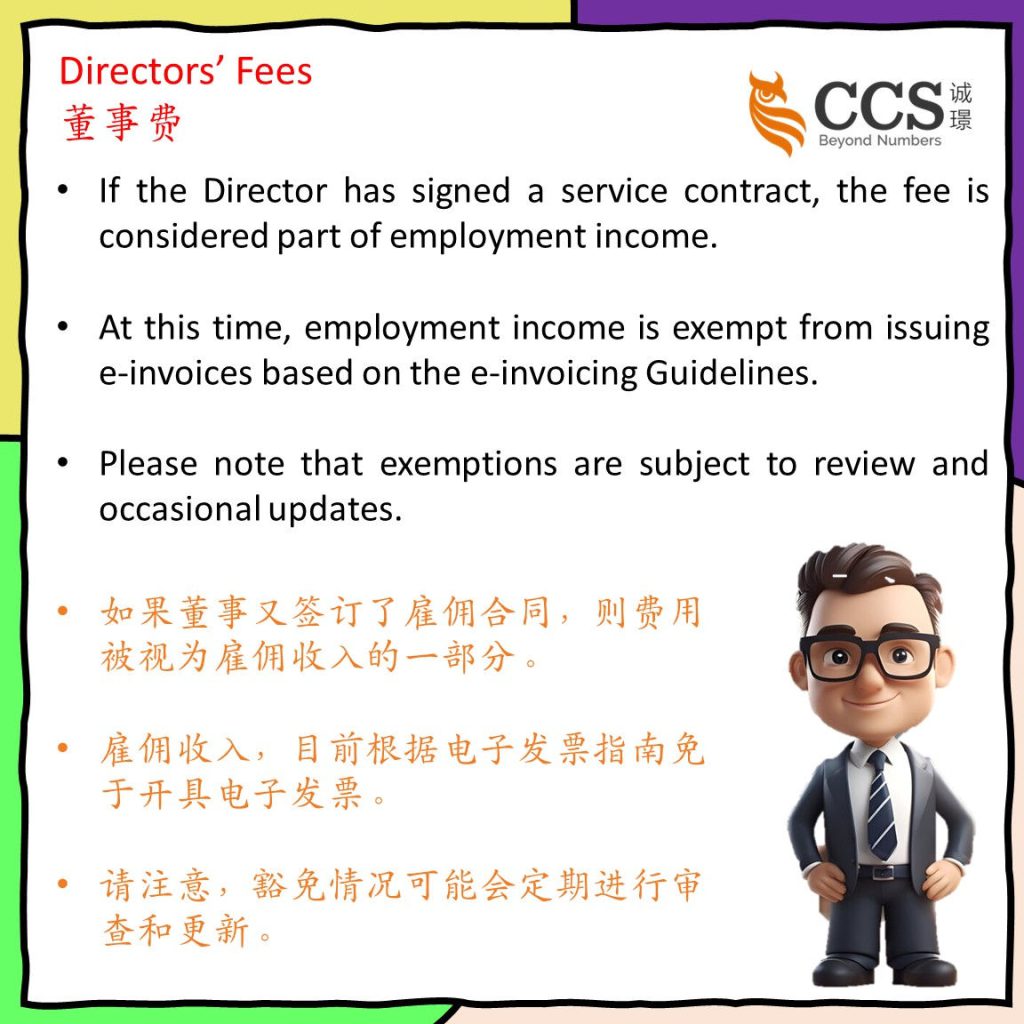
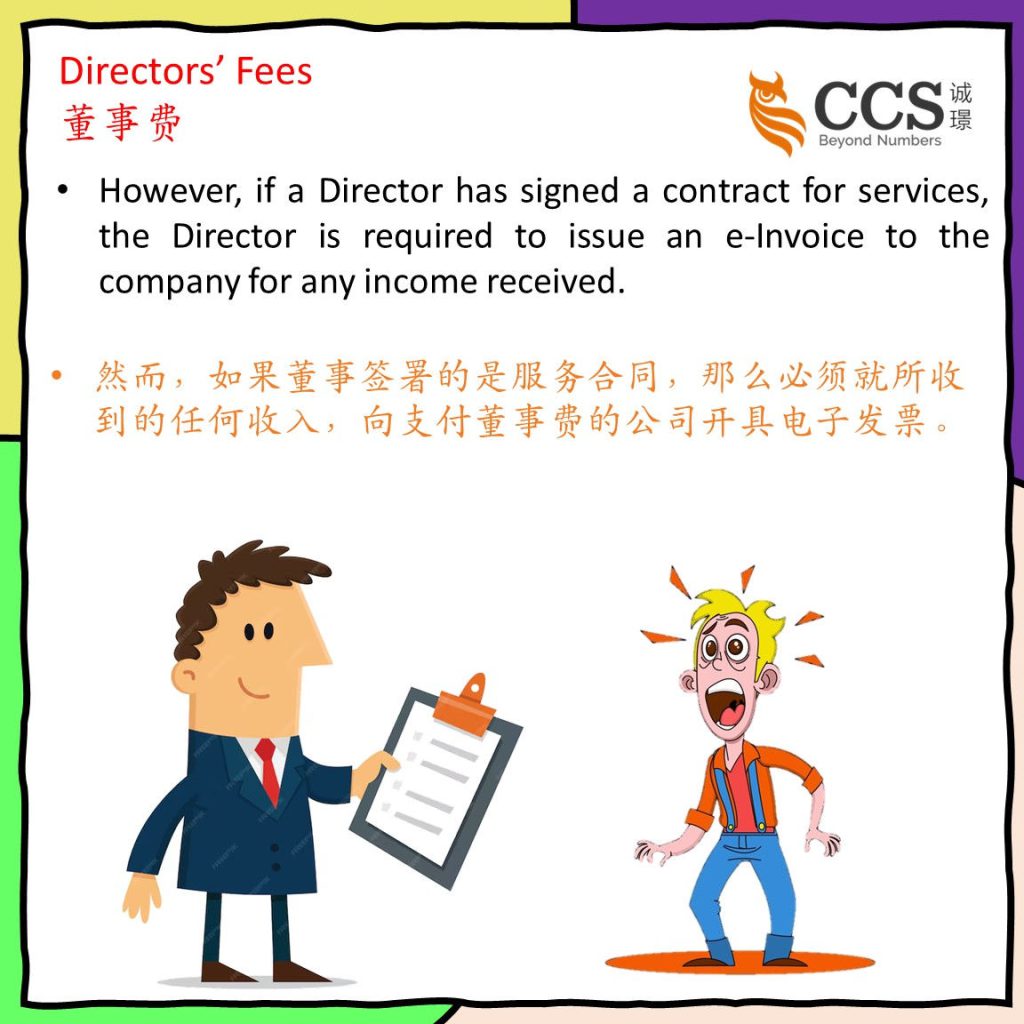
For directors who have entered into a contract for services with a company, issuing an e-invoice for any income received is mandatory, reflecting the transaction’s commercial nature.
Conversely, directors’ fees from a service contract viewed as employment income are currently exempt from the e-invoicing requirement.
This distinction underscores the importance of understanding the nature of the contractual relationship and the corresponding e-invoicing obligations.
Taxpayers, especially those in directorial positions, are advised to stay informed about their e-invoicing responsibilities and any potential changes to exemptions, as guidelines are subject to periodic reviews and updates by the relevant authorities.
Referring to Section 2.4.5 of the e-Invoice Guideline Version 2.3:
“If the Supplier did not accept the request for rejection initiated by the Buyer (or did not proceed to cancel the said e-Invoice), no cancellation would be allowed after the 72 hours have elapsed.
Any amendment thereon would require issuing a new e-invoice (e.g., credit note, debit note or refund note e-invoice).”
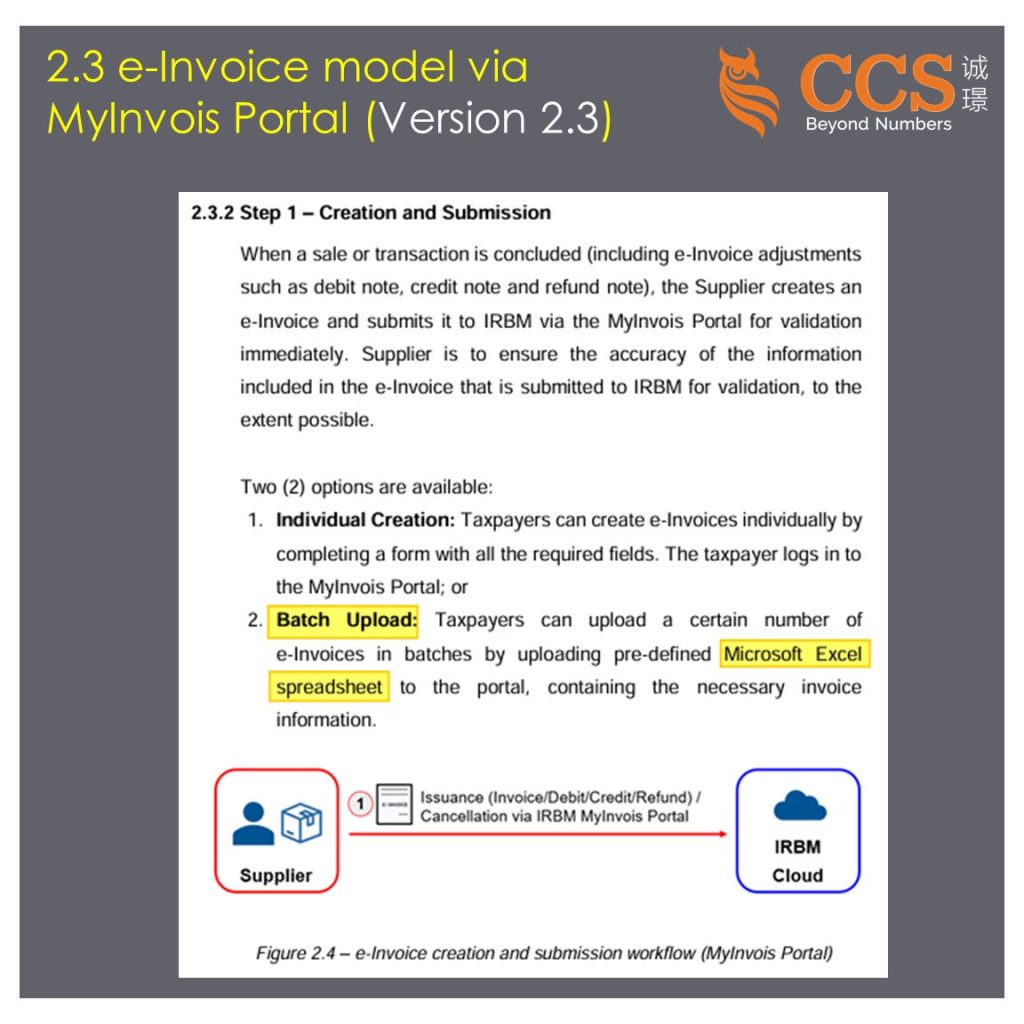
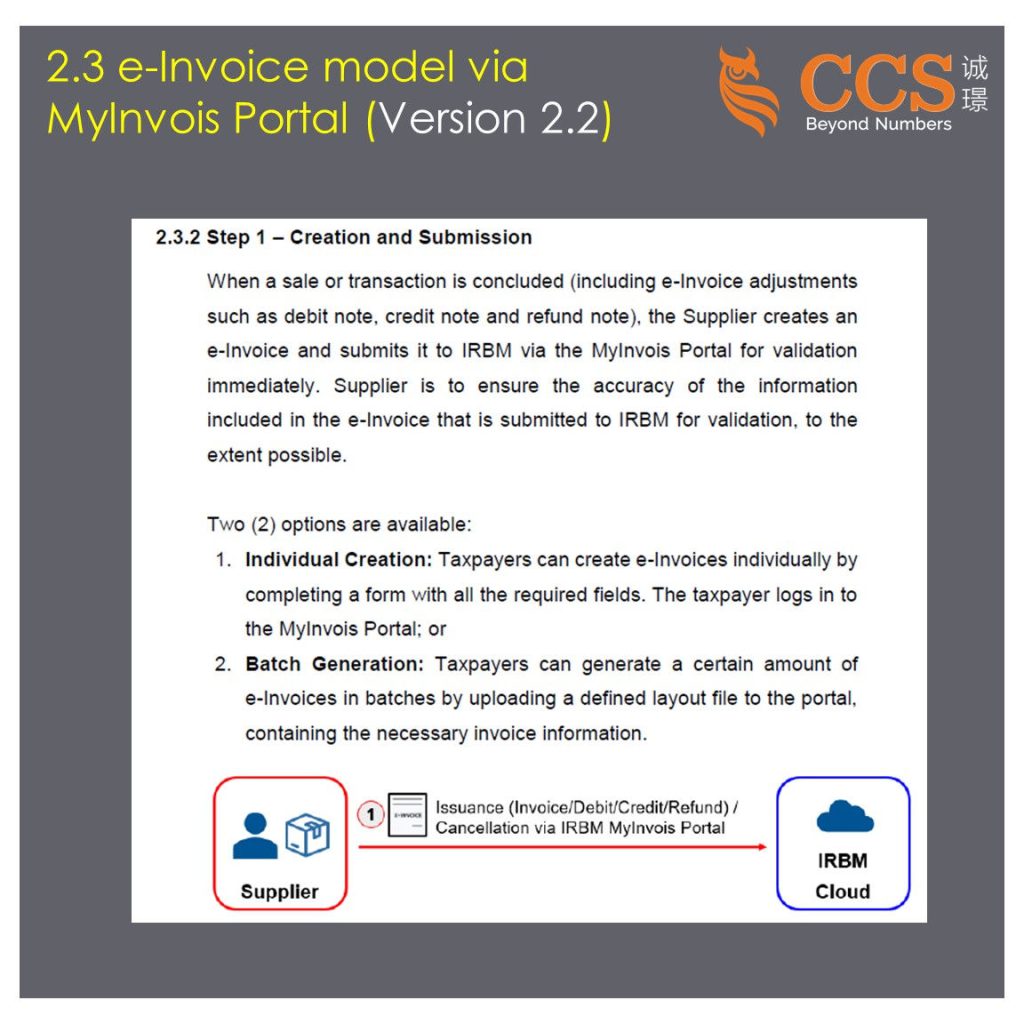
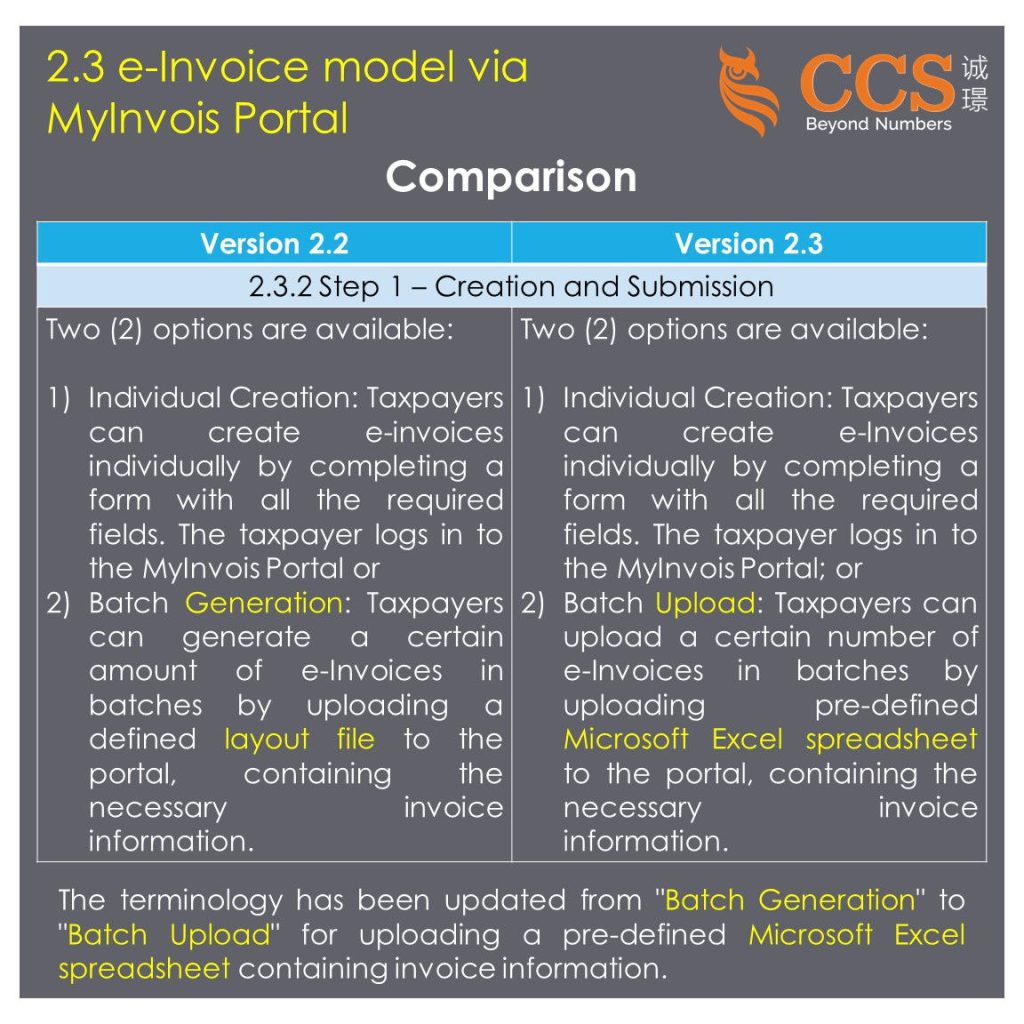
The change from “Batch Generation” to “Batch Upload” and from “defined layout file” to “pre-defined Microsoft Excel spreadsheet” in section 2.3.2 is likely to provide more clarity and specificity on the batch submission process via the MyInvois Portal.
📌 Batch Generation:
✅ This term is a bit vague and could be interpreted differently.
✅ It doesn’t specify the method or format for generating batches of e-invoices.
📌 Batch Upload:
✅ “Upload” is a more specific term that clearly indicates the action of transferring a file/data from the user’s system to the MyInvois Portal.
✅ It removes any ambiguity and makes it evident that batches of e-invoices are submitted to the portal through a file upload process.
📌 Defined Layout File:
✅ “Layout file” is a generic term that could refer to various file formats or structures.
✅ It lacks specificity on the exact file type and format expected for batch submissions.
📌 Pre-defined Microsoft Excel Spreadsheet:
✅ By explicitly mentioning “Microsoft Excel spreadsheet”, it provides clear guidance on the specific file format that is accepted for batch uploads.
✅ “Pre-defined” indicates that there is a predefined template or structure that users must follow when preparing the Excel file.
✅ This level of detail helps users understand exactly what is required for batch uploads, reducing confusion and ensuring compliance with the expected file format.
So, in essence, the changes were likely made to:
1) Use more precise terminology that accurately reflects the process (“Upload” instead of “Generate”).
2) Provide clear and specific information about the accepted file format (Microsoft Excel spreadsheet instead of a generic “layout file”).
3) Indicate that there is a predefined template/structure to follow for batch uploads (pre-defined Excel spreadsheet).
By making these changes, the guideline aims to give taxpayers and users more explicit and unambiguous instructions on correctly preparing and submitting batches of e-Invoices via the MyInvois Portal, minimising potential confusion or errors in the process.
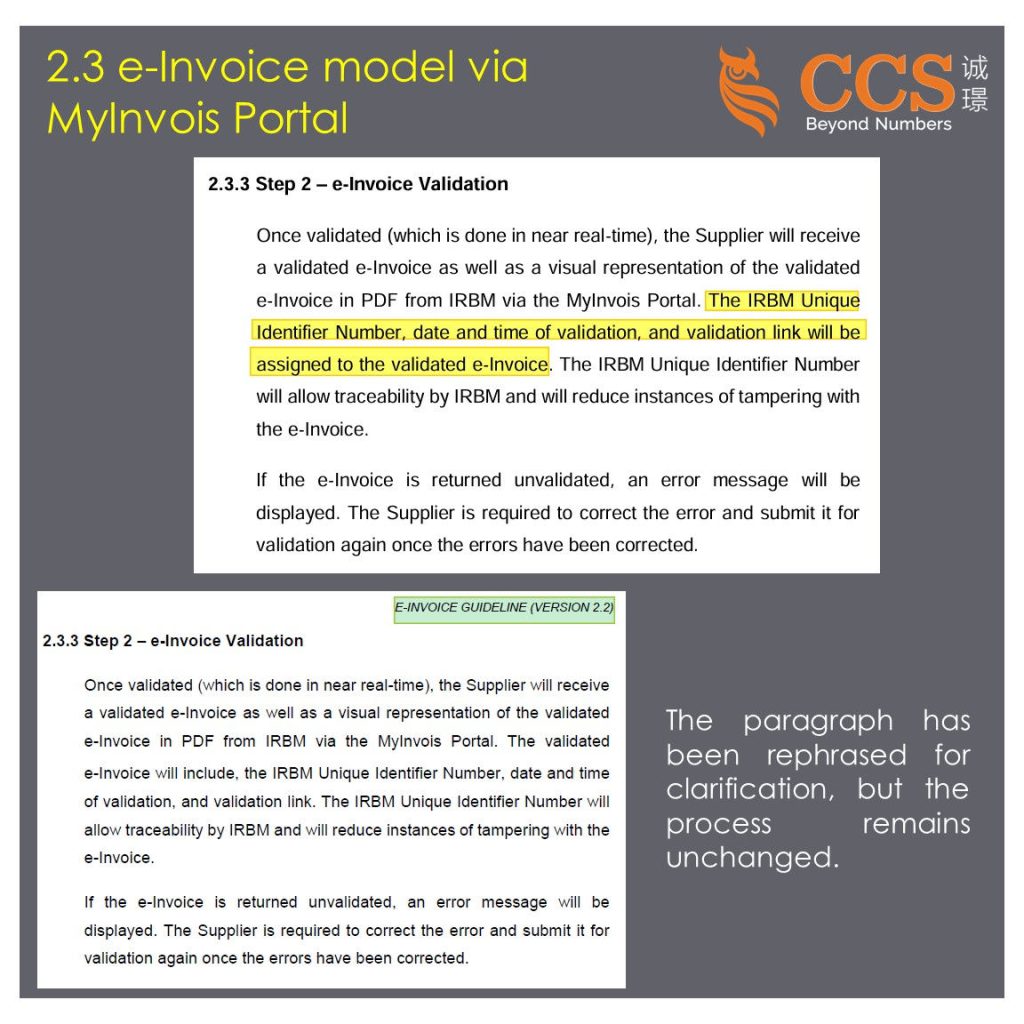
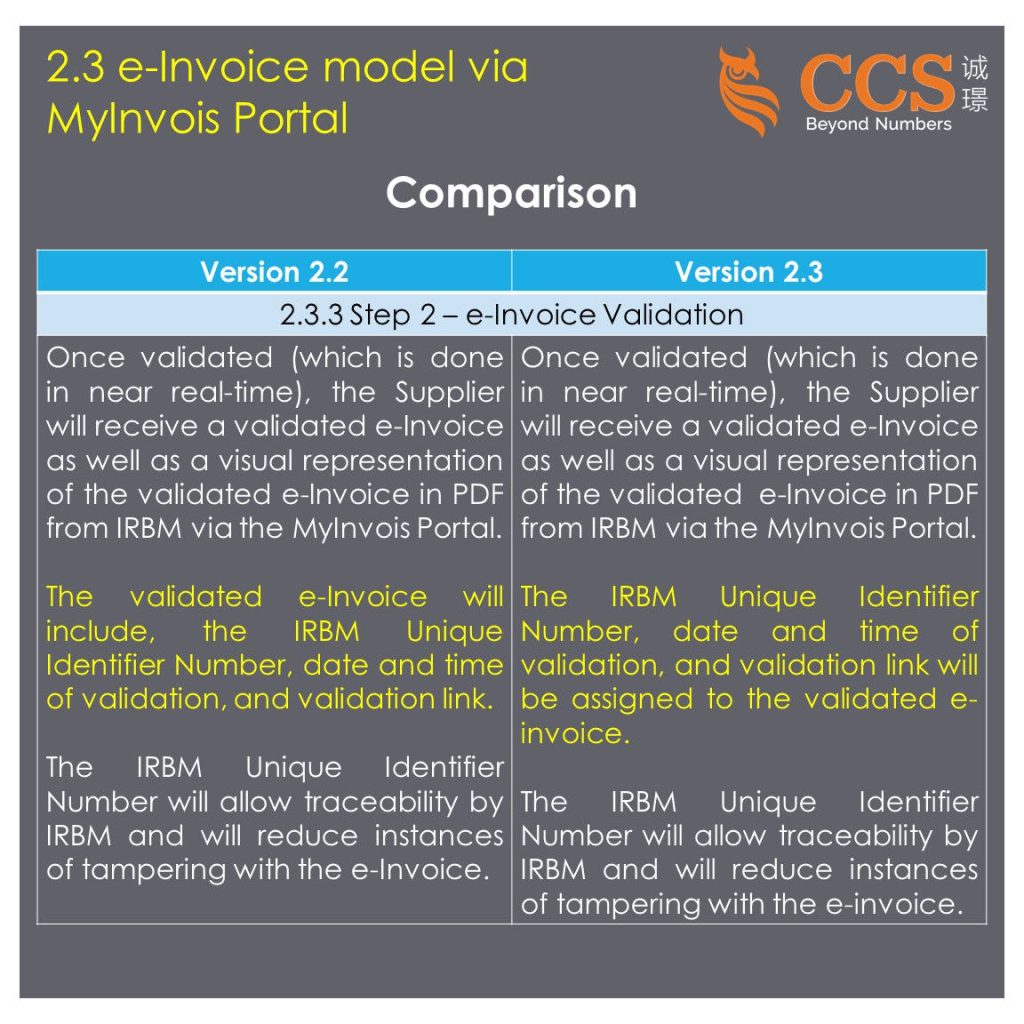
The change in section 2.3.3 between versions 2.2 and 2.3 is:
Version 2.2:
“The validated e-Invoice will include, the IRBM Unique Identifier Number, date and time of validation, and validation link.”
Version 2.3:
“The IRBM Unique Identifier Number, date and time of validation, and validation link will be assigned to the validated e-Invoice.”
So the change is from stating that the validated e-invoice “will include” those details to saying they “will be assigned to” the validated e-invoice.
This is a minor phrasing change, but it slightly alters the meaning. Version 2.3 clarifies that the IRBM Unique Identifier Number, date/time, and validation link are assigned or added to the e-invoice upon validation rather than already included in the original e-invoice submitted.
The rationale could be to make it clear that these validation-related details are dynamically assigned by IRBM during the validation process rather than being pre-existing elements in the e-Invoice created by the supplier.
Untuk makluman, Sistem e-PCB Plus akan menggantikan sistem PCB sediada (e-PCB / e-CP39 / e- Data PCB) dalam satu platform.
Sistem baharu ini boleh diakses melalui Portal Mytax dengan menggunakan Nombor Pendaftaran Cukai (TIN) daripada ID MyTAX pengguna. Tarikh sebenar penggunaan sistem baharu ini akan dimaklumkan kemudian kepada majikan.
Majikan perlu memastikan individu yang diberi kuasa berkaitan kiraan, bayaran & penghantaran data PCB telah mempunyai ID MyTAX.
Majikan juga perlu memastikan maklumat data pekerja ( nama / TIN / no. pengenalan) adalah betul dan teratur bagi membolehkan PCB pekerja diproses apabila menggunakan sistem baharu. Pendaftaran dan semakan TIN / ID MyTAX boleh dibuat melalui perkhidmatan e-Daftar di portal MyTAX atau dengan menghubungi pejabat LHDNM yang berdekatan.
The Inland Revenue Board of Malaysia (IRBM) has expanded the scope of e-invoicing to include additional document types beyond the initial Invoice, Credit Note, Debit Note, and Refund Note.
This extension aims to provide comprehensive coverage and facilitate seamless e-invoicing operations across various business scenarios.
In addition to the existing document types, businesses can now leverage the following e-Invoice formats within the MyInvois System:
1. Self-Billed Invoice
2. Self-Billed Credit Note
3. Self-Billed Debit Note
4. Self-Billed Refund Note
These new document types cater to specific situations where the Buyer assumes the role of the Supplier and issues self-billed e-invoices, as outlined in Section 8 of the e-invoice Specific Guideline.
By incorporating these additional formats, the MyInvois System empowers businesses with greater flexibility and compliance across diverse transaction scenarios.
Self-Billed Invoice
There are certain circumstances where another party (other than the Supplier) will be allowed to issue a self-billed e-Invoice.
Kindly refer to Section 8 of the e-Invoice Specific Guideline where self-billed e-Invoice will be allowed.
Self-Billed Invoice refers to the initial self-billed e-Invoice that will be issued by the Buyer.
Self-Billed Credit Note
Self-Billed Credit Note is issued by Buyers to correct errors, apply discounts, or account for returns in a previously issued Self-Billed e-Invoice with the purpose of reducing the value of the original Self-Billed e-Invoice.
This is used in situations where the reduction of the original Self-Billed e-Invoice does not involve return of monies to the Buyer.
Self-Billed Debit Note
Self-Billed Debit Note is the document issued by Buyers to indicate additional charges on a previously issued Self-Billed e-Invoice.
Self-Billed Refund Note
Self-Billed Refund Note is the document issued by Buyers to confirm the refund of the Buyer’s payment. This is used in situations where there is a return of monies to the Buyer.
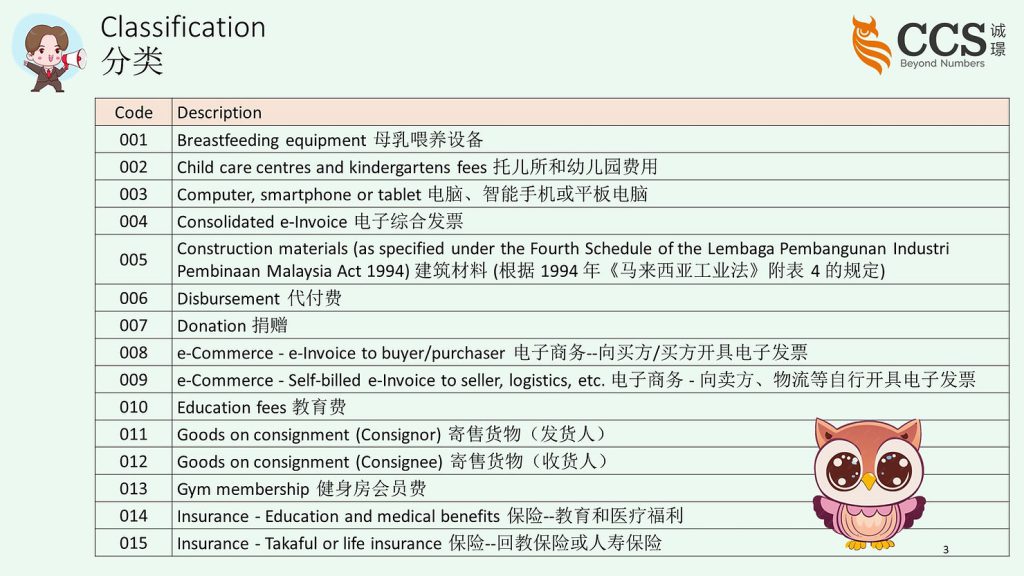
The “Classification Code” is a mandatory field in e-Invoices that categorizes the nature of the transaction or the types of products/services involved.
IRBM requires this code to facilitate the analysis and monitoring of various transactions for tax purposes.
The classification codes cover a wide range of items and scenarios, from common expenses like medical treatments and educational fees to specific transactions like consignment sales, self-billed invoices for imports/exports, and even categories like breastfeeding equipment or sports-related purchases.
By requiring businesses to assign the appropriate classification code, IRBM can gain valuable insights into spending patterns, identify potential areas of tax leakage or non-compliance, and make informed decisions regarding tax policies and administration.
For taxpayers, using the correct classification code ensures accurate reporting and compliance with e-invoicing requirements while enabling IRBM to streamline its processes and enhance tax collection and monitoring efficiency.
Therefore, taxpayers must familiarise themselves with the classification codes and select the most relevant option that accurately represents the nature of their transaction. This ensures compliance and contributes to the effectiveness of IRBM’s tax administration efforts.
Where goods purchased may need to be shipped directly to the Shipping Recipient instead of the Buyer
In the new e-Invoice Specific Guideline (Version 2.1), paragraph 3.5.6 clarifies the details provided by individual Shipping Recipients to issue the Annexure to the e-Invoice.
The key points are:
1. For Malaysian individuals, the Shipping Recipient needs to provide:
✅ Full name as per MyKad/MyTentera
✅ Address
✅ TIN; or MyKad/MyTentera identification number; or both TIN and MyKad/MyTentera number
2. For non-Malaysian individuals, the Shipping Recipient needs to provide:
✅ Full name as per passport/MyPR/MyKAS
✅ Address
✅ TIN or both TIN and passport/MyPR/MyKAS number
3. This allows flexibility for individual Shipping Recipients to provide a minimum set of details for annexing to the e-Invoice issued by the Supplier.
4. It eases the burden on individual Shipping Recipients from having to provide complete details like businesses.
In summary, this new paragraph provides concessions and options for individual Shipping Recipients to facilitate easier compliance when Suppliers need to annex Shipping Recipient details to the e-invoices issued. Taxpayers who are individual Shipping Recipients should take note of these concessions.
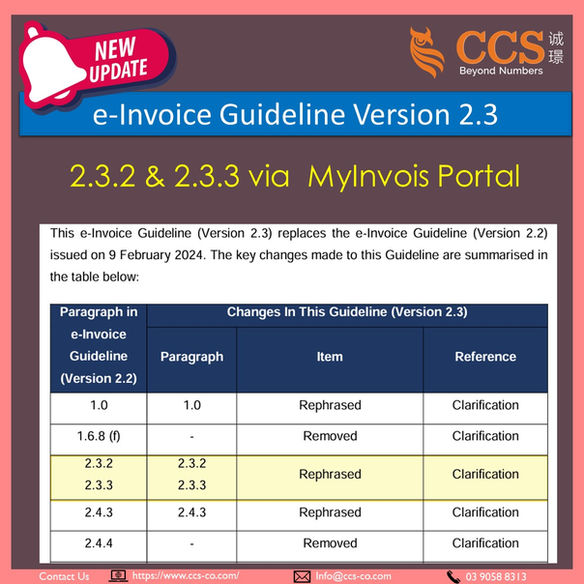
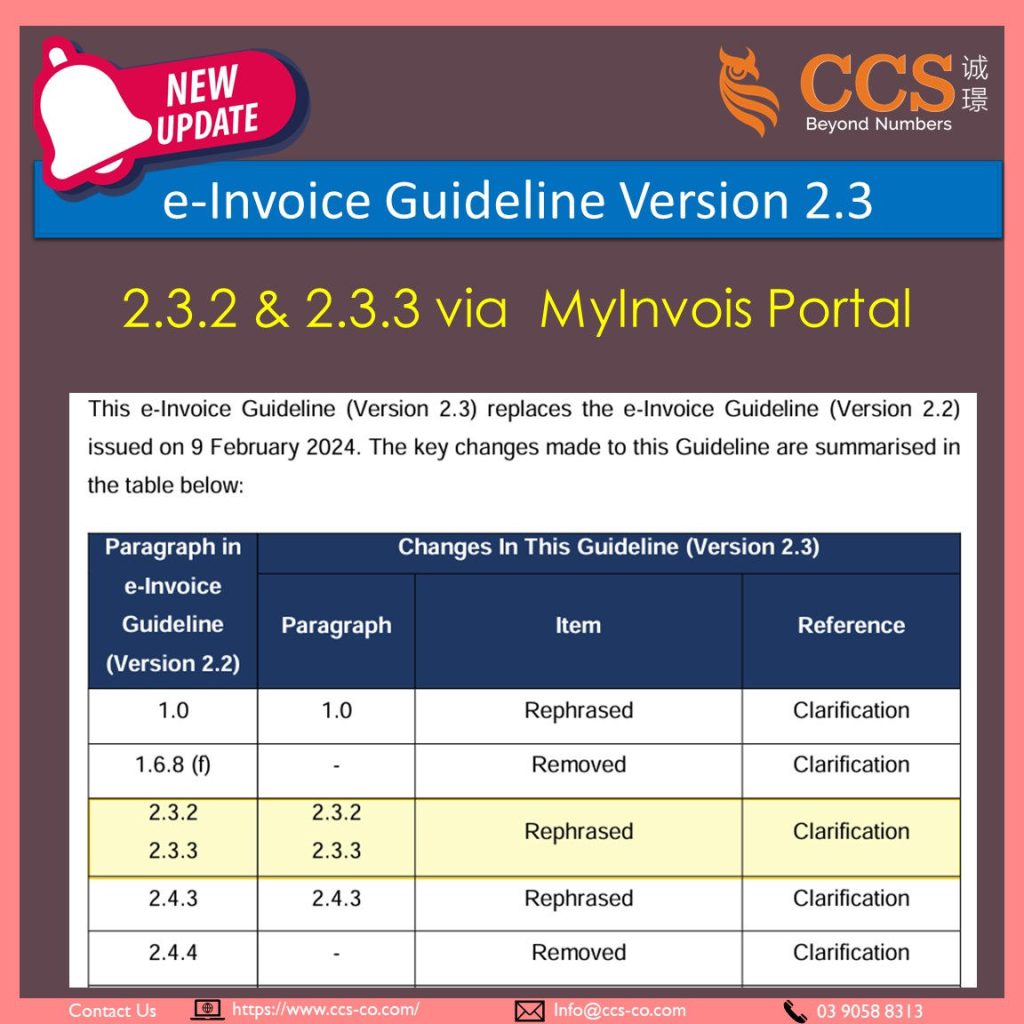
The change in section 2.4.3 between versions 2.2 and 2.3 is related to how the details of the API response after successful e-invoice validation are presented.
Version 2.2:
“Once validated by the MyInvois System (which is done in near real-time), the Supplier or technology provider (if the Supplier utilises a technology provider) will receive an API response with the following information:
(a) the IRBM Unique Identifier Number from IRBM;
(b) date and time of validation, and
(c) validation link,
via API.”
Version 2.3:
“Once validated (which is done in near real-time), the Supplier or technology provider (if the Supplier utilises a technology provider) will receive an API response which contains the following:
(a) the IRBM Unique Identifier Number from IRBM;
(b) date and time of validation, and
(c) information to form validation link (please refer to Get Recent Documents / Get Document / Get Documents Details in the SDK for guidance),
via API.”
The changes are:
1. Removed “with the following information” after “API response”.
2. Changed “validation link” to “information to form validation link (please refer to Get Recent Documents / Get Document / Get Documents Details in the SDK for guidance)”.
The rationale for these changes could be:
1. Removing “with the following information” makes the sentence more concise.
2. Changing “validation link” to “information to form validation link” clarifies that the API response does not directly provide the complete validation link, but rather the necessary information to construct the validation link.
3. The addition “(please refer to Get Recent Documents / Get Document / Get Documents Details in the SDK for guidance)” provides users with a reference to the specific SDK sections that will guide them on how to use the information provided in the API response to properly form the validation link.
This change aims to provide more precise information about the API response content and direct users to the relevant SDK documentation for guidance on constructing the validation link using the information received.
Overall, it clarifies that the API response gives the necessary pieces of information, but users need to refer to the SDK for specific instructions on how to utilise that information to build the complete validation link URL or endpoint.
第 2.4.3 节中 2.2 版和 2.3 版之间的改动涉及如何显示电子发票验证成功后的 API 响应详情。
版本 2.2:
“一旦通过 MyInvois 系统验证(几乎实时完成),供应商或技术提供商(如果供应商使用技术提供商)将收到包含以下信息的 API 响应:
(a) 来自IRBM的IRBM唯一识别码;
(b) 验证日期和时间,以及
(c) 验证链接;
通过应用程序接口(API)”。
2.3 版:
“一旦验证(近乎实时验证),供应商或技术提供商(如果供应商使用技术提供商)将收到包含以下内容的 API 响应:
2. 将 “验证链接 “改为 “形成验证链接的信息”,说明 API 响应并不直接提供完整的验证链接,而是提供构建验证链接的必要信息。
3. 增加”(请参阅 SDK 中的 “获取最新文档”/”获取文档”/”获取文档详细信息”,以获得指导)”,为用户提供 SDK 具体章节的参考,指导他们如何使用 API 响应中提供的信息来正确形成验证链接。
这一改动旨在提供有关 API 响应内容的更精确信息,并引导用户查看相关 SDK 文档,以获得使用收到的信息构建验证链接的指导。
总的来说,它说明了 API 响应提供了必要的信息,但用户需要参考 SDK 以获取具体说明,了解如何利用这些信息来构建完整的验证链接 URL 或端点。
⚠️ 2.4.4 Step 3 – Notification
The removal of the full paragraph explaining the Notification API details in section 2.4.4 could be due to a few potential reasons:
1. Simplification:
The paragraph provided quite detailed information about how the Notification API works, automatically triggering notifications to suppliers and buyers upon e-Invoice validation, and facilitating communication.
Removing this level of technical detail may have been done to simplify the guideline and make it more concise, especially if these specifics are already covered in the separate API documentation (SDK).
2. Avoiding redundancy:
If the Notification API functionality and workflow are already comprehensively documented in the Software Development Kit (SDK) or other technical resources provided to API users, the guideline may have aimed to avoid redundancy by simply referring API users to those dedicated resources.
3. Keeping the guideline focused:
The e-invoice Guideline is intended to provide an overview of the e-invoicing process, requirements, and timelines for taxpayers.
Removing granular API details could be a way to keep the guideline focused on the broader e-Invoicing aspects, rather than delving too deeply into API-specific technicalities.
Overall, the removal of this paragraph could be aimed at streamlining the guideline, avoiding redundancy with dedicated API documentation, maintaining a broader focus on e-Invoicing essentials, and allowing for potential future changes or updates to the Notification API without creating inconsistencies within the guideline itself.
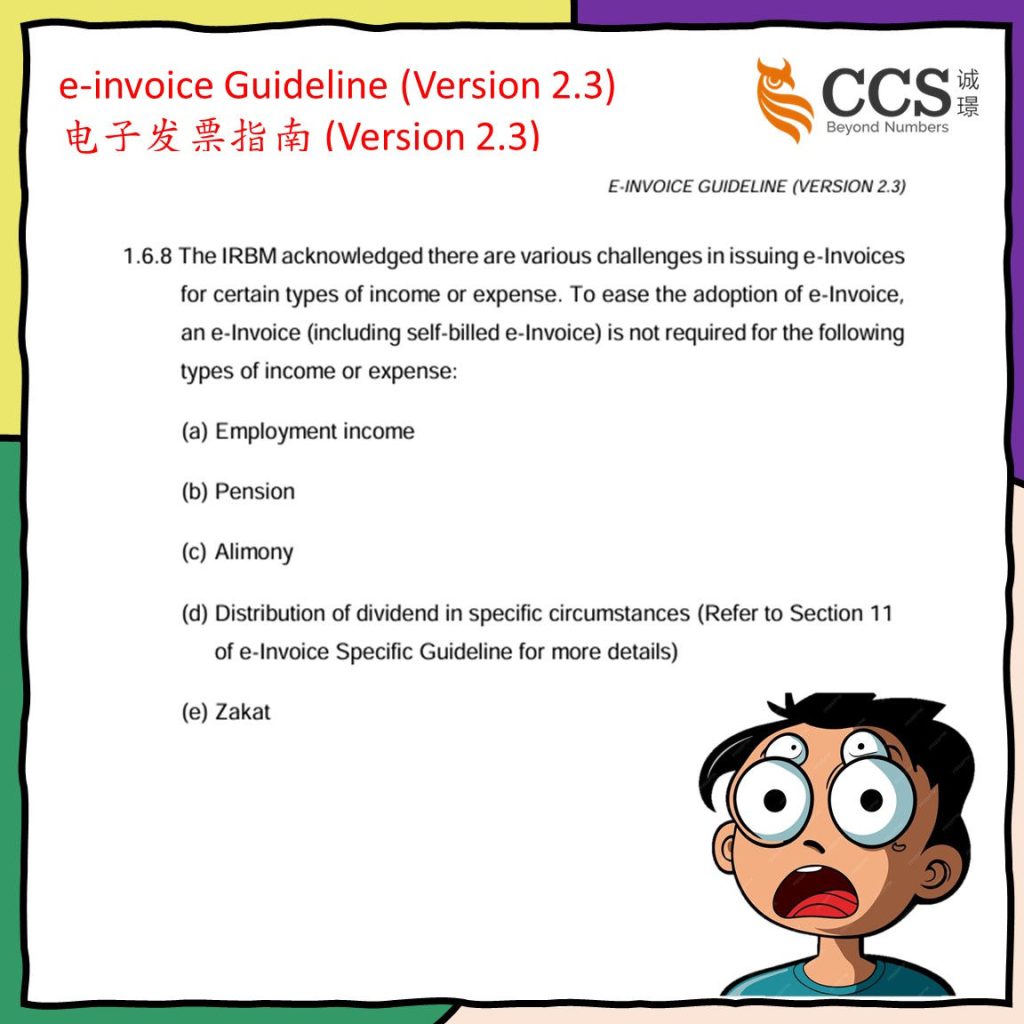
The removal of “Scholarship” from the list of exemptions in Section 1.6.8 of the e-Invoice Guideline Version 2.3 indicates that scholarships will now require the issuance of e-Invoices.
Potential Rationale:
The rationale for removing the scholarship exemption is to leverage the benefits of the e-invoicing system.
This system ensures better transparency and documentation of scholarship payments/disbursements, which can lead to more efficient financial management and reduced administrative burden.
By requiring e-invoices for scholarships, the issuing institutions (universities, organisations, etc.) must generate validated self-billed e-invoices for the scholarship amounts paid to students/recipients.
This allows for:
1) Proper recording and tracking of scholarship payments in the e-invoicing system.
2) Validation and authentication of scholarship e-invoices by IRBM.
3) Easier reporting and documentation for both the issuer and recipient.
4) Alignment with the overall move towards comprehensive e-Invoicing adoption.
e-Invoicing Impact:
1) Institutions/organisations issuing scholarships will now need to ensure their processes are updated to generate and issue self-billed e-Invoices for scholarship payments.
2) Students/recipients of scholarships should be prepared to receive self-billed e-Invoices instead of traditional documentation.
3) The self-billed e-Invoices received can serve as valid proof of scholarship income for students/recipients for tax purposes or other documentation needs.
4) Issuing institutions may need to make system changes, update templates, train staff, etc., to facilitate self-billed e-Invoice generation for scholarships.
5) There could be an initial transition period where some scholarship payments may still be documented through traditional means until the e-Invoicing process is fully adopted.
In summary, the removal of the scholarship exemption brings scholarship payments into the scope of e-Invoicing requirements, likely to improve transparency, documentation, and aligned with the overall digitalization of tax administration processes.
Here’s how the self-billed e-Invoicing process would work for scholarships:
For institutions/organisations issuing scholarships to students who do not run a business, the e-Invoicing process should be:
1) The institution/organisation would issue a self-billed e-Invoice treating the student as the “Supplier”.
2) In the self-billed e-Invoice, the student’s personal details (name, address, identification number) would go in the “Supplier” fields.
3) And the institution’s own details would go in the “Buyer” fields.
4) The description on the self-billed e-Invoice would be something like “Scholarship to [Student Name]”
5) The institution is essentially self-billing an e-invoice as if they are the “Buyer” by paying the scholarship amount to the “Supplier” (student).