Day: October 16, 2026

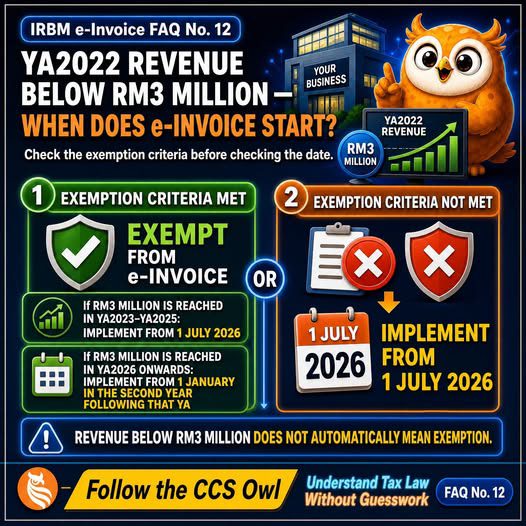
  • E-Invoice FAQ No. 12: Implementation Dates Based on YA 2022–YA 2025 Turnover

    E-Invoice FAQ No. 12: Implementation Dates Based on YA 2022–YA 2025 Turnover

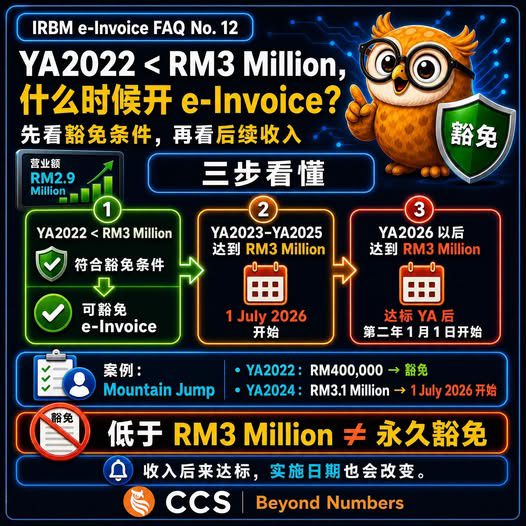
    FAQ No. 12 explains how the e-Invoice implementation date is determined by reference to a business’s turnover and whether it meets the exemption criteria.

    If the Business Meets the Exemption Criteria

    If turnover for YA 2022 was below RM3 million, the business is generally exempt. However:

    • If turnover reached RM3 million in YA 2023, YA 2024 or YA 2025, the e-Invoice requirement takes effect from 1 July 2026.

    • If the RM3 million threshold is reached only in YA 2026 or a later year, implementation begins on 1 January of the second year following the YA in which the threshold was reached.

    If the Business Does Not Meet the Exemption Criteria

    Even if turnover for YA 2022 was below RM3 million, the business must begin implementing e-Invoice from 1 July 2026 if it does not meet the exemption criteria.

    e-Invoice常见问题第12条:根据YA 2022至YA 2025营业额确定实施日期

    常见问题第12条说明,e-Invoice的实施日期取决于企业的营业额,以及企业是否符合豁免条件。

    符合豁免条件的企业

    如果企业在YA 2022的营业额低于RM300万,原则上可获豁免。不过:

    • 如果企业在YA 2023、YA 2024或YA 2025达到RM300万门槛,e-Invoice要求将从2026年7月1日起生效。

    • 如果企业直到YA 2026或之后才达到RM300万门槛,则从达到门槛所在YA之后第二年的1月1日开始实施。

    不符合豁免条件的企业

    即使企业在YA 2022的营业额低于RM300万,只要不符合豁免条件,仍须从2026年7月1日起开始实施 e-Invoice。
  • e-Invoice Implementation: How to Assess the YA 2023–YA 2025 Revenue Threshold and Exemption

    e-Invoice Implementation: How to Assess the YA 2023–YA 2025 Revenue Threshold and Exemption

    Businesses should review their annual turnover or revenue for YA 2023, YA 2024 and YA 2025, and assess two points:

    • Did the business reach or exceed RM3 million in any of those years?

    • If its revenue was below RM3 million in all three years, does it meet the e-Invoice exemption criteria?

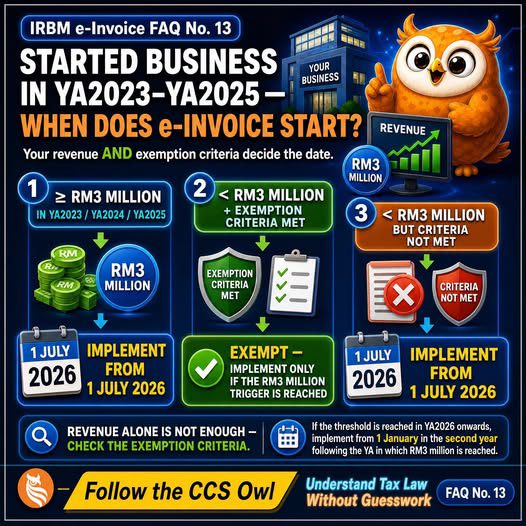
    FAQ No. 13 sets out three possible outcomes:

    • Revenue of RM3 million or more in any of YA 2023–YA 2025: The business generally begins implementing e-Invoice from 1 July 2026.

    • Revenue below RM3 million in all three years, and the exemption criteria are met: The business is exempt, including from self-billed e-Invoice requirements.

    • Revenue below RM3 million in all three years, but the exemption criteria are not met: The business must still begin implementing e-Invoice from 1 July 2026.

    The Exemption May Not Be Permanent

    If an exempt business reaches or exceeds the RM3 million threshold in YA 2026 or a later year, its e-Invoice implementation obligation will resume from 1 January of the second year after the YA in which the threshold is reached.

    For example, Pak Salleh’s revenue was RM185,000 in YA 2025, so he was initially exempt. If his revenue reaches RM3.17 million in YA 2027, his e-Invoice implementation date will be 1 January 2029.

    Businesses should therefore review both their revenue and exemption eligibility, and monitor whether they meet the threshold in future years.

    e-Invoice实施时间:如何评估YA 2023至YA 2025的收入门槛与豁免资格

    企业应回顾YA 2023、YA 2024及YA 2025三个课税年度的年营业额或收入,并分别检查以下两点:

    • 任何一个年度的收入是否达到或超过RM300万?

    • 如果三个年度的收入都低于RM300万,企业是否符合 e-Invoice 豁免条件?

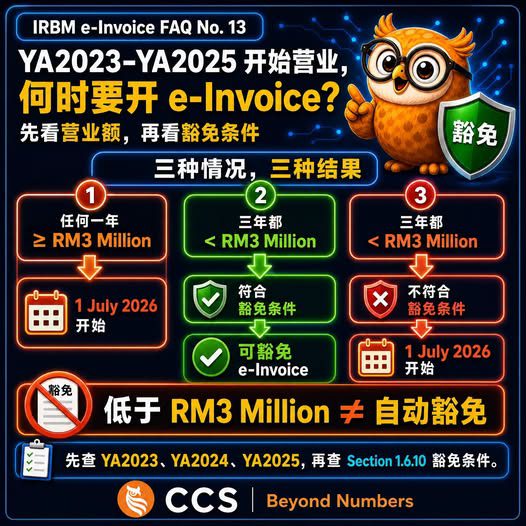
    FAQ No. 13列出三种可能情况:

    • YA 2023至YA 2025期间,任何一个年度的收入达到或超过RM300万:企业通常须从2026年7月1日起实施 e-Invoice。

    • 三个年度的收入均低于RM300万,且符合豁免条件:企业可获豁免,包括豁免自开 e-Invoice 要求。

    • 三个年度的收入均低于RM300万,但不符合豁免条件:企业仍须从2026年7月1日起实施 e-Invoice。

    豁免并非永久有效

    如果获豁免的企业在YA 2026或之后的课税年度达到或超过RM300万门槛,其 e-Invoice 实施义务将恢复,并从达到门槛所在YA之后第二年的1月1日起实施。

    例如,Pak Salleh在YA 2025的收入为RM185,000,因此当时符合豁免条件。如果他的收入在YA 2027达到RM317万,实施日期将为2029年1月1日。

    因此,企业应同时检查收入水平与豁免资格,并持续关注未来年度是否达到门槛。

  • E-Invoice Guideline v4.8: Does Your Business Qualify for the Para 1.6.10 Exemption?

    E-Invoice Guideline v4.8: Does Your Business Qualify for the Para 1.6.10 Exemption?

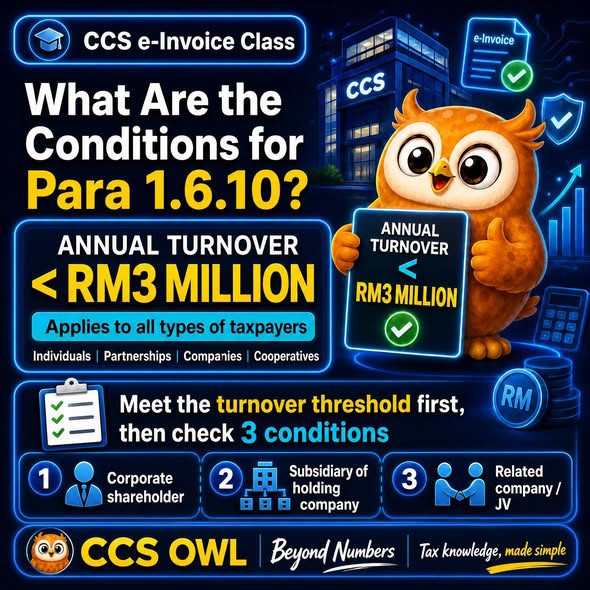
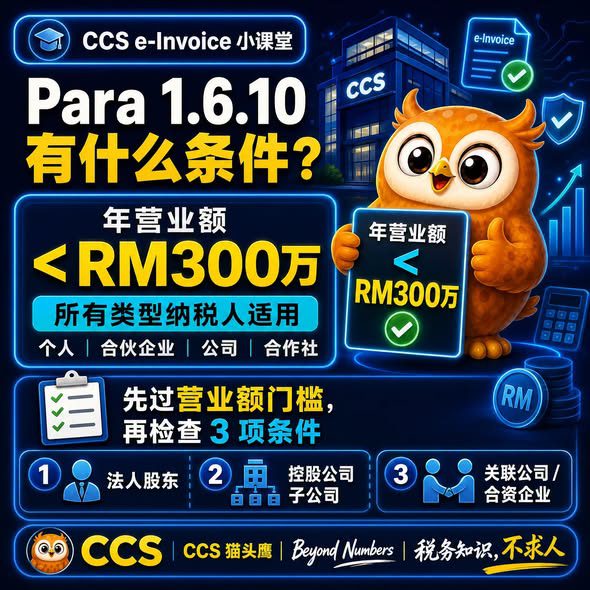
    A business’s annual turnover below RM3 million is only the starting point for assessing eligibility for the e-Invoice exemption under paragraph 1.6.10 of the e-Invoice Specific Guideline v4.8. The business must also satisfy all three of the following conditions:

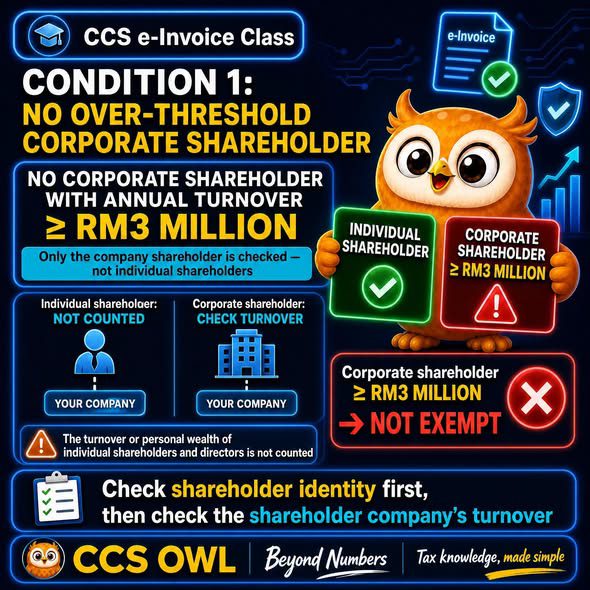
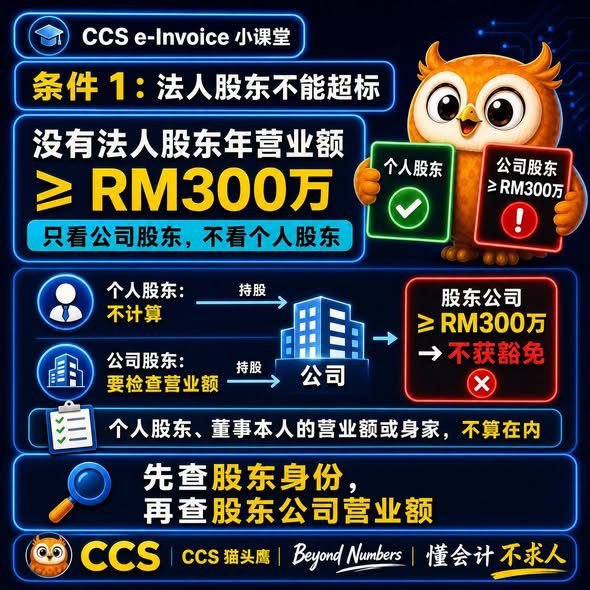
    • It has no corporate shareholder with annual turnover of RM3 million or more.

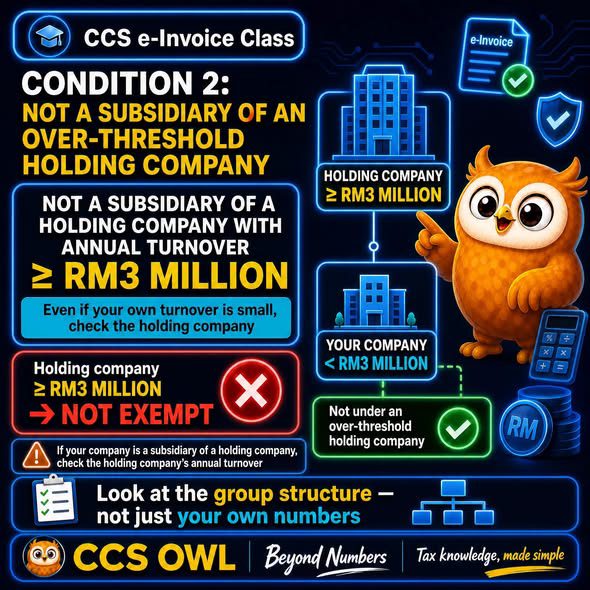
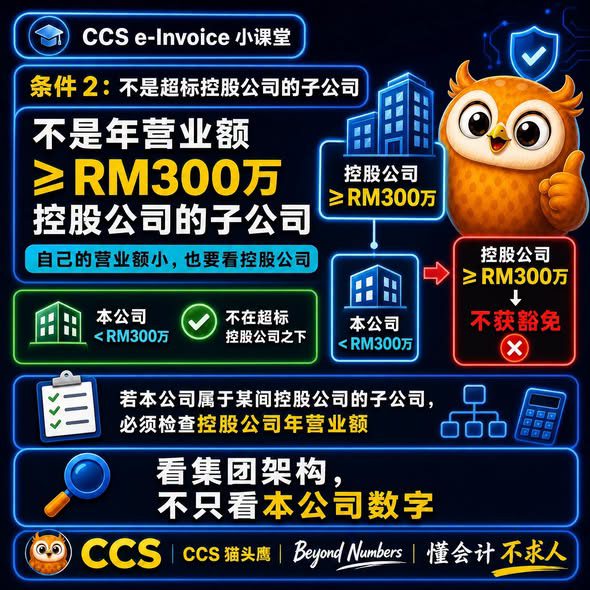
    • It is not a subsidiary of a holding company with annual turnover of RM3 million or more.

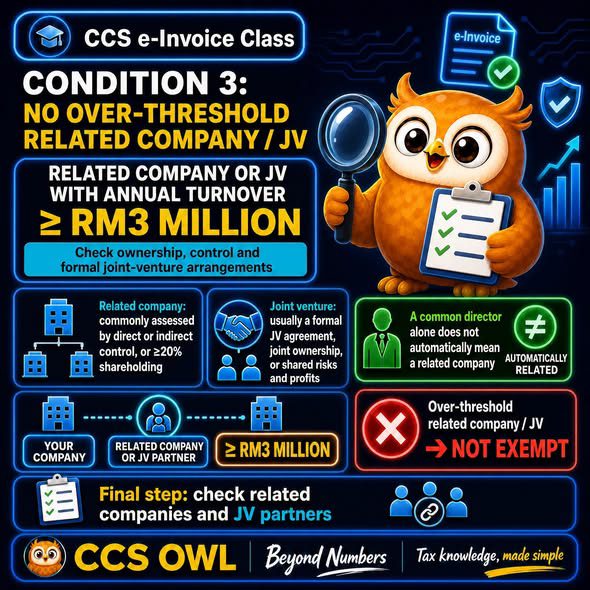
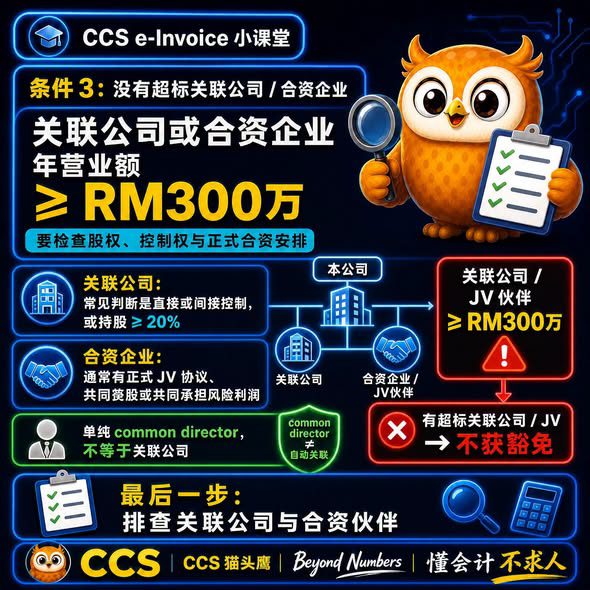
    • It has no related company or joint venture with annual turnover of RM3 million or more.

    This means that a business may have annual turnover below RM3 million and still not qualify for the exemption if it has a corporate shareholder, holding-company relationship, related company or joint-venture arrangement that meets the threshold.

    A Practical Checklist

    When assessing eligibility, businesses should look beyond their own turnover and review:

    • whether their shareholders are individuals or companies;

    • whether they form part of a group or holding-company structure;

    • whether there are related companies involving shareholdings of 20% or more, or direct or indirect control; and

    • whether there is a formal joint-venture agreement or arrangement.

    In short: Check the turnover threshold first, then review the ownership and group relationships. All applicable conditions must be satisfied before the exemption can be confirmed.

    CCS Cat Owl | Beyond Numbers | Accounting knowledge for everyone

    《e-Invoice Specific Guideline》第4.8版:企业是否符合第1.6.10段的豁免条件?

    根据《e-Invoice Specific Guideline》第4.8版第1.6.10段,企业年营业额低于RM300万只是评估 e-Invoice 豁免资格的第一步。企业还必须同时符合以下三项条件:

    • 没有年营业额达到或超过RM300万的法人股东。

    • 不是年营业额达到或超过RM300万的控股公司的子公司。

    • 没有年营业额达到或超过RM300万的关联公司或合资企业。

    因此,即使企业自身年营业额低于RM300万,如果其法人股东、控股公司、关联公司或合资安排达到相关门槛,企业仍可能不符合豁免条件。

    实务检查清单

    评估资格时,企业不应只检查自身营业额,还应检视:

    • 股东是个人还是公司;

    • 企业是否属于集团或控股架构;

    • 是否存在持股20%或以上,或直接或间接控制的关联公司;以及

    • 是否有正式的合资协议或安排。

    简单来说:先看营业额,再检查股权及集团关系。必须同时符合所有适用条件,才能确认豁免资格。

    CCS猫头鹰|Beyond Numbers|懂会计不求人

  • When Must a New Business Begin Implementing e-Invoice?

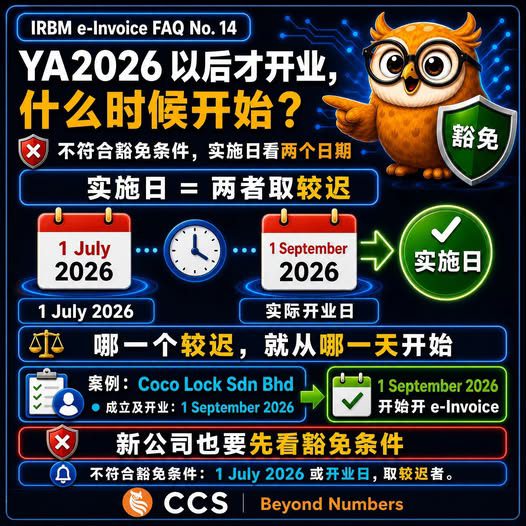
    When Must a New Business Begin Implementing e-Invoice?

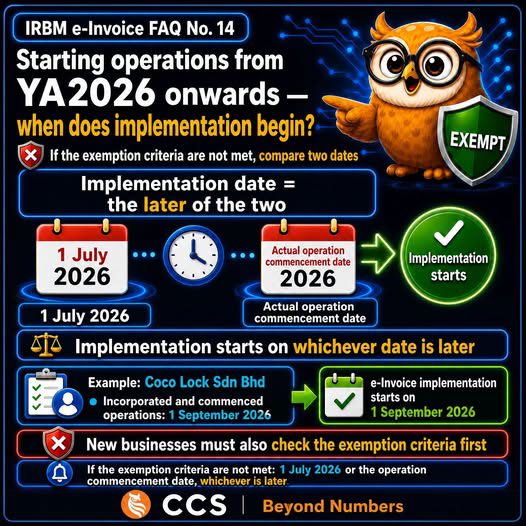
    For a business that starts operating from YA 2026 onwards and does not meet the e-Invoice exemption criteria, the implementation date is the later of:

    • 1 July 2026; or

    • the date the business actually begins operations.

    For example, Coco Lock Sdn Bhd began operations on 1 September 2026. As this is later than 1 July 2026, the company must begin implementing e-Invoice from 1 September 2026.

    Businesses should first check whether they qualify for an exemption, then compare the two dates.

    If the Business Qualifies for an Exemption

    A business that starts operating from 2026 onwards and meets the e-Invoice exemption criteria is exempt from implementation while it continues to meet those conditions. There is therefore no immediate implementation date.

    However, if the business later reaches or exceeds the annual turnover or revenue threshold of RM3 million, e-Invoice implementation will begin on 1 January of the second year following the Year of Assessment (YA) in which the threshold is reached.

    For example, if the business reaches the RM3 million threshold in YA 2027, it must begin implementing e-Invoice from 1 January 2029. “The second year” means the second year after the YA in which the threshold was reached; it is not calculated as two years from the date the threshold was reached.

    Businesses should review their exemption status regularly.

    新企业何时必须开始实施 e-Invoice?

    对于从YA 2026起开始营业、但不符合 e-Invoice 豁免条件的企业,实施日期为以下两个日期中较迟的一个:

    • 2026年7月1日;或

    • 企业实际开始营业的日期。

    例如,Coco Lock Sdn Bhd于2026年9月1日开始营业。由于该日期晚于2026年7月1日,公司必须从2026年9月1日起开始实施 e-Invoice。

    企业应先确认是否符合豁免条件,再比较上述两个日期。

    符合豁免条件的企业

    从2026年起开始营业且符合 e-Invoice 豁免条件的企业,只要持续符合相关条件,即可豁免实施 e-Invoice,因此目前没有须立即开始实施的日期。

    不过,如果企业之后达到或超过RM300万的年营业额或收入门槛,就须从达到门槛所在课税年度(YA)之后第二年的1月1日起实施 e-Invoice。
    例如,如果企业在YA 2027达到RM300万门槛,就须从2029年1月1日起开始实施 e-Invoice。“第二年”是指达到门槛的YA之后第二个年度,并非从达标当天起计算两年。

    企业应定期重新检查自身是否仍符合豁免条件。

  • E-Invoice Guideline v4.9: Identification Options for Malaysian and MyPR/MyKAS Holders

    E-Invoice Guideline v4.9: Identification Options for Malaysian and MyPR/MyKAS Holders

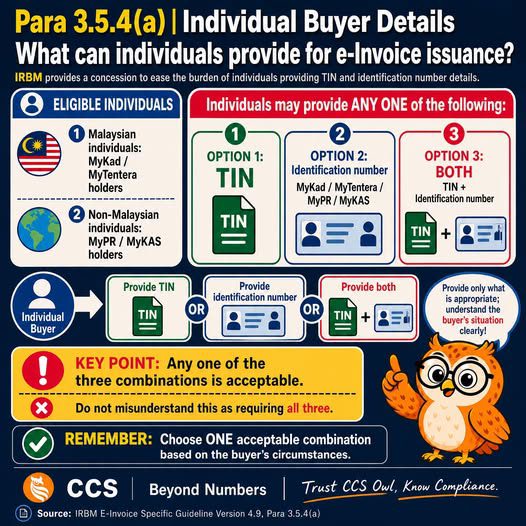
    Paragraph 3.5.4(a) of the IRBM E-Invoice Specific Guideline (Version 4.9) applies to Malaysian individuals holding a MyKad or MyTentera identification number, and non-Malaysian individuals holding a MyPR or MyKAS identification number.

    They may provide any one of the following:

    • their Tax Identification Number (TIN);

    • their MyKad, MyTentera, MyPR or MyKAS identification number; or

    • both their TIN and identification number.

    All three details are not required. Any one of the listed options is sufficient under paragraph 3.5.4(a).

    《E-Invoice Specific Guideline》第4.9版:马来西亚个人及MyPR/MyKAS持有人的身份资料选项

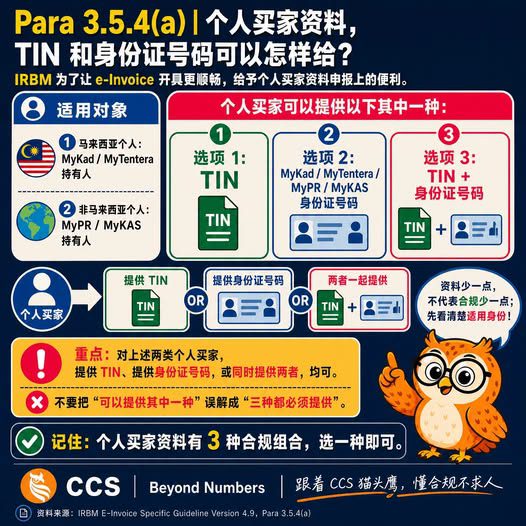
    IRBM《E-Invoice Specific Guideline》第4.9版第3.5.4(a)段适用于持有MyKad或MyTentera身份证号码的马来西亚个人,以及持有MyPR或MyKAS身份证号码的非马来西亚个人。

    上述个人可提供以下任一资料:

    • 税务识别号码(TIN);

    • MyKad、MyTentera、MyPR或MyKAS身份证号码;或

    • TIN及上述身份证号码。

    并非三项资料都必须提供。根据第3.5.4(a)段,提供所列选项中的任意一种即可。

  • E-Invoice Guideline v4.9: Identification Requirements for Non-Malaysian Individuals

    E-Invoice Guideline v4.9: Identification Requirements for Non-Malaysian Individuals

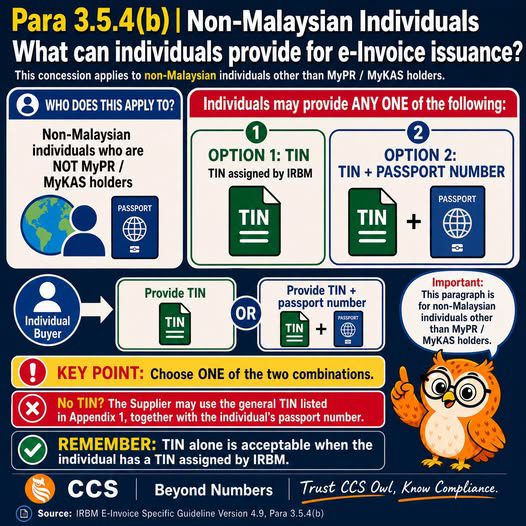
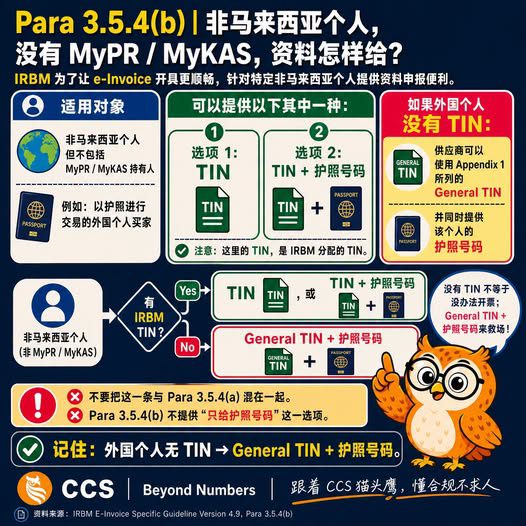
    Paragraph 3.5.4(b) of the IRBM E-Invoice Specific Guideline (Version 4.9) applies to non-Malaysian individuals, excluding MyPR and MyKAS holders.

    If the individual has a TIN assigned by IRBM, they may provide either:

    • the TIN only; or

    • both the TIN and passport number.

    If the individual does not have a TIN, the supplier may use the General TIN listed in Appendix 1 of the guideline together with the individual’s passport number.

    Important: A passport number alone is not sufficient under paragraph 3.5.4(b).

    《E-Invoice Specific Guideline》第4.9版:非马来西亚个人的身份资料要求

    IRBM《E-Invoice Specific Guideline》第4.9版第3.5.4(b)段适用于非马来西亚个人,但不包括MyPR或MyKAS持有人。

    如果该个人拥有由IRBM分配的TIN,可提供以下其中一种资料:

    • 仅提供TIN;或

    • 同时提供TIN和护照号码。

    如果该个人没有TIN,供应商可使用指南附录1所列的通用TIN,并同时填写该个人的护照号码。

    请注意:根据第3.5.4(b)段,仅提供护照号码并不足够。

  • E-Invoice Guideline v4.9: Identification Details for Individual Buyers or Recipients

    E-Invoice Guideline v4.9: Identification Details for Individual Buyers or Recipients

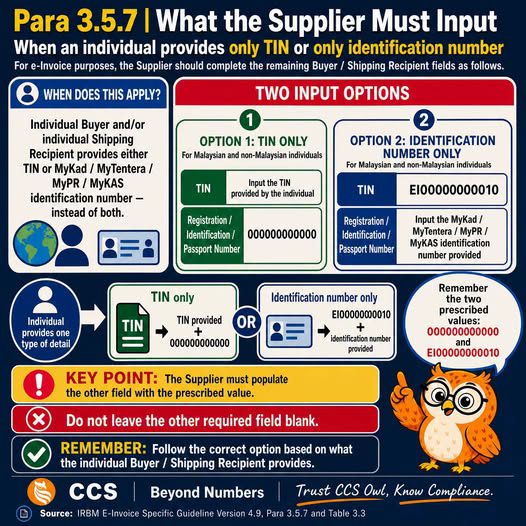
    Paragraph 3.5.7 of the E-Invoice Specific Guideline (Version 4.9) explains how a supplier should complete an e-Invoice when an individual buyer or recipient provides only one type of identification.

    • Only a TIN is provided: Enter the TIN provided by the individual in the TIN field and 000000000000 in the identification card/passport number field.

    • Only an identification number is provided: Enter EI00000000010 in the TIN field and the individual’s MyKad, MyTentera, MyPR or MyKAS number in the identification number field.

    Important: Do not leave the relevant fields blank. Ensure that the applicable TIN, identification number and code are entered accurately.

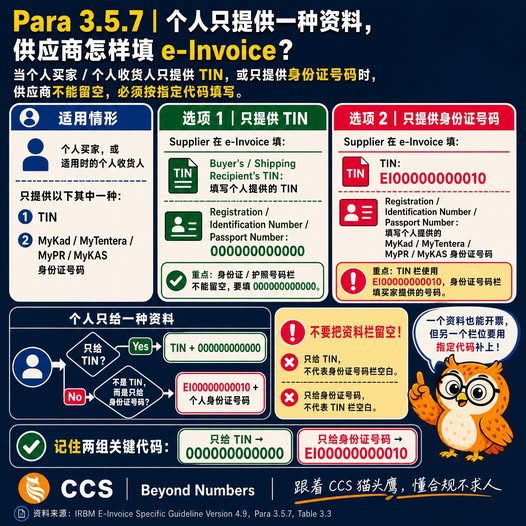
    《E-Invoice Specific Guideline》第4.9版第3.5.7段:个人买方或收货人的身份资料填写

    《E-Invoice Specific Guideline》第4.9版第3.5.7段说明,当个人买方或个人收货人只提供一种身份资料时,供应商应如何填写 e-Invoice。
    • 仅提供TIN:在TIN栏填写个人提供的TIN,并在身份证/护照号码栏填写 000000000000。

    • 仅提供身份证号码:在TIN栏填写 EI00000000010,并在身份证号码栏填写个人提供的MyKad、MyTentera、MyPR或MyKAS号码。

    请注意:相关栏位不得留空。请准确填写适用的TIN、身份证号码及代码。

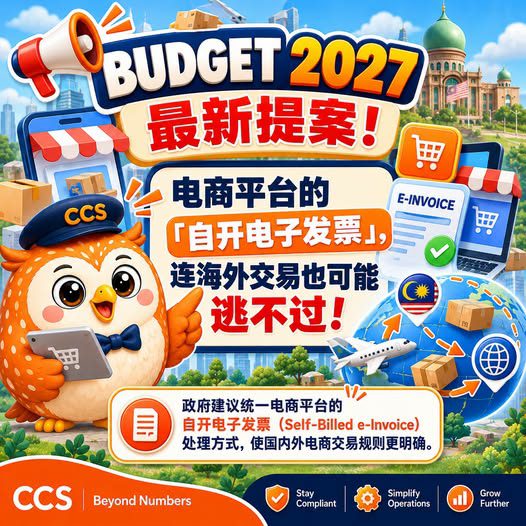
  • Proposed 2027 e-Invoice Rules for E-Commerce Platforms: Cross-Border Transactions

    Proposed 2027 e-Invoice Rules for E-Commerce Platforms: Cross-Border Transactions

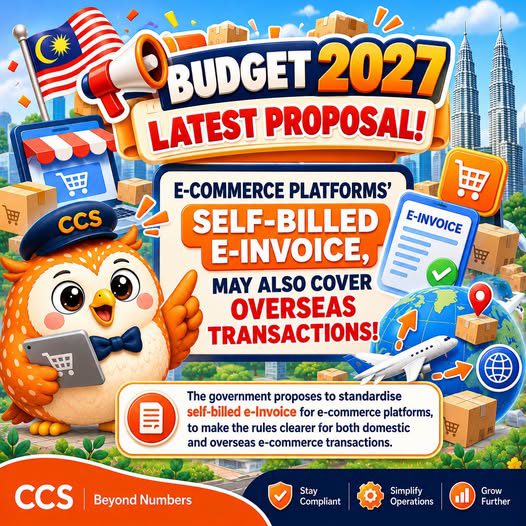
    The 2027 Budget proposes standardising how e-commerce platforms handle self-billed e-Invoices, with clearer requirements for domestic and international transactions. The proposed effective date is 1 January 2027.

    For e-commerce sellers, the question may no longer be only how much discount a customer is asking for, but also who is responsible for issuing the self-billed e-Invoice.

    Transactions Covered by the Proposal

    Regardless of whether the platform is based in Malaysia or overseas, platform providers would, in principle, be required to issue self-billed e-Invoices in the following scenarios:

    • Malaysian seller to Malaysian buyer;

    • Malaysian seller to overseas buyer;

    • overseas seller to Malaysian buyer; and

    • overseas seller to overseas buyer, where the platform is based in Malaysia.

    The only combination identified as outside the proposed requirement is an overseas platform serving an overseas seller and an overseas buyer. In other words, the proposal indicates that seven of the eight possible combinations would be covered.

    The Proposal Is Not Yet Final

    This is a policy proposal under the 2027 Budget. Its implementation will be subject to the guidelines and enforcement rules that the Inland Revenue Board of Malaysia (LHDN) is expected to issue.

    Having the platform issue a self-billed e-Invoice may make part of the invoicing process more convenient. However, this does not necessarily mean sellers can leave all tax matters to the platform. Responsibility for issuing an invoice should not be confused with responsibility for a seller’s wider tax obligations.

    Will the proposal make e-commerce more convenient, or increase platforms’ compliance costs? The detailed guidelines should clarify how the requirements will work in practice.

    CCS | Beyond Numbers

    2027年拟议电商平台 e-Invoice 规则:涵盖跨境交易?

    《2027年财政预算案》提出统一电商平台处理自开电子发票(Self-Billed e-Invoice)的方式,并进一步明确国内及国际交易的相关要求。建议生效日期为2027年1月1日。

    对于电商卖家而言,除了顾客要求多少折扣之外,可能还需要关注:究竟由谁负责开具自开 e-Invoice?

    提案涵盖的交易情形

    无论电商平台设在马来西亚还是海外,平台提供者原则上都须在以下情形开具自开 e-Invoice:

    • 马来西亚卖家向马来西亚买家销售;

    • 马来西亚卖家向海外买家销售;

    • 海外卖家向马来西亚买家销售;以及

    • 海外卖家向海外买家销售,但平台设在马来西亚。

    提案指出,唯一不适用的组合是:海外平台、海外卖家与海外买家。换言之,八种可能组合中,拟有七种纳入相关要求。

    提案尚待落实细则

    这仍是《2027年财政预算案》中的政策提案。具体实施方式仍须以马来西亚内陆税收局(LHDN)之后发布的指南及执行规定为准。

    由平台开具自开 e-Invoice,或许能让部分开票流程更方便,但这并不代表卖家可以把所有税务事项都交由平台处理。开票责任与卖家的整体税务责任不能混为一谈。

    这项提案会让电商交易更便利,还是会增加平台的合规成本?后续详细指南将有助于厘清实际执行方式。

    CCS | Beyond Numbers

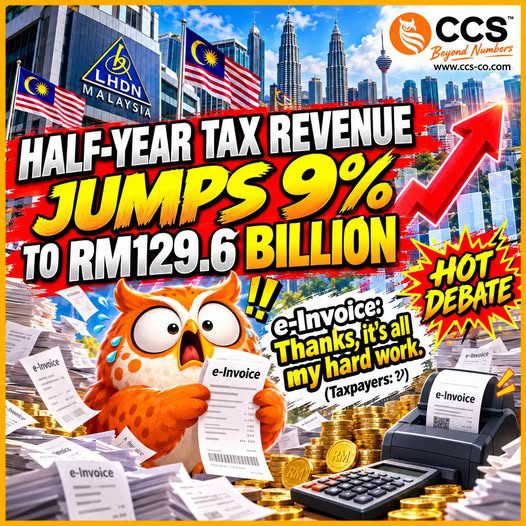
  • Half-Year Tax Revenue Rises 9% to RM129.6 Billion

    Half-Year Tax Revenue Rises 9% to RM129.6 Billion

    Tax revenue for the half-year increased by 9% to RM129.6 billion.

    e-Invoice might take credit for the rise—but taxpayers may have a different view.

    半年税收增长9%,达RM1,296亿

    半年税收增长9%,达到RM1,296亿。

    e-Invoice或许会把这项增长归功于自己的“努力”,但纳税人可能有不同看法。

  • Tax Revenue Reaches RM129.6 Billion in Six Months, Up 9%

    Tax Revenue Reaches RM129.6 Billion in Six Months, Up 9%

    Tax revenue for the first six months reached RM129.6 billion, an increase of 9%.

    As e-Invoicing begins to take effect, transaction data is becoming more transparent. Businesses may find themselves asking: is e-Invoicing simply digital invoicing—or is it starting to feel like a digital cash register?

    In short: As data becomes more transparent, tax authorities may find it easier to trace transactions and tax obligations.

    半年税收达RM1,296亿,同比增长9%

    首六个月税收达RM1,296亿,同比增长9%。

    随着 e-Invoice 开始实施,交易数据变得更加透明。企业负责人或许会开始问:这只是电子发票,还是逐渐变成了“电子收银机”?

    简单来说:数据越透明,税务机关就越容易追踪交易及相关税务义务。