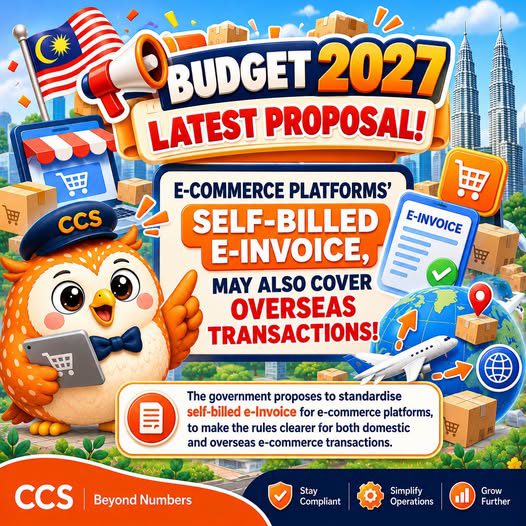
The 2027 Budget proposes standardising how e-commerce platforms handle self-billed e-Invoices, with clearer requirements for domestic and international transactions. The proposed effective date is 1 January 2027.
For e-commerce sellers, the question may no longer be only how much discount a customer is asking for, but also who is responsible for issuing the self-billed e-Invoice.
Transactions Covered by the Proposal
Regardless of whether the platform is based in Malaysia or overseas, platform providers would, in principle, be required to issue self-billed e-Invoices in the following scenarios:
- Malaysian seller to Malaysian buyer;
- Malaysian seller to overseas buyer;
- overseas seller to Malaysian buyer; and
- overseas seller to overseas buyer, where the platform is based in Malaysia.
The only combination identified as outside the proposed requirement is an overseas platform serving an overseas seller and an overseas buyer. In other words, the proposal indicates that seven of the eight possible combinations would be covered.
The Proposal Is Not Yet Final
This is a policy proposal under the 2027 Budget. Its implementation will be subject to the guidelines and enforcement rules that the Inland Revenue Board of Malaysia (LHDN) is expected to issue.
Having the platform issue a self-billed e-Invoice may make part of the invoicing process more convenient. However, this does not necessarily mean sellers can leave all tax matters to the platform. Responsibility for issuing an invoice should not be confused with responsibility for a seller’s wider tax obligations.
Will the proposal make e-commerce more convenient, or increase platforms’ compliance costs? The detailed guidelines should clarify how the requirements will work in practice.
CCS | Beyond Numbers
2027年拟议电商平台 e-Invoice 规则:涵盖跨境交易?
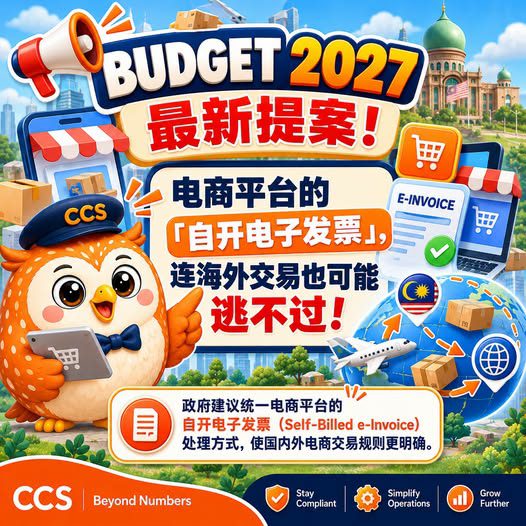
《2027年财政预算案》提出统一电商平台处理自开电子发票(Self-Billed e-Invoice)的方式,并进一步明确国内及国际交易的相关要求。建议生效日期为2027年1月1日。
对于电商卖家而言,除了顾客要求多少折扣之外,可能还需要关注:究竟由谁负责开具自开 e-Invoice?
提案涵盖的交易情形
无论电商平台设在马来西亚还是海外,平台提供者原则上都须在以下情形开具自开 e-Invoice:
- 马来西亚卖家向马来西亚买家销售;
- 马来西亚卖家向海外买家销售;
- 海外卖家向马来西亚买家销售;以及
- 海外卖家向海外买家销售,但平台设在马来西亚。
提案指出,唯一不适用的组合是:海外平台、海外卖家与海外买家。换言之,八种可能组合中,拟有七种纳入相关要求。
提案尚待落实细则
这仍是《2027年财政预算案》中的政策提案。具体实施方式仍须以马来西亚内陆税收局(LHDN)之后发布的指南及执行规定为准。
由平台开具自开 e-Invoice,或许能让部分开票流程更方便,但这并不代表卖家可以把所有税务事项都交由平台处理。开票责任与卖家的整体税务责任不能混为一谈。
这项提案会让电商交易更便利,还是会增加平台的合规成本?后续详细指南将有助于厘清实际执行方式。
CCS | Beyond Numbers