Day: October 16, 2026

  • E-Invoice FAQ No. 18: An Eligible Business May Stop Issuing e-Invoices Without Applying to IRBM

    E-Invoice FAQ No. 18: An Eligible Business May Stop Issuing e-Invoices Without Applying to IRBM

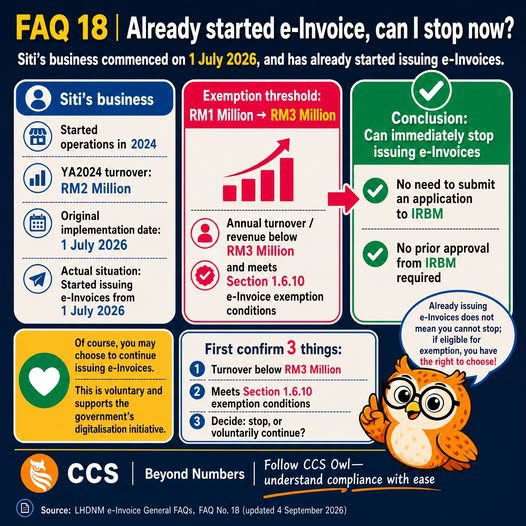
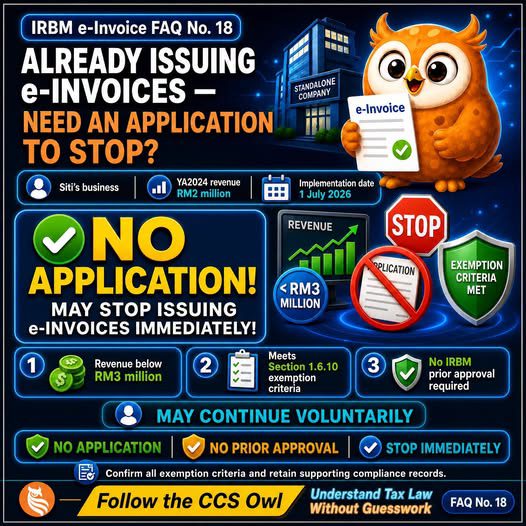
    Siti commenced trading in 2024 and recorded turnover of RM2 million in YA 2024. Her business began issuing e-Invoices from its original implementation date of 1 July 2026.

    Following the increase in the exemption threshold to RM3 million, and provided the business meets the exemption criteria in Section 1.6.10, it may stop issuing e-Invoices immediately.

    No separate application to the Inland Revenue Board of Malaysia (IRBM) is required, and prior approval is not needed. The business may also choose to continue issuing e-Invoices voluntarily in support of the Government’s digitalisation programme.

    e-Invoice常见问题第18条:符合条件的企业可停止开具 e-Invoice,无需向IRBM申请

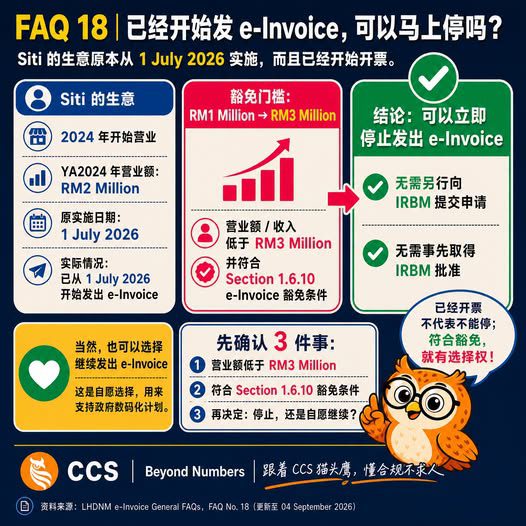
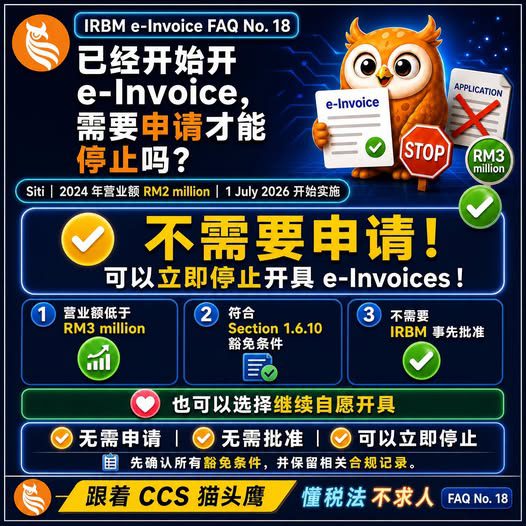
    Siti于2024年开始营业,其生意在YA 2024的营业额为RM200万。企业原定从2026年7月1日起实施 e-Invoice,并已开始开具 e-Invoice。

    随着豁免门槛提高至RM300万,只要企业符合第1.6.10节所列的豁免条件,即可立即停止开具 e-Invoice。

    企业无需另行向马来西亚内陆税收局(IRBM)提交申请,也无需事先取得批准。企业也可以选择继续自愿开具 e-Invoice,以支持政府的数码化计划。

  • E-Invoice FAQ No. 16: What if Your Business Has Not Issued e-Invoices Since 1 July 2026?

    E-Invoice FAQ No. 16: What if Your Business Has Not Issued e-Invoices Since 1 July 2026?

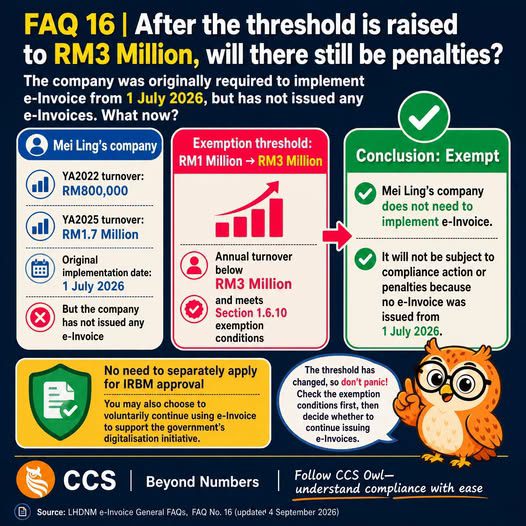
    The e-Invoice exemption threshold has been raised from RM1 million to RM3 million. Businesses that have not started issuing e-Invoices may therefore be concerned about whether they will face penalties. FAQ No. 16 addresses a situation of this kind.

    Mei Ling’s Company

    Mei Ling’s company had:

    • YA 2022 turnover: RM800,000

    • YA 2025 turnover: RM1.7 million

    • Original implementation date: 1 July 2026

    • Actual position: It had not issued any e-Invoices since 1 July 2026

    Although the company’s YA 2025 turnover exceeded the former RM1 million threshold, it remained below the revised RM3 million threshold. If it also meets the applicable e-Invoice exemption criteria, it qualifies for the exemption.

    In that case, the company is not required to implement e-Invoicing and will not face compliance action or penalties for not issuing e-Invoices from 1 July 2026 onwards.

    Is an Application to IRBM Required?

    According to FAQ No. 16, a business that meets the exemption criteria does not need to apply separately for approval from the Inland Revenue Board of Malaysia (IRBM).

    However, being below the RM3 million threshold alone does not automatically qualify a business for exemption. The business must also meet the applicable exemption criteria and satisfy the requirements relevant to its circumstances.

    Can an Exempt Business Continue Issuing e-Invoices?

    Yes. A business that qualifies for the exemption may choose either not to implement e-Invoicing or to continue issuing e-Invoices voluntarily in support of the Government’s digitalisation programme.

    What Businesses Should Check

    When assessing their position, businesses should consider more than whether their turnover is below RM3 million. They should also confirm:

    • whether they meet the applicable exemption criteria;

    • whether their circumstances fall within the relevant FAQ guidance;

    • whether their turnover in a subsequent year has reached or exceeded RM3 million; and

    • whether they have chosen to continue issuing e-Invoices voluntarily.

    The revised threshold does not automatically exempt every business. However, a business that meets the exemption criteria need not assume it will be penalised simply because it did not issue e-Invoices from its original implementation date.

    CCS | Beyond Numbers

    e-Invoice常见问题第16条:自2026年7月1日起未开具 e-Invoice,怎么办?

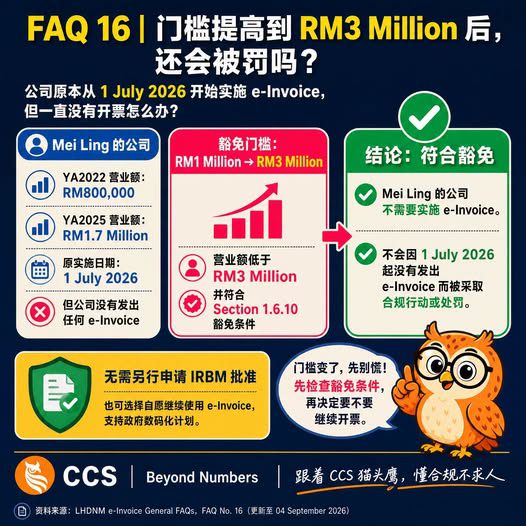
    e-Invoice豁免门槛已从RM100万提高至RM300万。尚未开始开具 e-Invoice 的企业,可能会担心是否会因此受罚。常见问题第16条说明了类似情况的处理方式。

    Mei Ling公司的情况

    Mei Ling公司的情况如下:

    • YA 2022营业额:RM800,000

    • YA 2025营业额:RM170万

    • 原定实施日期:2026年7月1日

    • 实际情况:自2026年7月1日起,公司尚未开具任何 e-Invoice

    虽然公司在YA 2025的营业额超过原有的RM100万门槛,但仍低于调整后的RM300万门槛。如果公司同时符合适用的 e-Invoice 豁免条件,即可获得豁免。

    在这种情况下,公司无需实施 e-Invoice,也不会因自2026年7月1日起未开具 e-Invoice 而面临合规行动或处罚。

    是否需要向IRBM提出申请?

    根据常见问题第16条,符合豁免条件的企业无需另行向马来西亚内陆税收局(IRBM)申请批准。

    不过,仅仅营业额低于RM300万,并不代表企业自动符合豁免资格。企业还必须满足适用的豁免条件,并符合与自身情况相关的要求。

    符合豁免条件的企业,可以继续开具 e-Invoice 吗?

    可以。符合豁免条件的企业可以选择不实施 e-Invoice,也可以选择继续自愿开具,以支持政府的数码化计划。

    企业应检查哪些事项?

    评估自身情况时,企业不应只看营业额是否低于RM300万,还应确认:

    • 是否符合适用的豁免条件;

    • 自身情况是否属于相关常见问题所涵盖的情形;

    • 后续课税年度的营业额是否已达到或超过RM300万;以及

    • 是否选择继续自愿开具 e-Invoice。

    门槛调整并不代表所有企业都会自动获得豁免。不过,符合豁免条件的企业,不应仅因未在原定实施日期开始开具 e-Invoice,就认为自己必然会受到处罚。

    CCS | Beyond Numbers

  • E-Invoice FAQ No. 15: Exemption for a Sole Proprietorship with Turnover Below RM3 Million

    E-Invoice FAQ No. 15: Exemption for a Sole Proprietorship with Turnover Below RM3 Million

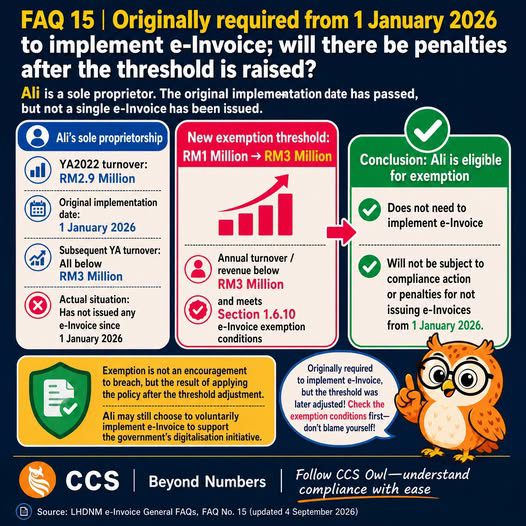
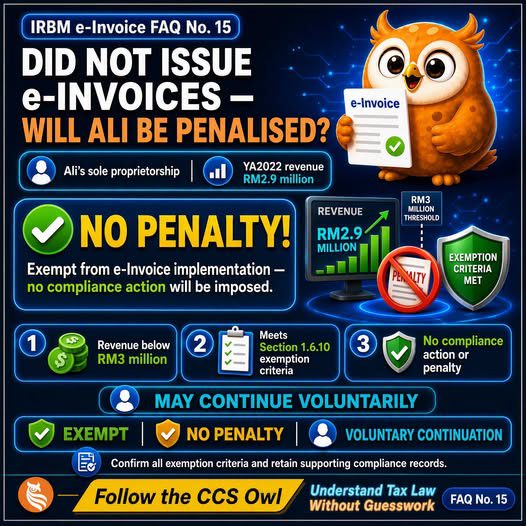
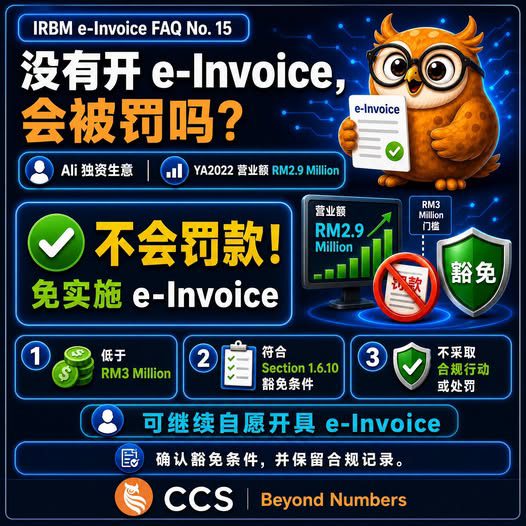
    FAQ No. 15 concerns Ali’s sole proprietorship, which recorded turnover of RM2.9 million in YA 2022. Its original e-Invoice implementation date was 1 January 2026, but it did not issue e-Invoices during that period.

    The exemption threshold has since increased from RM1 million to RM3 million. As the business’s turnover in subsequent years did not exceed RM3 million, and it meets the exemption criteria in Section 1.6.10, it is not required to implement e-Invoicing.

    Accordingly, the business will not face compliance action or penalties for not issuing e-Invoices from 1 January 2026 onwards. It may nevertheless choose to implement e-Invoicing voluntarily in support of the Government’s digitalisation programme.

    e-Invoice常见问题第15条:营业额低于RM300万的独资企业豁免

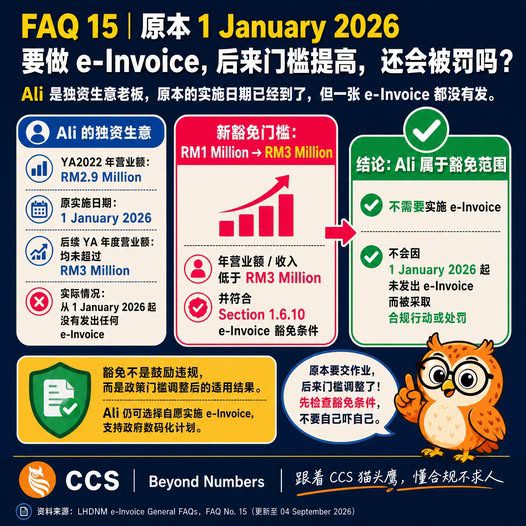
    常见问题第15条以Ali的独资生意为例。该生意在YA 2022的营业额为RM290万,原定实施 e-Invoice 的日期为2026年1月1日,但在该期间并未开具 e-Invoice。

    后来,e-Invoice豁免门槛从RM100万提高至RM300万。由于该生意之后各年度的营业额均未超过RM300万,并符合第1.6.10节所列的豁免条件,因此无需实施 e-Invoice。

    因此,该生意不会因自2026年1月1日起未开具 e-Invoice 而面临合规行动或处罚。不过,企业仍可选择自愿实施 e-Invoice,以支持政府的数码化计划。

  • E-Invoice FAQ No. 19: Stopping E-Invoice Issuance Under the Exemption

    E-Invoice FAQ No. 19: Stopping E-Invoice Issuance Under the Exemption

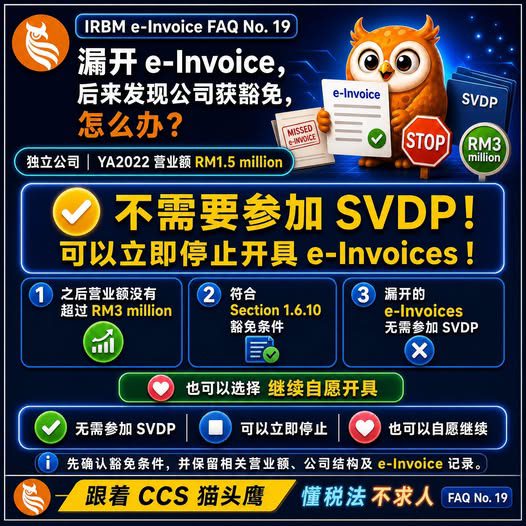
    FAQ No. 19 clarifies that a business does not need to participate in the Special Voluntary Disclosure Programme (SVDP) to stop issuing e-Invoices if it qualifies for the exemption.

    The exemption applies provided that the business’s revenue does not subsequently exceed RM3 million and it meets the criteria in Section 1.6.10. If these conditions are met, the business may stop issuing e-Invoices immediately.

    The business may also choose to continue issuing e-Invoices voluntarily.

    e-Invoice常见问题第19条:符合豁免条件后可停止开具 e-Invoice

    常见问题第19条说明,符合豁免条件的企业无需参加自愿披露计划(SVDP),即可停止开具 e-Invoice。

    适用前提是:企业之后的营业额没有超过RM300万,并且符合第1.6.10节所列的豁免条件。在符合这些条件的情况下,企业可以立即停止开具 e-Invoice。

    企业也可以选择继续自愿开具 e-Invoice。

  • E-Invoice FAQ No. 16: No Penalty for a Business That Meets the Exemption Criteria

    E-Invoice FAQ No. 16: No Penalty for a Business That Meets the Exemption Criteria

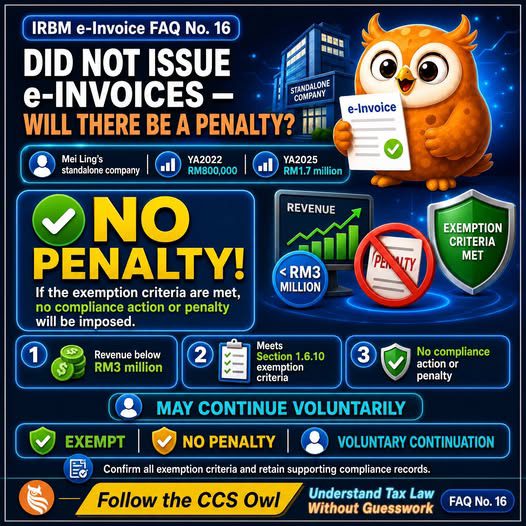
    FAQ No. 16 concerns Mei Ling’s company, which recorded revenue of RM800,000 in YA 2022 and RM1.7 million in YA 2025.

    The company’s revenue is below RM3 million, and it meets the exemption criteria in Section 1.6.10. Therefore, even if it did not issue e-Invoices from 1 July 2026, no e-Invoice compliance action or penalty will be imposed.

    The company may also choose to continue issuing e-Invoices voluntarily.

    e-Invoice常见问题第16条:符合豁免条件的企业不会因此受罚

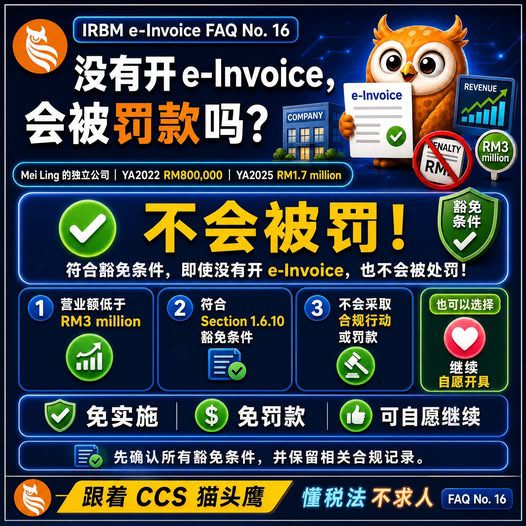
    常见问题第16条以Mei Ling的公司为例。该公司在YA 2022的收入为RM800,000,在YA 2025为RM170万。

    公司收入低于RM300万,并符合第1.6.10节所列的豁免条件。因此,即使公司没有从2026年7月1日起开具 e-Invoice,也不会因此面临 e-Invoice 合规行动或处罚。

    公司也可以选择继续自愿开具 e-Invoice。

  • E-Invoice FAQ No. 17: Exemption Requires No Application or Prior IRBM Approval

    E-Invoice FAQ No. 17: Exemption Requires No Application or Prior IRBM Approval

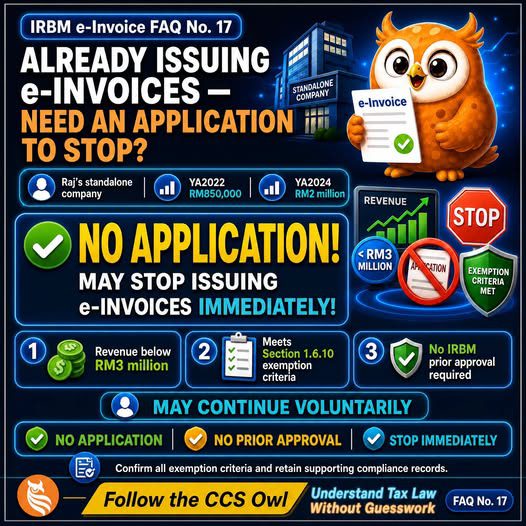
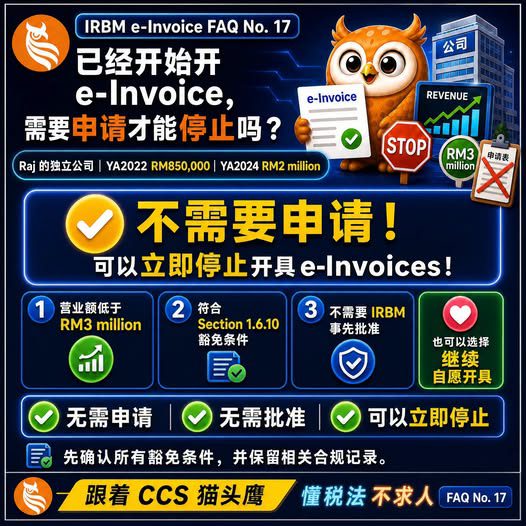
    FAQ No. 17 concerns Raj’s standalone company, which was initially required to implement e-Invoice from 1 July 2026. The company’s revenue has remained below RM3 million, and it meets the exemption criteria in Section 1.6.10.

    The company may therefore stop issuing e-Invoices immediately. It does not need to submit an application or obtain prior approval from the Inland Revenue Board of Malaysia (IRBM).

    The company may also choose to continue issuing e-Invoices voluntarily in support of the Government’s digitalisation initiative.

    e-Invoice常见问题第17条:豁免无需申请或事先取得IRBM批准

    常见问题第17条以Raj的独立公司为例。该公司原本须从2026年7月1日起实施 e-Invoice,但其收入一直低于RM300万,并符合第1.6.10节所列的豁免条件。

    因此,公司可以立即停止开具 e-Invoice,无需提交申请,也无需事先取得马来西亚内陆税收局(IRBM)的批准。

    公司也可以选择继续自愿开具 e-Invoice,以支持政府的数码化倡议。

  • E-Invoice FAQ No. 20: An Exempt Business May Stop Issuing e-Invoices Immediately

    E-Invoice FAQ No. 20: An Exempt Business May Stop Issuing e-Invoices Immediately

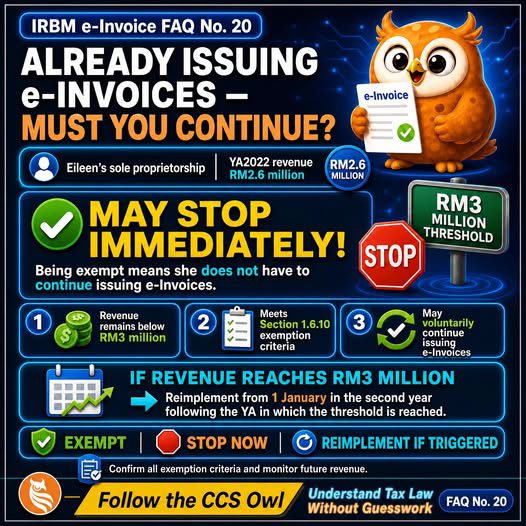
    FAQ No. 20 concerns Eileen, who operates a sole proprietorship. Her revenue was RM2.6 million in YA 2022 and remained below RM3 million in subsequent Years of Assessment. She also meets the exemption criteria in Section 1.6.10.

    As a result, Eileen does not have to continue issuing e-Invoices and may stop immediately, even if she has already started issuing them.

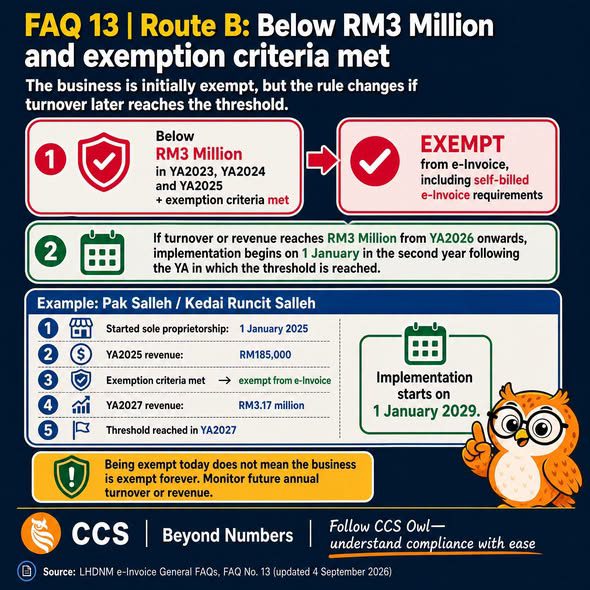
    If her revenue later reaches RM3 million, she must resume e-Invoice implementation from 1 January of the second year following the Year of Assessment in which the threshold was reached. She may also choose to continue issuing e-Invoices voluntarily while exempt.

    In short: The exemption applies if the business has not exceeded RM3 million in revenue and meets the Section 1.6.10 criteria. An exempt business may stop issuing e-Invoices immediately, but must monitor future revenue against the threshold.

    e-Invoice常见问题第20条:符合豁免条件的企业可立即停止开具 e-Invoice

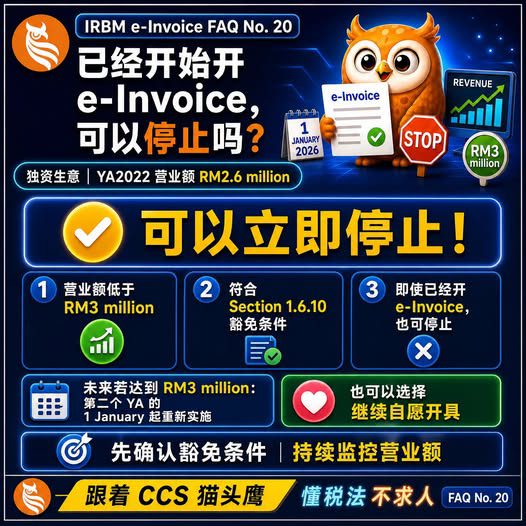
    常见问题第20条以独资经营者Eileen为例。她在YA 2022的收入为RM260万,之后各课税年度的收入均低于RM300万,并且符合第1.6.10节所列的豁免条件。

    因此,Eileen无需继续开具 e-Invoice;即使已经开始开具,也可以立即停止。

    如果她未来达到RM300万收入门槛,就必须从达到门槛所在课税年度之后第二年的1月1日起重新实施 e-Invoice。即使符合豁免条件,Eileen也可以选择继续自愿开具 e-Invoice。

    简单来说:企业收入未超过RM300万且符合第1.6.10节的豁免条件,即可豁免。符合条件的企业可以立即停止开具 e-Invoice,但仍须留意未来收入是否达到门槛。

  • E-Invoice FAQ No. 18: No Application or Prior IRBM Approval Needed for the Exemption

    E-Invoice FAQ No. 18: No Application or Prior IRBM Approval Needed for the Exemption

    FAQ No. 18 clarifies that a business meeting the e-Invoice exemption criteria does not need to apply for the exemption or obtain prior approval from the Inland Revenue Board of Malaysia (IRBM).

    Siti’s business recorded revenue of RM2 million in YA 2024. Although its e-Invoice implementation date was 1 July 2026, its revenue remained below RM3 million in all relevant Years of Assessment, and it met the exemption criteria in Section 1.6.10.

    Siti may therefore stop issuing e-Invoices immediately. Alternatively, she may continue issuing them voluntarily.

    e-Invoice常见问题第18条:豁免无需申请或事先取得IRBM批准

    常见问题第18条说明,符合 e-Invoice 豁免条件的企业无需提出申请,也无需事先取得马来西亚内陆税收局(IRBM)的批准。

    Siti的生意在YA 2024录得RM200万收入。虽然其 e-Invoice 实施日期为2026年7月1日,但相关课税年度的收入均低于RM300万,而且符合第1.6.10节所列的豁免条件。

    因此,Siti可以立即停止开具 e-Invoice;她也可以选择继续自愿开具。

  • E-Invoice FAQ No. 15: Exemption for a Sole Proprietorship Below the RM3 Million Threshold

    E-Invoice FAQ No. 15: Exemption for a Sole Proprietorship Below the RM3 Million Threshold

    FAQ No. 15 considers Ali, who operates a sole proprietorship. His turnover was RM2.9 million in YA 2022 and did not exceed RM3 million in subsequent Years of Assessment.

    If Ali’s turnover remains below RM3 million and he meets the e-Invoice exemption criteria in Section 1.6.10, he is exempt from implementing e-Invoice.

    Accordingly, even if Ali does not issue e-Invoices from 1 January 2026, he will not face e-Invoice compliance action or penalties, provided he qualifies for the exemption.

    An exempt business may still choose to issue e-Invoices voluntarily in support of the Government’s digitalisation initiative.

    e-Invoice常见问题第15条:营业额低于RM300万的独资企业豁免

    常见问题第15条以Ali为例。Ali经营独资生意,YA 2022的营业额为RM290万,之后各课税年度的营业额均未超过RM300万。

    只要Ali的营业额低于RM300万,并符合第1.6.10节所列的 e-Invoice 豁免条件,即可豁免实施 e-Invoice。

    因此,只要符合豁免资格,即使Ali从2026年1月1日起没有开具 e-Invoice,也不会因此面临 e-Invoice 合规行动或处罚。

    获豁免的企业仍可选择自愿开具 e-Invoice,以支持政府的数码化计划。

  • E-Invoice FAQ No. 13: Implementation Based on YA 2023–YA 2025 Revenue

    E-Invoice FAQ No. 13: Implementation Based on YA 2023–YA 2025 Revenue

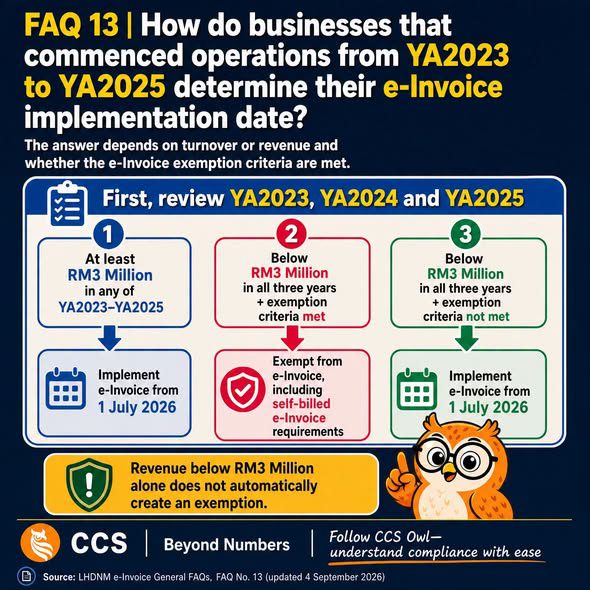
    FAQ No. 13 sets out three outcomes based on a business’s revenue and whether it meets the e-Invoice exemption criteria:

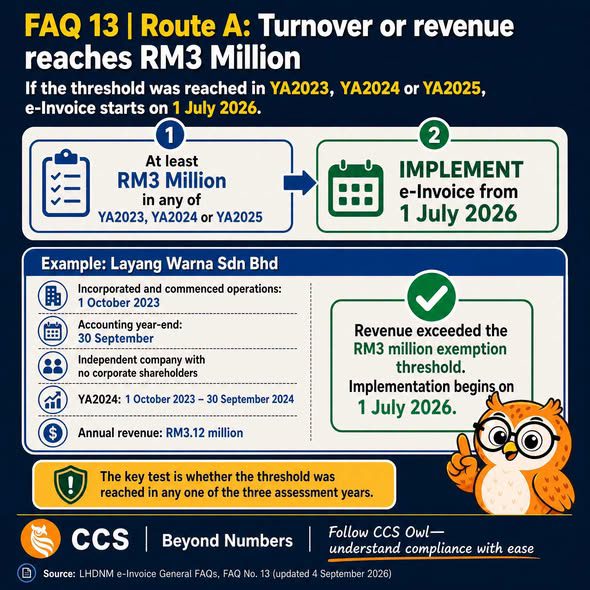
    • Revenue of RM3 million or more in any of YA 2023, YA 2024 or YA 2025: Implement e-Invoice from 1 July 2026.

    • Revenue below RM3 million in all three years, and exemption criteria met: The business is exempt. The requirement will apply if the business reaches the RM3 million threshold in a future year.

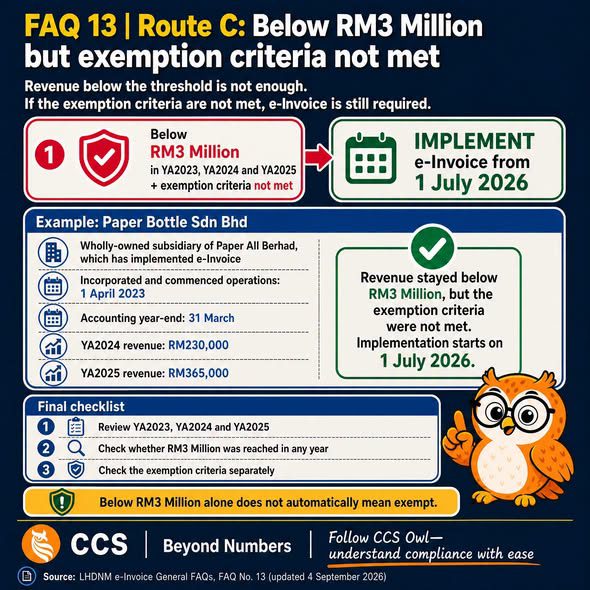
    • Revenue below RM3 million in all three years, but exemption criteria not met: Implement e-Invoice from 1 July 2026.

    In short: Check both the revenue threshold and the exemption criteria to determine the applicable implementation date.

    e-Invoice常见问题第13条:根据YA 2023至YA 2025收入确定实施时间

    常见问题第13条根据企业的收入及其是否符合 e-Invoice 豁免条件,列出三种情况:

    • YA 2023、YA 2024或YA 2025任何一个年度的收入达到或超过RM300万:从2026年7月1日起实施 e-Invoice。

    • 三个年度的收入均低于RM300万,且符合豁免条件:企业可获豁免。若企业未来达到RM300万门槛,相关要求将重新适用。

    • 三个年度的收入均低于RM300万,但不符合豁免条件:从2026年7月1日起实施 e-Invoice。

    简单来说:企业应同时检查收入门槛及豁免条件,以确定适用的实施日期。