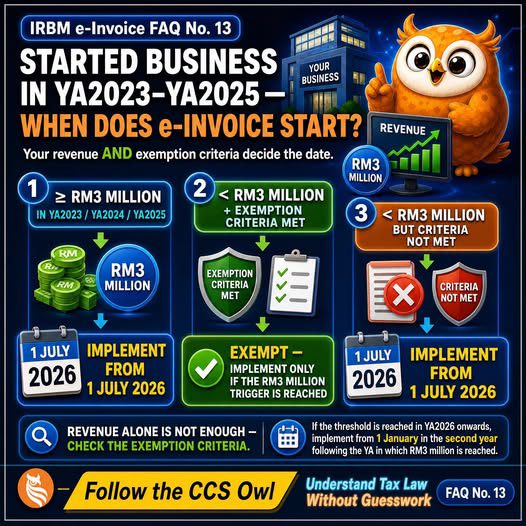
Businesses should review their annual turnover or revenue for YA 2023, YA 2024 and YA 2025, and assess two points:
- Did the business reach or exceed RM3 million in any of those years?
- If its revenue was below RM3 million in all three years, does it meet the e-Invoice exemption criteria?
FAQ No. 13 sets out three possible outcomes:
- Revenue of RM3 million or more in any of YA 2023–YA 2025: The business generally begins implementing e-Invoice from 1 July 2026.
- Revenue below RM3 million in all three years, and the exemption criteria are met: The business is exempt, including from self-billed e-Invoice requirements.
- Revenue below RM3 million in all three years, but the exemption criteria are not met: The business must still begin implementing e-Invoice from 1 July 2026.
The Exemption May Not Be Permanent
If an exempt business reaches or exceeds the RM3 million threshold in YA 2026 or a later year, its e-Invoice implementation obligation will resume from 1 January of the second year after the YA in which the threshold is reached.
For example, Pak Salleh’s revenue was RM185,000 in YA 2025, so he was initially exempt. If his revenue reaches RM3.17 million in YA 2027, his e-Invoice implementation date will be 1 January 2029.
Businesses should therefore review both their revenue and exemption eligibility, and monitor whether they meet the threshold in future years.
e-Invoice实施时间:如何评估YA 2023至YA 2025的收入门槛与豁免资格
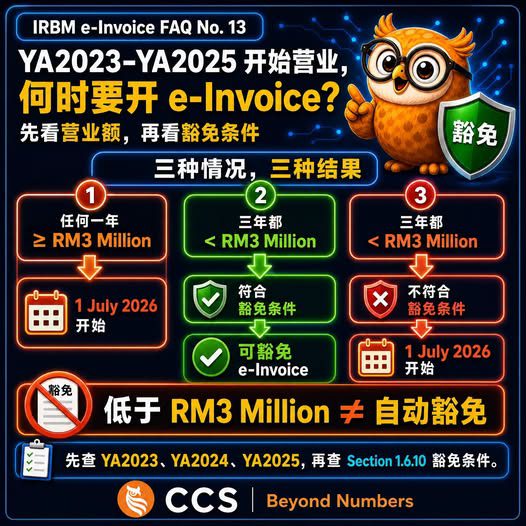
企业应回顾YA 2023、YA 2024及YA 2025三个课税年度的年营业额或收入,并分别检查以下两点:
- 任何一个年度的收入是否达到或超过RM300万?
- 如果三个年度的收入都低于RM300万,企业是否符合 e-Invoice 豁免条件?
FAQ No. 13列出三种可能情况:
- YA 2023至YA 2025期间,任何一个年度的收入达到或超过RM300万:企业通常须从2026年7月1日起实施 e-Invoice。
- 三个年度的收入均低于RM300万,且符合豁免条件:企业可获豁免,包括豁免自开 e-Invoice 要求。
- 三个年度的收入均低于RM300万,但不符合豁免条件:企业仍须从2026年7月1日起实施 e-Invoice。
豁免并非永久有效
如果获豁免的企业在YA 2026或之后的课税年度达到或超过RM300万门槛,其 e-Invoice 实施义务将恢复,并从达到门槛所在YA之后第二年的1月1日起实施。
例如,Pak Salleh在YA 2025的收入为RM185,000,因此当时符合豁免条件。如果他的收入在YA 2027达到RM317万,实施日期将为2029年1月1日。
因此,企业应同时检查收入水平与豁免资格,并持续关注未来年度是否达到门槛。