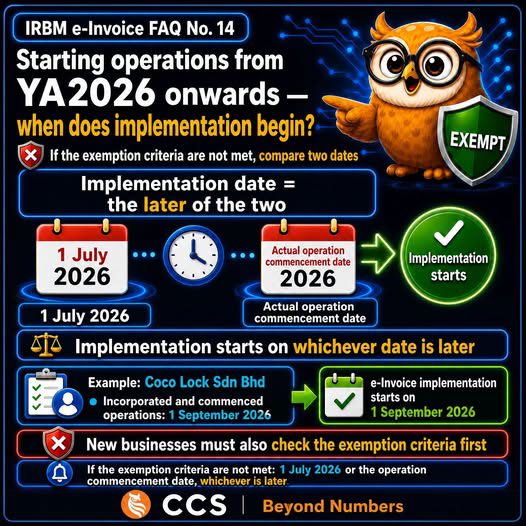
For a business that starts operating from YA 2026 onwards and does not meet the e-Invoice exemption criteria, the implementation date is the later of:
- 1 July 2026; or
- the date the business actually begins operations.
For example, Coco Lock Sdn Bhd began operations on 1 September 2026. As this is later than 1 July 2026, the company must begin implementing e-Invoice from 1 September 2026.
Businesses should first check whether they qualify for an exemption, then compare the two dates.
If the Business Qualifies for an Exemption
A business that starts operating from 2026 onwards and meets the e-Invoice exemption criteria is exempt from implementation while it continues to meet those conditions. There is therefore no immediate implementation date.
However, if the business later reaches or exceeds the annual turnover or revenue threshold of RM3 million, e-Invoice implementation will begin on 1 January of the second year following the Year of Assessment (YA) in which the threshold is reached.
For example, if the business reaches the RM3 million threshold in YA 2027, it must begin implementing e-Invoice from 1 January 2029. “The second year” means the second year after the YA in which the threshold was reached; it is not calculated as two years from the date the threshold was reached.
Businesses should review their exemption status regularly.
新企业何时必须开始实施 e-Invoice?
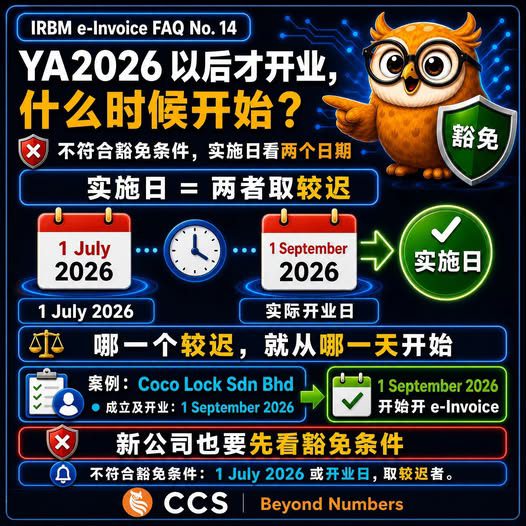
对于从YA 2026起开始营业、但不符合 e-Invoice 豁免条件的企业,实施日期为以下两个日期中较迟的一个:
- 2026年7月1日;或
- 企业实际开始营业的日期。
例如,Coco Lock Sdn Bhd于2026年9月1日开始营业。由于该日期晚于2026年7月1日,公司必须从2026年9月1日起开始实施 e-Invoice。
企业应先确认是否符合豁免条件,再比较上述两个日期。
符合豁免条件的企业
从2026年起开始营业且符合 e-Invoice 豁免条件的企业,只要持续符合相关条件,即可豁免实施 e-Invoice,因此目前没有须立即开始实施的日期。
不过,如果企业之后达到或超过RM300万的年营业额或收入门槛,就须从达到门槛所在课税年度(YA)之后第二年的1月1日起实施 e-Invoice。
例如,如果企业在YA 2027达到RM300万门槛,就须从2029年1月1日起开始实施 e-Invoice。“第二年”是指达到门槛的YA之后第二个年度,并非从达标当天起计算两年。
企业应定期重新检查自身是否仍符合豁免条件。