The Income Tax (Exemption) (No. 6) Order 2021 [P.U. (A) 282/2021] was amended by the Income Tax (Exemption) (No. 6) Order 2021 (Amendment) Order 2024 [P.U. (A) 107/2024].
The amendment order was made on 8 March 2024 and has effect from the year of assessment 2024.
The key changes introduced by the amendment order are:
1. Extension of exemption period:
The exemption period for qualifying companies providing fund management services to business trusts or real estate investment trusts in Malaysia has been extended.
The original order provided the exemption from the year of assessment 2021 until the year of assessment 2023.
The amendment order extends this period until the year of assessment 2027.
2. Reduction of exempted statutory income:
A new subparagraph 3(2A) has been inserted, which states that the statutory income derived from the business of providing fund management services that qualifies for the exemption shall be 60% of the statutory income.
This effectively reduces the amount of income exempted from tax for qualifying companies.
In summary, the amendment order extends the exemption period for qualifying companies until the year of assessment 2027 but limits the exemption to 60% of the statutory income derived from the provision of fund management services to business trusts or real estate investment trusts in Malaysia.
These changes are effective from the year of assessment 2024.
References:
Income Tax (Exemption) (No. 6) Order 2021 (Amendment) Order 2024
Under the National Automotive Policy 2020 and the Low Carbon Mobility Blueprint 2021 – 2030, Malaysia is making significant strides toward developing an ecosystem for electric mobility.
The National Automotive Policy 2020 was launched on February 21, 2020, with the goal of improving the automotive industry during the digital industrial transformation era. Its focus is on Next-Generation Vehicles (NxGV), Industrial Revolution 4.0 (IR 4.0), and Mobility-as-a-Service (MaaS) to position Malaysia as a regional leader in manufacturing, engineering, and technology.
The policy builds upon the objectives of the NAP 2014, which aimed to establish Malaysia as a hub for Energy Efficient Vehicles (EEV) through research and development capabilities for right-hand drive vehicles and related technologies such as fuel efficiency, light materials, telematics, tooling, and component design. To widen the infrastructure network of charging equipment, it is vital to ensure that the product can be produced locally at competitive cost.
Proposal
It is proposed that the following tax incentives be offered to better complement the ecosystem for electric vehicles and to attract immediate high-value investment in the manufacturing of electric vehicle charging equipment.
income tax exemption of 100% on statutory income from the year of assessment 2023 to the year of assessment 2032. Companies that make early investments are eligible to enjoy tax exemption for a period up to 10 years. Thus, companies that make investments after the year of assessment 2023 are eligible to enjoy the remaining exemption period only; or
Investment Tax Allowance of 100% for 5 years, and it can be used to offset up to 100% of statutory income for each year of assessment.
Effective Date
For applications received by the Malaysian Investment Development Authority (MIDA) from 25 February 2023 until 31 December 2025.
Our website's articles, templates, and material are solely for reference. Although we make every effort to keep the information up to date and accurate, we make no representations or warranties of any kind, either express or implied, regarding the website or the information, articles, templates, or related graphics that are contained on the website in terms of its completeness, accuracy, reliability, suitability, or availability. Any reliance on such information is therefore strictly at your own risk.
Keep in touch with us so that you can receive timely updates |
Under Section 54A(1) of the ITA 1967, where a person who is resident in Malaysia for the basis year for a year of assessment carries on the qualifying business of –
transporting passengers or cargo by sea on a Malaysian Ship, or
letting out on charter a Malaysian Ship owned by him on a voyage or time charter basis,
the statutory income for that year of assessment from that business shall be exempt from tax.
Footnotes
Business of transporting passengers or cargo by sea
Under Section 54(2)(a) of the ITA 1967, the gross income of a resident person from the business of transporting passengers or cargo by sea shall be ascertained by reference to his income from wherever derived or accrued.
It implies that the World Income Scope Basis is used in the calculation of a resident person’s income from an entity engaged in the business of transporting passengers or cargo by sea.
Income of a resident person from the business of transporting passengers or cargo by sea from wherever derived or accrued includes –
income received and receivable in Malaysia, and
income received and receivable outside Malaysia, irrespective of whether it is remitted to Malaysia.
The world income of a resident person from the business of transporting passengers or cargo is taxable within the scope of subsection 4(a) of the ITA 1967 unless it qualifies for exemption under Section 54A(1)(a) of the ITA 1967
Letting out on Charter a Malaysian Ship owned by him on a Voyage or Time Charter Basis
With effect from the year of assessment 1999, tax exemption is extended to a resident person carrying on the business of letting out on charter a Malaysian Ship owned by him on a voyage or time charter basis under Section 54A(1)(b) of the ITA 1967.
In addition, the Income Tax (Exemption) (No. 29) Order 1998 [P.U.(A) 473] provides a retrospective exemption for the years of assessment 1984 to 1998.
Income Tax (Exemption) (No. 7) Order 2022 [P.U. (A) 312/2022]
IN exercise of the powers conferred by paragraph 127(3)(b) of the Income Tax Act 1967 [Act 53], the Minister makes Income Tax (Exemption) (No. 7) Order 2022 [P.U. (A) 312/2022], which was gazetted on October 6, 2022.
This Order shall have effect from the year of assessment 2021 until the year of assessment 2023.
Under the Order, a person resident in Malaysia who carries on the business of transporting passengers or cargo by sea on a Malaysian ship; or letting out on charter a Malaysian ship owned by him on a voyage or time charter basis (Collective known as “Qualified Person”) is exempted in the basis period for a year of assessment from:
the provisions of subsections 54A(1) and (2) of the Act; and
the payment of income tax in respect of the statutory income derived from a source of business consisting of a Malaysian ship.
The qualified person is required to acquire annual verification from the Ministry of Transport Malaysia that the following conditions have been satisfied to be eligible for the exemption:
incurs annual operating expenditure of at least two hundred and fifty thousand ringgit (RM250,000.00) for each Malaysian ship; and
has a number of full-time employees in Malaysia for each Malaysian ship—
in the case of shore employees, at least 4 of the following employees and the majority of the employees shall be Malaysian citizens:
a chief executive officer;
an administrative and finance officer;
an operating officer; and
an officer in charge of the health, protection, safety and environmental affairs; and
in the case of employees who are ship personnel as provided under Part III of the Merchant Shipping Ordinance 1952 [Ord. 70/1952], shall be subject to the minimum requirement as specified in the Safe-Manning Certificate issued by the Marine Department Malaysia.
In short
Effective from the year of assessment 2021 until the year of assessment 2023, where a person who is resident for the basis year for a year of assessment carries on the business of transporting passengers or cargo by sea on a Malaysian ship; or carries on the qualifying business of letting out on charter a Malaysian Ship owned by him on a voyage or time charter basis, the statutory income for that year of assessment from that business shall be exempt from tax
Nothing in this Order shall absolve or is deemed to have absolved the qualified person from complying with any requirement to submit any return or statement of account or to furnish any other information under the Income Tax Act 1967.
Income Tax (Exemption) (No. 7) Order 2022 [P.U. (A) 312/2022] can be found here:-
Our website's articles, templates, and material are solely for reference. Although we make every effort to keep the information up to date and accurate, we make no representations or warranties of any kind, either express or implied, regarding the website or the information, articles, templates, or related graphics that are contained on the website in terms of its completeness, accuracy, reliability, suitability, or availability. Therefore, any reliance on such information is strictly at your own risk.
Keep in touch with us so that you can receive timely updates |
This tax incentive included in Budget 2023, tabled in Parliament on 7 October 2022, was not included in Budget 2023 (Re-tabled) on 24 February 2023.
Response from MOF (Ministry of Finance): Not extended/Discontinued
Current Position
If a private healthcare company makes a new investment or engages in expansion, modernisation, or refurbishment activities, it may be eligible for an income tax exemption equivalent to the Investment Tax Allowance of 100% of the qualifying capital expenditure for a period of 5 years.
Additionally, this allowance may be set off against 100% of the company’s statutory income.
The tax incentive is subject to the following conditions:
at least 10% of the total number of patients receiving private healthcare services for each year of assessment are comprised of qualified healthcare travellers; and
at least 10% of the company’s gross income for each year of assessment is derived from services to qualified healthcare travellers.
The tax incentive is for applications received by the Malaysian Investment Development Authority (MIDA) from 1 January 2021 until 31 December 2022.
Proposal [This tax incentive included in Budget 2023, tabled in Parliament on 7 October 2022, was not included in Budget 2023 (Re-tabled) on 24 February 2023]
It is proposed that the tax incentive be extended for three years further to support the growth of quality private healthcare services and increase the arrival of healthcare travellers.
Effective Date
For applications received by MIDA from 1 January 2023 until 31 December 2025.
Our website's articles, templates, and material are solely for reference. Although we make every effort to keep the information up to date and accurate, we make no representations or warranties of any kind, either express or implied, regarding the website or the information, articles, templates, or related graphics that are contained on the website in terms of its completeness, accuracy, reliability, suitability, or availability. Any reliance on such information is therefore strictly at your own risk.
Keep in touch with us so that you can receive timely updates |
This tax incentive included in Budget 2023, tabled in Parliament on 7 October 2022, was not included in Budget 2023 (Re-tabled) on 24 February 2023.
Response from MOF (Ministry of Finance): Not extended/Discontinued
Current Position
As part of Budget 2018, tour operators have been provided with tax incentives, including the following:
a tax exemption of 100 percent on statutory income derived from the business of operating tour packages to Malaysia with the participation of at least 750 inbound tourists per year; and
a tax exemption of 100 percent on statutory income derived from the business of operating tour packages within Malaysia with participation of at least 1,500 local tourists per year.
During the COVID-19 pandemic, the tax incentive was reviewed as follows:
extended for a period of 2 years from the year of assessment 2021 to the year assessment 2022; and
tourism packages within Malaysia with participation of at least 200 local tourists per year and nil for inbound tourists for tourism packages to Malaysia
Proposal [This tax incentive included in Budget 2023, tabled in Parliament on 7 October 2022, was not included in Budget 2023 (Re-tabled) on 24 February 2023]
It is proposed that the following requirements of tax incentive programmes be revised to increase tourism activities in Malaysia during the transition phase to the endemic phase:
tourism packages within Malaysia with the participation of at least 400 local tourists per year; or
tourism packages to Malaysia with the participation of at least 200 inbound tourists per year; and
tax incentive is extended for a year.
Effective Date
For the year of assessment 2023.
Our website's articles, templates, and material are solely for reference. Although we make every effort to keep the information up to date and accurate, we make no representations or warranties of any kind, either express or implied, regarding the website or the information, articles, templates, or related graphics that are contained on the website in terms of its completeness, accuracy, reliability, suitability, or availability. Any reliance on such information is therefore strictly at your own risk.
Keep in touch with us so that you can receive timely updates |
Most of the time, a conference is a large meeting where researchers, academicians, and professionals can share their work and research in fields like medicine, law, science, engineering, technologies, business management, and so on.
Since the year of assessment 1997, Malaysian organisers of conferences whose principal activities are to promote and run conferences have been given tax incentives if they bring in at least 500 foreign participants each year [Income Tax (Exemption) (No. 53) Order 2000].
In Budget 2020, the government introduced tax incentives for qualifying persons whose principal activities are other than promoting or organising conferences. This is part of an effort to make Malaysia the best place for international conferences. These qualifying persons must bring at least 500 foreign people to conferences that they promote or organise every year [Income Tax (Exemption) (No.4) Order 2021].
Consequently, the IRB published Public Ruling (PR) No. 2/2022 titled “Tax Incentive For Organising Conferences In Malaysia” on the 29th of July 2022 to explain the tax incentive that is now available.
The Public Ruling outlines the tax incentive that was provided under:
The Income Tax (Exemption) (No. 53) Order 2000 [P.U. (A) 500]; and
The Income Tax (Exemption) (No.4) Order 2021 [P.U. (A) 195/2021].
The Public Ruling also includes examples to exemplify the tax incentive.
Income Tax (Exemption) (No.53) Order 2000 [P.U. (A) 500/2000]
Effective from the year of assessment 1997 onwards, tax exemption is granted for eligible conference promoters:
brought in at least five hundred (500) foreign participants to attend conferences held in Malaysia on the basis year for a year of assessment; and
the exemption is on 100% of the statutory income derived from organising conferences held in Malaysia in the relevant year of assessment.
Income Tax (Exemption) (No.4) Order 2021 [P.U. (A) 195/2021]
Effective from the year of assessment 2020 until the year of assessment 2025, tax exemption is granted for eligible conference promoters who carry on business or activity other than business or activity of promoting and organising conferences in Malaysia, including the arranging of accommodation, tours and sightseeing for foreign participants:-
need to bring in at least five hundred (500) foreign participants to attend conferences held in Malaysia on the basis year for a year of assessment; and
the exemption granted is on 100% of the statutory income derived from organising conferences held in Malaysia in the relevant assessment year.
The income tax exemption will apply only if the qualifying person brings in at least 500 foreign participants in the YA.
The PR reiterates that the exemption granted under P.U.(A) 500 or P.U.(A) 195 does not relieve the conference promoter or qualified person from the duty to submit any return, statement of accounts, or any other information as required under the ITA.
It is required that a separate account be kept to track the revenue that is exempted according to both orders.
Our website's articles, templates, and material are solely for reference. Although we make every effort to keep the information up to date and accurate, we make no representations or warranties of any kind, either express or implied, regarding the website or the information, articles, templates, or related graphics that are contained on the website in terms of its completeness, accuracy, reliability, suitability, or availability. Any reliance on such information is therefore strictly at your own risk.
Keep in touch with us so that you can receive timely updates |
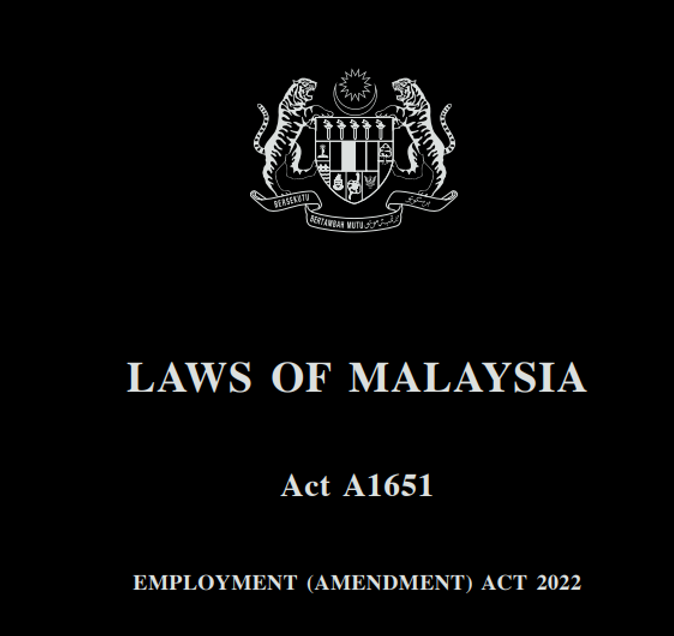
5. It was identical to the Employment (Amendment) Bill 2021 in all significant respects except a 98-day maternity leave provision.
除了98天的产假条款外,该法令在其他方面都与2021年就业(修正)法案相同。
6. The bill initially extended the amount of time a woman can take off for maternity leave to 90 days from the previous 60 days.
该法案最初只是将妇女可以休产假的时间,从之前的60天延长到90天。
7. During the debate in the Parliament, the Dewan Rakyat decided to raise this to 98 days, which is in line with the International Labour Standards (ILO –https://www.ilo.org/global/lang–en/index.htm ).
10. The ministry in a statement said that at present, Act 265 only applied to the categories of employees specified in the First Schedule.
It involves employees earning RM2,000 and below; or
workers with no wage limits such as manual labour workers, workers involved in the operation of motor vehicles and workers who supervise manual labour workers as well as domestic workers.
11. The main amendment in the Employment (Amendment) Act 2021 is to extend the application of the Employment Act 1955 (Act 265) to all employees regardless of salary earned, says the Human Resources Ministry.
12. With the implementation of this extension, all parts of Act 265 that are currently in place and deal with employee wage caps were removed; specifically, sections 44A, 69B, 69C, 69E, and 81G.
13. Therefore, according to the ministry, follow-up amendments need to be made to the First Schedule of Act 265 through an Order under the powers of the human resources minister under subsection 2(2) of Act 265 to enable all workers in the country to receive the minimum benefits and protections prescribed under Act 265.
14. The ministry also said a draft order to amend the First Schedule has been prepared.
该部还表示,已经拟定了一份修正第一附表的指令草案。
15. At this point, all we can do is wait for the Minister of Human Resources to gazette the effective date and the amendment order to the First Schedule.
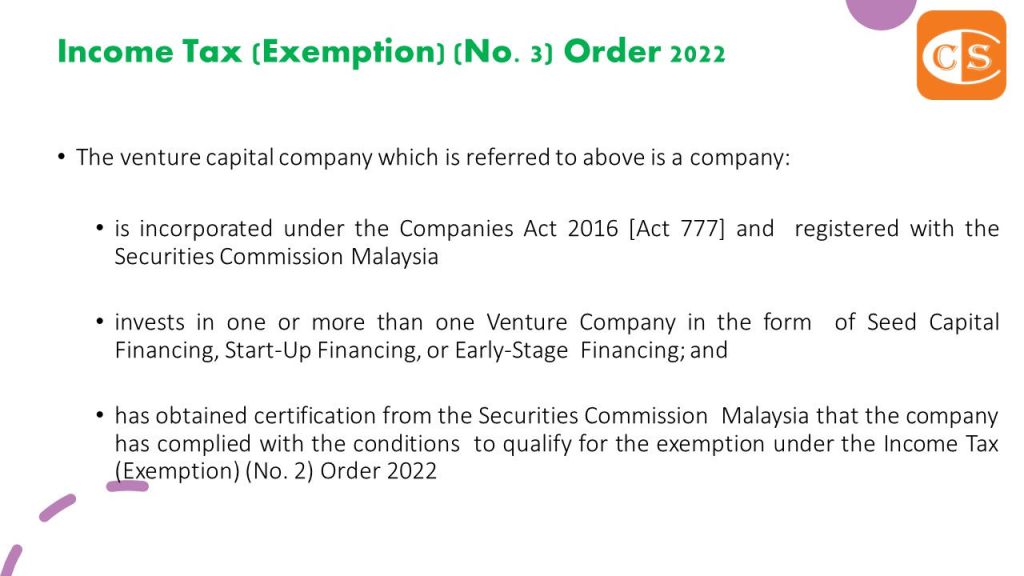
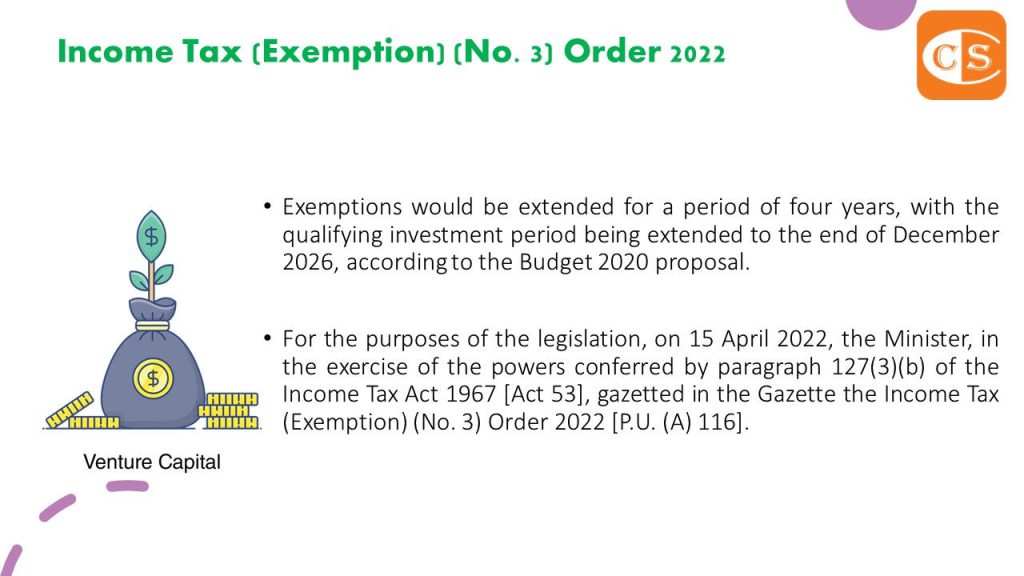
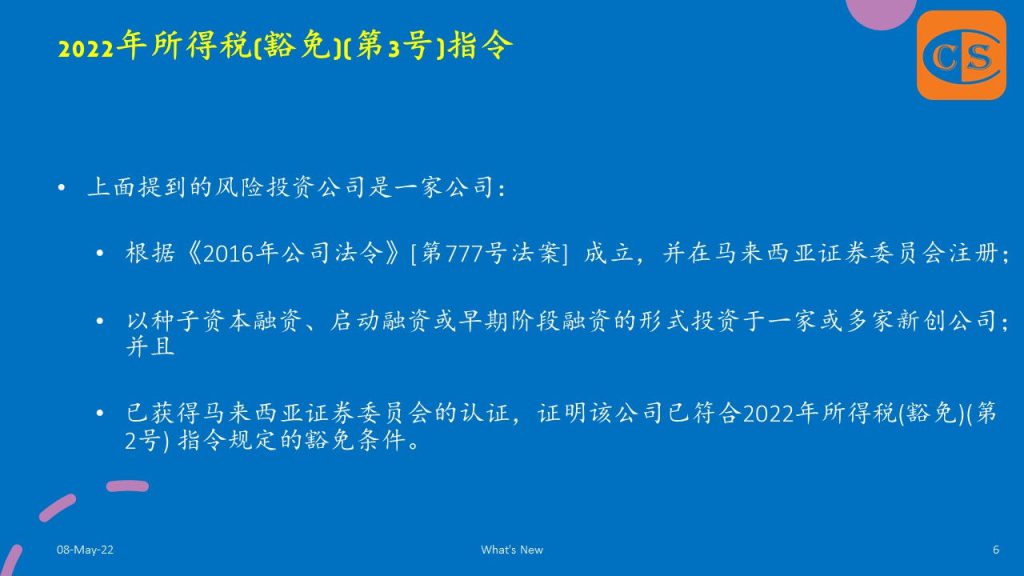
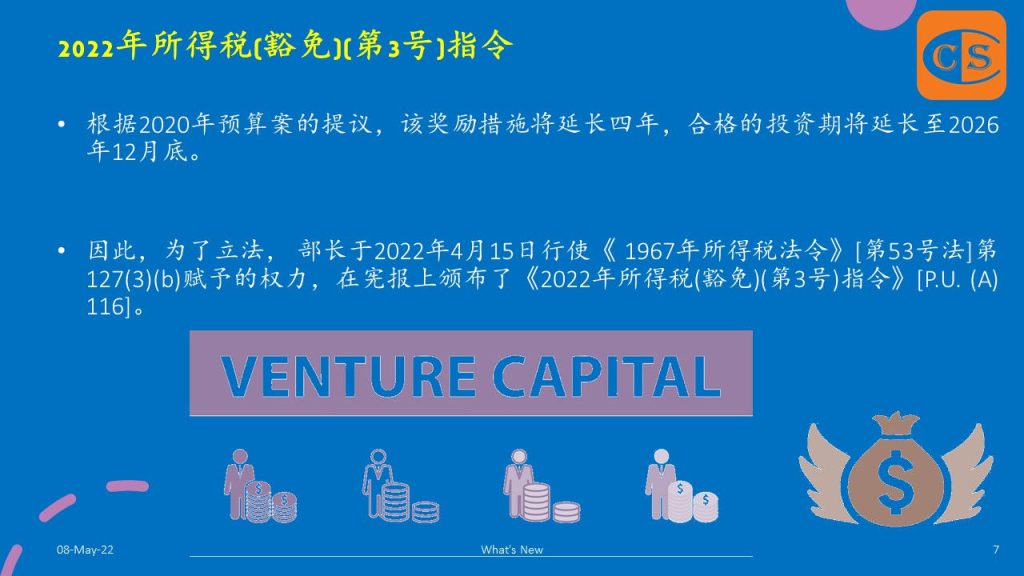
1. Exemptions would be extended for a period of four years, with the qualifying investment period being extended to the end of December 2026, according to the Budget 2020 proposal.
2. For the purposes of the legislation, on 15 April 2022, the Minister, in the exercise of the powers conferred by paragraph 127(3)(b) of the Income Tax Act 1967 [Act 53], gazetted in the Gazette the Income Tax (Exemption) (No. 3) Order 2022 [P.U. (A) 116].
1. As proposed in Budget 2020, the incentive would be extended for a period of four years, with the qualifying investment period being extended to the end of December 2026. Applications for the incentives must be filed to the SC by December 31, 2023, for certification purposes.
2. For the purposes of the legislation, on 15 April 2022, the Minister, in the exercise of the powers conferred by paragraph 127(3)(b) of the Income Tax Act 1967 [Act 53], gazetted in the Gazette the Income Tax (Exemption) (No. 2) Order 2022 [P.U. (A) 115].
1. On 5 April 2022, the Minister, in the exercise of the powers conferred by paragraph 157(3)(b) of the Income Tax Act 1967 [Act 53], gazetted the Income Tax (Exemption) Order 2022 [P.U. (A) 96].
2. For the year of assessment 2022, the Minister grants an exemption from the application of the provisions of subparagraph 2(2) of Part I of Schedule 1 to the Act to a company in respect of its chargeable income in relation to any income received in Malaysia from outside Malaysia during the basis period.