E-Invoicing Impact on JMB Fund Collection

Question: Joint Management Bodies (JMBs) of apartments and condominiums collect maintenance and sinking funds from residential owners. What impact does e-invoicing have on this process? Should JMBs issue individual e-invoices or consolidated e-invoices to residential owners? Do you have any advice on preventing individual residential owners from simply rejecting the validation of the e-invoice? Answer: […]
e-invoice Cancellation Protocol: Buyer’s Last-Minute Cancellation

Question: If the buyer cancels the invoice 71 hours after validation, and the seller is unable to proceed with the cancellation due to a public holiday, what further action should be taken? Answer: In the scenario where the buyer requests cancellation of the e-invoice at 71 hours after validation, and the seller is unable to […]
Finance (No. 2) Act 2023 is Gazetted
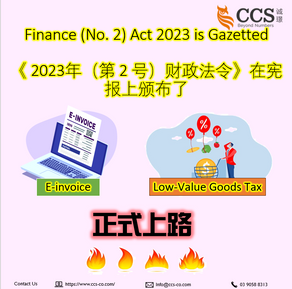
The content of Finance (No. 2) Act 2023 mirrors that of Finance (No. 2) Bill 2023 without any noteworthy differences. To download and read: 9
Income Tax (Exemption) (No. 4) 2016 (Amendment) Order 2023
The purpose of the Income Tax (Exemption) (No. 4) 2016 (Amendment) Order 2023 [P.U. (A) 344, gazetted on 09/11/2023], is to extend the expiration date of a particular provision within the original order. Specifically, the amendment changes the expiry date from “31 December 2022” to “31 December 2024” in subparagraph 6(4) of the Income Tax […]
Budget 2024 Proposals On Individual Tax
Paragraph 46(1)(c) of the ITA provides that a deduction up to a maximum of RM5,000 is allowed to an individual on the expenses incurred by him for the medical treatment, special needs and carer for his parents. Effective from the YA 2021, the deduction on the expenses incurred by an individual for the medical treatment, […]
Revised E-Invoicing Implementation Timeline: Impacts and Challenges for Businesses
During the budget presentation last Friday, our Prime Minister stated, “The government agrees to enforce e-invoicing mandatorily for taxpayers with annual income or sales exceeding 100 million ringgit, starting from 1 August 2024. As for taxpayers falling under other income categories, implementation will be done in phases, with the target of full implementation starting from […]
Sample of Malaysian e-invoicing
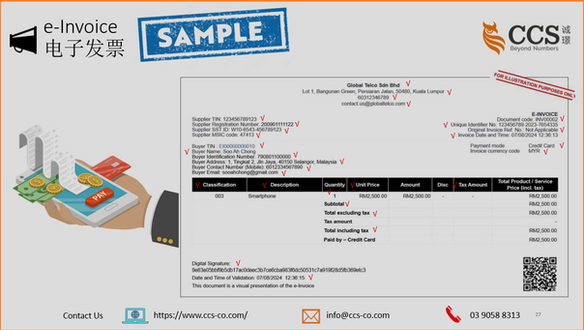
51 mandatory data fields need to be filled out when issuing an e-invoice. These fields are typically categorised into 9 sections:- 1. Address 2. Business Details 3. Contact Number 4. Invoice Details 5. Parties 6. Party Details 7. Payment Info 8. Products / Services 9. Unique Identifier Number 开具电子发票时需要填写 51 个必填数据字段。 这些字段通常分为 9 个部分: 1. […]
Overview of e-invoice issuance for transactions with the buyers
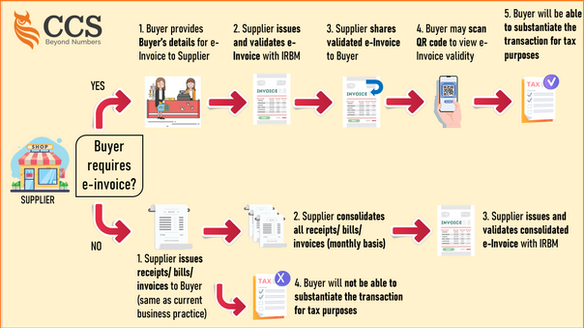
When a buyer requests for an e-invoice, the process is as follows: 1) Buyer must provide their details for e-Invoice to Supplier 2) Supplier then issues and validates e-invoice with IRBM. The supplier will receive a validated e-Invoice in PDF from IRBM via the MyInvois Portal. 3) Upon validation, the supplier shares the validated e-invoice […]
Budget 2024 Speech: On e-invoicing

Overall, the government sees e-invoicing as a key tool for improving tax administration and reducing revenue leakage, which will help strengthen Malaysia’s economy. 总体而言,政府将电子发票视为改善税收管理和减少税收流失的重要工具,这将有助于加强马来西亚的经济。 Attachments | 附件: e-invoice Guideline version 2.1 | 电子发票指南 [ 2.1 版本] – 28.10.2023 Other related articles that you might find interesting:- Revised E-Invoicing Implementation Timeline: Impacts and Challenges for Businesses […]
Budget 2024 Major Highlights
Whether you are a business owner, an individual taxpayer, or a tax professional, these Budget 2024 Major Highlights can help you stay informed about the latest budget speech. 11