Day: April 19, 2024

  • Updated Food and Beverage Guidelines (16 April 2024)

    Updated Food and Beverage Guidelines (16 April 2024)

    The Service Tax reintroduced on 1 September 2018, is a consumption tax administered under the Service Tax Act 2018 and its subsidiary legislation.

    Service tax is imposed on prescribed services known as “taxable services”.

    A person who provides taxable services exceeding a specified threshold of taxable service value must register under the Service Tax Act 2018 and is known as a “registered person” who must charge service tax on the taxable services provided to their customers.

    The Food and Beverage Guidelines, dated 26 June 2023, have been withdrawn and replaced with the updated Guidelines issued on 16 April 2024 (“latest guidelines“), which can be downloaded below:

    This guide is prepared to enhance understanding of the service tax treatment on providing food and beverage services.

    The latest guidelines issued by the Royal Malaysian Customs Department (JKDM), provide further clarification on the scope, tax rates, and responsibilities for F&B operators.

    Key Points:

    1. The scope of the Service Tax covers services provided by restaurants, bars, cafeterias, coffee shops, catering services, and food courts with characteristics of a restaurant.
    2. The threshold for SST registration for F&B operators is exceeding RM1.5 million within a 12-month period.
    3. The standard service tax rate for the provision of food and beverages is 6%. However, effective March 1, 2024, services other than food, beverages, telecommunications, parking, and logistics have been increased to 8%.
    4. Other services provided within the Food and Beverage Area (FBA) such as facility rentals, entertainment, cigarette sales, and alcoholic beverage sales are subject to an 8% rate. Package-related services (e.g., wedding packages) will follow the main service rate of 6%.
    5. Bakery sales at cake shops and packaged food sales (e.g., at convenience stores) are not subject to SST as they do not have restaurant characteristics. However, franchise counters selling food are subject to SST if the franchisor requires registration.

    Calculation Example:

    Delicious Burger Restaurant has achieved sales of RM1.6 million in 12 months.

    The price of a burger with a drink is RM10.60.

    The service tax to be imposed is RM0.60 (RM10 x 6%).

    Delicious Burger Price: RM10.00

    SST @ 6%: RM0.60

    Total: RM10.60
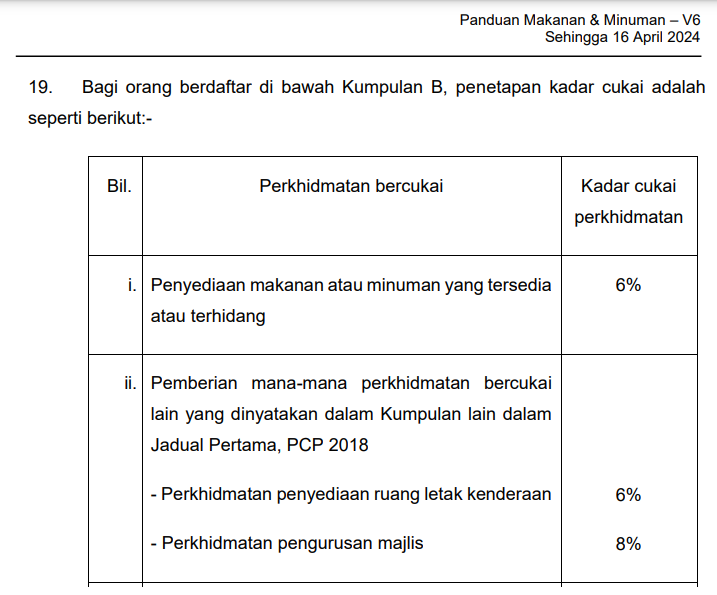
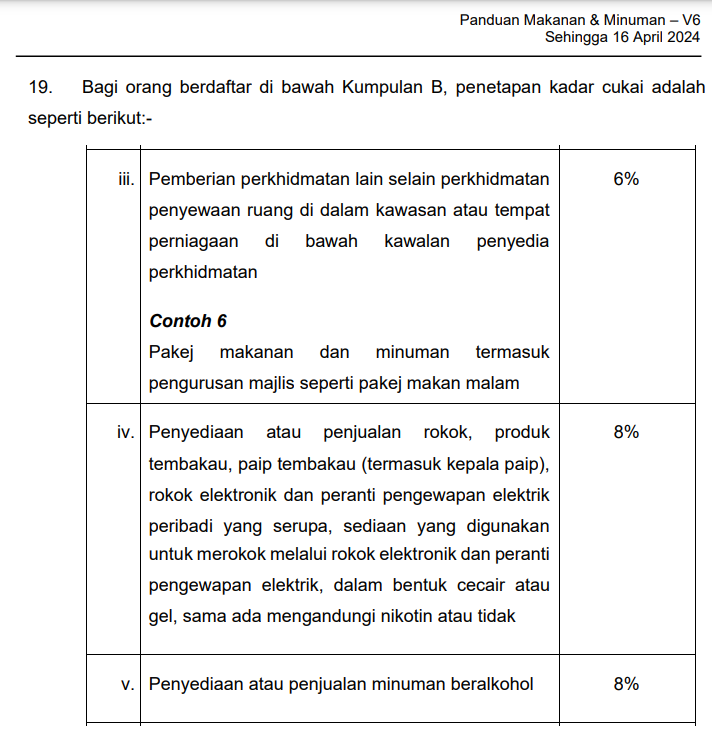
    Paragraph 19 of the Food and Beverage Guidelines issued by JKDM touches on the determination of service tax rates for taxable services provided by registered persons under Group B, First Schedule, Service Tax Regulations 2018.

    In detail, the prescribed service tax rates are as follows:

    1. 6% Rate for:

    – Provision of food or beverages that are available or served

    – Provision of parking space

    – Food and beverage packages including event management

    2. 8% Rate for:

    • Provision of other services apart from space rental within areas or premises under the control of the service provider. For example, facility rentals, entertainment such as karaoke, amusement parks, live cooking services, and so on.
    • Provision or sale of cigarettes, tobacco products, vape, and electronic smoking devices whether containing nicotine or not
    • Provision or sale of alcoholic beverages
    • Provision or sale of non-alcoholic beverages (e.g., mineral water, canned/bottled/carton drinks)

    Although there is a difference in service tax rates between 6% and 8%, the determination of these rates is based on the type of taxable service provided and not subject to the primary service of the food and beverage operator.

    However, there is an exception, which is the packaged taxable services provided, will be subject to the service tax rate based on the primary service offered by the registered persons under Group B.

    For example, if a restaurant offers a wedding package that includes food, beverages, event management, entertainment, and hall rental, the entire package will be subject to a 6% rate because the primary service offered is the provision of food and beverages.

    Therefore, it is important for food and beverage operators registered under SST to clearly understand the types of taxable services provided and the correct tax rates to ensure compliance with the Service Tax Act 2018.

    Note to F&B Operators:

    – Ensure annual sales value and register for SST if exceeding the threshold value

    – Apply tax according to the type of service provided, whether 6% or 8%

    – Service tax accounts based on the date of payment received

    – Issue tax invoices and file SST-02 returns within the prescribed period

    In conclusion, it is important for F&B operators to understand the scope of services, correct tax rates, and comply with the Service Tax Act 2018 requirements to avoid any penalties.

    Further information can be obtained through the SST website at the link https://mysst.customs.gov.my or by contacting the Customs Call Center.

    7
  • What are the e-Invoice Treatments for Directors’ Fees?

    What are the e-Invoice Treatments for Directors’ Fees?

    The e-Invoicing Guidelines in Malaysia are a comprehensive framework designed to modernise and streamline the invoicing process across various transactions, enhancing efficiency and tax compliance.

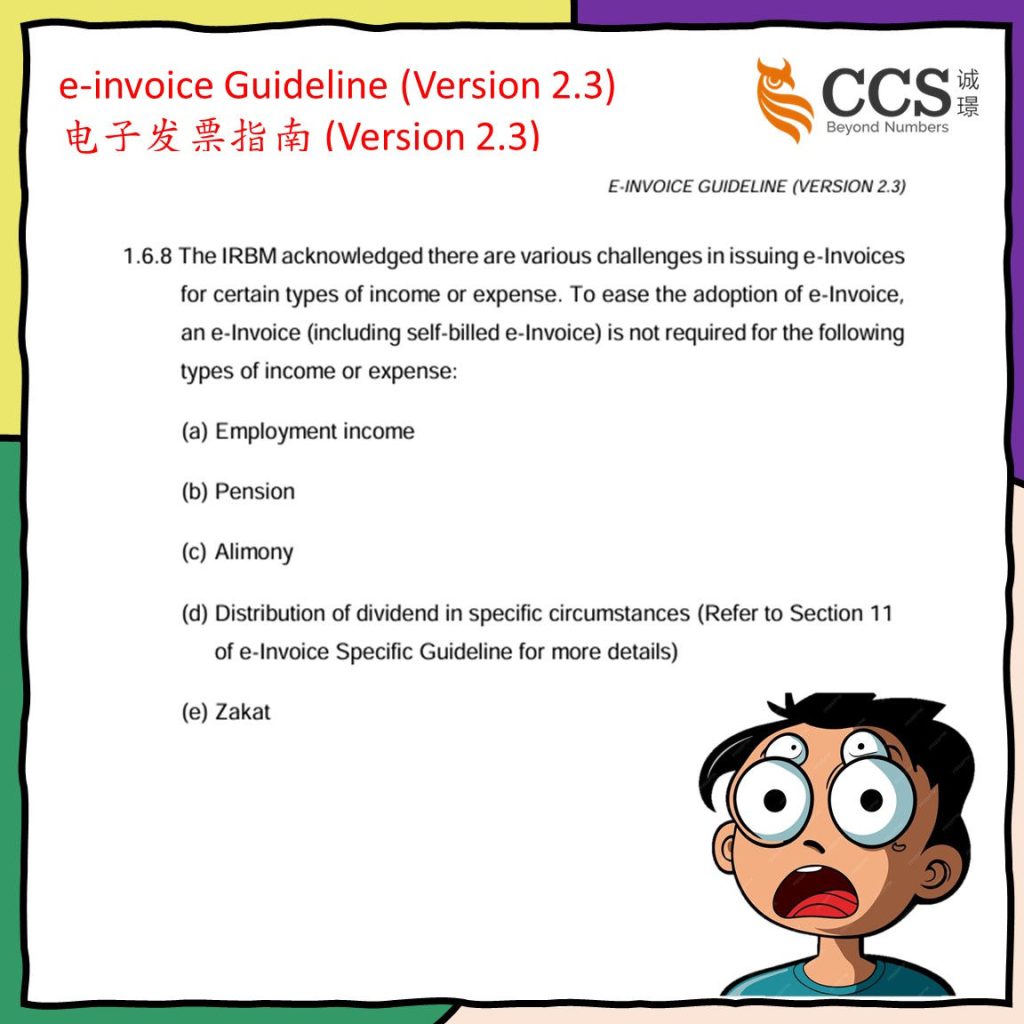
    The guidelines cover myriad transactions and touch upon the specific income types exempted from the e-invoicing system.

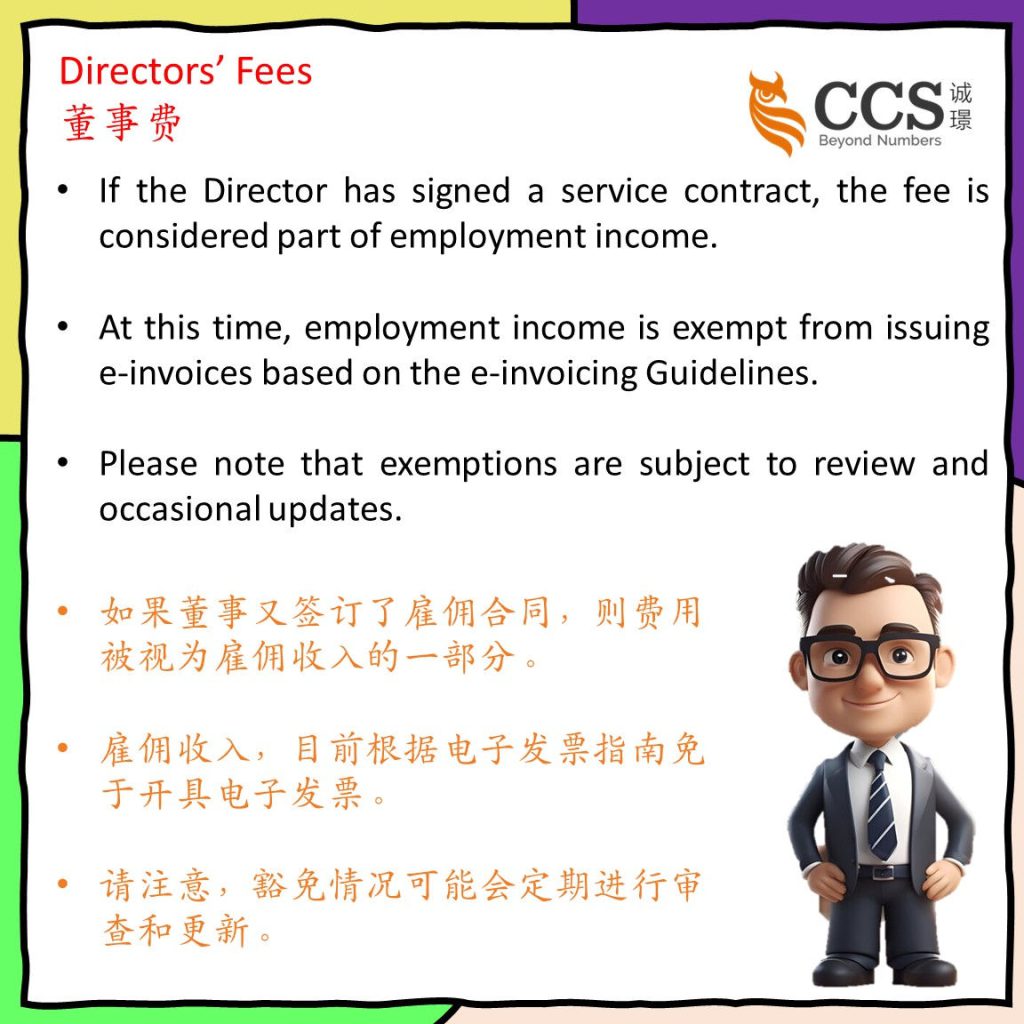
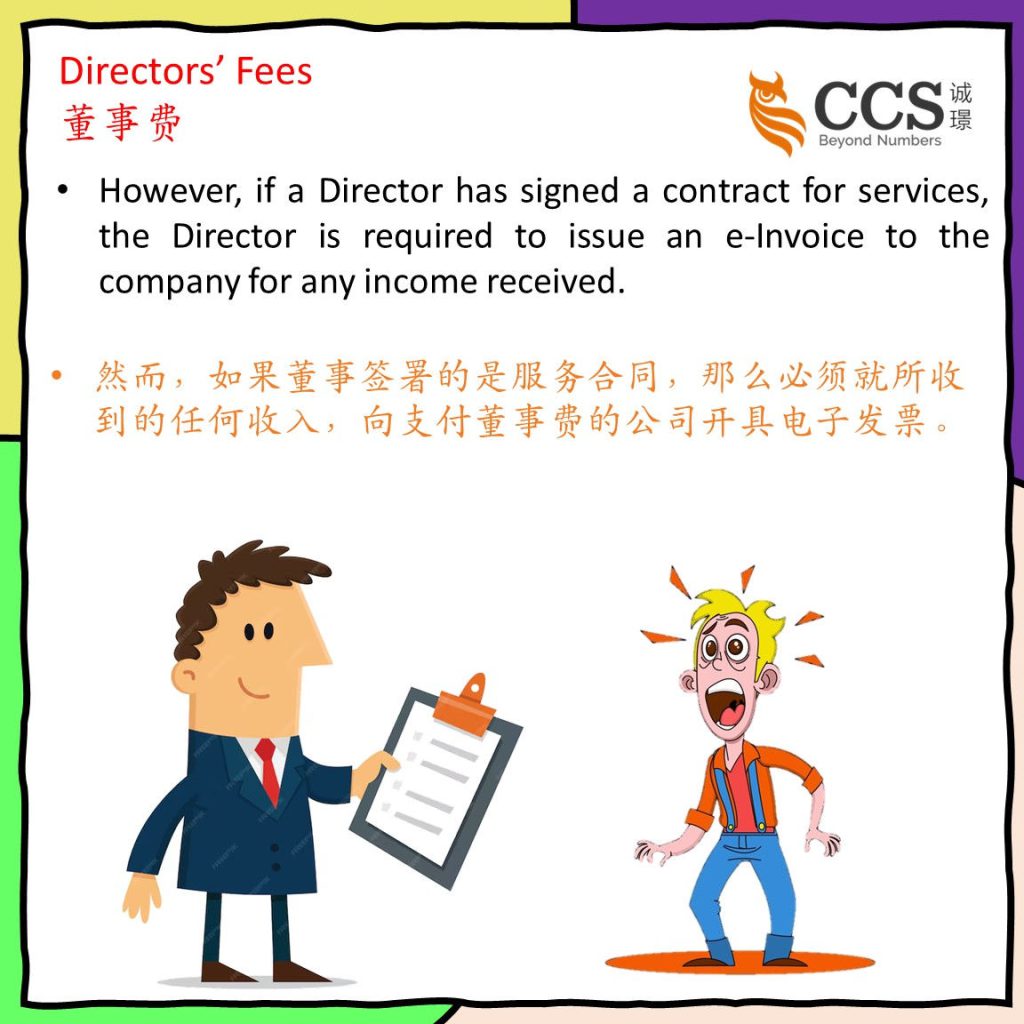
    For directors who have entered into a contract for services with a company, issuing an e-invoice for any income received is mandatory, reflecting the transaction’s commercial nature.

    Conversely, directors’ fees from a service contract viewed as employment income are currently exempt from the e-invoicing requirement.

    This distinction underscores the importance of understanding the nature of the contractual relationship and the corresponding e-invoicing obligations.

    Taxpayers, especially those in directorial positions, are advised to stay informed about their e-invoicing responsibilities and any potential changes to exemptions, as guidelines are subject to periodic reviews and updates by the relevant authorities.

    🌻🌻🌻🌻🌻🌻🌻🌻🌻🌻🌻🌻

    马来西亚电子发票指南是一个全面的框架,旨在更新和简化各种交易的发票开具流程,提高效率和税务合规性。

    在其涵盖的众多交易中,该指南还涉及电子发票系统豁免的特定收入类型。

    对于已与公司签订服务合同的董事,必须为收到的任何收入开具电子发票,以反映交易的商业性质。

    相反,董事从雇佣合同中获得的酬金被视为就业收入,目前则不受电子发票要求的限制。

    这种区别强调了了解合同关系性质和相应电子发票义务的重要性。

    建议纳税人,特别是那些担任董事职务的纳税人,需要了解他们的电子发票责任以及豁免方面的任何潜在变化,因为有关当局会定期审查和更新准则。

    1
  • If the supplier rejects the buyer’s request within 72 hours, does this mean the e-invoice will become a valid e-invoice after 72 hours?

    If the supplier rejects the buyer’s request within 72 hours, does this mean the e-invoice will become a valid e-invoice after 72 hours?

    Referring to Section 2.4.5 of the e-Invoice Guideline Version 2.3:

    “If the Supplier did not accept the request for rejection initiated by the Buyer (or did not proceed to cancel the said e-Invoice), no cancellation would be allowed after the 72 hours have elapsed.

    Any amendment thereon would require issuing a new e-invoice (e.g., credit note, debit note or refund note e-invoice).”

    根据电子发票指南第2.4.5节:

    “供应商没有接受买方发起的拒绝请求(或未取消该电子发票),在72小时过去后将不允许取消。

    此后的任何修改都需要发行新的电子发票(例如,贷项通知、借项通知或退款通知电子发票)。 ”

    2
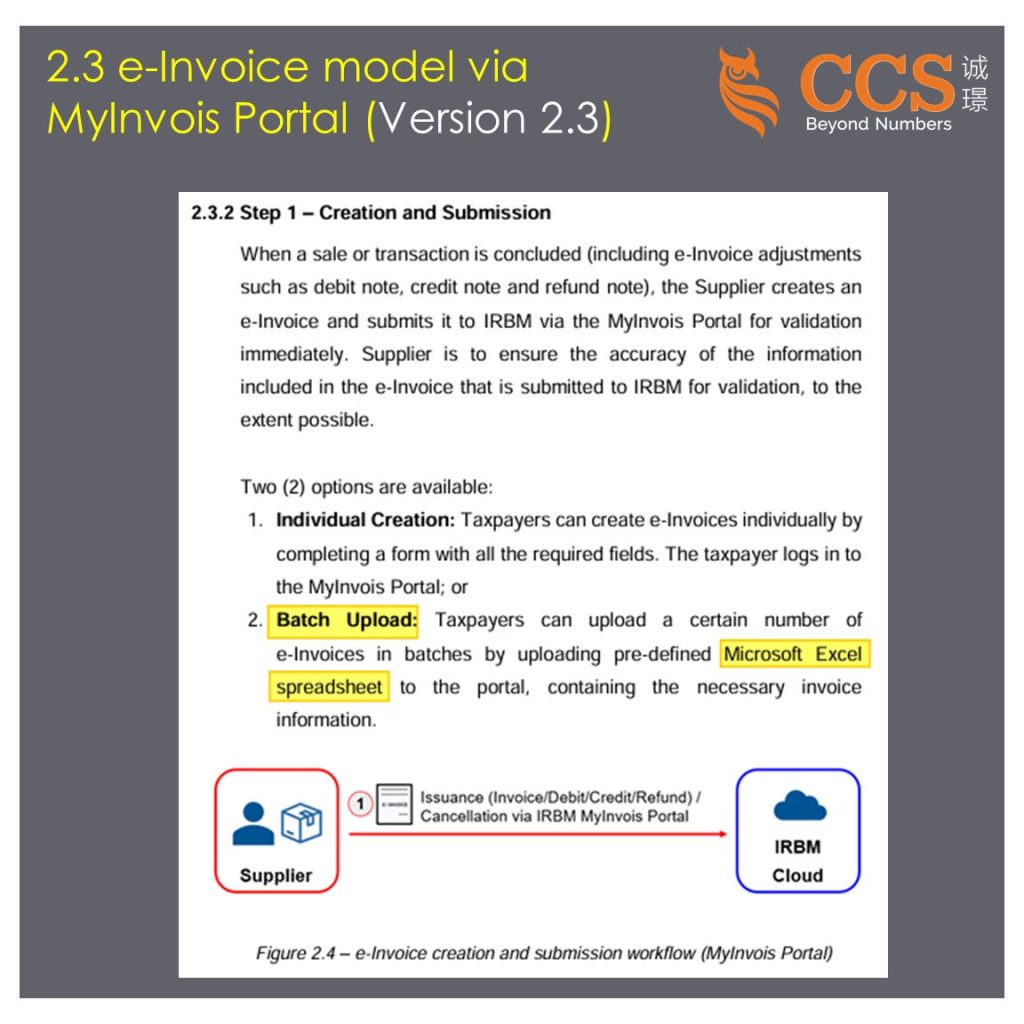
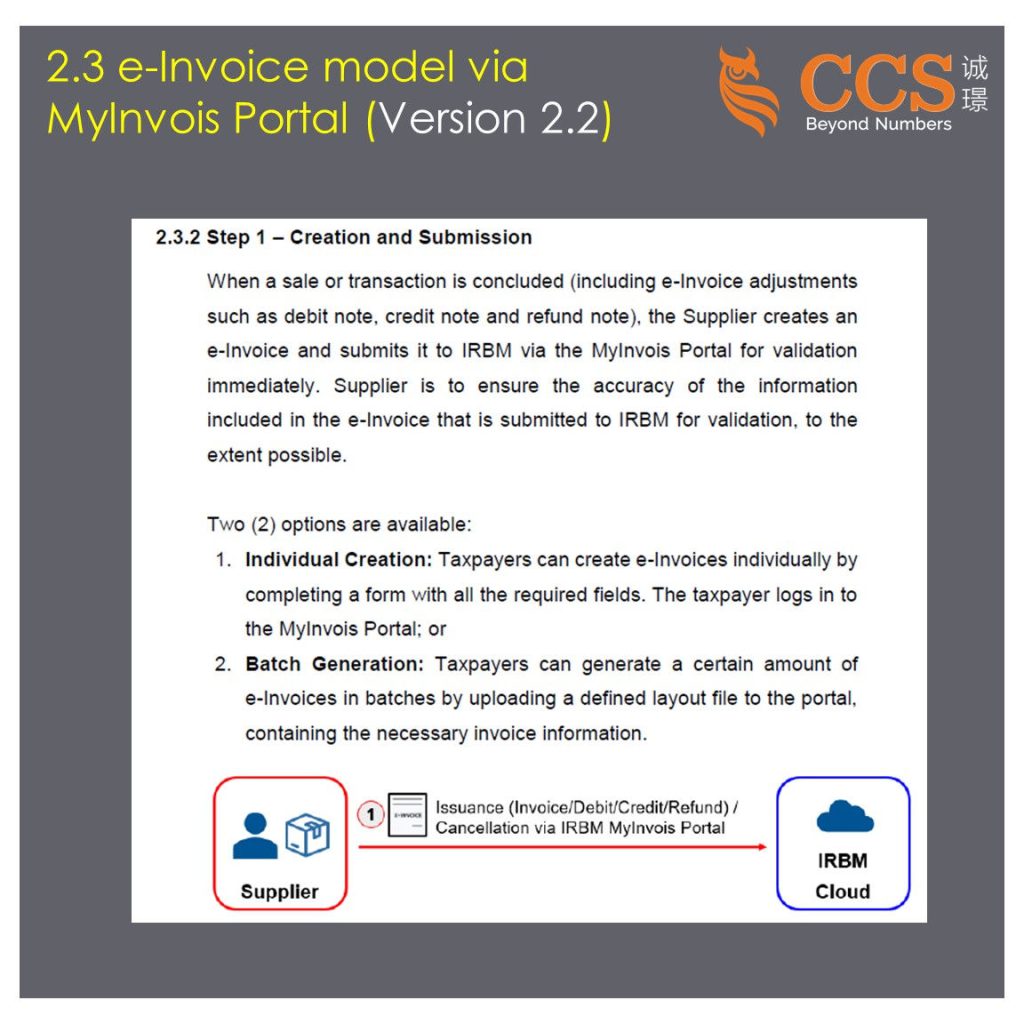
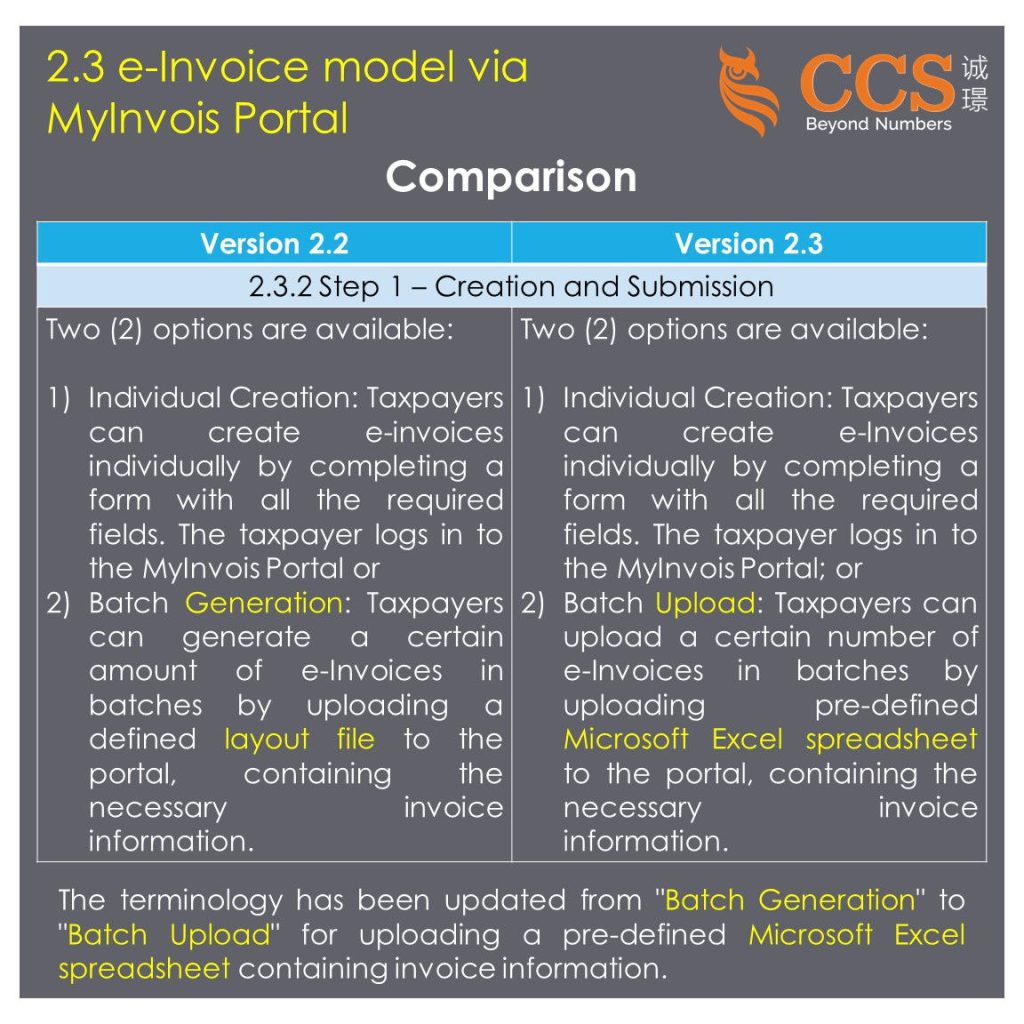
  • e-Invoice Guideline Version 2.3 – Enhancing Clarity in Batch Submission: Transition from “Batch Generation” to “Batch Upload”

    e-Invoice Guideline Version 2.3 – Enhancing Clarity in Batch Submission: Transition from “Batch Generation” to “Batch Upload”

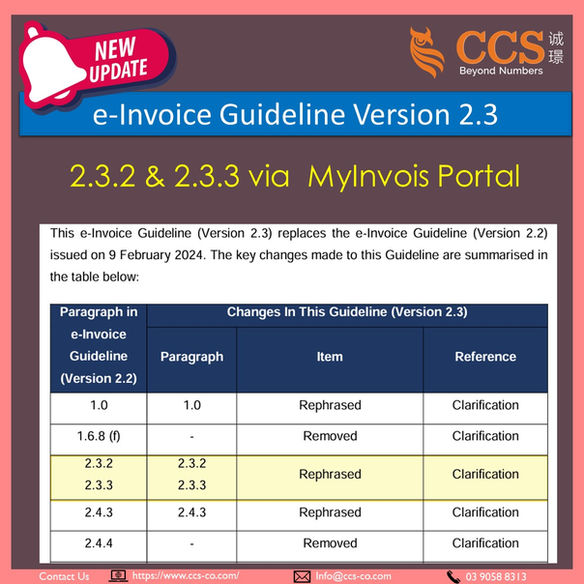
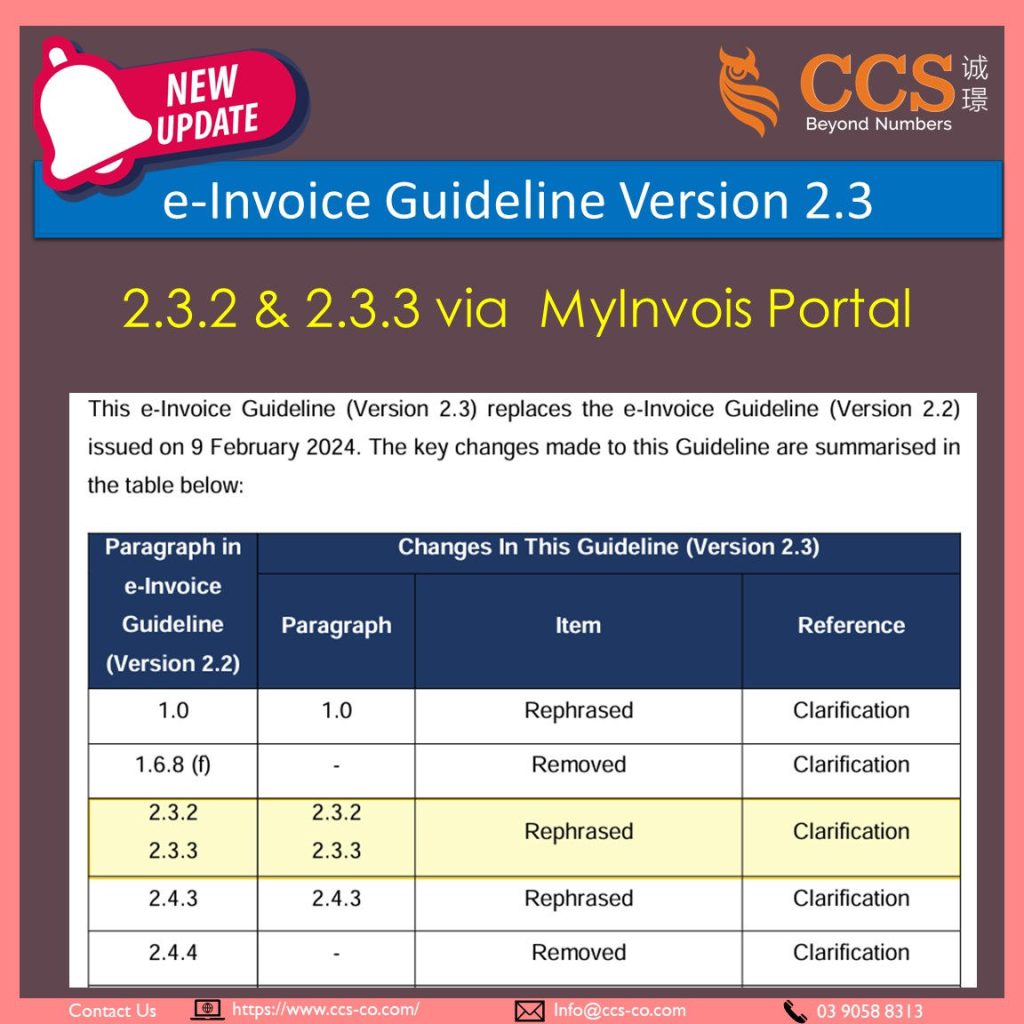
    2.3.2 Step 1 – Creation and Submission

    The change from “Batch Generation” to “Batch Upload” and from “defined layout file” to “pre-defined Microsoft Excel spreadsheet” in section 2.3.2 is likely to provide more clarity and specificity on the batch submission process via the MyInvois Portal.

    📌 Batch Generation:

    ✅ This term is a bit vague and could be interpreted differently.

    ✅ It doesn’t specify the method or format for generating batches of e-invoices.

    📌 Batch Upload:

    ✅ “Upload” is a more specific term that clearly indicates the action of transferring a file/data from the user’s system to the MyInvois Portal.

    ✅ It removes any ambiguity and makes it evident that batches of e-invoices are submitted to the portal through a file upload process.

    📌 Defined Layout File:

    ✅ “Layout file” is a generic term that could refer to various file formats or structures.

    ✅ It lacks specificity on the exact file type and format expected for batch submissions.

    📌 Pre-defined Microsoft Excel Spreadsheet:

    ✅ By explicitly mentioning “Microsoft Excel spreadsheet”, it provides clear guidance on the specific file format that is accepted for batch uploads.

    ✅ “Pre-defined” indicates that there is a predefined template or structure that users must follow when preparing the Excel file.

    ✅ This level of detail helps users understand exactly what is required for batch uploads, reducing confusion and ensuring compliance with the expected file format.

    So, in essence, the changes were likely made to:

    1) Use more precise terminology that accurately reflects the process (“Upload” instead of “Generate”).

    2) Provide clear and specific information about the accepted file format (Microsoft Excel spreadsheet instead of a generic “layout file”).

    3) Indicate that there is a predefined template/structure to follow for batch uploads (pre-defined Excel spreadsheet).

    By making these changes, the guideline aims to give taxpayers and users more explicit and unambiguous instructions on correctly preparing and submitting batches of e-Invoices via the MyInvois Portal, minimising potential confusion or errors in the process.

    将第 2.3.2 节中的 “批量生成 “改为 “批量上传”,并将 “设定的版式文件 “改为 “预 定义的 Microsoft Excel 电子表格”,可能会使通过 MyInvois 门户网站进行批量提交的 流程更加清晰和具体。

    📌 批量生成:

    ✅ 这个术语有点模糊,可以有不同的解释。

    ✅ 它没有说明生成成批电子发票的方法或格式。

    📌 批量上传:

    ✅ “上传”是一个更具体的术语,它明确指出了将文件/数据从用户系统传输到 MyInvois 门户网站的操作。

    ✅ 它消除了任何歧义,并清楚地表明电子发票批次是通过文件上传流程提交到门户网站的。

    📌 设定的版式文件:

    ✅ ”设定文件” 是一个通用术语,可以指各种文件格式或结构。

    ✅ 它没有具体说明批量提交所需的确切文件类型和格式。

    📌 预先设定的 Microsoft Excel 电子表格:

    ✅ 通过明确提及 “Microsoft Excel 电子表格”,为批量上传所接受的特定文件格式提供了明确的指导。

    ✅ “预先设定”表示用户在准备 Excel 文件时必须遵循预定义的模板或结构。

    ✅ 这种详细程度有助于用户准确了解批量上传的要求,减少混乱并确保符合预期的文件格式。

    因此,从本质上讲,这些更改可能是为了

    1) 使用更精确的术语,准确反映流程(用 “上传 “代替 “生成”)。

    2) 提供有关可接受的文件格式的明确而具体的信息(Microsoft Excel 电子表格,而不是通用的 “设定的版式文件”)。

    3) 说明批量上传有预定义模板/结构可循(预先设定 Excel 电子表格)。

    通过这些改动,该指南旨在为纳税人和用户提供更清晰明确的指导,说明如何通过 MyInvois 门户网站正确准备和提交电子发票批次,最大限度地减少过程中可能出现的混乱或错误。

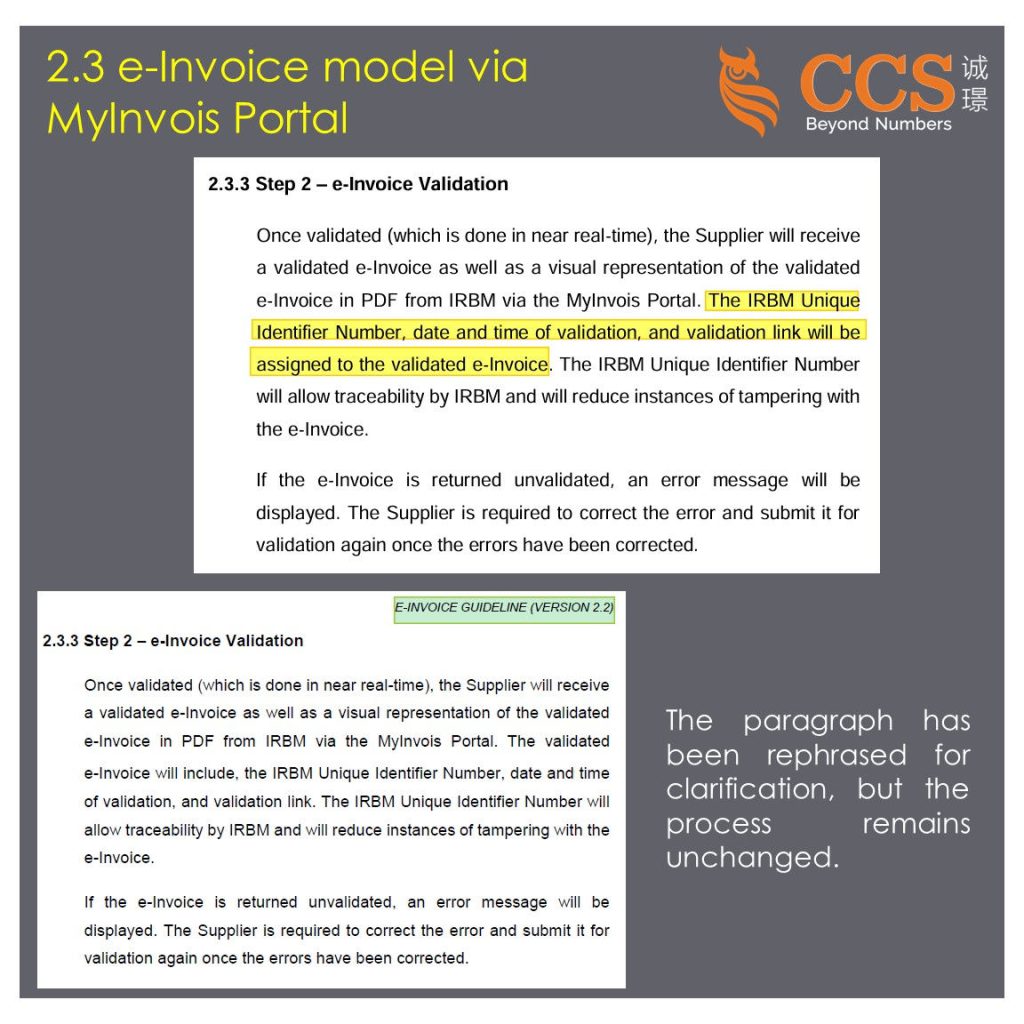
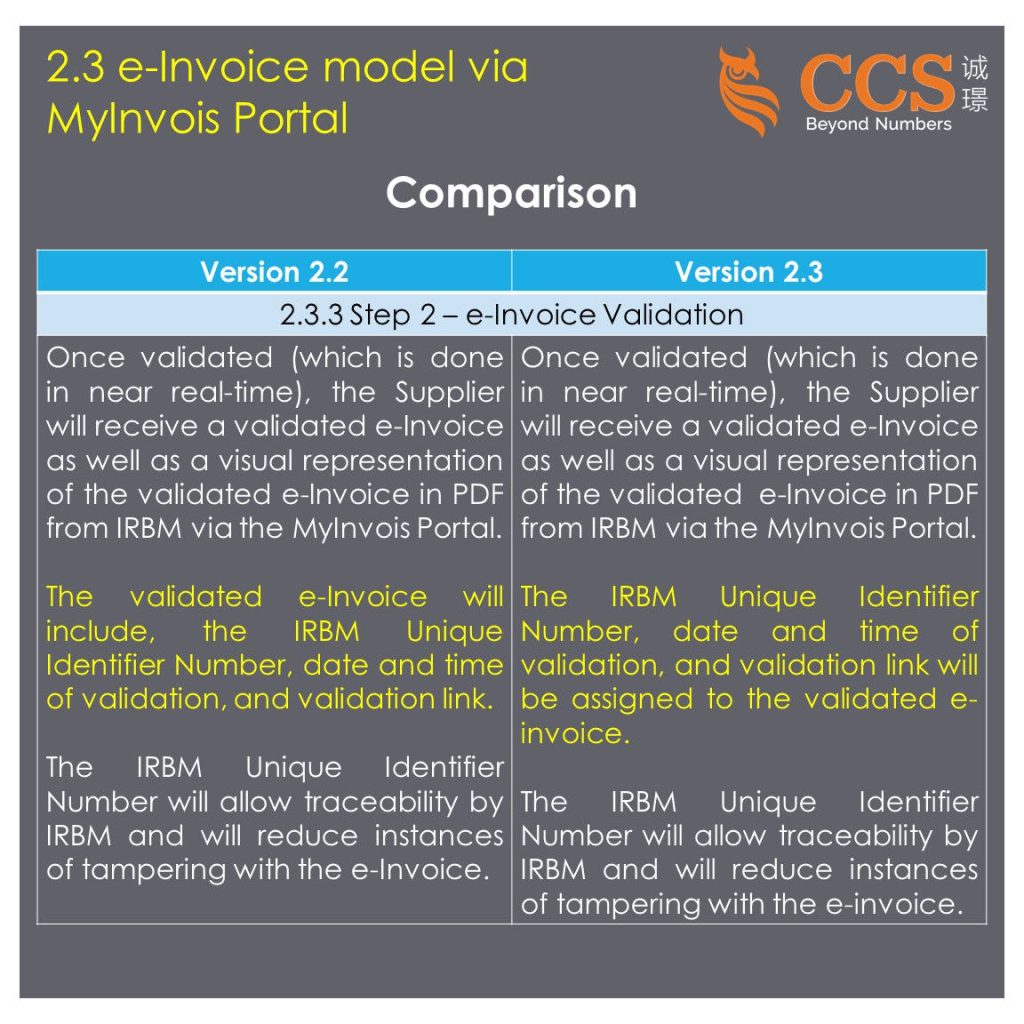
    2.3.3 Step 2 – e-Invoice Validation

    The change in section 2.3.3 between versions 2.2 and 2.3 is:

    Version 2.2:

    “The validated e-Invoice will include, the IRBM Unique Identifier Number, date and time of validation, and validation link.”

    Version 2.3:

    “The IRBM Unique Identifier Number, date and time of validation, and validation link will be assigned to the validated e-Invoice.”

    So the change is from stating that the validated e-invoice “will include” those details to saying they “will be assigned to” the validated e-invoice.

    This is a minor phrasing change, but it slightly alters the meaning. Version 2.3 clarifies that the IRBM Unique Identifier Number, date/time, and validation link are assigned or added to the e-invoice upon validation rather than already included in the original e-invoice submitted.

    The rationale could be to make it clear that these validation-related details are dynamically assigned by IRBM during the validation process rather than being pre-existing elements in the e-Invoice created by the supplier.

    在 2.3.3 节中,2.2 版和 2.3 版之间的变化如下:

    版本 2.2:

    “经过验证的电子发票将包括 IRBM 唯一标识符编号、验证日期和时间以及验证链接。

    版本 2.3:

    “IRBM 唯一标识符号码、验证日期和时间以及验证链接将分配给已验证的电子发票”。

    因此,这一改动是将 “将包括 “验证过的电子发票的细节改为 “将分配给 “验证过的电子发票。

    这只是措辞上的微小改动,但却略微改变了含义。2.3 版明确指出,IRBM 唯一标识符号码、日期/时间和验证链接将在验证时分配或添加到电子发票中,而不是已经包含在提交的原始电子发票中。

    这样做的理由可能是为了明确这些与验证有关的细节是由 IRBM 在验证过程中动态分配的,而不是供应商创建的电子发票中预先存在的元素。

    🌻🌻🌻🌻🌻🌻🌻🌻🌻🌻🌻🌻

    1
  • LHDN’s Announcement: Notifikasi Sistem e-PCB Plus : Notice for Verification of TIN and MyTAX ID

    LHDN’s Announcement: Notifikasi Sistem e-PCB Plus : Notice for Verification of TIN and MyTAX ID

    Untuk makluman, Sistem e-PCB Plus akan menggantikan sistem PCB sediada (e-PCB / e-CP39 / e- Data PCB) dalam satu platform.

    Sistem baharu ini boleh diakses melalui Portal Mytax dengan menggunakan Nombor Pendaftaran Cukai (TIN) daripada ID MyTAX pengguna. Tarikh sebenar penggunaan sistem baharu ini akan dimaklumkan kemudian kepada majikan.

    Majikan perlu memastikan individu yang diberi kuasa berkaitan kiraan, bayaran & penghantaran data PCB telah mempunyai ID MyTAX.

    Majikan juga perlu memastikan maklumat data pekerja ( nama / TIN / no. pengenalan) adalah betul dan teratur bagi membolehkan PCB pekerja diproses apabila menggunakan sistem baharu. Pendaftaran dan semakan TIN / ID MyTAX boleh dibuat melalui perkhidmatan e-Daftar di portal MyTAX atau dengan menghubungi pejabat LHDNM yang berdekatan.

    3
  • Expansion of the Scope of Service Tax (ST) Exemption for Maintenance Services

    Expansion of the Scope of Service Tax (ST) Exemption for Maintenance Services

    The government has agreed to extend the exemption from paying ST to maintenance services related to the following matters:

    1. Residential building repair services;
    2. Sinking fund;
    3. Maintenance services related to land or buildings for residential use provided by developers, joint management bodies, management corporations, or residential associations.

    This means that any maintenance and repair services on residential premises, such as roof repairs or any equipment and facilities that are part of residential premises, such as lifts, air conditioners, and water heating systems, are not subject to ST.

    3
  • Expansion of E-Invoicing Scope by IRBM: Introduction of Additional Self-Billed Document

    Expansion of E-Invoicing Scope by IRBM: Introduction of Additional Self-Billed Document

    The Inland Revenue Board of Malaysia (IRBM) has expanded the scope of e-invoicing to include additional document types beyond the initial Invoice, Credit Note, Debit Note, and Refund Note.

    This extension aims to provide comprehensive coverage and facilitate seamless e-invoicing operations across various business scenarios.

    In addition to the existing document types, businesses can now leverage the following e-Invoice formats within the MyInvois System:

    1. Self-Billed Invoice

    2. Self-Billed Credit Note

    3. Self-Billed Debit Note

    4. Self-Billed Refund Note

    These new document types cater to specific situations where the Buyer assumes the role of the Supplier and issues self-billed e-invoices, as outlined in Section 8 of the e-invoice Specific Guideline.

    By incorporating these additional formats, the MyInvois System empowers businesses with greater flexibility and compliance across diverse transaction scenarios.

    Self-Billed Invoice

    There are certain circumstances where another party (other than the Supplier) will be allowed to issue a self-billed e-Invoice.

    Kindly refer to Section 8 of the e-Invoice Specific Guideline where self-billed e-Invoice will be allowed.

    Self-Billed Invoice refers to the initial self-billed e-Invoice that will be issued by the Buyer.

    Self-Billed Credit Note

    Self-Billed Credit Note is issued by Buyers to correct errors, apply discounts, or account for returns in a previously issued Self-Billed e-Invoice with the purpose of reducing the value of the original Self-Billed e-Invoice.

    This is used in situations where the reduction of the original Self-Billed e-Invoice does not involve return of monies to the Buyer.

    Self-Billed Debit Note

    Self-Billed Debit Note is the document issued by Buyers to indicate additional charges on a previously issued Self-Billed e-Invoice.

    Self-Billed Refund Note

    Self-Billed Refund Note is the document issued by Buyers to confirm the refund of the Buyer’s payment. This is used in situations where there is a return of monies to the Buyer.

    🌻🌻🌻🌻🌻🌻🌻🌻🌻🌻🌻🌻🌻🌻🌻🌻🌻🌻

    马来西亚税务局(IRBM)扩大了电子发票的范围,除最初的发票、贷方凭证、借方凭证和退款凭证外,还增加了其他文件类型。

    这一扩展旨在提供全面的覆盖范围,并促进各种业务情况下的无缝电子发票操作。

    除了现有的文件类型,企业现在还可以在 MyInvois 系统中使用以下电子发票格式:

    1. 自开发票

    2. 自开贷记凭证

    3. 自开借记凭证

    4. 自开退款凭证

    这些新文件类型适用于买方扮演供应商角色并开具自开票电子发票的特定情况,如电子发票特定指南第 8 节所述。

    通过纳入这些附加格式,MyInvois 系统为企业在各种交易场景中提供了更大的灵活性和合规性。

    自开发票

    在某些情况下,允许另一方(供应商除外)开具自开电子发票。

    请参阅《电子发票具体指引》第 8 节中允许开具自开电子发票的内容。

    自开贷方凭证 

    买方开出 “自开贷方凭证 “是为了纠正之前开出的 “自开电子发票 “中的错误、应用折扣或说明退货情况,目的是减少原始 “自开电子发票 “的价值。

    在减少原始自开电子发票金额不涉及向买方退还款项的情况下使用。

    自开借方凭证

    自开借方凭证是买方开出的单据,用于注明先前开出的自开电子发票上的额外费用。

    自开退款凭证

    自开退款凭证是由买家开出的文件,用于确认买家付款的退款。用于向买方退还款项的情况。

    1
  • E-Invoice Classification Codes: A Key Requirement for Tax Monitoring

    E-Invoice Classification Codes: A Key Requirement for Tax Monitoring

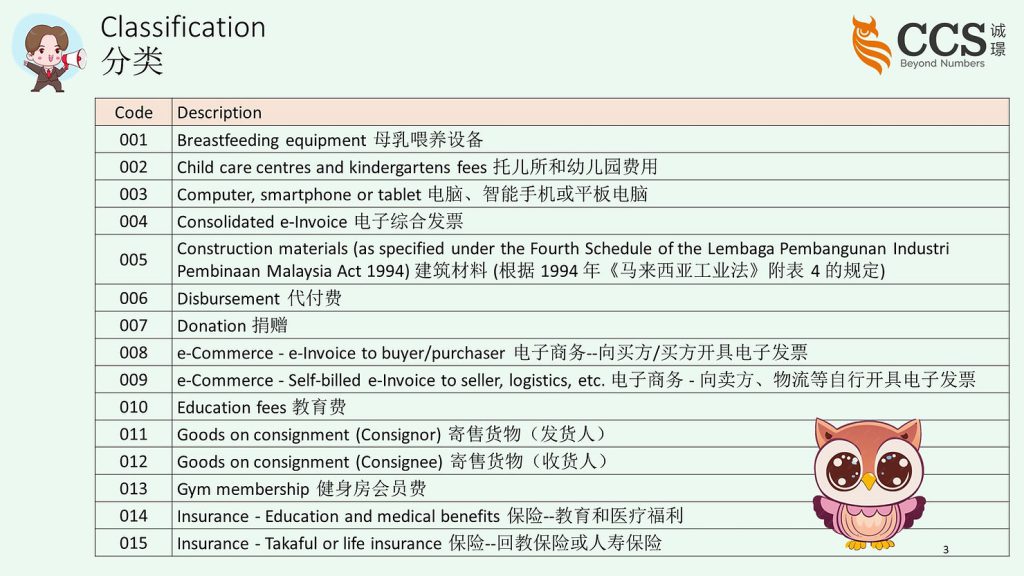
    The “Classification Code” is a mandatory field in e-Invoices that categorizes the nature of the transaction or the types of products/services involved.

    IRBM requires this code to facilitate the analysis and monitoring of various transactions for tax purposes.

    The classification codes cover a wide range of items and scenarios, from common expenses like medical treatments and educational fees to specific transactions like consignment sales, self-billed invoices for imports/exports, and even categories like breastfeeding equipment or sports-related purchases.

    By requiring businesses to assign the appropriate classification code, IRBM can gain valuable insights into spending patterns, identify potential areas of tax leakage or non-compliance, and make informed decisions regarding tax policies and administration.

    For taxpayers, using the correct classification code ensures accurate reporting and compliance with e-invoicing requirements while enabling IRBM to streamline its processes and enhance tax collection and monitoring efficiency.

    Therefore, taxpayers must familiarise themselves with the classification codes and select the most relevant option that accurately represents the nature of their transaction. This ensures compliance and contributes to the effectiveness of IRBM’s tax administration efforts.

    🌻🌻🌻🌻🌻🌻🌻🌻🌻🌻🌻🌻

    “类别代码” (Classification Code) 是电子发票中的必填字段,用于对交易性质或所涉及的产品/服务类型进行分类。

    IRBM 要求使用该代码,以便于分析和监控各种交易的税务目的。

    类别代码涵盖广泛的项目和情况,从医疗和教育费用等常见支出,到寄售、进口/出口自开票等特定交易,甚至哺乳设备或体育相关采购等类别。

    通过要求企业指定适当的分类代码,IRBM 可以深入了解消费模式,识别潜在的漏税或不合规领域,并就税收政策和管理做出明智决策。

    对纳税人而言,使用正确的类别代码可确保准确报告和遵守电子发票要求,同时还能使 IRBM 简化流程,提高税收征管和监控的整体效率。

    因此,纳税人必须熟悉分类代码,并选择最相关的选项,以准确反映其交易的性质。这不仅能确保纳税人遵守规定,还有助于提高 IRBM 税收管理工作的效率。

    19
  • Buying gifts for someone is no longer so Simple in e-invoicing era

    Buying gifts for someone is no longer so Simple in e-invoicing era

    Where goods purchased may need to be shipped directly to the Shipping Recipient instead of the Buyer

    In the new e-Invoice Specific Guideline (Version 2.1), paragraph 3.5.6 clarifies the details provided by individual Shipping Recipients to issue the Annexure to the e-Invoice.

    The key points are:

    1. For Malaysian individuals, the Shipping Recipient needs to provide:

    ✅ Full name as per MyKad/MyTentera

    ✅ Address

    ✅ TIN; or MyKad/MyTentera identification number; or both TIN and MyKad/MyTentera number

    2. For non-Malaysian individuals, the Shipping Recipient needs to provide:

    ✅ Full name as per passport/MyPR/MyKAS

    ✅ Address

    ✅ TIN or both TIN and passport/MyPR/MyKAS number

    3. This allows flexibility for individual Shipping Recipients to provide a minimum set of details for annexing to the e-Invoice issued by the Supplier.

    4. It eases the burden on individual Shipping Recipients from having to provide complete details like businesses.

    In summary, this new paragraph provides concessions and options for individual Shipping Recipients to facilitate easier compliance when Suppliers need to annex Shipping Recipient details to the e-invoices issued. Taxpayers who are individual Shipping Recipients should take note of these concessions.

    🌻🌻🌻🌻🌻🌻🌻🌻🌻🌻🌻🌻

    购买的货物如果需要直接运给托运收件人而不是买方本人,同时又要电子发票的话,请注意了⚠️⚠️

    在新的《电子发票具体指南》(2.1 版)中,第 3.5.6 段澄清了个别托运收件人为开具电子发票附件而提供的详细信息。

    要点如下

    1. 对于马来西亚个人,托运收件人需要提供

    ✅ MyKad/MyTentera 上的全名

    ✅ 地址

    ✅ 个人身份识别码;或 MyKad/MyTentera 识别码;或个人身份识别码和 MyKad/MyTentera 号码。

    2. 对于非马来西亚个人,托运收件人需要提供

    ✅ 护照/MyPR/MyKAS 上的全名

    ✅ 地址

    ✅ TIN 或 TIN 和护照/MyPR/MyKAS 号码

    3. 这允许个别托运收件人灵活地提供一套最基本的详细信息,作为供应商开具的电子发票的附件。

    4. 可减轻个人托运收件人的负担,使其不必像企业一样提供完整的详细信息。

    总之,这一新段落为个人托运收件人提供了优惠和选择,以便在供应商需要将托运收件人详细信息附在所开具的电子发票上时更容易遵从。

    1