
Tag: Statutory Income

  • IRBM’s Response to CTIM on e-C 2022 (3)

    IRBM’s Response to CTIM on e-C 2022 (3)

    Regarding Form e-C 2022, CTIM has offered feedback and comments to the Inland Revenue Board of Malaysia (IRBM).

    The Inland Revenue Board of Malaysia issued its response on 29 July 2022 and 2 August 2022, respectively.

    Despite this, on 11 August 2022, CTIM provided IRBM with additional feedback and comments on the form e-C 2022 after IRBM‘s responses were provided.

    The IRBM issued their responses on September 9, 2022, to the following sections of Form e-C 2022 mentioned in the CTIM Additional Feedback and Comments on 11 August 2022.

    Issue No 1: Item A2 and A7 – Disclosure in the Form e-C relating to Foreign Source Income

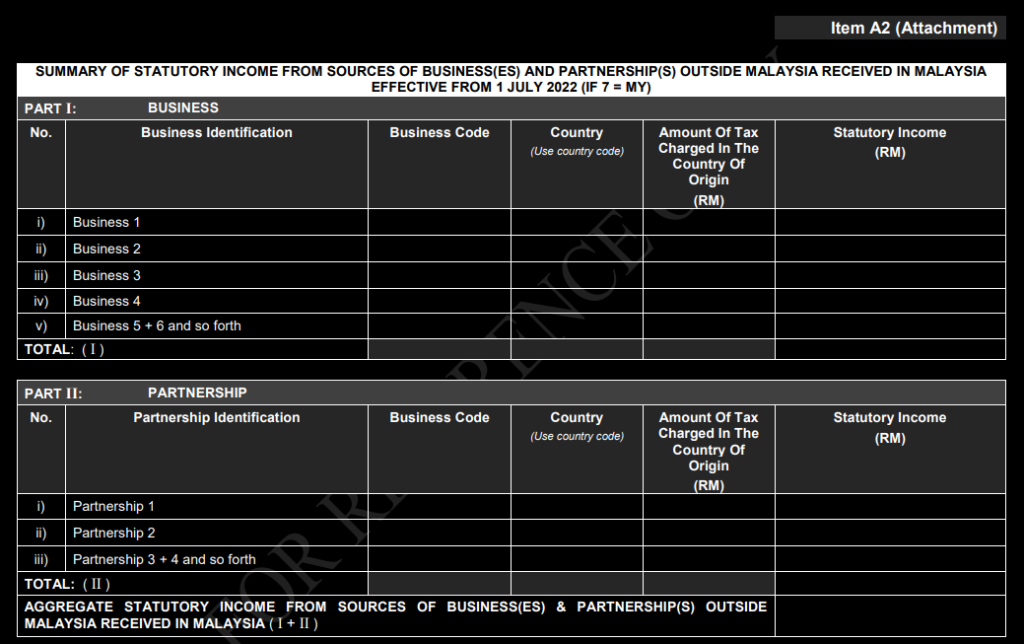
    1.1 Referred to the “Summary of Statutory Income from sources of business(es) and partnership(s) outside Malaysia received in Malaysia starting from 1 July 2022.“

    Currently, the TAeF allows disclosure of 1 country under 1 business source only.

    How do the taxpayers disclose the information in a situation where the foreign source income (FSI) is from multiple countries in one business source (e.g., Business 1)’?

    IRBM’s response on 2 August 2022:

    Income reporting should be done separately by the country. For e-Filing, the system allows the use of the same business code for each reporting business income from different countries.

    A2 of the e-Form C 2022 (i.e., Summary of statutory income from sources of business(es) and partnership(s) outside Malaysia received in Malaysia effective from 1 July 2022)

    CTIM additional feedback and comments on 11 August 2022:

    Based on IRBM’s response above, CTIM notes that the system allows the same business code for different countries. However, Form e-C only allows disclosure of 1 business source for 1 country.

    IRBM’s response on 9 September 2022:

    Income from similar activities from the same country should be combined and reported in the same row and space. Income segregation for the same business code from the same country does not need to be done for FSI reporting in e-C 2022.

    CTIM additional feedback and comments on 11 August 2022:

    Based on the A2 of the e-Form C 2022 (i.e., Summary of statutory income from sources of business(es) and partnership(s) outside Malaysia received in Malaysia effective from 1 July 2022), the e-Form C 2022 system seems to have not been updated to allow disclosure of foreign business income for more than 1 country under 1 business source.

    As extracted below, it appears that row 2 has been fixed as Business 2, row 3 as Business 3, and so on.

    CTIM would like to seek further clarification from IRBM on whether:-

    • IRBM will update its system to allow taxpayers to select “business identification” manually, or
    • As long as the taxpayers inserted the same business code in different rows, the IRBM will take these disclosures as foreign business income under 1 business source (even though the business identification column does not match).

    IRBM’s response on 9 September 2022: Taxpayers can use the same business code for each country concerned on different rows to indicate companies doing the same business in those countries.

    The proposal from CTIM will be considered when designing e-C for the subsequent assessment year.

    CTIM additional feedback and comments on 11 August 2022:

    Example: ABC Sdn Bhd has two business sources:

    1. providing engineering services and
    2. trading machines.

    ABC Sdn Bhd has branches in Singapore and Hong Kong that provide the same engineering services.

    In YA 2022, the following information is available for the Form e-C disclosure:

    Based on the example given above, can IRBM guide how the “Summary of statutory income …. In Malaysia” and the “Summary of Statutory Income from sources …. received in Malaysia from outside Malaysia” be completed?

    IRBM’s response on 9 September 2022:

    Based on the limited information above, the following are general guidelines for reporting in e-C 2022:

    1. The statutory income of business 1 in Malaysia is reported in column A1 and appendix A1 respectively.
    2. The statutory income of business 1 in Singapore and Hong Kong is reported either in column A2 and appendix A2 or column A 20 and appendix A20 depending on when the income is remitted. This reporting is subject to the business income in Singapore and Hong Kong having been taxed in those countries.
    3. Interest income from Singapore and Hong Kong must be reported in either column appendix A7 and appendix A7 or columns A 20 and appendix A20, depending on when the income is remitted.

    The ultimate tax reporting and calculation will be determined by the relevant circumstances in connection with:

    • the management of company activities,
    • the date of remittance of income sourced outside of Malaysia, and
    • the income tax status in the place of origin.

    1.2 Capital Allowance disclosure

    CTIM additional feedback and comments on 11 August 2022:

    Using the same example above –

    • How does a taxpayer complete Item C1a (Attachment) of Form e-C for YA 2022?
    • If the remaining portion of the FSI is received in Malaysia in YA 2023, how does a taxpayer complete Item C1a (Attachment) in Form e-C for YA 2023?
    • Only a portion of the statutory FSI is received in Malaysia in YA 2022. In this case, how do we disclose the amount of the CA utilised (absorbed) under Item C1a (Attachment) of Form e-C for YA 2022?

    IRBM’s response on 9 September 2022:

    The disclosure of information regarding capital allowances in schedule 3 of appendix C1a for form e-C2022 is only required if the business income was derived from Malaysia (referring to column and Appendix A1).

    Issued No 2: Item A20 – Income from sources outside Malaysia received in Malaysia for the period from 01.01.2022 to 30.06.2022 [If 7 = MY]

    CTIM additional feedback and comments on 11 August 2022:

    Referring to IRBM’s response on 2 August 2022 (as follows), it appears that a direct translation of the sentence means “the FSI received in Malaysia shall refer to the gross amount“.

    Kindly confirm that the actual FSI remitted shall be taken as the gross income instead, i.e., there is no requirement to re-compute the gross income of which the FSI is remitted into Malaysia.

    IRBM’s response on 9 September 2022:

    There is no need to re-compute the remitted income because it is gross income based on the provisions of Section 6, Part XX of the ITA 1967.

    Issue No 3: Part E – Summary of losses for business and partnership that are subject to restriction under Section 44(5F)

    Previously, this section was used to report normal business and pioneer losses with the heading of the appendix: Summary of Losses (Including Pioneer Losses after tax relief period).

    It is now renamed to cover losses subject to restriction under Section 44(5F).

    However, the Guidebook 2022 still stipulates that this section is “Including Pioneer Losses After Tax Relief Period” (see screenshot below):

    CTIM additional feedback and comments on 11 August 2022:

    As highlighted before, the query concerns the disclosure of the pioneer loss that is subject to the Promotion of Investment Act 1986 (“PIA”).

    The tax treatment of the unabsorbed pioneer loss after the expiry of the pioneer status period is governed under Section 25(5) of the PIA (not Section 44(5F) of the ITA).

    As such, kindly confirm that taxpayers are not required to disclose the unabsorbed pioneer loss that is governed under the PIA in Part E Attachment of Form e-C YA 2022.

    This is because Part E Attachment is only for disclosure of business loss and any pioneer loss that is governed under the ITA.

    As mentioned before, the taxpayers can still continue to maintain the movement of the pioneer losses after the tax relief period (that is governed under the PIA) separately using the HK-F2 (not part of the Form e-C YA 2022 to be submitted to the HASIL) for tax audit purposes.

    IRBM’s response on 9 September 2022:

    This column is intended to report loss positions subject to restrictions under section 44(5F) of the ITA 1967 and includes losses post-pioneer status period.

    IRBM will amend the label of this attachment so that it is more applicable to all circumstances when they develop the future return form.

    Issue No 4: Declaration Section

    Option 2 in the declaration section of the YA2021 Form C was worded as “This return form is prepared based on unaudited accounts.‘

    If a company cannot get its audited financial statements signed by the filing due date but still wishes to submit its tax return, it would select “Option 2′.

    Option 2 also applies to a Permanent Establishment (‘PE’) that is not registered with the Companies Commission of Malaysia (“SSM”) and would not have audited financial statements for tax purposes.

    However, the scenario would no longer fit into any of the above options in the YA 2022 Form C.

    CTIM understand that under the law, unless an audit exemption is granted, a company must submit its tax return based on signed audited financial statements. However, it is not uncommon that the audited accounts could not be ready by the filing due date due to various reasons.

    CTIM’s initial feedback and comments:

    In these circumstances, we would like to seek clarification, particularly:

    Is the company permitted to submit its tax return for YA 2022 based on draft audited financial statements without an audit exemption?

    IRBM’s response on 2 August 2022:

    Form C needs to be drawn up based on the financial statements prepared according to the act of its establishment as provided under section 77A of the ITA 1967.

    For companies incorporated under the Companies Act 2016, form C needs to be submitted based on the audited financial statements signed by the approved company auditor unless the company gets an exemption under the Companies Act 2016 from submitting audited accounts.

    Therefore, the submission of Form C must be based on option 1.

    If the form C submission is not based on audited financial statements, the form C submission will be rejected.

    CTIM additional feedback and comments on 11 August 2022:

    The above response does not address the issue of a PE which is not registered with SSM.

    Kindly clarify

    IRBM’s response on 9 September 2022:

    Sections 561 and 562 of the Companies Act 2016 apply to foreign companies that conduct business in Malaysia.

    The company must submit a tax return form per section 77A(4) of the Income Tax Act 1967, and it must be based on financial statements that have been compiled in line with the act of its establishment.

    Because of this, PEs in Malaysia are required to submit Form C based on audited financial statements under the rules of the PE establishment statute in Malaysia or the act governing the parent company of the PE.

    Submission of tax return forms based on management accounts is invalid and will be subject to penalty under section 112 of the ITA 1967.

    With that, the choice in the Declaration Section of form C has remained.

    Our website's articles, templates, and material are solely for reference. Although we make every effort to keep the information up to date and accurate, we make no representations or warranties of any kind, either express or implied, regarding the website or the information, articles, templates, or related graphics that are contained on the website in terms of its completeness, accuracy, reliability, suitability, or availability. Therefore, any reliance on such information is strictly at your own risk.

    Keep in touch with us so that you can receive timely updates |

    要获得即时更新,请与我们保持联系

    1. Website ✍️ https://www.ccs-co.com/ 2. Telegram ✍️ http://bit.ly/YourAuditor 3. Facebook ✍

    4. Blog ✍ https://lnkd.in/e-Pu8_G 5. Google ✍ https://lnkd.in/ehZE6mxy

    6. LinkedIn ✍ https://www.linkedin.com/company/74734209/admin/

    16
  • IRBM’s Response to CTIM on e-C 2022 (2)

    IRBM’s Response to CTIM on e-C 2022 (2)

    We would like to inform you that the Inland Revenue Board of Malaysia (IRBM) has disseminated a revised version of the Company Return Form (Form C) for the Year of Assessment 2022.

    To download a PDF copy of the return – https://t.me/YourAuditor/3259

    Chartered Tax Institute of Malaysia’s Previous Feedback

    Regarding Form e-C 2022, the Chartered Tax Institute of Malaysia (CTIM) has offered their input and comments to the Inland Revenue Board of Malaysia (IRBM).

    The responses from IRBM were shared by us on August 25, 2022 (https://www.ccs-co.com/post/irbm-s-response-to-ctim-on-e-c-2022)

    Chartered Tax Institute of Malaysia’s Additional Feedback

    Following the responses provided by IRBM, CTIM has forwarded Additional Feedback and Comments on Form e-C 2022 to IRBM. Some of the areas:-

    1. Statutory Income, Total Income and Chargeable Income [Part A]
    2. Summary of Statutory Income from Sources of Business(es) and Partnership(s) in Malaysia [Attachment A1]
    3. Summary of Statutory Income from Sources of Business(es) and Partnership(s) Outside Malaysia Received in Malaysia Effective From 1 July 2022 [Attachment A2]
    4. Other Statutory Income from Other Sources in Malaysia [Attachment A6]
    5. Other Statutory Income from Sources Outside Malaysia Received in Malaysia Effective from 1 July 2022 [Attachment A7]
    6. Summary of Investment Allowance for Service Sector Under Schedule 7B [Attachment C4]

    The responses were provided by IRBM on September 9, 2022.

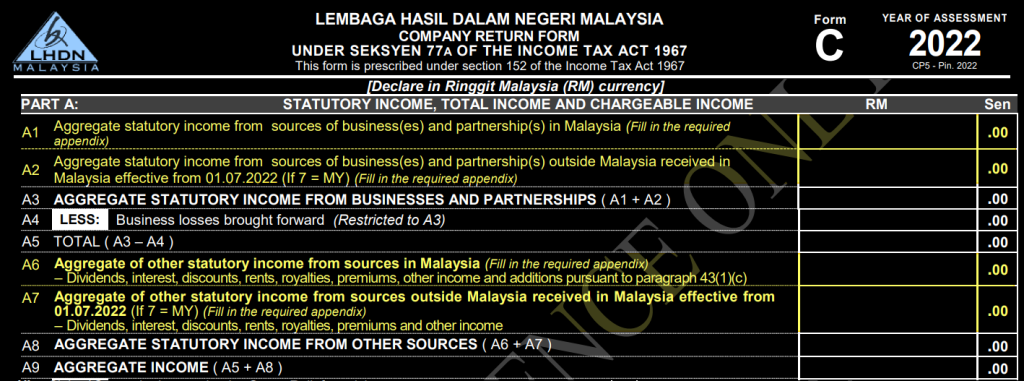
    Issue No 1: Statutory Income, Total Income and Chargeable Income [Part A]

    Form e-C 2022:

    There is a reference to the columns A1, A2, A6, and A7.

    Matter 1

    In Form e-C 2022, Aggregate Statutory Income from sources of businesses/partnerships in Malaysia and Aggregate Statutory Income from sources of businesses/partnerships outside Malaysia received in Malaysia effective from 01.07.2022 are to be disclosed separately:

    • A1; and
    • A2

    But, Statutory income from businesses and partnerships is taxed as a source of income under Section 4(a) of the ITA. This is true no matter country of origin from (what country the income comes).

    Matter 2

    In Form e-C 2022, Aggregate Statutory Income from sources in Malaysia and Aggregate Statutory Income from sources outside Malaysia received in Malaysia effective from 01.07.2022 are to be disclosed separately:

    • A6; and
    • A7

    But, These statutory incomes are taxed as separate sources of income, regardless of country of origin.

    Practical Issue

    • This distinction between Malaysian and foreign origin increases the cost of compliance since additional effort will be necessary, for example, to apportion the amounts for each source of income.
    • As a result, the cost of compliance will increase.

    Feedback / Proposal of CTIM

    • To remain as per YA2021 as a single item labelled Aggregate statutory income from other sources

    Response of IRBM on September 9, 2022

    The separation between income from Malaysia and income from outside Malaysia received in Malaysia must be done in the tax calculation for the purpose of:

    1. Ensures the correct imposition of tax rates and avoids source income outside Malaysia received in Malaysia from being taken into account in determining tax according to the prosperous tax rate (33%).
    2. Determining the eligibility of tax credit claims under sections 132 and 133, as this depends on whether or not that country has a DTA with Malaysia.

    Issue No 2: Summary of Statutory Income from Sources of Business(es) and Partnership(s) in Malaysia [Attachment A1]

    Attachment A1 of Form e-C 2022:

    Attachment A1 in Form e-C 2022 requires a summary of Statutory Income from Sources of Business(es) and Partnership(s) in Malaysia only.

    Practical Issue

    • This distinction between Malaysian and foreign origin increases the cost of compliance since additional effort will be necessary, for example, to apportion the amounts for each source of income.
    • As a result, the cost of compliance will increase.

    Feedback / Proposal of CTIM

    • To remain as per YA2021, i.e., Attachment A1 for both sources in Malaysia and Outside Malaysia Received in Malaysia, effective from 1 July 2022.

    Response of IRBM on September 9, 2022

    Refer to IRBM’s response for Issue No 1.

    Issue No 3: Summary of Statutory Income from Sources of Business(es) and Partnership(s) Outside Malaysia Received in Malaysia Effective From 1 July 2022 [Attachment A2]

    Attachment A2 in Form e-C 2022 requires a summary of Statutory Income from Sources of Business(es) and Partnership(s) outside Malaysia received in Malaysia effective from 1 July 2022.

    Practical Issue

    • This distinction between Malaysian and foreign origin increases the cost of compliance since additional effort will be necessary, for example, to apportion the amounts for each source of income.
    • As a result, the cost of compliance will increase.
    • In addition, the Attachment only allows a maximum of 5 rows in any individual component.
    • Where there are several countries of origin for the same business or partnership source, taxpayers would not be able to give the relevant information.

    Feedback / Proposal of CTIM

    • To remove this Attachment, apply Attachment A1 for both sources in Malaysia and Outside Malaysia Received in Malaysia, effective from 1 July 2022.

    Response of IRBM on September 9, 2022

    Refer to IRBM’s response for Issue No 1.

    Furthermore, if there is insufficient space, the 5th and subsequent foreign source of business income should be combined and reported in the 5th line of each category.

    The Taxpayer can place one of the countries in the “Country” column. Keep complete records of each business source of income outside Malaysia for audit purposes.

    Issue No 4: Other Statutory Income from Other Sources in Malaysia [Attachment A6]

    Attachment A6 in Form e-C 2022 requires a summary of Other Statutory Income from Other Sources in Malaysia only.

    Practical Issue

    • This distinction between Malaysian and foreign origin increases the cost of compliance since additional effort will be necessary, for example, to apportion the amounts for each source of income.
    • As a result, the cost of compliance will increase.

    Feedback / Proposal of CTIM

    • To remain as per YA2021, i.e., Attachment A6 for both sources in Malaysia and Outside Malaysia Received in Malaysia, effective from 1 July 2022.

    Response of IRBM on September 9, 2022

    Refer to IRBM’s response for Issue No 1.

    Issue No 5: Other Statutory Income from Sources Outside Malaysia Received in Malaysia Effective from 1 July 2022 [Attachment A7]

    Attachment A7 in Form e-C 2022 requires a summary of Other Statutory Income from Other Sources outside Malaysia received in Malaysia effective from 1 July 2022.

    Practical Issue

    • This distinction between Malaysian and foreign origin increases the cost of compliance since additional effort will be necessary, for example, to apportion the amounts for each source of income.
    • As a result, the cost of compliance will increase.

    Feedback / Proposal of CTIM

    • To remain as per YA2021, i.e., Attachment A6 for both sources in Malaysia and Outside Malaysia Received in Malaysia, effective from 1 July 2022.

    Response of IRBM on September 9, 2022

    Refer to IRBM’s response for Issue No 1.

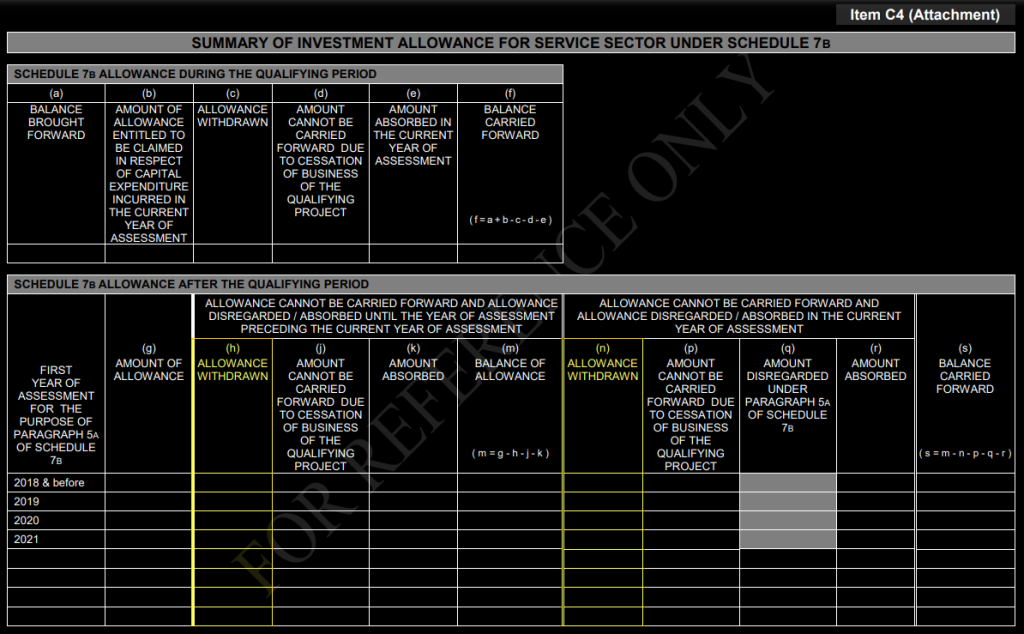
    Issue No 6: Summary of Investment Allowance for Service Sector Under Schedule 7B [Attachment C4]

    On Items h and n – Allowance Withdrawn

    Issues

    Schedule 7B of the ITA does not have provisions for the withdrawal of allowances.

    Feedback / Proposal of CTIM

    • To remove items “h” and “n” from the Attachment

    Response of IRBM on September 9, 2022

    The Income Tax Act of 1967, Schedule 3, Paragraph 2 provides the Minister with authority to approve written applications for service sector investment allowances and to set such terms and conditions as it sees proper.

    As a consequence, the company is not qualified to make a claim for the sector investment allowance service if any of the conditions are violated.

    Therefore, maintaining Columns “h” and “n” is important because it is necessary to fill in these columns if a company that has claimed service sector investment allowances in previous years of assessment is found to be in violation of the conditions established by the Minister in the current year, which renders the company ineligible to claim the sector investment allowance (This occurs when the Minister discovers that the company has violated the conditions set forth by the Minister in the current year.)

    In addition, columns “h” and “n” also need to be maintained in parallel with the existence of columns “c”.

    Our website's articles, templates, and material are solely for reference. Although we make every effort to keep the information up to date and accurate, we make no representations or warranties of any kind, either express or implied, regarding the website or the information, articles, templates, or related graphics that are contained on the website in terms of its completeness, accuracy, reliability, suitability, or availability. Any reliance on such information is therefore strictly at your own risk.

    Keep in touch with us so that you can receive timely updates |

    要获得即时更新,请与我们保持联系

    1. Website ✍️ https://www.ccs-co.com/ 2. Telegram ✍️ http://bit.ly/YourAuditor 3. Facebook ✍

    4. Blog ✍ https://lnkd.in/e-Pu8_G 5. Google ✍ https://lnkd.in/ehZE6mxy

    6. LinkedIn ✍ https://www.linkedin.com/company/74734209/admin/

    20
  • Tax Exemption in relation to Late Life Asset Production Sharing Contract (PSC)

    Tax Exemption in relation to Late Life Asset Production Sharing Contract (PSC)

    Late Life Asset Production Sharing Contract (PSC)

    The Late Life Asset (LLA) PSC was adopted by Petronas in 2019 for specific oil and gas fields nearing the end of their productive life with resources of less than 30 MMstb.

    These PSCs have better terms for Contractors, intending to extend the value of the fields until abandonment.

    The first two LLA fields (the Tembungo and the MASA Cluster) were offered in the 2020 Malaysian Bidding Round.

    Proposed Incentives for Late-Life Assets (LLA) Projects

    In Budget 2022, some measures have been suggested to persuade oil and gas investors to participate in LLA projects. To read more:

    Petroleum (Income Tax) (Exemption) Order 2022

    IN exercise of the powers conferred by subsection 65C(1) of the Petroleum (Income Tax) Act 1967 [Act 543], the Minister makes the Petroleum (Income Tax) (Exemption) Order 2022, which was gazetted on September 27, 2022.

    This Order is deemed to have come into operation on 1 January 2020.

    Tax Exemption

    The Minister may determine a project as a Late-Life Assets project which is a brownfield oil or gas field [an oil or gas field that has been developed and has reached a peak level of oil or gas production rate] and has an economic lifespan not exceeding ten years commencing from the year a Late-Life Assets production sharing contract is signed.

    Under this Order:

    • Petroleum Income Tax Exemption in respect of statutory income derived from petroleum operations concerning Late-Life Assets production sharing contract is granted, provided
      • a Late-Life Assets production sharing contract with Petroliam Nasional Berhad (“PETRONAS“) has been signed from 1 January 2020 to 31 December 2029.
    • The Statutory Income shall be determined per the formula provided in the Order.

    In determining the Chargeable Income referred to in the formula, the statutory income shall be ascertained in accordance with Chapter 4 of Part III of the Act and by having regard to the Petroleum (Income Tax) (Accelerated Capital Allowances) (Late-Life Assets Production Sharing Contract) Rules 2022 [P.U. (A) 301/2022]

    Non-application

    These Rules shall not apply to a chargeable person in the basis period for a year of assessment where the chargeable person—

    • has been granted accelerated capital allowance under the Petroleum (Income Tax)(Accelerated Capital Allowances) (Marginal Field) Rules 2013 [P.U. (A) 119/2013];
    • has been granted an investment allowance under the Petroleum (Income Tax) (Investment Allowance) Regulations 2013 [P.U.(A) 120/2013];
    • has been granted tax exemption under the Petroleum (Income Tax) (Exemption) Order 2013 [P.U. (A) 122/2013];
    • has been granted accelerated capital allowance under the Petroleum (Income Tax) (Accelerated Capital Allowances) (PETRONAS Marginal Field) Rules 2014 [P.U. (A) 304/2014];
    • has been granted tax exemption under the Petroleum (Income Tax) (Exemption) Order 2014 [P.U. (A) 305/2014];
    • has been granted an investment allowance under the Petroleum (Income Tax) (Investment Allowance for PETRONAS) Regulations 2021 [P.U.(A) 336/2021];
    • carries on petroleum operations in the Joint Development Area; or
    • carries on petroleum operations in an area under any agreement or arrangement made by the Government with any government of any territory outside Malaysia for the joint exploration and exploitation of petroleum in overlapping areas.
    Our website's articles, templates, and material are solely for reference. Although we make every effort to keep the information up to date and accurate, we make no representations or warranties of any kind, either express or implied, regarding the website or the information, articles, templates, or related graphics that are contained on the website in terms of its completeness, accuracy, reliability, suitability, or availability. Any reliance on such information is therefore strictly at your own risk.

    Keep in touch with us so that you can receive timely updates |

    要获得即时更新,请与我们保持联系

    1. Website ✍️ https://www.ccs-co.com/ 2. Telegram ✍️ http://bit.ly/YourAuditor 3. Facebook ✍

    4. Blog ✍ https://lnkd.in/e-Pu8_G 5. Google ✍ https://lnkd.in/ehZE6mxy

    6. LinkedIn ✍ https://www.linkedin.com/company/74734209/admin/
    21
  • 4: Tax Incentives for The East Coast Economic Region (ECER) – Tax Exemption

    4: Tax Incentives for The East Coast Economic Region (ECER) – Tax Exemption

    1. The East Coast Economic Region (ECER) was formed in 2007 with the launch of the ECER Master Plan by the Federal Government.

    2. The formation of ECER was intended to accelerate economic growth and ensure equitable distribution of wealth across the country, in line with national aspirations to become a high-income developed nation by 2020.

    3. As a result, the government has provided tax incentives for the ECER

    4. In recent weeks, the Malaysian government published Five pieces of subsidiary legislation to extend the deadline to apply for incentives in the ECER from the previous deadline of December 2020 to the new date of December 2022:-

    👉 Income Tax (Exemption) (No. 4) 2016 (Amendment) Order 2022 [P.U.(A) 88/2022]

    👉 Income Tax (Exemption) (No. 5) 2016 (Amendment) Order 2022 [P.U.(A) 89/2022]

    👉 Income Tax (Exemption) (No. 6) 2016 (Amendment) Order 2022 [P.U.(A) 90/2022]

    👉 Income Tax (Exemption) (No. 7) 2016 (Amendment) Order 2022 [P.U.(A) 91/2022]

    👉 Income Tax (Exemption) (No. 8) 2016 (Amendment) Order 2022 [P.U.(A) 92/2022]

    👉 To Download All – https://t.me/YourAuditor/2928

    5. In accordance with paragraphs 5A and 6 of The Income Tax (Exemption) (No. 7) Order 2016 (P.U.(A) 160/2016 (*)), a qualifying person is exempt from payment of income tax on statutory income derived from a special qualifying activity at the rate of not less than 70% and not more than 100% as specified by the Minister for a period of consecutive years of assessment as the Minister may determine.

    (*) As amended by the Income Tax (Exemption) (No. 7) 2016 (Amendment) Order 2018 [P.U.(A) 394/2018]

    6. Join our Telegram – https://t.me/YourAuditor

    🌻🌻🌻🌻🌻🌻🌻🌻

    1. 东海岸经济区(ECER)于2007年随着联邦政府推出东海岸经济区总体规划而成立。

    2. 组建东海岸经济区的目的是为了加速经济增长,确保全国财富的公平分配,以符合国家在2020年成为高收入发达国家的愿望。

    3. 因此,政府为东海岸经济区提供了税收激励措施

    4. 几周前,马来西亚政府在宪报颁布了5项附属立法,将申请东海岸经济区 (ECER) 税收优惠措施的截止日期从之前的 2020 年 12 月延长至 2022 年 12 月:-

    👉 2016年所得税(豁免)(第4号) 2022年(修正)指令 [P.U.(A)88/2022]

    👉 2016年所得税(豁免)(第5号) 2022年(修正)指令 [P.U.(A)89/2022]

    👉 2016年所得税(豁免)(第6号) 2022年(修正)指令 [P.U.(A)90/2022]

    👉 2016年所得税(豁免)(第7号) 2022年(修正)指令 [P.U.(A)91/2022]

    👉 2016年所得税(豁免)(第8号) 2022年(修正)指令 [P.U.(A)92/2022]

    👉 下载 – https://t.me/YourAuditor/2928

    5. 2016年所得税(豁免)(第7号) 指令 [P.U. (A) 160/2016 (*)] 规定,只要遵守 P.U. (A) 160/2016 第5A和6段的规定,符合条件的人士可在部长规定的连续评估年限内,对来自特殊合格活动的法定收入免交不低于 70%,不高于 100% 的所得税。

    (*) 经2016年所得税(豁免)(第4号)2018年(修正)指令 [P.U.(A)394/2018] 修订

    6. 加入 Telegram 群 – https://t.me/YourAuditor

    🌼🌼🌼🌼🌼🌼🌼🌼🌼🌼

    9
  • Tax Incentives for Sabah Development Corridor (SDC)

    Tax Incentives for Sabah Development Corridor (SDC)

    1. The Sabah Development Corridor (SDC) Blueprint, which was launched on 28 January 2008, is implemented with the aim of bringing the quality of life of Sabah’s people up another level as well as accelerating the economic growth for Sabah while promoting regional balance and bridging the rural-urban divide and concurrently ensuring sustainable management of state’s resources.

    2. In recent weeks, the Malaysian government published three pieces of subsidiary legislation to extend the deadline to apply for incentives in the Sabah Development Corridor (the “SDC”) from the previous deadline of December 2020 to the new date of December 2022:-

    👉 Stamp Duty (Exemption) (No. 8) 2018 (Amendment) Order 2022 [P.U.(A) 74/2022]

    👉 Income Tax (Exemption) (No. 12) 2018 (Amendment) Order 2022 [P.U.(A) 76/2022]

    👉 Income Tax (Exemption) (No. 11) 2018 (Amendment) Order 2022 [P.U.(A) 75/2022]

    3. Join our Telegram – https://t.me/YourAuditor 🌻🌻🌻🌻🌻🌻🌻🌻

    1. 沙巴发展走廊(SDC)蓝图于2008年1月28日启动,其目的是将沙巴人民的生活质量提高到另一个水平,并加速沙巴的经济增长,同时促进区域平衡和缩小城乡差距,并同时确保国家资源的可持续性管理。 2. 几周前,马来西亚政府在宪报颁布了三项附属立法,将申请沙巴发展走廊 (SDC) 激励措施的截止日期从之前的 2020 年 12 月截止日期延长至新的 2022 年 12 月截止日期:- 👉 2018年印花税(豁免)(第8号)2022年(修正)指令 [P.U.(A) 74/2022] 👉 2018年所得税(豁免)(第12号)2022年(修正)指令 [P.U.(A)76/2022] 👉 2018年所得税(豁免)(第11号)2022年(修正)指令 [P.U.(A)75/2022] 3. 加入 Telegram 群 – https://t.me/YourAuditor 🌼🌼🌼🌼🌼🌼🌼🌼🌼🌼

    10
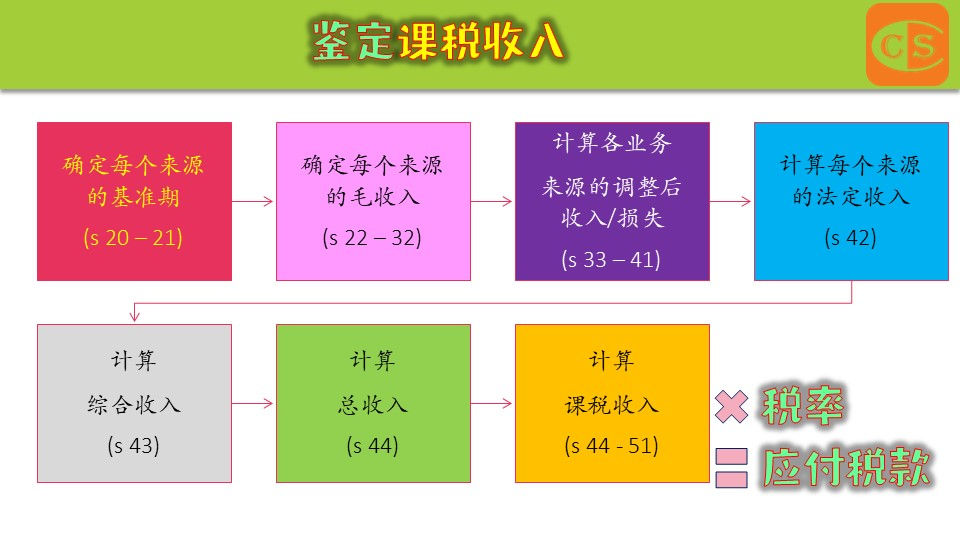
  • Ascertaining Chargeable Income

    Ascertaining Chargeable Income

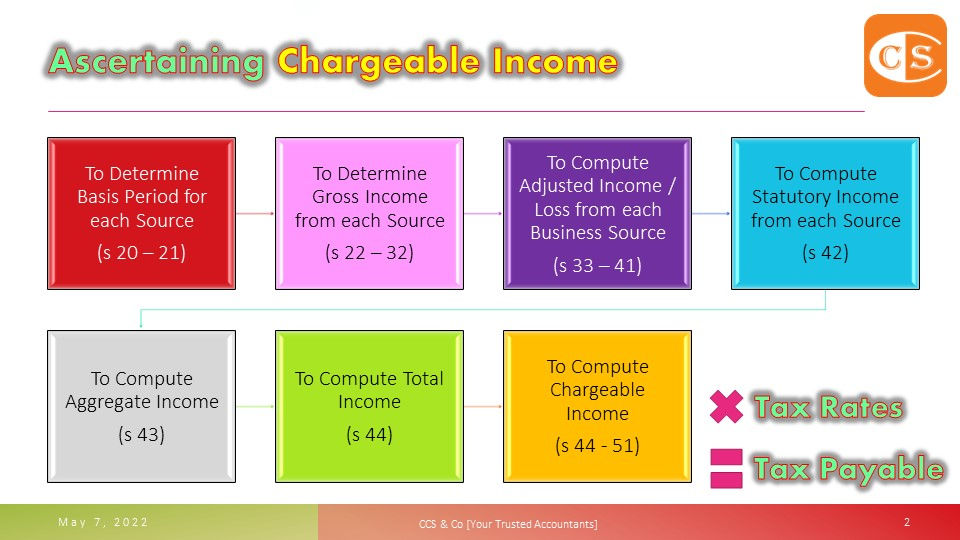
    1. Individual tax residents must subtract personal reliefs — such as those for the individual taxpayer, children, and so on — from their Total Income to arrive at Chargeable Income.

    2. Next, it is necessary to apply the appropriate tax rates to the Chargeable Income, which are determined by:

    👉 the type of taxpayer in question (for example, a knowledge worker in Iskandar Malaysia is taxed at 15%.) and

    👉 the rate of tax applicable to that person (Graduated Tax Rates apply to resident individuals).

    👉 Since non-individuals are not eligible for personal exemptions, the chargeable income of non-individuals (including companies, Limited Liability Partnership, etc.) will be the same as total income.

    3. As to how to Determine the Basis Period for each Source, Determine Gross Income from each Source, Compute Adjusted Income / Loss from each Business Source, Compute Statutory Income from each Source, Compute Aggregate Income, and Compute Total Income, are other stories.

    4. Join our Telegram – https://t.me/YourAuditor

    🌻🌻🌻🌻🌻🌻🌻🌻🌻🌻🌻🌻

    1. 个人税收居民必须从其总收入(Total Income)中减去个人减免 — 如针对其本身、子女等的减免,以得出应征税收入(或称之为“课税收入”)。

    2. 接下来,有必要对应征税收入(或称之为“课税收入”,Chargeable Income)施予适当的税率,这一点由以下因素决定: 👉 有关纳税人的类型(例如,马来西亚伊斯干达的知识工作者的税率为15%);和 👉 适用于该人的税率(累进税率 (Graduated Tax Rates) 仅适用于税务居民个人)。 👉 由于非个人不能享受个人减免的待遇,非个人(包括公司、有限责任合伙公司等)的应征税收入(或称之为“课税收入”)将与总收入 (Total Income)相同。

    3. 至于如何确定每个来源的基准期,确定每个来源的毛收入 (Gross Income),计算每个业务来源的调整收入/损失 (Adjusted Income / Loss),计算每个来源的法定收入 (Statutory Income),计算总收入(Total Income),以及计算课税收入 (Chargeable Income),是另一个故事

    4. Join our Telegram – https://t.me/YourAuditor 🌳🌳🌳🌳🌳🌳🌳🌳🌳🌳🌳🌳

    11