Tag: CTIM

  • IRBM’s Response to CTIM on the Tax Corporate Governance Framework (TCGF) & TCGF Guidelines

    IRBM’s Response to CTIM on the Tax Corporate Governance Framework (TCGF) & TCGF Guidelines

    The new Tax Corporate Governance Framework (“TCGF“), dated April 11, 2022, as well as the Guidelines for the TCG Framework (Guidelines), has been published on the website of the Inland Revenue Board of Malaysia (“IRBM”). The TCG Framework and these Guidelines are intended to be read in conjunction with one another.

    For further information, see the article titled “Tax Corporate Governance Framework Introduced.”

    The Chartered Tax Institute of Malaysia (CTIM) has received responses from the IRBM dated 20 September 2022 to members’ comments and requests for clarification on the Tax Corporate Governance Framework and TCGF Guidelines regard to specific issues.

    Issue No 1 – The Criteria

    Refer to paragraph 4.1 of the TCG Framework Guidelines:-
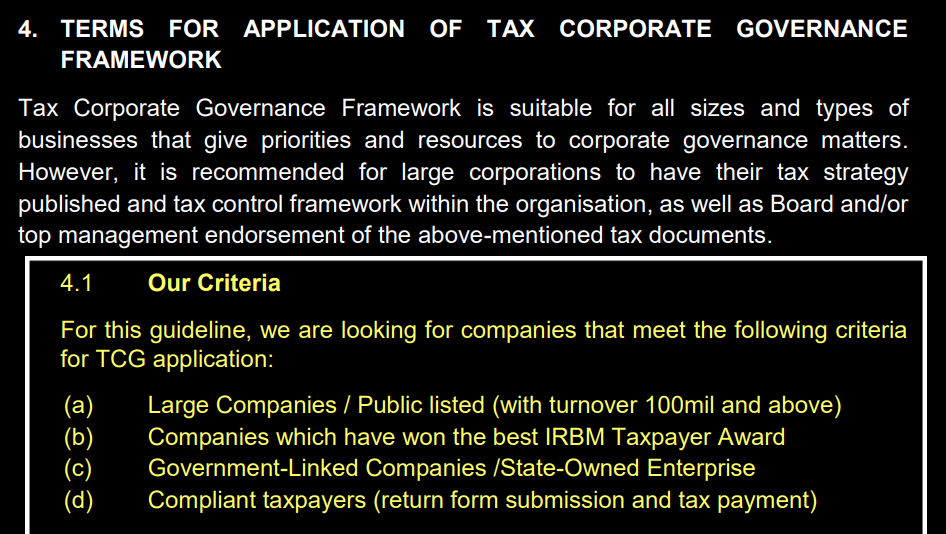
    IRBM has confirmed that other companies, in addition to those mentioned above, are free to come forward voluntarily to apply for and participate in the Tax Corporate Governance Framework (TCGF) Programme.

    Other interested organisations may contact IRBM via [email protected] to communicate their interest or to obtain further information on the Programme.

    Issue No 2 – Application of Tax Corporate Governance

    Refer to paragraph 4.2 of the TCG Framework Guidelines:-
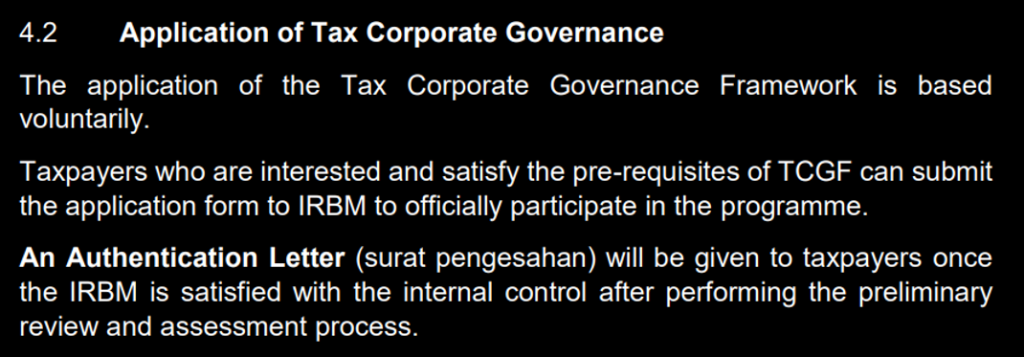
    CTIM members’ comments and requests for clarification:-

    Will the application form to participate in the TCGF Programme be available on the IRBM’s website?

    It is suggested that the IRBM issues a prescribed form for submission by taxpayers to maintain consistency in the applications submitted.

    Please advise the earliest date a taxpayer can apply to participate in the TCGF Programme.

    Is there any deadline to apply?

    It is stated that an authentication letter is given to taxpayers once the IRBM is satisfied with the internal control after performing the preliminary review and assessment process. What is the timeline for the IRBM to issue this letter, and who will conduct the preliminary review and assessment?

    IRBM’s Response:

    A test run of the TCG is being carried out as a pilot project in Malaysia at the moment.

    As a result, an invitation to participate in the programme will be sent from Inland Revenue to the chosen company, and the application form will be made available to them.

    Other interested companies can get in touch with IRBM via [email protected] to express their interest or to gain further information, and notification will only be given to the qualified organisation.

    The framework says that the proposed time frame, which starts when the IRBM accepts the participant as a participant and ends when the participant status is granted, is eight to twelve months.

    A TCG committee will examine this with TCG officers from the branch office.

    Issue No 3 – TCG Review

    Refer to paragraph 9 of the TCG Framework Guidelines:-
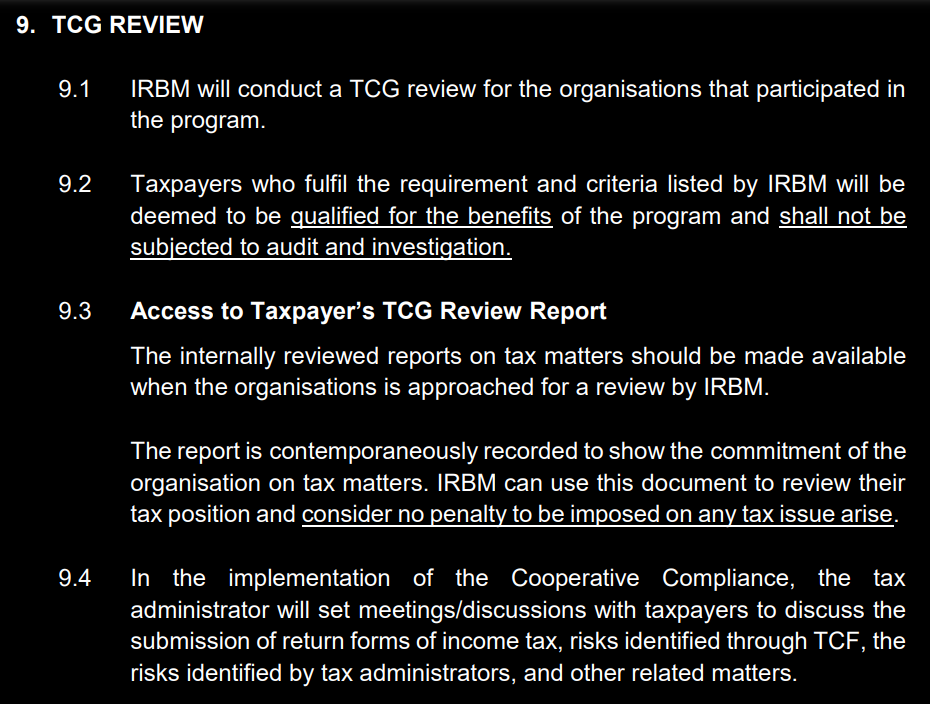
    CTIM members’ comments and requests for clarification:-

    • Please elaborate on the procedures in place to review the TCG. Please also clarify if the TCG will be reviewed by the same IRBM branch which handles the taxpayer’s income tax files.
    • Is there any separate team in the IRBM in charge of the framework? If so, any contact details?
    • Will the review process result in an audit on the taxpayer?
    • Understand that taxpayers who fulfil the requirement and criteria listed by the IRBM will be deemed qualified for the program’s benefits and shall not be subjected to audit and investigation, but for how long (e.g. 3 years, 5 years, etc.) will not be subjected to audit and investigation after the Authentication Letter is issued?
      • Also, please confirm if exclusion from audit and investigation will cover all tax aspects, so long as the framework covers the same taxes, transfer pricing etc.
    • Please confirm that information provided to the IRBM for the purpose of the Programme are strictly confidential and will not be shared with other Government agencies or used against taxpayers to conduct tax audits and investigations.

    IRBM’s Response:

    The TCG review will be conducted by the TCG committee and TCG officers from the branch office, which handles the organisation’s income tax files.
    The IRBM will perform an adequacy review of the organisation’s TCGF and an effectiveness review of the organisation’s tax control framework (TCF).

    Organisations may contact IRBM via [email protected] for any questions regarding TCG Framework and Guidelines.

    The review procedure is primarily for the IRBM to accept the organisation into the programme.

    IRBM will discuss the issues upfront with the organisation if any key tax risk areas are identified during the review.

    Taxpayers that fulfil the requirement will not be subjected to audit and investigation for three (3) assessment years from the date of the award letter. TCGF should be applied comprehensively to collectively enjoy the programme benefit (terms applied).

    The information provided to the IRBM for the purpose of the programme is treated as confidential.

    Issue No 4 – TCG Process

    Refer to paragraph 12 of the TCG Framework Guidelines:-
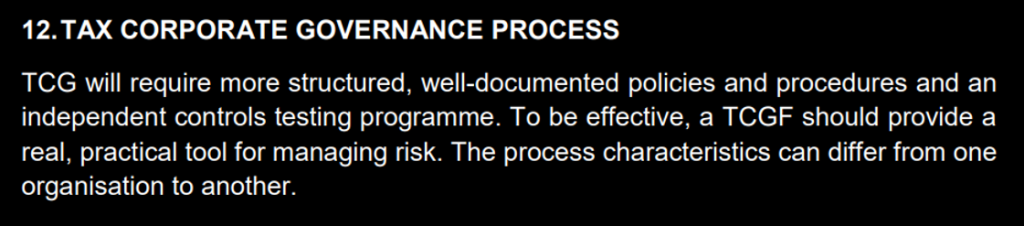
    An approach to implementing tax governance procedures is described in the following process.
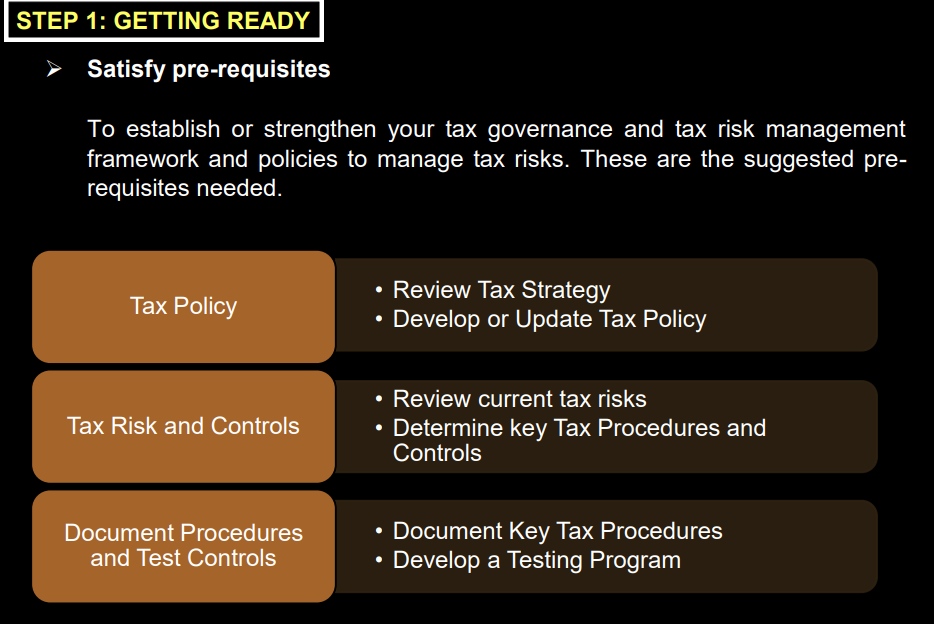
    CTIM members’ comments and requests for clarification:-

    Will thresholds be implemented to determine what constitutes key/material transactions undertaken by the taxpayer (including related party transactions) and thus needs to be specifically addressed in the TCGF in terms of tax risks involved?

    If so, will the threshold be based on absolute value alone as per Paragraph 13.1 of the TCGF Guidelines (or proportion of a certain denominator, e.g. revenue)?

    IRBM’s Response:

    IRBM will not set the thresholds since the organisation may have different needs, sizes and backgrounds. The organisation’s tax control framework shall be able to identify, overcome, control and report tax risks suitable to the organisation’s tax policy/tax strategy and the organisation’s risk appetite.
    CTIM members’ comments and requests for clarification:-

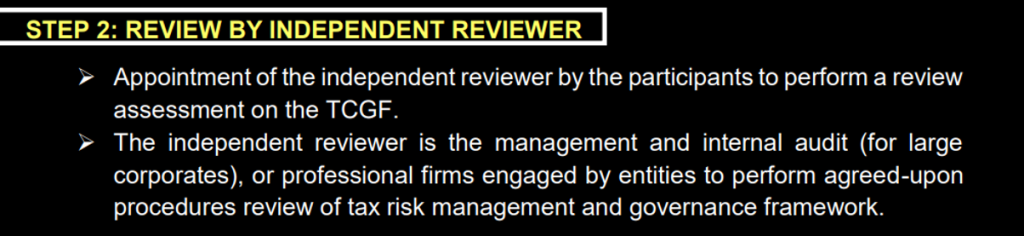
    Can an approved tax agent under S.153 of the ITA 1967 undertake this review assessment?

    If the preparation of the TCGF is outsourced to the tax agent, can another entity within the same group act as a tax agent to perform the review (e.g. internal audit service provider)

    IRBM’s Response:

    Yes. An approved tax agent under S.153 of the ITA 1967 can undertake this review assessment. However, for greater independence, the organisation should appoint different parties to perform the review.

    CTIM members’ comments and requests for clarification:-

    Please clarify the methods that will be used by the IRBM to review and evaluate the TCGF. Given that documentation must be made available upon request by the IRBM, please clarify the notice period provided to taxpayers upon the IRBM’s request.

    IRBM’s Response:

    IRBM will perform an adequacy review on the organisation’s TCGF and an effectiveness review on the organisation’s TCF.

    The following methods can be used to check and evaluate TCGF and TCF:

    1. Reperformance
    2. Tests and inspections
    3. Observation d) Questions

    In general, the organisation is responsible for maintaining sufficient documentation to meet the programme’s requirements. We understand that due to certain reasons, the organisation may require more time to prepare the documents.

    Therefore, ample time will be given to the organisation to submit the documentation.

    Issue No 5 – TCGF Programme Timeframe

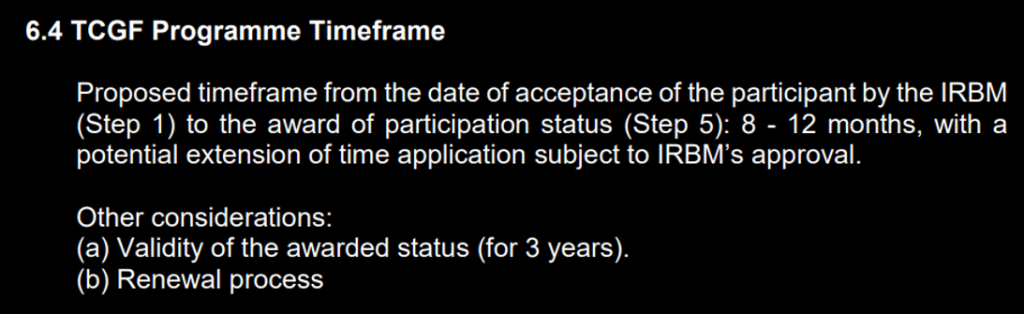
    Refer to paragraph 6.4 of the TCG Framework:-
    CTIM members’ comments and requests for clarification:-

    We note that upon the award of the participation status in the TCGF Programme, the status is valid for a period of 3 years and renewal is required.

    Please elaborate if taxpayers must undergo Steps 1 to 5 as mentioned in Paragraph 12 of the TCGF Guidelines.

    IRBM’s Response:

    Yes, taxpayers will be required to undergo Steps 1 to 5, as mentioned in Paragraph 12 of the TCGF Guidelines.

    Issue No 6 – Benefits of the TCGF Programme

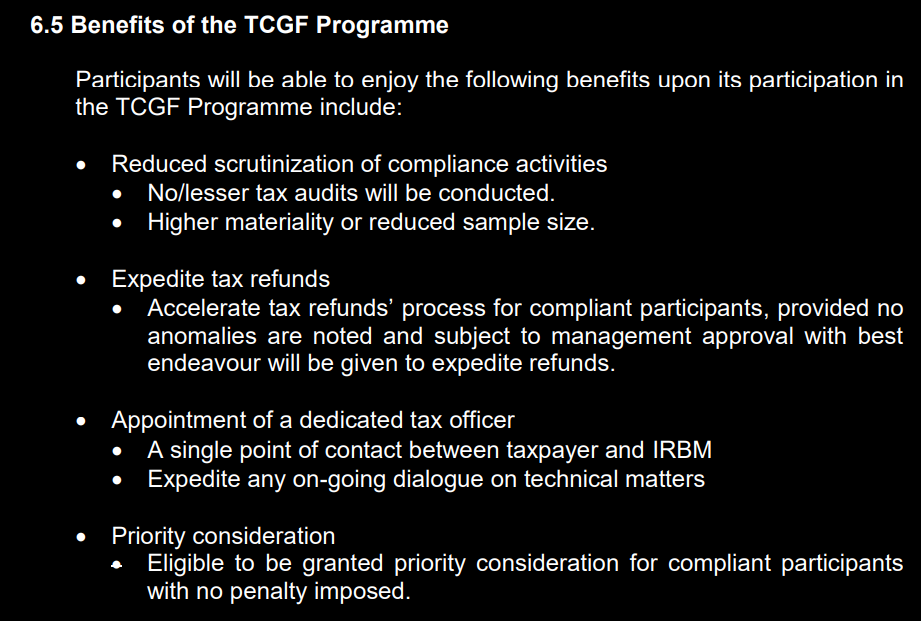
    Refer to paragraph 6.5 of the TCG Framework:-
    CTIM members’ comments and requests for clarification:-

    Priority consideration

    • Eligible to be granted priority consideration for compliance participants with no penalty imposed.

    Please elaborate on the benefits available to taxpayers under this category.

    Will taxpayers benefit from reduced penalty rates where there are issues of non-compliance detected?

    If so, please advise the rate of penalty reduction.

    IRBM’s Response:

    The IRBM will assess the reason for non-compliance and see whether sufficient control has been applied at the organisational level for reduced or no penalty consideration.

    The penalty rate will follow the current ruling.

    Issue No 7 – Others

    CTIM members’ comments and requests for clarification:-

    Are there any participation fees charged by the IRBM?

    IRBM’s Response:

    No participation fee is required.

    Our website's articles, templates, and material are solely for reference. Although we make every effort to keep the information up to date and accurate, we make no representations or warranties of any kind, either express or implied, regarding the website or the information, articles, templates, or related graphics that are contained on the website in terms of its completeness, accuracy, reliability, suitability, or availability. Therefore, any reliance on such information is strictly at your own risk.

    Keep in touch with us so that you can receive timely updates |

    要获得即时更新,请与我们保持联系

    1. Website ✍️ https://www.ccs-co.com/ 2. Telegram ✍️ http://bit.ly/YourAuditor 3. Facebook ✍

    4. Blog ✍ https://lnkd.in/e-Pu8_G 5. Google ✍ https://lnkd.in/ehZE6mxy

    6. LinkedIn ✍ https://www.linkedin.com/company/74734209/admin/

    14
  • IRBM’s Response to CTIM on e-C 2022 (3)

    IRBM’s Response to CTIM on e-C 2022 (3)

    Regarding Form e-C 2022, CTIM has offered feedback and comments to the Inland Revenue Board of Malaysia (IRBM).

    The Inland Revenue Board of Malaysia issued its response on 29 July 2022 and 2 August 2022, respectively.

    Despite this, on 11 August 2022, CTIM provided IRBM with additional feedback and comments on the form e-C 2022 after IRBM‘s responses were provided.

    The IRBM issued their responses on September 9, 2022, to the following sections of Form e-C 2022 mentioned in the CTIM Additional Feedback and Comments on 11 August 2022.

    Issue No 1: Item A2 and A7 – Disclosure in the Form e-C relating to Foreign Source Income

    1.1 Referred to the “Summary of Statutory Income from sources of business(es) and partnership(s) outside Malaysia received in Malaysia starting from 1 July 2022.“

    Currently, the TAeF allows disclosure of 1 country under 1 business source only.

    How do the taxpayers disclose the information in a situation where the foreign source income (FSI) is from multiple countries in one business source (e.g., Business 1)’?

    IRBM’s response on 2 August 2022:

    Income reporting should be done separately by the country. For e-Filing, the system allows the use of the same business code for each reporting business income from different countries.

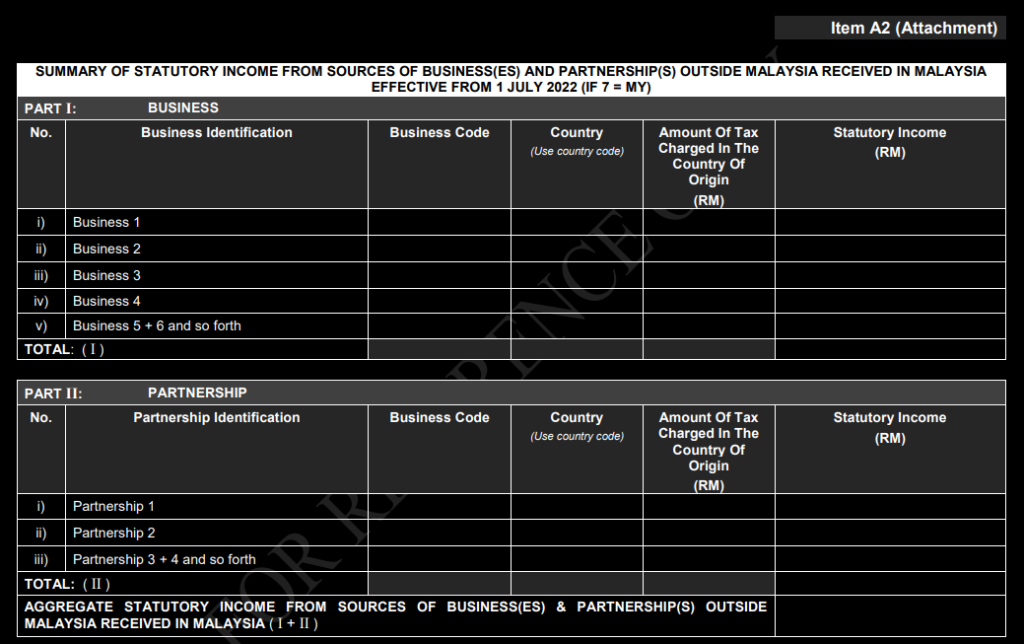
    A2 of the e-Form C 2022 (i.e., Summary of statutory income from sources of business(es) and partnership(s) outside Malaysia received in Malaysia effective from 1 July 2022)

    CTIM additional feedback and comments on 11 August 2022:

    Based on IRBM’s response above, CTIM notes that the system allows the same business code for different countries. However, Form e-C only allows disclosure of 1 business source for 1 country.

    IRBM’s response on 9 September 2022:

    Income from similar activities from the same country should be combined and reported in the same row and space. Income segregation for the same business code from the same country does not need to be done for FSI reporting in e-C 2022.

    CTIM additional feedback and comments on 11 August 2022:

    Based on the A2 of the e-Form C 2022 (i.e., Summary of statutory income from sources of business(es) and partnership(s) outside Malaysia received in Malaysia effective from 1 July 2022), the e-Form C 2022 system seems to have not been updated to allow disclosure of foreign business income for more than 1 country under 1 business source.

    As extracted below, it appears that row 2 has been fixed as Business 2, row 3 as Business 3, and so on.

    CTIM would like to seek further clarification from IRBM on whether:-

    • IRBM will update its system to allow taxpayers to select “business identification” manually, or
    • As long as the taxpayers inserted the same business code in different rows, the IRBM will take these disclosures as foreign business income under 1 business source (even though the business identification column does not match).

    IRBM’s response on 9 September 2022: Taxpayers can use the same business code for each country concerned on different rows to indicate companies doing the same business in those countries.

    The proposal from CTIM will be considered when designing e-C for the subsequent assessment year.

    CTIM additional feedback and comments on 11 August 2022:

    Example: ABC Sdn Bhd has two business sources:

    1. providing engineering services and
    2. trading machines.

    ABC Sdn Bhd has branches in Singapore and Hong Kong that provide the same engineering services.

    In YA 2022, the following information is available for the Form e-C disclosure:

    Based on the example given above, can IRBM guide how the “Summary of statutory income …. In Malaysia” and the “Summary of Statutory Income from sources …. received in Malaysia from outside Malaysia” be completed?

    IRBM’s response on 9 September 2022:

    Based on the limited information above, the following are general guidelines for reporting in e-C 2022:

    1. The statutory income of business 1 in Malaysia is reported in column A1 and appendix A1 respectively.
    2. The statutory income of business 1 in Singapore and Hong Kong is reported either in column A2 and appendix A2 or column A 20 and appendix A20 depending on when the income is remitted. This reporting is subject to the business income in Singapore and Hong Kong having been taxed in those countries.
    3. Interest income from Singapore and Hong Kong must be reported in either column appendix A7 and appendix A7 or columns A 20 and appendix A20, depending on when the income is remitted.

    The ultimate tax reporting and calculation will be determined by the relevant circumstances in connection with:

    • the management of company activities,
    • the date of remittance of income sourced outside of Malaysia, and
    • the income tax status in the place of origin.

    1.2 Capital Allowance disclosure

    CTIM additional feedback and comments on 11 August 2022:

    Using the same example above –

    • How does a taxpayer complete Item C1a (Attachment) of Form e-C for YA 2022?
    • If the remaining portion of the FSI is received in Malaysia in YA 2023, how does a taxpayer complete Item C1a (Attachment) in Form e-C for YA 2023?
    • Only a portion of the statutory FSI is received in Malaysia in YA 2022. In this case, how do we disclose the amount of the CA utilised (absorbed) under Item C1a (Attachment) of Form e-C for YA 2022?

    IRBM’s response on 9 September 2022:

    The disclosure of information regarding capital allowances in schedule 3 of appendix C1a for form e-C2022 is only required if the business income was derived from Malaysia (referring to column and Appendix A1).

    Issued No 2: Item A20 – Income from sources outside Malaysia received in Malaysia for the period from 01.01.2022 to 30.06.2022 [If 7 = MY]

    CTIM additional feedback and comments on 11 August 2022:

    Referring to IRBM’s response on 2 August 2022 (as follows), it appears that a direct translation of the sentence means “the FSI received in Malaysia shall refer to the gross amount“.

    Kindly confirm that the actual FSI remitted shall be taken as the gross income instead, i.e., there is no requirement to re-compute the gross income of which the FSI is remitted into Malaysia.

    IRBM’s response on 9 September 2022:

    There is no need to re-compute the remitted income because it is gross income based on the provisions of Section 6, Part XX of the ITA 1967.

    Issue No 3: Part E – Summary of losses for business and partnership that are subject to restriction under Section 44(5F)

    Previously, this section was used to report normal business and pioneer losses with the heading of the appendix: Summary of Losses (Including Pioneer Losses after tax relief period).

    It is now renamed to cover losses subject to restriction under Section 44(5F).

    However, the Guidebook 2022 still stipulates that this section is “Including Pioneer Losses After Tax Relief Period” (see screenshot below):

    CTIM additional feedback and comments on 11 August 2022:

    As highlighted before, the query concerns the disclosure of the pioneer loss that is subject to the Promotion of Investment Act 1986 (“PIA”).

    The tax treatment of the unabsorbed pioneer loss after the expiry of the pioneer status period is governed under Section 25(5) of the PIA (not Section 44(5F) of the ITA).

    As such, kindly confirm that taxpayers are not required to disclose the unabsorbed pioneer loss that is governed under the PIA in Part E Attachment of Form e-C YA 2022.

    This is because Part E Attachment is only for disclosure of business loss and any pioneer loss that is governed under the ITA.

    As mentioned before, the taxpayers can still continue to maintain the movement of the pioneer losses after the tax relief period (that is governed under the PIA) separately using the HK-F2 (not part of the Form e-C YA 2022 to be submitted to the HASIL) for tax audit purposes.

    IRBM’s response on 9 September 2022:

    This column is intended to report loss positions subject to restrictions under section 44(5F) of the ITA 1967 and includes losses post-pioneer status period.

    IRBM will amend the label of this attachment so that it is more applicable to all circumstances when they develop the future return form.

    Issue No 4: Declaration Section

    Option 2 in the declaration section of the YA2021 Form C was worded as “This return form is prepared based on unaudited accounts.‘

    If a company cannot get its audited financial statements signed by the filing due date but still wishes to submit its tax return, it would select “Option 2′.

    Option 2 also applies to a Permanent Establishment (‘PE’) that is not registered with the Companies Commission of Malaysia (“SSM”) and would not have audited financial statements for tax purposes.

    However, the scenario would no longer fit into any of the above options in the YA 2022 Form C.

    CTIM understand that under the law, unless an audit exemption is granted, a company must submit its tax return based on signed audited financial statements. However, it is not uncommon that the audited accounts could not be ready by the filing due date due to various reasons.

    CTIM’s initial feedback and comments:

    In these circumstances, we would like to seek clarification, particularly:

    Is the company permitted to submit its tax return for YA 2022 based on draft audited financial statements without an audit exemption?

    IRBM’s response on 2 August 2022:

    Form C needs to be drawn up based on the financial statements prepared according to the act of its establishment as provided under section 77A of the ITA 1967.

    For companies incorporated under the Companies Act 2016, form C needs to be submitted based on the audited financial statements signed by the approved company auditor unless the company gets an exemption under the Companies Act 2016 from submitting audited accounts.

    Therefore, the submission of Form C must be based on option 1.

    If the form C submission is not based on audited financial statements, the form C submission will be rejected.

    CTIM additional feedback and comments on 11 August 2022:

    The above response does not address the issue of a PE which is not registered with SSM.

    Kindly clarify

    IRBM’s response on 9 September 2022:

    Sections 561 and 562 of the Companies Act 2016 apply to foreign companies that conduct business in Malaysia.

    The company must submit a tax return form per section 77A(4) of the Income Tax Act 1967, and it must be based on financial statements that have been compiled in line with the act of its establishment.

    Because of this, PEs in Malaysia are required to submit Form C based on audited financial statements under the rules of the PE establishment statute in Malaysia or the act governing the parent company of the PE.

    Submission of tax return forms based on management accounts is invalid and will be subject to penalty under section 112 of the ITA 1967.

    With that, the choice in the Declaration Section of form C has remained.

    Our website's articles, templates, and material are solely for reference. Although we make every effort to keep the information up to date and accurate, we make no representations or warranties of any kind, either express or implied, regarding the website or the information, articles, templates, or related graphics that are contained on the website in terms of its completeness, accuracy, reliability, suitability, or availability. Therefore, any reliance on such information is strictly at your own risk.

    Keep in touch with us so that you can receive timely updates |

    要获得即时更新,请与我们保持联系

    1. Website ✍️ https://www.ccs-co.com/ 2. Telegram ✍️ http://bit.ly/YourAuditor 3. Facebook ✍

    4. Blog ✍ https://lnkd.in/e-Pu8_G 5. Google ✍ https://lnkd.in/ehZE6mxy

    6. LinkedIn ✍ https://www.linkedin.com/company/74734209/admin/

    16
  • IRBM’s Response to CTIM on e-C 2022 (2)

    IRBM’s Response to CTIM on e-C 2022 (2)

    We would like to inform you that the Inland Revenue Board of Malaysia (IRBM) has disseminated a revised version of the Company Return Form (Form C) for the Year of Assessment 2022.

    To download a PDF copy of the return – https://t.me/YourAuditor/3259

    Chartered Tax Institute of Malaysia’s Previous Feedback

    Regarding Form e-C 2022, the Chartered Tax Institute of Malaysia (CTIM) has offered their input and comments to the Inland Revenue Board of Malaysia (IRBM).

    The responses from IRBM were shared by us on August 25, 2022 (https://www.ccs-co.com/post/irbm-s-response-to-ctim-on-e-c-2022)

    Chartered Tax Institute of Malaysia’s Additional Feedback

    Following the responses provided by IRBM, CTIM has forwarded Additional Feedback and Comments on Form e-C 2022 to IRBM. Some of the areas:-

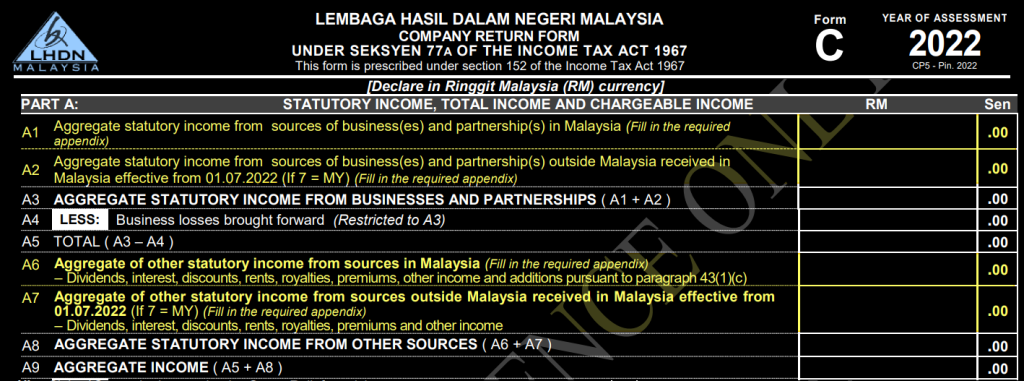
    1. Statutory Income, Total Income and Chargeable Income [Part A]
    2. Summary of Statutory Income from Sources of Business(es) and Partnership(s) in Malaysia [Attachment A1]
    3. Summary of Statutory Income from Sources of Business(es) and Partnership(s) Outside Malaysia Received in Malaysia Effective From 1 July 2022 [Attachment A2]
    4. Other Statutory Income from Other Sources in Malaysia [Attachment A6]
    5. Other Statutory Income from Sources Outside Malaysia Received in Malaysia Effective from 1 July 2022 [Attachment A7]
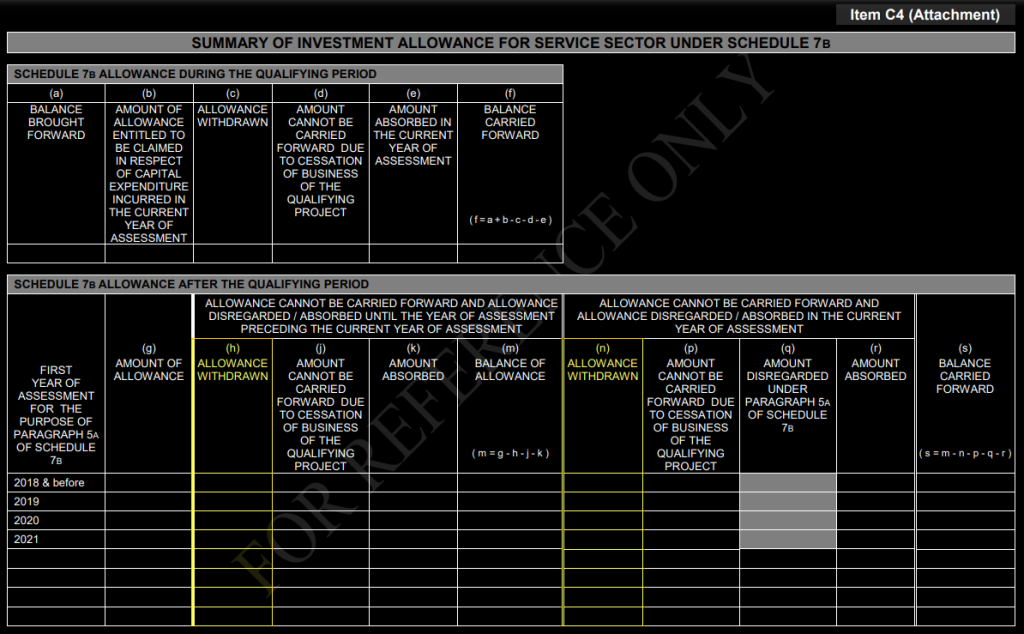
    6. Summary of Investment Allowance for Service Sector Under Schedule 7B [Attachment C4]

    The responses were provided by IRBM on September 9, 2022.

    Issue No 1: Statutory Income, Total Income and Chargeable Income [Part A]

    Form e-C 2022:

    There is a reference to the columns A1, A2, A6, and A7.

    Matter 1

    In Form e-C 2022, Aggregate Statutory Income from sources of businesses/partnerships in Malaysia and Aggregate Statutory Income from sources of businesses/partnerships outside Malaysia received in Malaysia effective from 01.07.2022 are to be disclosed separately:

    • A1; and
    • A2

    But, Statutory income from businesses and partnerships is taxed as a source of income under Section 4(a) of the ITA. This is true no matter country of origin from (what country the income comes).

    Matter 2

    In Form e-C 2022, Aggregate Statutory Income from sources in Malaysia and Aggregate Statutory Income from sources outside Malaysia received in Malaysia effective from 01.07.2022 are to be disclosed separately:

    • A6; and
    • A7

    But, These statutory incomes are taxed as separate sources of income, regardless of country of origin.

    Practical Issue

    • This distinction between Malaysian and foreign origin increases the cost of compliance since additional effort will be necessary, for example, to apportion the amounts for each source of income.
    • As a result, the cost of compliance will increase.

    Feedback / Proposal of CTIM

    • To remain as per YA2021 as a single item labelled Aggregate statutory income from other sources

    Response of IRBM on September 9, 2022

    The separation between income from Malaysia and income from outside Malaysia received in Malaysia must be done in the tax calculation for the purpose of:

    1. Ensures the correct imposition of tax rates and avoids source income outside Malaysia received in Malaysia from being taken into account in determining tax according to the prosperous tax rate (33%).
    2. Determining the eligibility of tax credit claims under sections 132 and 133, as this depends on whether or not that country has a DTA with Malaysia.

    Issue No 2: Summary of Statutory Income from Sources of Business(es) and Partnership(s) in Malaysia [Attachment A1]

    Attachment A1 of Form e-C 2022:

    Attachment A1 in Form e-C 2022 requires a summary of Statutory Income from Sources of Business(es) and Partnership(s) in Malaysia only.

    Practical Issue

    • This distinction between Malaysian and foreign origin increases the cost of compliance since additional effort will be necessary, for example, to apportion the amounts for each source of income.
    • As a result, the cost of compliance will increase.

    Feedback / Proposal of CTIM

    • To remain as per YA2021, i.e., Attachment A1 for both sources in Malaysia and Outside Malaysia Received in Malaysia, effective from 1 July 2022.

    Response of IRBM on September 9, 2022

    Refer to IRBM’s response for Issue No 1.

    Issue No 3: Summary of Statutory Income from Sources of Business(es) and Partnership(s) Outside Malaysia Received in Malaysia Effective From 1 July 2022 [Attachment A2]

    Attachment A2 in Form e-C 2022 requires a summary of Statutory Income from Sources of Business(es) and Partnership(s) outside Malaysia received in Malaysia effective from 1 July 2022.

    Practical Issue

    • This distinction between Malaysian and foreign origin increases the cost of compliance since additional effort will be necessary, for example, to apportion the amounts for each source of income.
    • As a result, the cost of compliance will increase.
    • In addition, the Attachment only allows a maximum of 5 rows in any individual component.
    • Where there are several countries of origin for the same business or partnership source, taxpayers would not be able to give the relevant information.

    Feedback / Proposal of CTIM

    • To remove this Attachment, apply Attachment A1 for both sources in Malaysia and Outside Malaysia Received in Malaysia, effective from 1 July 2022.

    Response of IRBM on September 9, 2022

    Refer to IRBM’s response for Issue No 1.

    Furthermore, if there is insufficient space, the 5th and subsequent foreign source of business income should be combined and reported in the 5th line of each category.

    The Taxpayer can place one of the countries in the “Country” column. Keep complete records of each business source of income outside Malaysia for audit purposes.

    Issue No 4: Other Statutory Income from Other Sources in Malaysia [Attachment A6]

    Attachment A6 in Form e-C 2022 requires a summary of Other Statutory Income from Other Sources in Malaysia only.

    Practical Issue

    • This distinction between Malaysian and foreign origin increases the cost of compliance since additional effort will be necessary, for example, to apportion the amounts for each source of income.
    • As a result, the cost of compliance will increase.

    Feedback / Proposal of CTIM

    • To remain as per YA2021, i.e., Attachment A6 for both sources in Malaysia and Outside Malaysia Received in Malaysia, effective from 1 July 2022.

    Response of IRBM on September 9, 2022

    Refer to IRBM’s response for Issue No 1.

    Issue No 5: Other Statutory Income from Sources Outside Malaysia Received in Malaysia Effective from 1 July 2022 [Attachment A7]

    Attachment A7 in Form e-C 2022 requires a summary of Other Statutory Income from Other Sources outside Malaysia received in Malaysia effective from 1 July 2022.

    Practical Issue

    • This distinction between Malaysian and foreign origin increases the cost of compliance since additional effort will be necessary, for example, to apportion the amounts for each source of income.
    • As a result, the cost of compliance will increase.

    Feedback / Proposal of CTIM

    • To remain as per YA2021, i.e., Attachment A6 for both sources in Malaysia and Outside Malaysia Received in Malaysia, effective from 1 July 2022.

    Response of IRBM on September 9, 2022

    Refer to IRBM’s response for Issue No 1.

    Issue No 6: Summary of Investment Allowance for Service Sector Under Schedule 7B [Attachment C4]

    On Items h and n – Allowance Withdrawn

    Issues

    Schedule 7B of the ITA does not have provisions for the withdrawal of allowances.

    Feedback / Proposal of CTIM

    • To remove items “h” and “n” from the Attachment

    Response of IRBM on September 9, 2022

    The Income Tax Act of 1967, Schedule 3, Paragraph 2 provides the Minister with authority to approve written applications for service sector investment allowances and to set such terms and conditions as it sees proper.

    As a consequence, the company is not qualified to make a claim for the sector investment allowance service if any of the conditions are violated.

    Therefore, maintaining Columns “h” and “n” is important because it is necessary to fill in these columns if a company that has claimed service sector investment allowances in previous years of assessment is found to be in violation of the conditions established by the Minister in the current year, which renders the company ineligible to claim the sector investment allowance (This occurs when the Minister discovers that the company has violated the conditions set forth by the Minister in the current year.)

    In addition, columns “h” and “n” also need to be maintained in parallel with the existence of columns “c”.

    Our website's articles, templates, and material are solely for reference. Although we make every effort to keep the information up to date and accurate, we make no representations or warranties of any kind, either express or implied, regarding the website or the information, articles, templates, or related graphics that are contained on the website in terms of its completeness, accuracy, reliability, suitability, or availability. Any reliance on such information is therefore strictly at your own risk.

    Keep in touch with us so that you can receive timely updates |

    要获得即时更新,请与我们保持联系

    1. Website ✍️ https://www.ccs-co.com/ 2. Telegram ✍️ http://bit.ly/YourAuditor 3. Facebook ✍

    4. Blog ✍ https://lnkd.in/e-Pu8_G 5. Google ✍ https://lnkd.in/ehZE6mxy

    6. LinkedIn ✍ https://www.linkedin.com/company/74734209/admin/

    20
  • Double Tax Deduction for the Cost of Detection Test of Covid-2019

    Double Tax Deduction for the Cost of Detection Test of Covid-2019

    In the exercise of the powers conferred by paragraph 154(1)(b) read together with paragraph 33(1)(d) of the Income Tax Act 1967 [Act 53], the Minister, on September 9, 2022, gazetted the Income Tax (Deduction for Expenses in relation to the Cost of Detection Test of Coronavirus Disease 2019 (COVID-19) for Employees) (Amendment) Rules 2022 (P.U. (A) 291/2022) (“Amendment Rules“) to amend the Income Tax (Deduction for Expenses in relation to the Cost of Detection Test of Coronavirus Disease 2019 (COVID-19) for Employees) Rules 2021 [P.U. (A) 404/2021] (“Principal Rules”).

    Income Tax (Deduction for Expenses in relation to the Cost of Detection Test of Coronavirus Disease 2019 (COVID-19) for Employees) Rules 2021

    Under these Principal Rules, a Double Tax Deduction of expenses incurred by an employer resident in Malaysia for the cost of detection test of COVID-19 for its employees from 1 January 2021 until 31 December 2021.

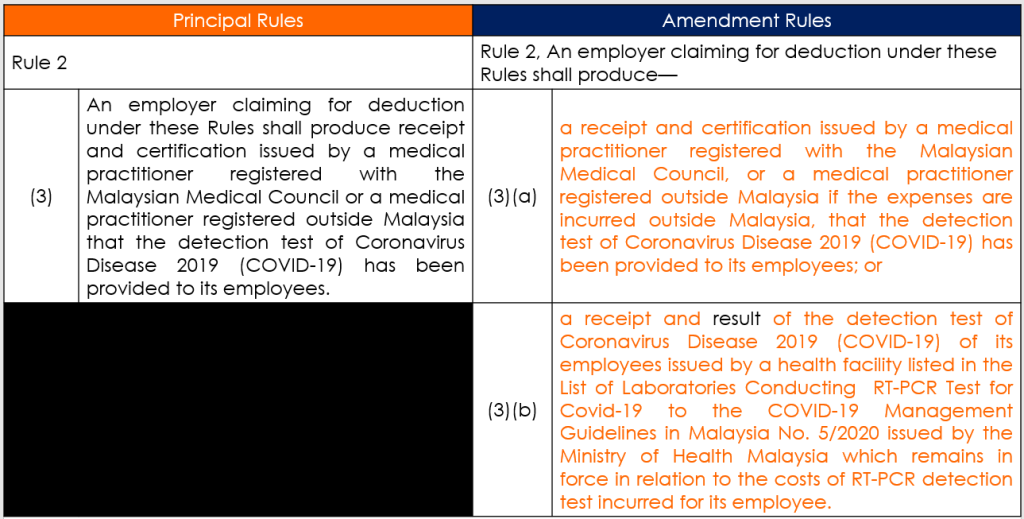
    An employer who wishes to claim a deduction under the Rules must produce a receipt and certification issued by a medical practitioner registered with the Malaysian Medical Council or a medical practitioner registered outside Malaysia stating that the Covid-19 Detection Test has been provided to the employees of the employer.

    Therefore, a medical report without a certificate is not eligible to claim this deduction.

    Likewise, receipts without a certificate are also not eligible to claim this deduction.

    The Inland Revenue Board of Malaysia has issued responses dated 18 May 2022 to CTIM members’ issues dated January 31, 2022, reiterating that Sub-rule 2(3) in P.U(A) 404/2021 must be complied with.

    Income Tax (Deduction for Expenses in relation to the Cost of Detection Test of Coronavirus Disease 2019 (COVID-19) for Employees) (Amendment) Rules 2022

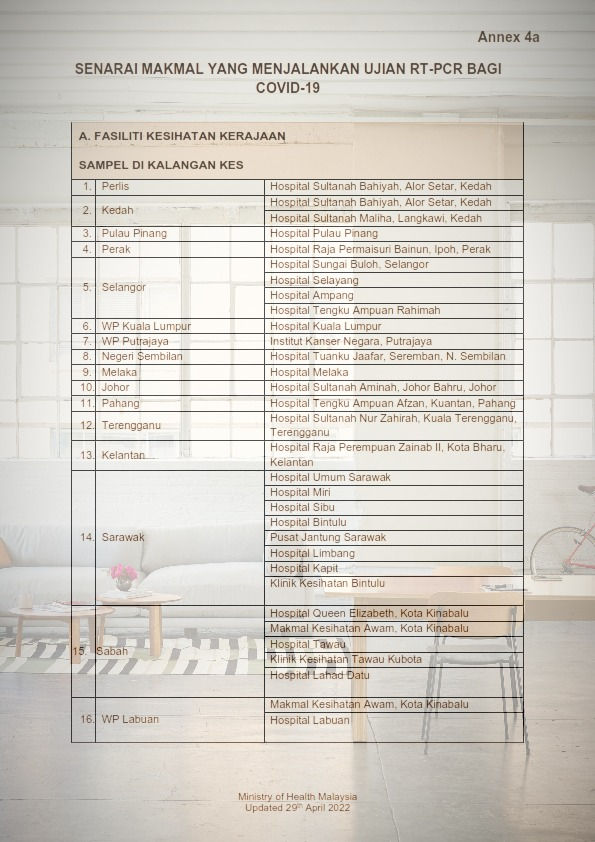
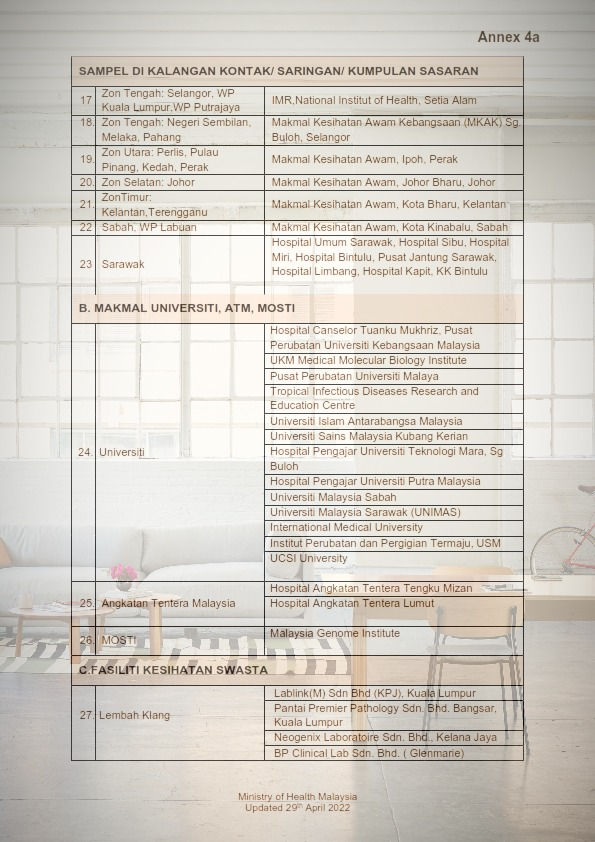
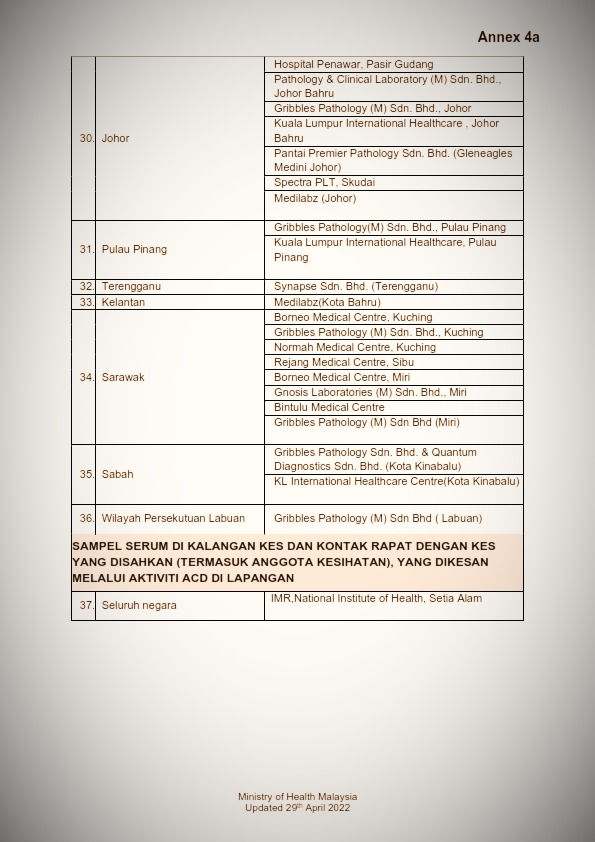
    The Amendment Rules amend the Principal Rules to state that, as an alternative, an employer wishing to claim such a deduction may present a receipt and the results of the Covid-19 Detection Test performed on its employees and issued by a health facility listed in the List of Laboratories Conducting RT-PCR Test for Covid-19 to the COVID-19 Management Guidelines in Malaysia No. 5/20201 issued by the Ministry of Health Malaysia.

    List of Laboratories Conducting RT-PCR Test for Covid-19 to the COVID-19 Management Guidelines in Malaysia No. 5/20201

    To Download:

    Our website's articles, templates, and material are solely for reference. Although we make every effort to keep the information up to date and accurate, we make no representations or warranties of any kind, either express or implied, regarding the website or the information, articles, templates, or related graphics that are contained on the website in terms of its completeness, accuracy, reliability, suitability, or availability. Any reliance on such information is therefore strictly at your own risk.

    Keep in touch with us so that you can receive timely updates |

    要获得即时更新,请与我们保持联系

    1. Website ✍️ https://www.ccs-co.com/ 2. Telegram ✍️ http://bit.ly/YourAuditor 3. Facebook ✍

    4. Blog ✍ https://lnkd.in/e-Pu8_G 5. Google ✍ https://lnkd.in/ehZE6mxy

    6. LinkedIn ✍ https://www.linkedin.com/company/74734209/admin/

    26
  • IRBM’s Response to CTIM on Profiling Issues

    IRBM’s Response to CTIM on Profiling Issues

    According to what the CTIM has been told, the Intelligence and Profiling Department of the Inland Revenue Board of Malaysia (IRBM) has been making requests for information involving tax practitioners and their clients (such as the names, identity card numbers, tax reference numbers, contact numbers, etc.) to gather data from tax practitioners and other industries in general.

    To explore the concerns that have arisen as a result of those mentioned above, CTIM collaborated with IRBM to host a virtual meeting on June 21, 2021, as well as a discussion forum on March 9, 2022.

    IRBM reaffirmed that the primary goal of IRBM, which is to gather this information, is to address the issue of omission, tax leakage, and economic issues that are harmful to the government and bring a significant influence on the growth and well-being of the nation.

    The Institute has since obtained clarification from IRBM regarding the following issues about Profiling Issues:

    1. Moving ahead, the IRBM‘s request for information and details will take on a more “targeted” approach in the data collection operation. IRBM is currently in the process of modifying the format of the letter.
    2. The taxpayers and tax agents may not necessarily have to provide IRBM with all the information and details the company has sought from them as part of its information-gathering activity. In contrast to a Tax Audit or Tax Investigation, it is understood by IRBM that, for the Intelligence and Profiling Department’s information gathering exercise, only information and details that are easily accessible in the possessions of taxpayers or tax agents are expected to be submitted to IRBM.
    3. IRBM has confirmed that submitting only easily accessible information and details, such as those specified in item 2 above, would not be regarded as providing incomplete information and will not be subject to punishment in this regard.
    Our website's articles, templates, and material are solely for reference. Although we make every effort to keep the information up to date and accurate, we make no representations or warranties of any kind, either express or implied, regarding the website or the information, articles, templates, or related graphics that are contained on the website in terms of its completeness, accuracy, reliability, suitability, or availability. Any reliance on such information is therefore strictly at your own risk.

    Keep in touch with us so that you can receive timely updates |

    要获得即时更新,请与我们保持联系

    1. Website ✍️ https://www.ccs-co.com/ 2. Telegram ✍️ http://bit.ly/YourAuditor 3. Facebook ✍

    4. Blog ✍ https://lnkd.in/e-Pu8_G 5. Google ✍ https://lnkd.in/ehZE6mxy

    6. LinkedIn ✍ https://www.linkedin.com/company/74734209/admin/

    21
  • IRBM’s Response to CTIM on  Forms CP 22 / CP 22A

    IRBM’s Response to CTIM on Forms CP 22 / CP 22A

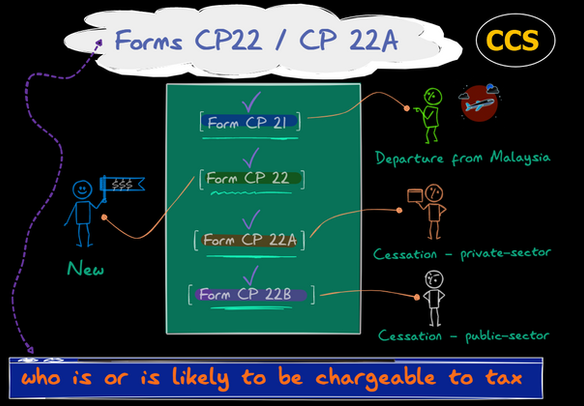
    Mandatory adoption of Prescribed Forms CP 21, CP 22, CP 22A and CP 22B effective from 1 January 2022

    Effective January 1, 2021, under the amendments to subsections 83 (2), (3), and (4) of the Income Tax Act 1967, Forms CP 21, CP 22, CP 22A, and CP 22B must be submitted by the employers using the Forms as prescribed by the Malaysian Inland Revenue Board (IRBM) under section 152 of the Act for:

    • Notification of Employee’s Departure from Malaysia;
    • Notification of New Employee;
    • Notification of Cessation of Employment or Death of Employees

    Income Tax Act 1967

    Section 83(2):

    Where an employer commences to employ an individual who is or is likely to be chargeable to tax in respect of income in respect of gains or profits from the employment, the employer shall give notice in the prescribed form to the Director-General (“DG”) not later than thirty days after the commencement of the employment.

    Section 82(3):

    Where an employer is about to cease to employ an individual who is or is likely to be chargeable to tax in respect of income in respect of gains or profits from the employment or where an individual under his employment dies, the employer shall, not less than thirty days before the cessation of the employment, or in respect of cessation by reason of death not more than thirty days after being informed of the death of the individual, give notice in the prescribed form to the Director-General of the cessation of the employment:

    Provided that, where he is satisfied that it is reasonable to do so in the circumstances, the Director-General may accept for the purposes of this subsection:

    • a notice in the prescribed form given less than thirty days before the cessation of the employment, or
    • a notice in the prescribed form given on or after the cessation, or
    • in respect of cessation by reason of death, a notice in the prescribed form given more than thirty days after being informed of the death of the individual:

    Provided further that an employer shall not be required to give the notice in the prescribed form to the Director General under this subsection in respect of an individual—

    1. where the income from the employment of that individual is subject to deduction under any rules made pursuant to section 154(1)(a); or
    2. where the total monthly remuneration from the employment of that individual is below the minimum amount of income that is subject to deduction under any rules made pursuant to section 154(1)(a),

    and where it is known to him that the individual is not retiring from any employment.

    Layman’s terms

    According to Section 83(2) and (3), an employer who has an employee who is or is likely to be chargeable to tax is obligated to provide written notice in the prescribed form to the DG.

    According to Section 83(2), 83(3), and 83(4) of the ITA, “only individual likely to be charged tax” need to give written notification using Forms CP21, Form 22, and Form 22A.

    IRBM’s Practice

    However, in the course of the tax audit, Unit Majikan requests that Form CP 22 be produced for all employees (including those who are not liable to income tax). 

    It appears that ALL newer and leavers are required to give notice via Forms CP21, 22, and 22A.

    IRBM’s Response to CTIM

    The MIRB has responded, dated 27 April 2022, to the above issues that were brought up in the CTIM Memorandum on Compliance and Operational Issues 1/2022 dated 12 April 2022.

    Employers are responsible for reporting new employees who are taxable or likely to be taxed on Form CP22 (Prescribed Form for the Notification of New Employee) within thirty days of the date the employee began working for the company.

    It is not a violation of the law for a Unit Majikan audit officer to request Form CP22 from all newly hired employees, including those who are not taxable, as part of their auditing duties.

    The audit officer from Unit Majikan is asking for Form CP22 to verify and cross-reference whether or not the employer complies with the provisions of subsection 83(2) of the ITA 1967.

    If the employer does not submit CP22 forms for new employees who are not eligible or taxable, the employer has the option of providing the Unit Majikan audit officer with supporting documentation, such as salary slips or any other documents that show payment of salary,

    • These documents verify or prove that the employee is not eligible to be taxed.

    Employers do not need to submit Forms CP 22A or CP 22B if the employee’s income is subject to a monthly tax deduction (PCB) or the employee’s monthly salary is below the minimum amount eligible for PCB. However, this is conditional on whether the employee will continue to work or not or retire from any employment in Malaysia.

    It is possible to submit Forms CP21, CP22A, and CP22B online using the e-SPC service, which may be accessed through MyTax. In addition, IRBM is working to improve the e-SPC service to allow required Forms to be uploaded through the portal.

    In 2023, IRBM will commence the process of developing the online submission mechanism for Form CP22.

    Our website's articles, templates, and material are solely for reference. Although we make every effort to keep the information up to date and accurate, we make no representations or warranties of any kind, either express or implied, regarding the website or the information, articles, templates, or related graphics that are contained on the website in terms of its completeness, accuracy, reliability, suitability, or availability. Any reliance on such information is therefore strictly at your own risk.

    Keep in touch with us so that you can receive timely updates |

    要获得即时更新,请与我们保持联系

    1. Website ✍️ https://www.ccs-co.com/ 2. Telegram ✍️ http://bit.ly/YourAuditor 3. Facebook ✍

    4. Blog ✍ https://lnkd.in/e-Pu8_G 5. Google ✍ https://lnkd.in/ehZE6mxy

    6. LinkedIn ✍ https://www.linkedin.com/company/74734209/admin/

    23
  • IRBM’s Response to CTIM’s Development Cost for Customised Computer Software

    IRBM’s Response to CTIM’s Development Cost for Customised Computer Software

    Income Tax (Capital Allowance) (Development Cost for Customised Computer Software) Rules 2019

    On 3 October 2019, the Minister, in the exercise of the powers conferred by paragraphs 154(1)(b), 33(1)(d) and paragraphs 10 and 15 of Schedule 3 to the Income Tax Act 1967 [Act 53], gazetted the Income Tax (Capital Allowance) (Development Cost for Customised Computer Software) Rules 2019 [P.U (A) 274/2019].

    On April 9, 2020, the Malaysian Inland Revenue Board (also known as the “IRBM”/”LHDNM”) issued Practice Note No. 2/2020 (“Practice Note”) with a publication date of March 16, 2020.

    The purpose of this Practice Note is to provide some direction on how these Rules should be put into practice.

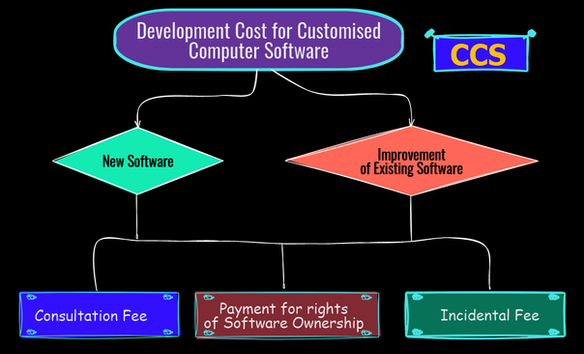
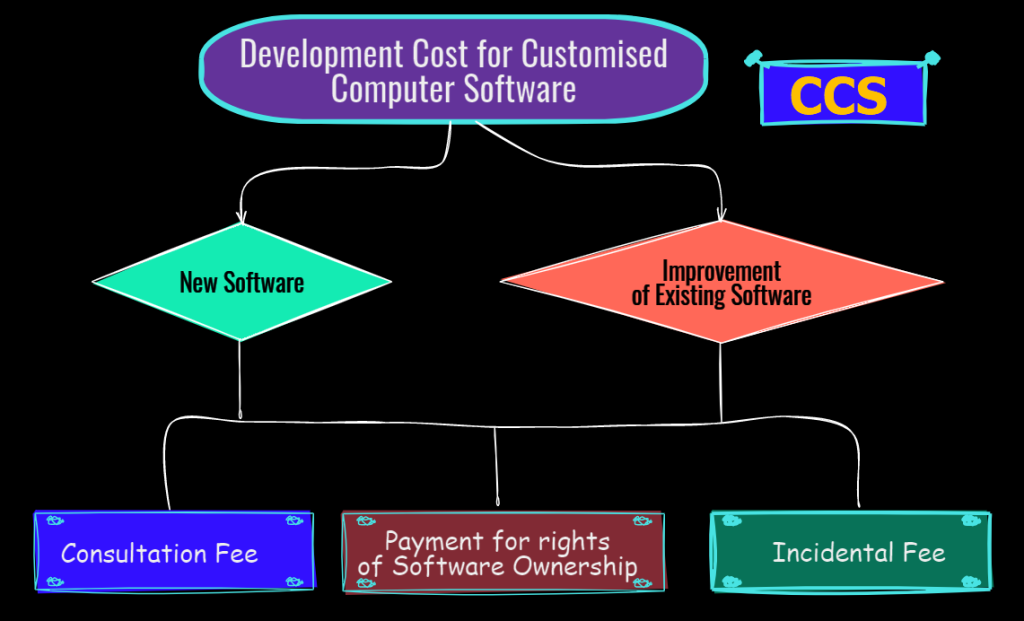
    According to the Practice Note, the term “development cost” for customised computer software refers to:

    • the expenses incurred in:
      • producing new software; or
      • improving the existing software
    • for it to be used to conduct business.

    Based on the Rules effective from YA 2018:

    • a Malaysian resident who has incurred qualifying development costs for customised computer software
    • will be eligible for CA claims at 20% Initial Allowance (IA) and 20% Annual Allowance (AA).

    Qualifying Development Costs

    • Consultation Fee
      • Consultation fee incurred on the development of the software specifically to develop a new software system, modification or modernisation of the existing software, excluding consultation fees related to initial procedure or planning stage such as feasibility study or preliminary study.
    • Payment for rights of software ownership
      • Payment for the right to use the software exclusively.
    • The incidental fee relating to the development of customised computer software
      • Payment incurred, which enabled the use of the software in a business and capitalised such as change of requirement the software.

    However, the Practice Note does not include a comprehensive list of examples of incidental expenses that may be seen as related to customised computer software production.

    Withholding Tax Implications

    Withholding tax (often known as “WHT”) may be applied to payments made to non-residents for the costs of developing customised computer software under either Section 109 or Section 109B of the Income Tax Act (ITA), depending on the specific circumstances of each transaction.

    If the appropriate WHT is not withheld and remitted to the MIRB within one month after paying or crediting the non-resident:

    • A penalty equal to 10% of the unpaid WHT will be assessed.
    • In addition, a capital allowance would not be granted for any qualifying capital expenditures that were incurred but for which the WHT, if applicable, had not been paid or remitted to the MIRB. In this case, the expenditure would not be eligible for a capital allowance.

    Capital allowance can be claimed in the basis period for a YA that the customised computer software can be used in a business.

    Effective Date and Timing of Claim

    The Practice Note provides:

    • The Rules apply to development costs for customised computer software incurred in the basis period from YA 2018.
    • The cost is considered/deemed to have been incurred when the customised software can be used for business purposes.

    To better demonstrate the position of the IRBM on the conditions above, the following examples have been provided in Practice Note 2/2020.

    * Y/A 2017’s cost of development does not qualify.

    Non Application

    The claim for capital allowance for the development cost of customised software provided under these Rules, however, will not be applicable if the person has claimed in respect of the customised software:

    • Any incentive under the Promotion of Investment Act 1986
    • Deduction under s 33 of the Income Tax Act 1967 (ITA)
    • Deduction for research and development expenditure under s 34A of ITA
    • Reinvestment allowance
    • Investment allowance for the services sector
    • Accelerated capital allowance under any Rules, or
    • Any tax exemption which is equivalent to any part or the whole amount of the development cost incurred.

    Response from the IRBM on 19 May 2022

    On 19 May 2022, CTIM sought confirmation on whether the following constitute qualifying expenditure as development cost for customised computer software (CCS) under the P.U. (A) 274/2019:

    1. Cloud service charges incurred during the development phase;
    2. Staff costs were incurred explicitly during the development of the CCS;
    3. Data migration from legacy IT system to the new CCS as part of the implementation of the CCS before “go live”;
    4. Development of mobile application.

    The following is a response from the IRBM to the points that CTIM made on 16 September 2021:

    Cloud Service charges incurred during the Development Phase

    Suppose cloud service payments are part of the expenses incurred while the CCS is being developed to enable the CCS to be used in business. In that case, the payment of the cloud service charges may be included as development costs for the CCS under the P.U. (A) 274/2019 on the assumption that the expenses are incurred during the CCS development period before the CCS can be fully utilised in business and capitalised.

    After the CCS development period has ended and the CCS can be used in business, maintenance-related expenses can be claimed under S.33 of the ITA.

    Staff Costs were incurred explicitly during the Development of the CCS

    Staff cost may be included as development cost for the CCS under P.U.(A) 274/2019, subject to the following conditions: –

    1. The staff cost is not included in the salary payment to existing company employees. (Note: The staff is explicitly appointed to develop the CCS.)
    2. The job description of the staff is clearly and manifestly for CCS development.

    Data Migration from legacy IT Systems to the new CCS as part of the implementation of the CCS before “go live.”

    Based on the fact that payment of data migration from legacy IT systems needs to be incurred while the CCS is developed to enable it to be used in business, LHDNM is of the view that it can be included as a development cost for the CCS under the P.U.(A) 274/2019.

    It is eligible to be claimed under the Incidental fee provided that the expenses are incurred during the CCS development period to enable the software to be used in business and not for routine data migration activities.

    Expenditure for data migration from a legacy system that is usual/customary or routine and incurred in generating business income can be claimed under S.33 of the ITA.

    Development of the Mobile Application

    LHDNM agrees with CTIM’s view that this mobile application is part of the CCS developed.

    Consequently, mobile application expenditure can be included as a development cost for the CCS under P.U.(A) 274/2019.

    Response from the IRBM on 4 June 2020

    Issue 1:

    • CTIM urged IRBM to confirm that “customised computer software” refers to software other than commercial off-the-shelf software and includes tailor-made software, software developed from scratch that caters to specific requirements of the business. software customised from a base software module; and
    • also to confirm that any subsequent enhancements or upgrades made to the customised computer software would qualify for capital allowance under the Rules.

    Feedback from IRBM:

    Based on P.U.(A) 274/2019, the development cost for software specifically refers to expenses incurred in developing new software or enhancing existing software for use in business purposes.

    Please refer to Practice Note No. 2/2020 (“Practice Note”).

    Issue 2:

    ‘Under rule 2, “development cost for customised computer software” means “consultation fee, payment for rights of software ownership and incidental fee relating to the development of customised computer software’.

    CTIM urged IRBM to clarify the following:-

    a. If “payment for rights of software ownership‘ is intended to cover all types of software licensing fees.

    Feedback from IRBM:

    Payment refers only to the right to exclusively use the software, where the payment enables the software to be used in business for the first time.

    Periodic software licensing fees are eligible for income tax deduction under subsection 33(1) of the Income Tax Act 1967.

    b. If “incidental fee relating to the development of customised computer software” would include testing and commissioning expenses, reimbursement/out-of-pocket expenses such as accommodation and travelling expenses.

    Feedback from IRBM:

    Please refer to Practice Note No. 2/2020 (“Practice Note”).

    c. Based on the Public Ruling (PR) No. 12/2014 on ‘Qualifying Plant and Machinery for Capital Allowances’, the payment for developing software, such as consulting fees, right to use the software such as licence fees, and other incidental charges do not qualify as plant and hence not eligible for capital allowance.

    CTIM suggested that:

    • this PR be amended accordingly following the gazette of P.U. (A) 274/2019; and
    • further clarification and examples should be provided in the PR to address the application of the Rules.

    Feedback from IRBM:

    This matter is duly noted.

    However, the LHDNM believes that Practice Note No. 2/2020 (“Practice Note”) has already clarified tax treatments related to this issue.

    Feedback from LHDN

    Disclaimer:

    The articles, templates, and other materials on our website are provided only for your reference.

    While we strive to ensure that the information presented is current and accurate, we cannot guarantee the completeness, reliability, suitability, or availability of the website or its content, including any related graphics. Consequently, any reliance on this information is entirely at your own risk.

    If you intend to use the content of our videos and publications as a reference, we recommend that you take the following steps:

    1. Verify that the information provided is current, accurate, and complete.
    2. Seek additional professional opinions, as the scope and extent of each issue, may be unique.

    免责声明:

    我们网站上的文章、模板和其他材料只供参考。

    虽然我们努力确保所提供的信息是最新和准确的,但我们不能保证网站或其内容,包括任何相关图形的完整性、可靠性、适用性或可用性。因此,您需要承担使用这些信息所带来的风险。

    如果你打算使用我们的视频和出版物的内容作为参考,我们建议你采取以下步骤:

    1. 核实所提供的信息是最新的、准确的和完整的。
    2. 寻求额外的专业意见,因为每个问题的范围和程度,可能是独特的。

    Keep in touch with us so that you can receive timely updates

    请与我们保持联系,以获得即时更新。

    1. Website ✍️ https://www.ccs-co.com/ 2. Telegram ✍️ http://bit.ly/YourAuditor 3. Facebook ✍

    4. Blog ✍ https://lnkd.in/e-Pu8_G 5. Google ✍ https://lnkd.in/ehZE6mxy

    6. LinkedIn ✍ https://www.linkedin.com/company/74734209/admin/

    21
  • The latest updates and issues in claiming RA for Manufacturing Activities

    The latest updates and issues in claiming RA for Manufacturing Activities

    The Reinvestment Allowance (RA) is an incentive provided to Malaysian resident companies involved in the manufacturing industry and specified agriculture sector.

    The purpose of this incentive is to encourage these companies to reinvest and grow their companies.

    Eligibility to Claim Reinvestment Allowance

    For these companies to be eligible for the RA incentive, they must have been actively engaged in business operations (i.e. manufacturing or agricultural) for a minimum of 36 months.

    In addition, to be eligible for RA incentives in the relevant year of assessment, these companies must have incurred capital expenditures in carrying out qualifying RA projects such as Expansion, Modernisation, Automation, and/or Diversification.

    The IRB published the following Public Rulings at the end of 2020 to assist Malaysian resident companies that were engaged in manufacturing and agricultural activities in assessing whether or not they were eligible to claim reinvestment allowance (RA):

    • PR No. 10/2020 – Reinvestment Allowance Part I – Manufacturing Activity dated 6 November 2020
    • PR 11/2020 – Reinvestment Allowance Part II – Agricultural and Integrated Activities dated 10 November 2020

    PRs No. 10/2020 and No. 11/2020 have been issued in their place, superseding PRs No. 9/2017 and 10/2017, respectively, all of which were published on the 22nd of December, 2017.

    Practice Note 1/2022

    The IRB has also recommended that Public Ruling No. 11/2020 be read in conjunction with Public Ruling No. 10/2020.

    The Inland Revenue Board of Malaysia (IRBM) published “The Practice Note 1/2022: Explanation in relation to the definition of ‘factory’ for RA claims” on the 17th of January 2022. (The Practice Note).

    Definition of ‘Factory’ for RA claims

    The meaning of ‘factory’ has been reiterated in the Practice Note as follows:

    • “Factory” means the portion of the floor areas of a building or an extension of a building used for a qualifying project to place or install plant or machinery or to store any raw materials, or goods or materials manufactured before the sale:
      • Provided that in respect of the portion of the building or extension of the building used for the storage of raw materials, goods or materials, or both, it shall not be more than one-tenth of the total floor area of the building or the extension to that building (i.e. One-tenth Rule).
    • The use of space for storage of raw materials or other goods or both which exceeds one-tenth of the total floor areas of the factory shall not be considered in calculating RA claim under Schedule 7A of the MITA;
    • Only the portion used for a qualifying project fulfils the definition of ‘factory’ and may be allowed for RA claim subject to stipulated conditions.

    Schedule 7A

    The Practice Note states that the sales office is not included in the ‘factory’ definition in Paragraph 9 of Schedule 7A of the ITA.

    Therefore, the total area of the sales office should be taken out to determine the ‘factory’ or space used for a qualifying project.

    In this Schedule, under Paragraph 8(a), “Qualifying Project“ means—

    1. a project undertaken by a company in expanding, modernising or automating its existing business in respect of manufacturing of a product or any related product within the same industry or in diversifying its existing business into any related product within the same industry;

    Back to the two Public Rulings

    The new Public Rulings provide information that is, for the most part, consistent with that of the prior Public Rulings.

    Both Public Rulings have been updated to explain and provide examples to demonstrate the legislative change enacted via the Finance Act 2018, which states that the carry-forward of unutilised RAs is restricted to seven Years of Assessment, with any unutilised allowances being disregarded after that.

    Public Ruling No. 10/2020 – Reinvestment Allowance Part I – Manufacturing Activity, dated 6 November 2020, has been revised to include a new Diagram 2 (see Paragraph 8.2 of the Public Ruling), which depicts the following fact pattern:

    1. a building is not used for manufacturing activities (not a qualifying project);
    2. the building is extended, and the extension is used for a qualifying project (diversification); and
    3. The amount of space dedicated to storage in the extended area accounts for 30% of the extension’s total floor area.

    According to the illustration of the Public Ruling, RA is not allowed on the total floor area extended as it does not fall under the factory definition as provided under Paragraph 9 of Table 7A of the ITA 1967.

    LHDNM Clarification on Their Response to CTIM Technical Issues

    Following a meeting with CTIM on the 8th of September 2021, the Inland Revenue Board of Malaysia (LHDNM) has clarified their response dated 15 July 2021 to the technical issues raised by CTIM on the 19th of May 2021.

    This clarification was issued on the 16th of September 2021 and is set out in brief as follows:

    Where the total floor area of the factory building comprises storage space, sales office space and size used for the qualifying project (expansion purpose), the treatment is as follows: –

    • Sales office space does not qualify for RA. It is not considered as part of the total floor area of the factory building for RA purposes.
    • Storage space >10% of the total floor of the factory building for RA purposes, i.e. storage space & area used for qualifying project – expansion) does not qualify for RA.
    • The area used for qualifying project – expansion qualifies for RA.

    Example

    • 25% sales office space does not qualify for RA. It is not considered part of the total floor area of the factory building for RA purposes.
    • 8% storage space also does not qualify for RA. It is considered as 10.7% storage space [8/(8+67) x 100%].
    • ONLY 67% used for qualifying projects (expansion) – qualifies for RA.
    22
  • LHDN Responses to CTIM Comments on FAQ on 2% Withholding Tax Deducted from Payment by Payer Company

    LHDN Responses to CTIM Comments on FAQ on 2% Withholding Tax Deducted from Payment by Payer Company

    1. Following the publication of a frequently asked question (FAQ) by the Inland Revenue Department (IRD) on the 2% withholding tax deducted from payments made by payer companies to agents, dealers, and distributors, the CTIM wrote to the Inland Revenue Department on 5 April 2022 requesting clarification on a number of points that had been left unclear.

    2. The response from the Inland Revenue Board was received on April 15, 2022.

    3. We have gathered the most important elements of the response for your convenience.

    4. Join our Telegram – https://t.me/YourAuditor

    🌻🌻🌻🌻🌻🌻🌻🌻

    1. 关于税收局所发出的针对付款人公司向代理商、经销商和分销商支付的款项中扣除2%的预扣税的常见问题,由于有些事项的说明有待厘清,因此马来西亚特许税务师协会(CTIM)于2022年4月5日,给内陆税收局写了一封信,要求税收局作出厘清。

    2. 而内陆税收局也在2022年4月15日作出了相应的回覆。

    3. 我们把回覆的重点整理出来给大家。

    4. 加入 Telegram 群 – https://t.me/YourAuditor 🌼🌼🌼🌼🌼🌼🌼🌼🌼🌼

    13