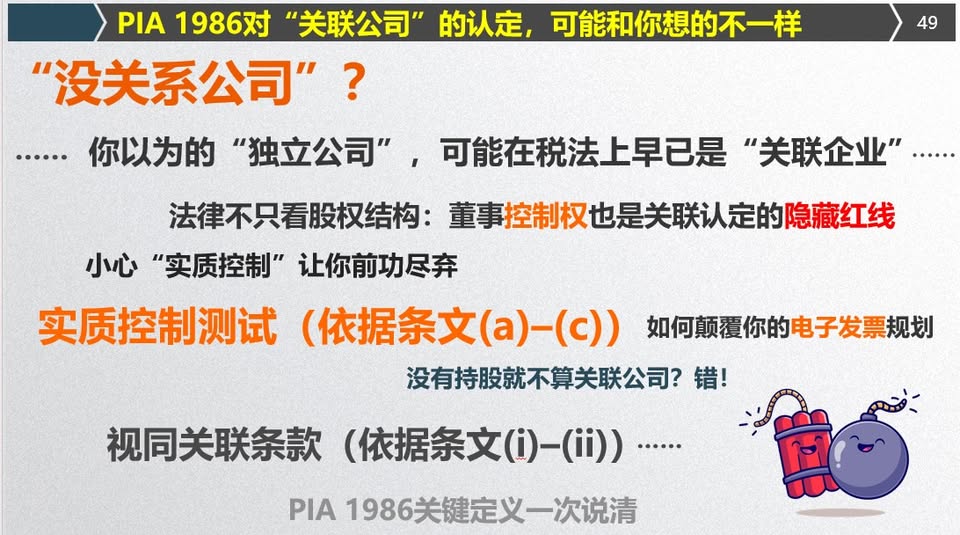
Many business owners assume that companies with separate shareholding structures and independent operations cannot be considered related. Under the definition in section 2(1) of Malaysia’s Promotion of Investments Act 1986 (PIA 1986), however, the assessment involves both operational control and a deemed-related-company rule based on share ownership.
The operational control test
A company may be considered related to another company if:
- its operations are, or can be, controlled directly or indirectly by that other company;
- it controls, or can control, the other company’s operations; or
- both companies’ operations are, or can be, controlled directly or indirectly by the same person.
This means the analysis is not limited to the percentage of shares held. The relevant question is whether a person or company controls, or can control, the companies’ operations.
A common director does not, by itself, automatically make two companies related. The director’s actual or potential control over the companies’ operations is relevant to the assessment.
The 20% deemed-related rule
Section 2(1) also provides that one company is deemed to be related to another if at least 20% of the issued share capital of one is beneficially owned, directly or indirectly, by the other.
This is a statutory deemed relationship. It should not be confused with the separate operational control test. A shareholding below 20% does not, on its own, meet this particular deemed-related threshold, but the companies may still be related if the operational control criteria are met.
Why the distinction matters
Where a tax provision uses the PIA 1986 definition, the relationship between companies may affect whether a business qualifies for a tax exemption or incentive. Separate incorporation or a shareholding below 20% should not be treated as an automatic safeguard: the control arrangements and the specific tax rule must also be considered.
In practice, review both the shareholding structure and who has the ability to direct or control the companies’ operations. The applicable consequences depend on the particular tax provision, so the PIA 1986 definition should not be assumed to apply to every related-company test.
马来西亚《1986年投资促进法令》下的关联公司:控制测试与20%持股规则
许多企业主认为,只要公司的股权结构各自独立、营运也互不相干,就不会被视为关联公司。然而,根据马来西亚《1986年投资促进法令》(PIA 1986)第2(1)条的定义,判断时须考虑营运控制关系,以及以股权为基础的法定视同关联规则。
营运控制测试
在以下情况下,一家公司可能被视为与另一家公司有关联:
- 该公司的营运由另一家公司直接或间接控制,或可由其控制;
- 该公司直接或间接控制,或可控制另一家公司的营运;或
- 两家公司的营运均由同一人直接或间接控制,或可由同一人控制。
因此,判断不应只看持股比例,关键问题还包括个人或公司是否实际控制或有能力控制相关公司的营运。
仅仅有共同董事,并不自动代表两家公司属于关联公司。评估时,还须考虑该董事是否实际或有能力控制两家公司的营运。
20%视同关联规则
PIA 1986 第2(1)条也规定,如果一家公司至少20%的已发行股本由另一家公司直接或间接实益持有,则该公司会被视为与另一家公司有关联。
这是法定的视同关联规定,应与另一项独立的营运控制测试区分。低于20%的持股本身并不符合这项特定的视同关联门槛,但如果满足营运控制条件,两家公司仍可能被视为关联公司。
为什么这项区别很重要
如果某项税务规定采用 PIA 1986 的定义,公司之间是否构成关联,可能影响企业是否符合税务豁免或优惠条件。分别注册成立,或持股低于20%,都不应被视为自动的保障;企业也须考虑实际控制安排及相关税务规则。
实务上,企业应同时检视股权结构,以及谁有能力指示或控制公司的营运。具体税务影响须视所适用的税务条文而定,因此不应假设 PIA 1986 的定义适用于所有关联公司测试。