Under HASiL’s e-Invoice Compliance Review Framework, information obtained from taxpayers through interviews, discussions, correspondence, or the examination of records and documents is confidential and may only be used for tax purposes.
This applies to information gathered during the review, including business records, transaction documents and relevant communications. The framework also states that registered tax agents must protect confidential information and must not disclose it to parties who are not authorised to receive it under the relevant tax laws.
This confidentiality requirement is intended to safeguard taxpayer information within the compliance review process. It does not, however, mean that information can never be disclosed; any disclosure must be consistent with the applicable legal provisions.
e-Invoice 合规审查中的资料保密
根据 HASiL 的《e-Invoice Compliance Review Framework》,通过面谈、讨论、书面往来,或查阅记录及文件而从纳税人取得的资料,均属机密,并且只可用于税务用途。
Under the e-Invoice Compliance Review Framework, findings of e-Invoice non-compliance may be penalised for each non-compliant transaction under the applicable legislation. The framework sets out several offences under the Income Tax Act 1967 (ITA), together with the penalties that may apply.
Failure to issue or retain receipts
Under paragraph 82(1)(b) of the ITA, a business with gross receipts exceeding RM150,000 from the sale of goods or RM100,000 from services in a year of assessment must issue printed, serial-numbered receipts and keep copies.
Failure to issue the required receipts or retain copies may result in a fine of RM300 to RM10,000, imprisonment for up to one year, or both. However, the framework states that a taxpayer is exempt from issuing receipts under this provision if an e-Invoice is issued for the goods sold or services provided under section 82C of the ITA.
Failure to issue an e-Invoice
Under subsection 82C(1) of the ITA, failure to issue an e-Invoice containing the required details and complying with the applicable requirements and specifications for a sale of goods or provision of services may result in a fine of RM200 to RM20,000, imprisonment for up to six months, or both.
Failure to issue a self-billed e-Invoice
Under subsection 82C(6)(a), failure to issue a self-billed e-Invoice when required under the conditions set by the Director General of Inland Revenue may result in a fine of RM200 to RM20,000, imprisonment for up to six months, or both.
E-commerce platform’s failure to issue a self-billed e-Invoice
Under subsection 82C(6)(b), an e-commerce platform provider’s failure to issue a required self-billed e-Invoice for a sale of goods or a service performed by another person through the platform may result in a fine of RM200 to RM20,000, imprisonment for up to six months, or both.
Failure to submit a consolidated e-Invoice
Under subsection 82C(7), failure to submit a consolidated e-Invoice within the prescribed time and in accordance with the applicable conditions may result in a fine of RM200 to RM20,000, imprisonment for up to six months, or both.
The framework’s per-transaction approach means that repeated non-compliance may create cumulative exposure. Businesses should review their invoicing processes and records, and seek professional advice where they are unsure how the requirements apply.
The e-Invoice Compliance Review Framework, effective from 15 December 2025, sets out how taxpayers may raise concerns about an e-Invoice compliance review and how HASiL may address improper conduct by tax agents or their representatives.
Taxpayers’ right to complain
A taxpayer who is dissatisfied with the attitude of an e-Invoice Compliance Officer (PEI) or the way a compliance review is handled may lodge a complaint with a senior HASiL officer. The officers listed in the framework include:
the State Operations Director for the e-Invoice and Employer Audit Section;
the Director of the Special Branch;
the State Director;
the Head of the Tax Compliance Sector;
the Deputy Director General; or
the Director General of Inland Revenue.
HASiL states that complaints received will be addressed firmly, fairly and impartially. It will not entertain complaints that are baseless or made with bad faith or improper intent.
Conduct of tax agents and representatives
The framework also states that HASiL may lodge a complaint against a tax agent or representative who does not cooperate, acts unprofessionally or behaves contrary to professional codes of ethics. The complaint may be referred to the relevant authority or professional body, including the Ministry of Finance Malaysia, the Chartered Tax Institute of Malaysia (CTIM), the Malaysian Institute of Accountants (MIA), the Malaysian Institute of Certified Public Accountants (MICPA), the Malaysian Association of Tax Accountants or the Malaysian Bar.
The framework provides formal channels for taxpayers to raise concerns, while also emphasising that complaints should have a proper basis and that tax agents and representatives are expected to maintain professional conduct.
HASiL 电子发票合规审查框架下的投诉机制
《e-Invoice Compliance Review Framework》自2025年12月15日起生效,说明纳税人如何就电子发票合规审查提出投诉,以及 HASiL 如何处理税务代理或其代表的不当行为。
纳税人的投诉权利
如果纳税人不满意电子发票合规官(PEI)的态度,或不满合规审查的处理方式,可向 HASiL 高级官员提出投诉。框架列出的官员包括:
州属电子发票及雇主审计组营运总监;
特别组总监;
州属总监;
税务合规领域主管;
副总监;或
国内税收总监。
HASiL 表示,将以严正、公平及公正的方式处理收到的投诉。对于缺乏事实依据,或带有恶意及不当意图的投诉,HASiL 将不予受理。
When an e-Invoice compliance review identifies an offence, HASiL may offer a compound payment instead of proceeding with prosecution. The e-Invoice Compliance Review Framework explains which units handle these cases and what taxpayers should do if a compound is offered.
Which unit handles compound cases?
For cases involving a compliance finding and a compound, the payment procedure is referred to the HASiL Legal Branch in the Klang Valley or the relevant State HASiL Legal Section.
For example, if a review finds that a business failed to issue e-Invoices for certain transactions and HASiL offers a compound, the case will be referred to the relevant legal unit to handle the compound payment process.
Payment deadline and possible prosecution
Taxpayers must pay the compound within the period specified in the compound notice. If payment is not received within that period, prosecution may proceed.
For example, if a notice specifies that payment must be made within 14 days, the taxpayer should pay by the stated deadline. Failure to do so may result in further legal action.
A compound provides an opportunity to resolve the matter without prosecution; it should not be treated as an automatic entitlement. Once a compound is offered, taxpayers should review the notice carefully and comply with its payment instructions and deadline.
If a taxpayer disagrees with the findings of an e-Invoice compliance review, the e-Invoice Compliance Review Framework provides a process for submitting a written objection supported by additional information and evidence.
The 18-calendar-day period
A taxpayer who is dissatisfied with the compliance findings may submit a formal objection within 18 calendar days from the date of the findings letter. The objection and supporting documents should be submitted to the relevant IRBM Legal Branch or State Legal Section for further action.
If no objection is received within the 18-day period, the taxpayer is regarded as agreeing with the findings and is expected to make the relevant compound payment. The case may then be referred to the Klang Valley Legal Branch or the relevant State IRBM Legal Section after the 18-day period. The referral is for further action; it should not be assumed that prosecution is automatic.
Supporting an objection
An objection should be supported by relevant information and documentary evidence, rather than disagreement alone. For example, if a taxpayer believes that certain transactions were incorrectly identified as non-compliant, the taxpayer may provide relevant system records and e-Invoice documentation to support the objection.
IRBM will formally notify the taxpayer of the decision on the objection. Depending on the outcome, the findings may be accepted or revised, or further action may follow.
The objection process is an opportunity to respond to the review findings; it does not automatically cancel them. Taxpayers should take note of the 18-calendar-day period and prepare their supporting documents promptly.
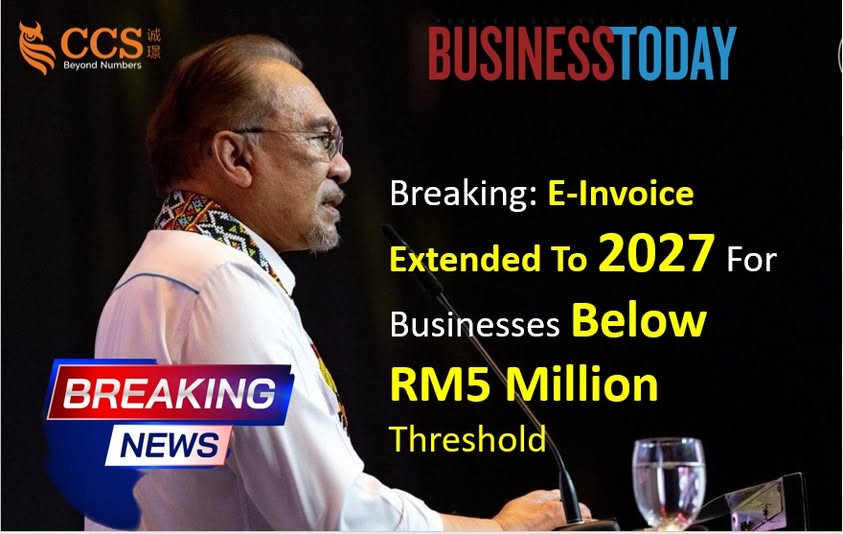
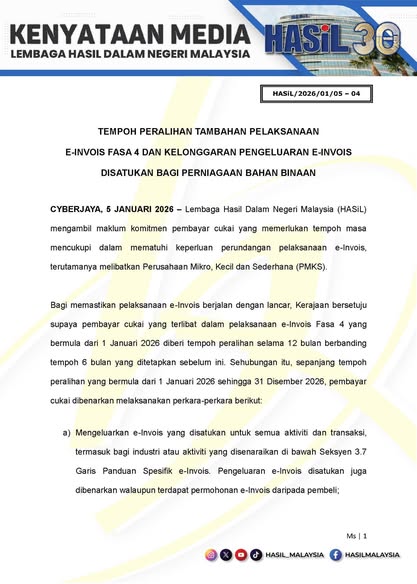
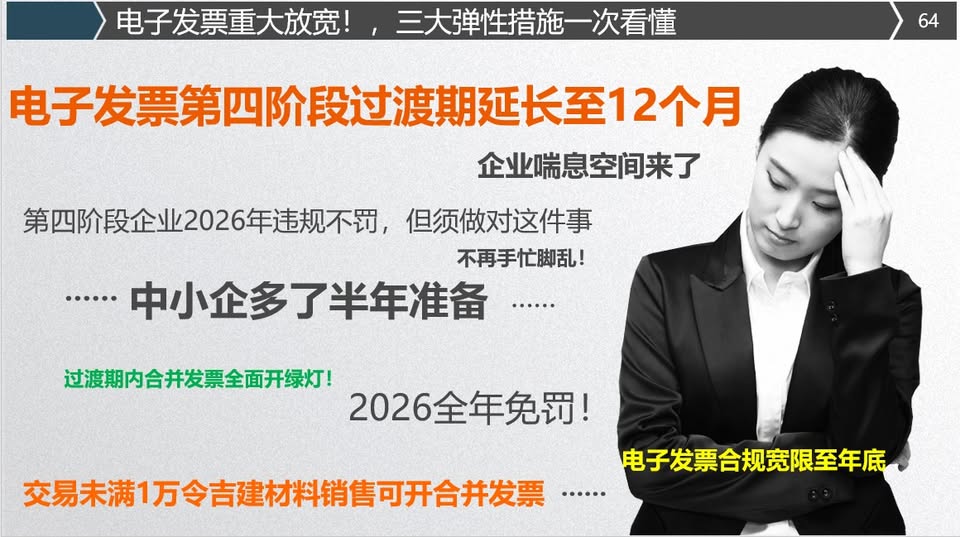
The Prime Minister’s announcement did not postpone the Phase 4 e-Invoice implementation date to 2027. Under the original schedule, the implementation date for affected Phase 4 taxpayers was 1 January 2026. The initial measure extended the transition period without prosecution from six months to 12 months, covering 1 January to 31 December 2026.
The transition period was subsequently extended. Under the latest e-Invoice Specific Guideline, Version 4.9, the interim relaxation for Phase 4 taxpayers with annual turnover or revenue of up to RM5 million runs until 31 December 2027. A separate exemption applies to taxpayers with annual turnover or revenue below RM3 million, subject to the applicable exemption criteria.
During the interim relaxation period, taxpayers who are required to implement e-Invoice may issue consolidated e-Invoices for all activities and transactions, as well as consolidated self-billed e-Invoices for the prescribed self-billing circumstances. If the applicable consolidation requirements are met, they may use consolidated documents even when a buyer or supplier requests an individual e-Invoice. IRBM will not undertake prosecution under Section 120 of the Income Tax Act 1967 during the relaxation period, provided taxpayers meet the relevant requirements.
Businesses should distinguish between the implementation date, the interim relaxation period and eligibility for exemption. Phase 4 was not postponed to 2027; rather, the relaxation period was extended. Businesses should check their own implementation obligations and ensure they comply with the conditions of any applicable relaxation.
之后,过渡期再次延长。根据最新的《e-Invoice Specific Guideline》版本4.9,年度营业额或收入不超过 RM5 million 的第四阶段纳税人,临时宽限期截至2027年12月31日。年度营业额或收入低于 RM3 million 的纳税人则可能适用另一项豁免,但须符合相关豁免条件。
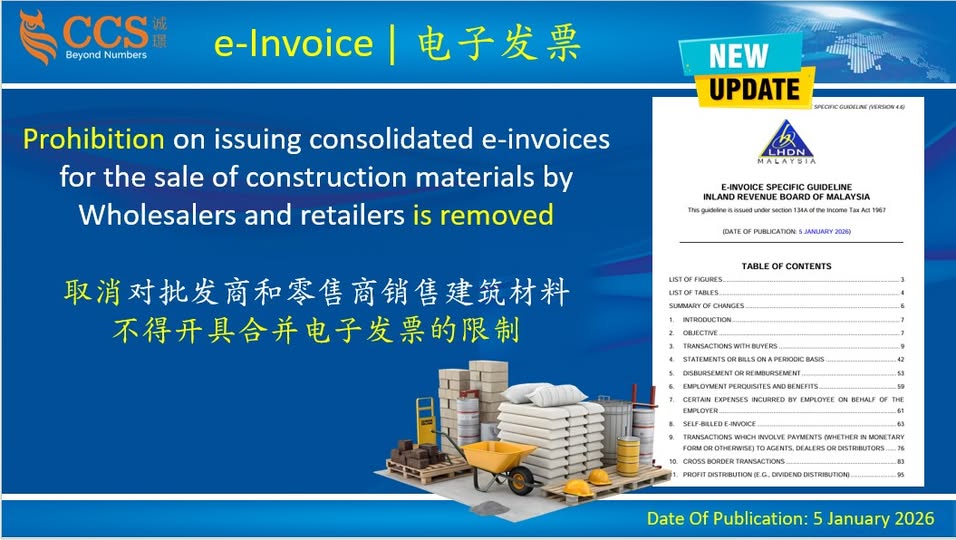
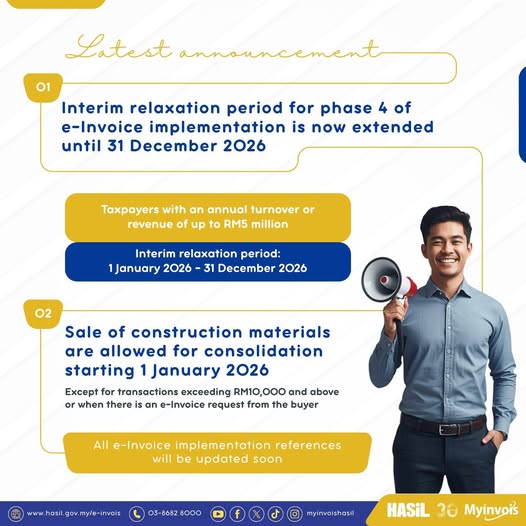
On 5 January 2026, HASiL issued Version 4.6 of the e-Invoice Specific Guideline, including changes affecting Phase 4 taxpayers and businesses dealing in construction materials.
Interim relaxation period extended
The initial announcement extended the Phase 4 interim relaxation period from six months to 12 months, covering 1 January to 31 December 2026. The period was subsequently extended. Under the latest Specific Guideline, Version 4.9, the interim relaxation for Phase 4 taxpayers runs until 31 December 2027.
During the interim relaxation period, taxpayers who are required to implement e-Invoice may issue consolidated e-Invoices for all activities and transactions, including those that would normally require individual e-Invoices. They may also issue consolidated self-billed e-Invoices for all prescribed self-billing circumstances. The relaxation allows consolidated documents to be used even when the buyer or supplier requests an individual e-Invoice, provided the applicable consolidation requirements are met.
IRBM will not undertake prosecution under Section 120 of the Income Tax Act 1967 for e-Invoice non-compliance during the relaxation period, provided taxpayers comply with the requirements for issuing consolidated e-Invoices or consolidated self-billed e-Invoices, as applicable.
Consolidated e-Invoices for construction materials
From 1 January 2026, wholesalers and retailers of construction materials covered by the relevant rules may issue consolidated e-Invoices. Under the standard requirements, an individual e-Invoice is required where a transaction exceeds RM10,000 or the buyer requests an e-Invoice.
Eligible Phase 4 taxpayers may also apply the interim relaxation described above during the applicable period. This allows consolidation in circumstances that would normally require an individual e-Invoice, subject to the relaxation requirements.
Businesses should confirm whether they are required to implement e-Invoice or qualify for an exemption, and check the latest HASiL guidance before applying the relevant rules. The transition period provides more time to prepare systems, train staff and organise records, but businesses should still ensure that their invoicing processes comply with the applicable requirements.
第四阶段 e-Invoice 更新:宽限期延长与合并开票安排
HASiL 于2026年1月5日发布《e-Invoice Specific Guideline》版本4.6,其中包括影响第四阶段纳税人及建筑材料行业的更新。
Businesses with annual turnover or revenue of up to RM5 million that are required to implement e-Invoice may have additional time to adapt. Under the latest e-Invoice Specific Guideline, the interim relaxation period for Phase 4 taxpayers runs until 31 December 2027. Businesses that qualify for an e-Invoice exemption should assess that separately.
During the relaxation period, eligible taxpayers may issue consolidated e-Invoices for all activities and transactions, including those that would normally require an individual e-Invoice. They may also use a consolidated e-Invoice even when a buyer requests an individual e-Invoice, provided they comply with the applicable consolidated e-Invoice requirements. IRBM will not undertake prosecution under Section 120 of the Income Tax Act 1967 for e-Invoice non-compliance during this period, provided those requirements are met.
Consolidated e-Invoices for construction material sales
Construction material suppliers may use consolidated e-Invoices where the applicable rules allow. Under the standard rules, an individual e-Invoice is generally required if a single transaction exceeds RM10,000 or the buyer requests one.
However, eligible Phase 4 taxpayers may rely on the interim relaxation described above, which allows consolidation across all activities and transactions during the relaxation period, subject to the requirements for issuing consolidated e-Invoices.
The relaxation period gives businesses more time to prepare their systems, train employees and organise their records. Businesses should confirm their implementation and exemption status, and check the latest HASiL guidance before deciding how to issue their e-Invoices.
第四阶段企业 e-Invoice 宽限安排:合并开票与建筑材料销售
对于须实施 e-Invoice、年度营业额或收入不超过 RM5 million 的企业,现有额外时间适应。根据最新的《e-Invoice Specific Guideline》,第四阶段纳税人的临时宽限期截至2027年12月31日。符合 e-Invoice 豁免条件的企业,应另行评估自身是否适用豁免。
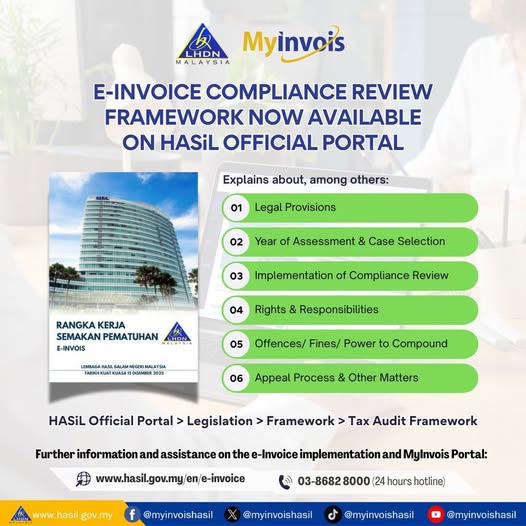
HASiL has published the e-Invoice Compliance Review Framework on its official portal. The framework explains how e-Invoice compliance reviews are conducted and outlines relevant procedures, taxpayer responsibilities and possible consequences of non-compliance.
The framework covers:
Legal provisions: The laws and provisions supporting compliance action.
Year of Assessment and case selection: The relevant assessment year and how cases may be selected for review.
Review procedures: How a compliance review is carried out and what may be examined.
Taxpayer rights and responsibilities: What taxpayers are entitled to and what is expected of them during a review.
Offences, penalties and compounding powers: Potential consequences where requirements are not met.
Appeals and other matters: The process for responding to or appealing a decision.
Taxpayers can read or download the framework through the HASiL portal by navigating to Legislation → Framework → Tax Audit Framework.
Understanding the review process and maintaining appropriate records can help businesses prepare for an e-Invoice compliance review.
e-Invoice 合规审查框架:纳税人应了解的事项
HASiL 已在官方网站发布《e-Invoice Compliance Review Framework》。该框架说明电子发票合规审查的进行方式,并概述相关程序、纳税人责任,以及未遵守规定可能产生的后果。
框架涵盖以下内容:
法律依据: 合规行动所依据的法律及条文。
课税年度与案件筛选: 相关课税年度,以及案件可能如何被选中审查。
审查程序: 合规审查的进行方式及可能检查的事项。
纳税人的权利与责任: 纳税人在审查过程中享有的权利及应履行的责任。
违规行为、罚款与复合权力: 未遵守规定可能面对的后果。
上诉程序及其他事项: 回应审查决定或提出上诉的相关程序。
纳税人可前往 HASiL 官方网站,依序进入 Legislation → Framework → Tax Audit Framework,查阅或下载完整框架。
The MyInvois mobile app allows users to manage e-Invoice matters on their smartphones, including issuing, viewing and tracking e-Invoices.
Before using the app for the first time, users must activate their account through the MyInvois Portal on the HASiL e-Invoice webpage. Once activation is complete, the app can be downloaded from the Apple App Store, Google Play Store or Huawei AppGallery.
The app offers a convenient way to access e-Invoice functions while on the move.
使用 MyInvois 手机应用程序管理电子发票
MyInvois 手机应用程序让用户可通过智能手机处理电子发票事务,包括开具、查看及跟进电子发票。
首次使用应用程序前,用户须先通过 HASiL 电子发票网页 登录 MyInvois Portal 并完成账户启用。完成启用后,可从 Apple App Store、Google Play Store 或 Huawei AppGallery 下载应用程序。
使用手机应用程序,用户可更方便地随时处理电子发票事务。
Hello 👋 Which service are you looking for? Let us know! 👇 ✅ Audit ✅ Tax ✅ Accounting ✅ Transfer Pricing ✅ E-invoice ✅ SST ✅ Others