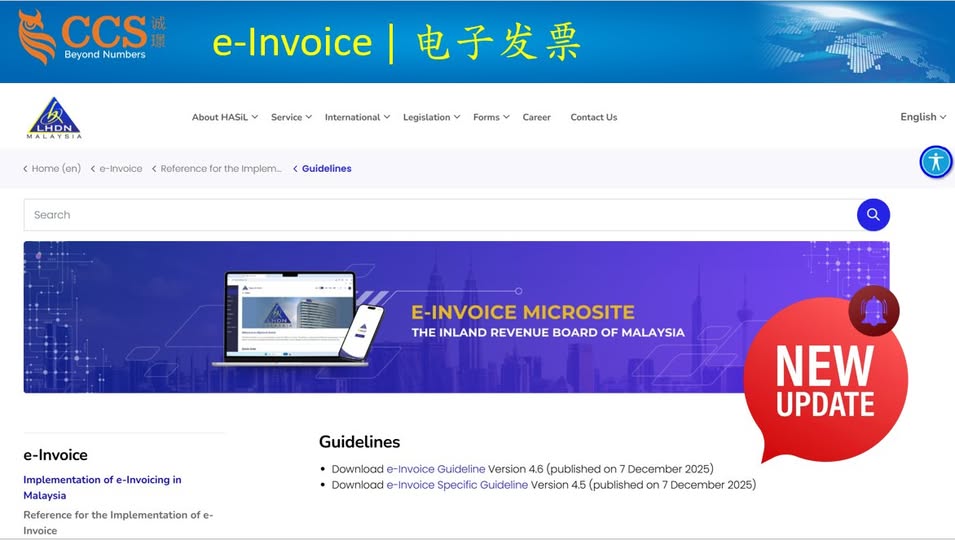
Version 4.6 of Malaysia’s e-Invoice Guideline, dated 10 December 2025, made three notable changes compared with Version 4.5. Some of the thresholds in Version 4.6 have since changed, so businesses should distinguish between what that version introduced and the current requirements.
Changes introduced in Version 4.6
Paragraph 1.0 — policy context: Version 4.6 expanded the introduction’s references to Malaysia’s national development plans by adding the Thirteenth Malaysia Plan alongside the Twelfth Malaysia Plan.
Paragraph 1.5 — implementation dates: The guideline set 1 January 2026 as the implementation date for taxpayers with annual turnover or revenue of up to RM5 million. It also revised the threshold used to determine implementation dates for certain businesses that began operating between YA2023 and YA2025. At the time, the relevant threshold was RM1 million, increased from RM500,000 under Version 4.5.
Paragraph 1.6.1(e) — exemption threshold: Version 4.6 raised the e-Invoice exemption threshold from RM500,000 to RM1 million. Eligible taxpayers below that threshold could be exempt from issuing e-Invoices, including self-billed e-Invoices, subject to the exemption criteria.
The current threshold is RM3 million
The RM1 million threshold described in Version 4.6 is no longer the current threshold. HASiL’s General FAQ, updated on 4 September 2026, reflects the increase to RM3 million. The exemption remains subject to the applicable criteria, including conditions relating to non-individual shareholders, subsidiaries, related companies and joint ventures.
For businesses that commenced operations from YA2023 to YA2025, reaching RM3 million in YA2023, YA2024 or YA2025 requires implementation from 1 July 2026. Businesses below RM3 million in those years that meet the exemption criteria are exempt. If an eligible business reaches RM3 million in YA2026 or a later year, it must implement e-Invoicing from 1 January in the second year following the year in which it reaches the threshold.
For businesses commencing operations from YA2026 onwards, those that do not meet the exemption criteria must implement e-Invoicing from 1 July 2026 or their commencement date, whichever is later. Eligible businesses below RM3 million in their first YA are exempt; if they later reach the threshold, the second-year implementation rule applies.
Example: a business with RM750,000 in annual turnover
Under Version 4.6, a business with annual turnover of RM750,000 was below the RM1 million threshold and could qualify for exemption if it met the relevant criteria. Under the current RM3 million threshold, RM750,000 remains below the turnover threshold, but the business must still meet the applicable exemption criteria.
An exemption for the business does not remove its suppliers’ e-Invoice obligations. Suppliers must issue e-Invoices in accordance with their own implementation requirements.
企业应按现行门槛评估自身义务,并在判断豁免资格时同时核对适用条件。
电子发票指南 4.6 版:主要变更与现行 RM3 million 门槛
马来西亚《电子发票指南》4.6版于2025年12月10日发布,相较4.5版作出三项值得关注的调整。由于其中部分门槛之后已有变更,企业应区分该版本当时的规定与现行要求。
4.6版引入的变更
第1.0段——政策背景:4.6版扩充了前言中的国家发展计划背景,在《第十二大马计划》之外,也加入了《第十三大马计划》。
第1.5段——实施日期:该版本规定,年营业额或收入不超过 RM5 million 的纳税人,实施日期为2026年1月1日。对于在 YA2023 至 YA2025 开始营业的部分企业,该版本也调整了用于确定实施日期的门槛。当时的门槛为 RM1 million,高于4.5版所采用的 RM500,000。
第1.6.1(e)段——豁免门槛:4.6版将电子发票豁免门槛从 RM500,000 提高至 RM1 million。低于该门槛并符合豁免条件的纳税人,可豁免开具电子发票,包括自开电子发票。
现行门槛为 RM3 million
4.6版所述的 RM1 million 门槛已不再是现行门槛。HASiL 于2026年9月4日更新的《一般常见问题解答》反映了门槛上调至 RM3 million。豁免仍须符合适用条件,包括有关非个人股东、子公司、关联公司及合资企业的规定。
对于在 YA2023 至 YA2025 开始营业的企业,若在 YA2023、YA2024 或 YA2025 达到 RM3 million,须从2026年7月1日起实施电子发票。若这些年度的营业额或收入低于 RM3 million,且企业符合豁免条件,则可获豁免。若符合条件的企业在 YA2026 或之后达到 RM3 million,则须从达到门槛的评税年度之后第二年的1月1日起实施电子发票。
对于从 YA2026 起开始营业的企业,不符合豁免条件者须从2026年7月1日或业务开始运营之日起实施电子发票,以较迟者为准。符合豁免条件且首个评税年度收入低于 RM3 million 的企业可获豁免;若之后达到门槛,则适用第二年实施规则。
例子:年营业额为 RM750,000 的企业
根据4.6版,年营业额为 RM750,000 的企业低于当时的 RM1 million 门槛;若符合相关条件,可享有豁免。按照现行 RM3 million 门槛,RM750,000 仍低于营业额门槛,但企业仍须符合适用的豁免条件。
企业本身获得豁免,并不免除其供应商的电子发票义务。供应商仍须按照自身适用的实施要求开具电子发票。
企业应依据现行门槛评估自身义务,并在判断豁免资格时同时核对适用条件。