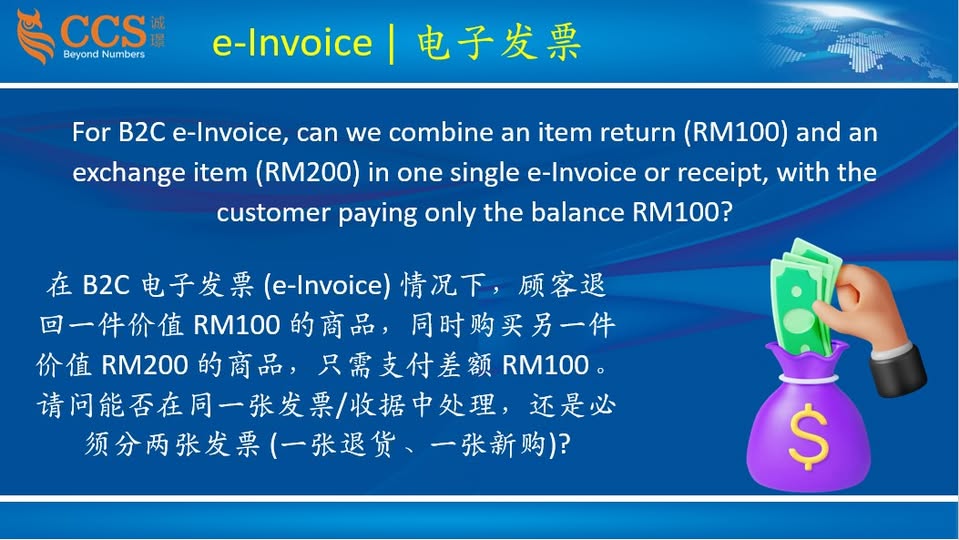
For a B2C transaction in which a customer returns an item worth RM100 and buys a new item worth RM200, paying only the RM100 difference, can both transactions be recorded in one e-Invoice or receipt, or must separate documents be issued?
According to HASiL’s guidance, a business may issue e-Invoices in line with its existing business practices, provided the transaction is clearly and accurately reflected. If the point-of-sale (POS) system supports recording the return and new sale in one document, a single e-Invoice may be issued. If the system cannot process them together, the business may issue two separate e-Invoices or receipts: one for the return and one for the new sale.
One Combined e-Invoice
For example, a customer returns a T-shirt worth RM100 and buys a jacket worth RM200, paying the RM100 difference. If the system supports combining both transactions in one document, the e-Invoice may show:
Returned item (T-shirt): RM100, recorded as a negative line item
New item (jacket): RM200
Net amount payable: RM100
Two Separate e-Invoices
If the system cannot properly offset the return against the new sale, the business may issue:
A credit note for the returned item: RM100
An e-Invoice for the new sale of the jacket: RM200
The customer pays the RM100 difference.
Either approach may be used, provided the e-Invoice accurately reflects the transaction and follows the business’s existing POS or accounting process.
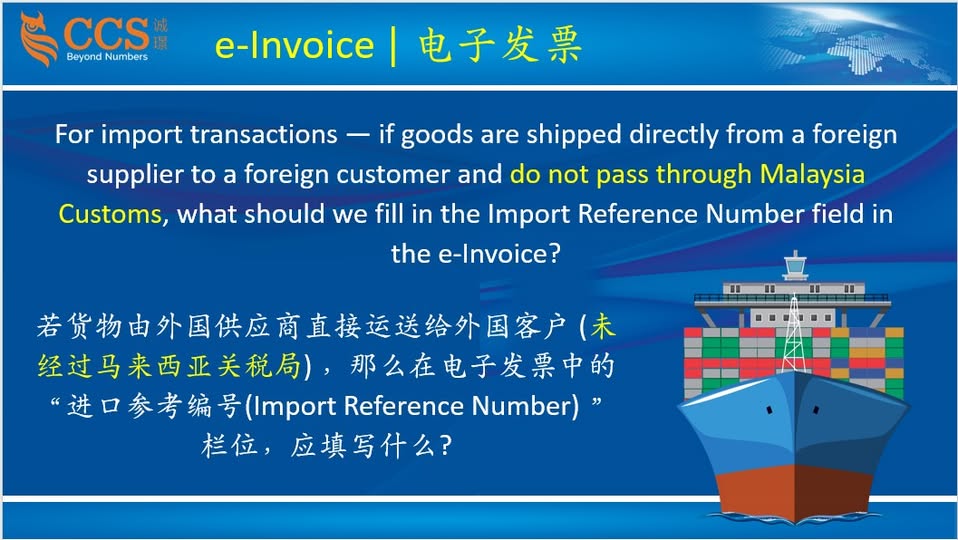
When goods are shipped directly from a foreign supplier to a foreign customer without entering Malaysia or passing through Malaysian Customs, should the “Import Reference Number” field in the e-Invoice be completed?
According to HASiL’s guidance, if goods are not physically imported into Malaysia, the field for the reference number of Customs Form No. 1, 9 and similar forms is not applicable. Taxpayers do not need to complete this field when issuing an e-Invoice for LHDNM validation.
Goods Shipped Directly Overseas
For example, Malaysian Company A orders goods from a supplier in China, who ships them directly to a customer in Singapore without the goods entering Malaysia.
As the goods do not pass through Malaysian Customs, there is no import declaration form, such as K1 or K9. The “Import Reference Number” field can therefore be left blank or omitted.
Goods Imported into Malaysia
If Malaysian Company A orders goods from a supplier in China and the goods are shipped into Malaysia and cleared through Malaysian Customs, the company must enter the relevant Customs Form number, such as K1, in the “Import Reference Number” field when issuing the e-Invoice.
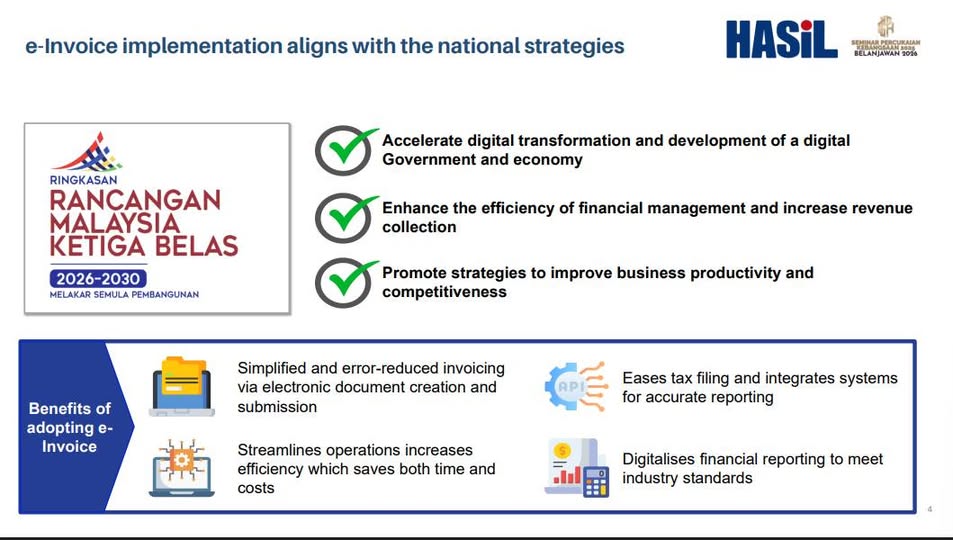
Malaysia’s e-Invoice initiative is part of the country’s wider digitalisation agenda. HASiL describes it as supporting the digitalisation of the business ecosystem and improving the efficiency of tax administration, in line with the Thirteenth Malaysia Plan (RMK13, 2026–2030).
What is an e-Invoice?
An e-Invoice is a structured, machine-readable digital representation of a transaction between a supplier and a buyer. It is submitted to the Inland Revenue Board of Malaysia (HASiL) through the MyInvois Portal or an integrated system in the prescribed format. A PDF or image of an invoice, on its own, is not an e-Invoice.
The MyInvois System checks submitted data against its requirements. Validation generally takes place in near real time and, according to HASiL, usually takes less than two seconds. Once validated, an e-Invoice receives a unique identifier. Its QR code can be used to check the invoice’s existence and status.
Potential benefits for businesses
Digital invoicing can reduce repeated manual data entry and support more consistent transaction records. When e-Invoicing is integrated with a business’s accounting or enterprise systems, it may also help streamline invoicing and reconciliation. The practical benefits depend on each business’s processes and systems; cost savings or faster reporting are not automatic.
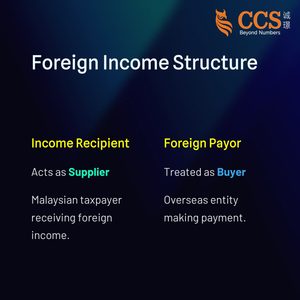
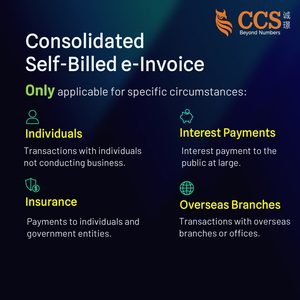
The system applies to business-to-business, business-to-consumer and business-to-government transactions. Its requirements also cover a range of business activities, including retail, food and beverage, construction, and cross-border transactions. The relevant treatment differs by transaction type. For example, certain transactions with foreign suppliers require a self-billed e-Invoice, while eligible transactions for which buyers do not request individual e-Invoices may be included in a consolidated e-Invoice.
Current implementation dates and exemption
HASiL’s current implementation timeline sets out the following dates according to annual turnover or revenue:
More than RM100 million: 1 August 2024.
More than RM25 million and up to RM100 million: 1 January 2025.
More than RM5 million and up to RM25 million: 1 July 2025.
Up to RM5 million: 1 January 2026, subject to the applicable exemption.
Effective 1 September 2026, taxpayers with annual turnover or revenue below RM3 million may be exempt from implementation, provided they meet the relevant exemption criteria. The criteria include rules that businesses should review before relying on the exemption. Eligible taxpayers are encouraged to participate voluntarily.
Businesses without their own invoicing system can use the free MyInvois Portal and MyInvois Mobile App. Qualifying e-Invoice implementation expenditure may also be eligible for tax incentives, subject to the relevant legislation and conditions.
The implementation schedule and related concessions have changed over time. Businesses should check HASiL’s current implementation timeline and e-Invoice guidance when determining their obligations.
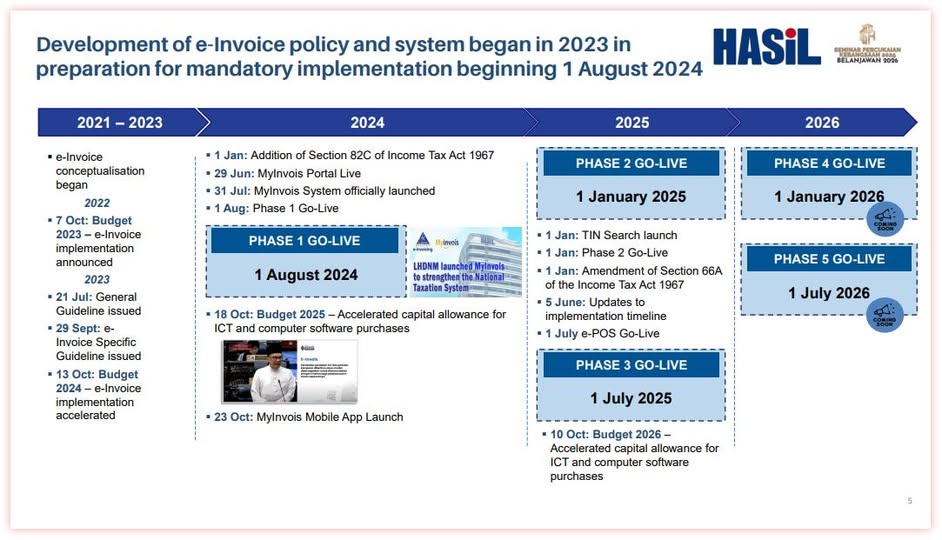
Malaysia’s e-Invoice system was introduced in stages, giving businesses time to prepare for changes to the way transactions are recorded and reported. Since the initial announcements, the implementation schedule and exemption threshold have been revised.
From announcement to implementation
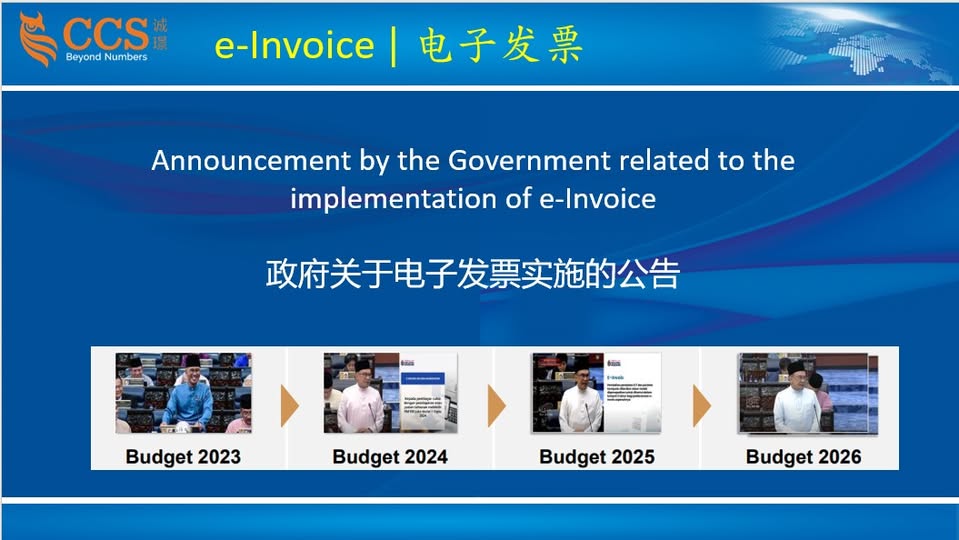
The Government announced the e-Invoice initiative in Budget 2023, presented in October 2022, with implementation planned in stages. The following year, Budget 2024 brought forward the rollout, setting 1 August 2024 as the start date for taxpayers with annual turnover or revenue exceeding RM100 million.
Section 82C of the Income Tax Act 1967 provides the statutory framework for e-Invoice requirements. HASiL’s guidelines and FAQs set out how the requirements apply to different taxpayers and transaction types.
Implementation dates
HASiL’s current timeline sets out four implementation dates, based on annual turnover or revenue:
More than RM100 million: 1 August 2024.
More than RM25 million and up to RM100 million: 1 January 2025.
More than RM5 million and up to RM25 million: 1 July 2025.
Up to RM5 million: 1 January 2026, subject to the applicable exemption.
The schedule was designed to extend e-Invoice implementation to more taxpayers over time. However, the final date does not mean that every business with annual turnover or revenue of up to RM5 million must implement e-Invoice.
The RM3 million exemption
Effective 1 September 2026, the Government raised the exemption threshold from RM1 million to RM3 million. Taxpayers with annual turnover or revenue below RM3 million are exempt from implementation if they meet the applicable exemption criteria.
HASiL’s updated FAQs also clarify that eligible taxpayers who had begun issuing e-Invoices may discontinue doing so without a separate application or prior approval. Businesses should check the criteria in the guidelines, including the rules concerning related companies, before relying on the exemption.
What businesses should consider
For businesses required to implement e-Invoice, preparation involves more than selecting a software system. They should review how sales, purchases, employee claims and other transactions are documented, and determine how the requirements fit into their existing processes.
Where buyers do not request individual e-Invoices, suppliers may generally issue consolidated e-Invoices for eligible transactions. These must be submitted within seven calendar days after the end of the month, subject to the applicable exclusions.
The implementation journey has moved from an initial policy announcement to a phased rollout, followed by a revised exemption threshold. Businesses should refer to HASiL’s current implementation timeline and latest guidance when assessing their obligations.
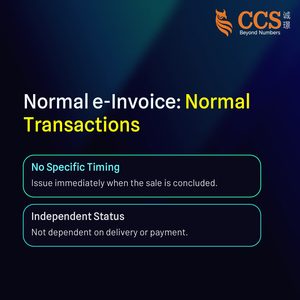
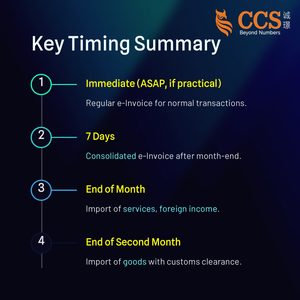
Understanding when an e-Invoice must be issued is important for managing compliance. However, there is no universal rule requiring every e-Invoice to be issued on the same day as the transaction. HASiL’s General FAQs state that, except for specific cases, issuance timing follows the taxpayer’s current invoicing practices and arrangements. HASiL General FAQs
Consolidated e-Invoices
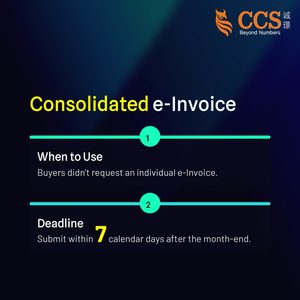
Where a buyer does not request an individual e-Invoice, a supplier may generally issue a consolidated e-Invoice for eligible transactions. This can apply to B2B, B2C and B2G transactions, subject to the activities and transactions that are not permitted to be consolidated under HASiL’s Specific Guideline.
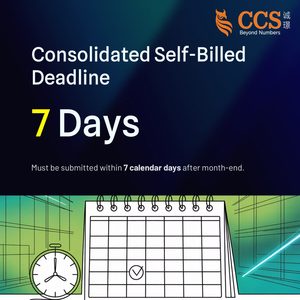
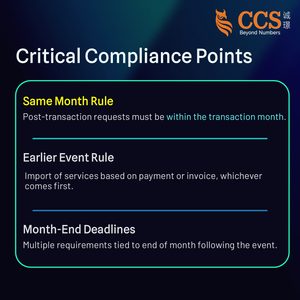
The consolidated e-Invoice must be submitted within seven calendar days after the end of the month. For example, eligible January transactions should be included in a consolidated e-Invoice submitted by 7 February. HASiL General FAQs
Construction progress claims
For progress claims relating to the construction of a property, the timing depends on whether certification of work done is required. If certification is not required, the contractor must issue an e-Invoice for the progress claim. If certification is required, the e-Invoice may be issued upon obtaining the certificate. HASiL Construction Industry FAQs
Imported goods and services
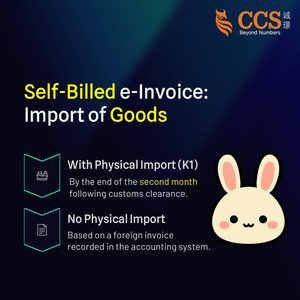
For imported goods, the Malaysian purchaser must issue a self-billed e-Invoice no later than the end of the second month following the month in which customs clearance is obtained. For example, if goods clear customs in January, the deadline is 31 March.
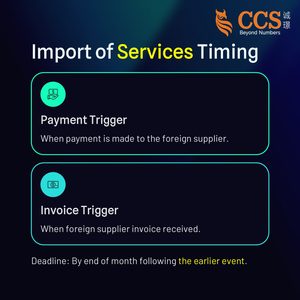
For imported services, the self-billed e-Invoice must be issued by the end of the month following the month in which the earlier of these events occurs: payment to the foreign supplier or receipt of the supplier’s invoice. The timing is determined in accordance with the prevailing rules for imported taxable services. For example, if payment is made on 15 March and the supplier’s invoice is received on 5 April, the deadline is 30 April. HASiL General FAQsHASiL e-Invoice Specific Guideline
Exports and foreign income
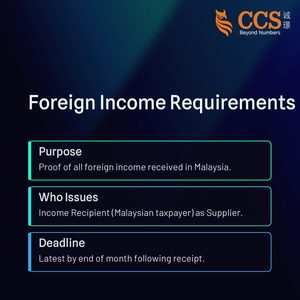
For exported goods, Malaysian suppliers should issue e-Invoices according to their current invoicing arrangements. Where available, the Customs Form No. 2 reference may be included, but the field is optional. This is distinct from foreign income received in Malaysia: an e-Invoice for such income must be issued by the end of the month following the month of receipt. HASiL General FAQsHASiL e-Invoice Specific Guideline
Other transactions and the 72-hour period
Businesses that pay commissions or other incentives to agents, dealers or distributors are required to issue a self-billed e-Invoice for those payments under the applicable rules. Domestic profit distributions, including dividends, have separate requirements and exemptions; they should not be treated as universally exempt or assigned the same timing rule as other payments. Interest, rental and royalty transactions may also be subject to transaction-specific requirements and exceptions. HASiL e-Invoice Specific Guideline
The 72-hour period is not a general deadline for issuing an e-Invoice. It is the period within which a supplier may cancel a validated e-Invoice or a buyer may request its rejection. After that period, adjustments are generally made using a credit note, debit note or refund note e-Invoice. HASiL e-Invoice Guideline
The practical starting point is to follow existing invoicing arrangements for ordinary transactions and identify whether a specific deadline applies. Particular care is needed for consolidated e-Invoices, progress claims, imports and foreign income.
Malaysia’s e-Invoice system was introduced through a phased rollout, giving businesses time to prepare for a significant change in how transactions are recorded and reported. Since the initial announcements, the implementation schedule and exemption threshold have been updated.
From announcement to implementation
The Government announced the e-Invoice initiative in Budget 2023, presented in October 2022, with implementation planned in stages. In Budget 2024, the rollout was brought forward, with the first group of taxpayers scheduled to begin on 1 August 2024.
Section 82C of the Income Tax Act 1967 provides the statutory framework for e-Invoice requirements. The applicable implementation dates are determined by the prescribed rollout and relevant guidelines.
Four implementation dates
HASiL’s phased timeline sets out four implementation dates based on annual turnover or revenue:
More than RM100 million: 1 August 2024.
More than RM25 million and up to RM100 million: 1 January 2025.
More than RM5 million and up to RM25 million: 1 July 2025.
Up to RM5 million: 1 January 2026, subject to the applicable exemption.
These dates remain important for understanding the rollout. However, the exemption threshold was subsequently revised.
The RM3 million exemption threshold
On 30 August 2026, the Government announced that the e-Invoice exemption threshold would increase from RM1 million to RM3 million, effective 1 September 2026. Taxpayers with annual turnover or revenue of less than RM3 million are exempt from implementation, subject to the applicable exemption criteria.
This means that the January 2026 implementation date for taxpayers with turnover or revenue of up to RM5 million does not make e-Invoice compulsory for every business in that range. Businesses should check whether they qualify for the exemption, including any relevant conditions concerning related companies.
The Government has encouraged eligible businesses to participate voluntarily in e-Invoice as part of the wider digitalisation effort. HASiL’s current implementation timeline and announcement on the revised threshold provide the latest information.
Support for implementation
Budget 2025 included tax incentives, such as accelerated capital allowance for qualifying expenditure on ICT equipment and computer software related to e-Invoice implementation. Eligibility and the applicable tax treatment are subject to the relevant rules.
The rollout has therefore developed through successive announcements, implementation phases and policy updates. Businesses should distinguish between the original schedule and the current position, particularly the RM3 million exemption that took effect on 1 September 2026.
An entity recognises a financial asset or financial liability when it becomes a party to the instrument’s contractual terms. The initial measurement depends on the applicable accounting framework and whether the arrangement is a financing transaction.
Under MPERS paragraph 11.13, a basic financial asset or financial liability is generally measured initially at the transaction price, including transaction costs where applicable. If payment is deferred beyond normal business terms, or the arrangement uses a below-market interest rate, it may constitute a financing transaction. In that case, the instrument is measured at the present value of future payments, discounted using a market rate for a similar instrument.
MFRS 9 generally requires initial measurement at fair value, with directly attributable transaction costs included for items not measured at fair value through profit or loss. For a sale with a significant financing component, revenue recognition should also be considered under MFRS 15. The detailed treatment therefore depends on the instrument and the relevant standards; the requirements should not be treated as identical in every respect.
Example: Sale with two-year interest-free credit
ABC Sdn Bhd sells machinery for RM100,000, payable after two years without interest. If the company’s normal credit terms are 30 to 90 days, the extended payment period may represent a financing transaction. Assuming a market rate of 6% a year, the present value of RM100,000 payable in two years is approximately RM89,000.
Under the applicable accounting treatment, the receivable may initially be recognised at its present value, with the financing element recognised over the credit period as finance income. The exact accounting depends on the applicable standards and facts.
The accounting present value is the receivable’s measurement for financial reporting; it does not, by itself, change the amount the customer is contractually required to pay. If the contract requires payment of RM100,000, the e-Invoice should not simply substitute the RM89,000 accounting value for the agreed amount. The e-Invoice records the transaction under the contractual arrangement, while accounting and income-tax treatment are determined under their respective rules. An e-Invoice amount does not, by itself, determine the timing or amount of taxable income.
Timing and interest charges
HASiL’s general e-Invoice workflow requires the supplier to create and submit an e-Invoice for validation when the sale or transaction is concluded. Deferring payment does not, on its own, mean that the supplier should wait until cash is received to issue the e-Invoice. The applicable rules for the particular transaction should also be considered.
Where no interest is separately charged under the contract, the finance income recognised for accounting purposes does not automatically represent a separate amount to be invoiced. If actual interest is charged, the applicable e-Invoice treatment depends on the interest-payment rules. For example, interest payments may fall under the self-billed e-Invoice rules, subject to exceptions. HASiL permits self-billed e-Invoices for interest to be issued on either an accrual or paid basis. Where an exception applies, the interest recipient is responsible for issuing an e-Invoice.
Employee loans
A loan advance is not, by itself, an invoice for a sale of goods or services. However, if a company grants an employee an interest-free or below-market loan, the accounting may require the financing element to be measured at present value and the difference to be assessed as an employee benefit, depending on the circumstances.
For instance, a RM20,000 interest-free loan repayable over three years, using a 5% market rate, has an approximate present value of RM17,277. The difference of approximately RM2,723 may represent an employee benefit for accounting purposes, subject to the applicable standards and facts.
If an employee is charged actual interest, the interest payment must be considered separately under the e-Invoice rules. Where an employee pays interest to an employer, the employee is not required to issue a self-billed e-Invoice; the interest recipient must issue an e-Invoice.
The central point is that accounting measurement, the amount invoiced under the contract and income-tax recognition are related, but they are not interchangeable. Businesses should assess each under the applicable accounting standards, contractual terms and e-Invoice requirements.
HASiL’s industry-specific FAQ sets out the following treatment for transactions between a money changer and an individual customer:
If the customer requests an e-Invoice, the money changer must issue a positive-valued e-Invoice for foreign currency sold to the customer and a negative-valued e-Invoice for foreign currency purchased from the customer. If both transactions take place at the same time, they may be included in one e-Invoice.
If the customer does not request an e-Invoice, the money changer must issue a receipt and aggregate the relevant receipts into a consolidated e-Invoice within seven calendar days after the end of the month.
Example
On 15 November 2025, Mr Tan sells USD1,000 to ABC Money Changer for RM4,700 and buys EUR500 for RM2,600. He requests an e-Invoice.
ABC Money Changer may issue one e-Invoice showing:
Purchase of USD1,000 from Mr Tan: negative RM4,700.
Sale of EUR500 to Mr Tan: positive RM2,600.
The net amount is negative RM2,100, meaning ABC Money Changer pays Mr Tan RM2,100.
If Mr Tan does not request an e-Invoice, ABC Money Changer issues a receipt and includes the transaction in its consolidated e-Invoice by 7 December 2025.
When a money changer charges a customer a fee, HASiL’s industry-specific FAQ requires the charge to be shown as a separate line item in the same e-Invoice as the customer’s other money-changing transactions.
For a consumer or individual who requests an e-Invoice, a money changer may include a simultaneous sale and purchase of foreign currency in one e-Invoice. The relevant currency amounts are shown as positive or negative values according to the transaction: a sale of foreign currency by the money changer is positive, while a purchase of foreign currency by the money changer is negative. Any charges imposed on the customer should be listed separately.
For example, on 20 November 2025, Mrs Lee sells SGD2,000 to a money changer at SGD1 = RM3.50 and buys AUD800 at AUD1 = RM3.20. The money changer also charges a RM50 commission and a RM30 handling fee. If Mrs Lee requests an e-Invoice, the same document may show the purchase of SGD as a negative RM7,000, the sale of AUD as a positive RM2,560, and the two charges as separate positive line items. The net amount payable by the money changer to Mrs Lee is RM4,360.
If the customer does not request an e-Invoice, the money changer must issue a receipt and aggregate the relevant receipts into a consolidated e-Invoice within seven calendar days after the end of the month.
HASiL’s industry-specific FAQ states that where two suppliers providing money-changing services transact with each other, the supplier that sells the foreign currency must issue an e-Invoice to the buyer.
For example, ABC Money Changer Sdn Bhd purchases JPY 5,000,000 from XYZ Currency Exchange Sdn Bhd at an agreed rate of JPY 100 to RM2.95. The currency purchase is worth RM147,500. If XYZ also charges a transaction fee of RM500, it should show the fee as a separate line item in the same e-Invoice. The total amount is RM148,000.
If the parties also conduct a separate transaction in the opposite direction, the supplier selling foreign currency in that transaction is responsible for issuing an e-Invoice to the buyer. Any arrangement to settle the amounts on a net basis does not change which party must issue the e-Invoice for each sale.
This treatment differs from transactions between a money changer and an individual customer. Where an individual requests an e-Invoice for a simultaneous sale and purchase of foreign currency, the money changer may include both in the same e-Invoice.
货币兑换商之间交易的电子发票处理
HASiL 的行业专项常见问题解答规定,两家提供货币兑换服务的供应商进行交易时,出售外币的一方须向买方开具电子发票。
例如,ABC Money Changer Sdn Bhd 按照每100日元兑 RM2.95 的议定汇率,向 XYZ Currency Exchange Sdn Bhd 购买 JPY 5,000,000,货币交易金额为 RM147,500。若 XYZ 另收 RM500 交易费,应在同一张电子发票中将该费用单独列项。总金额为 RM148,000。