
Day: November 11, 2026

  • e-Invoice Requirements for Donations and Contributions in Malaysia

    e-Invoice Requirements for Donations and Contributions in Malaysia

    Under HASiL’s FAQ for Donations or Contributions, recipients are generally required to issue individual or consolidated e-Invoices for donations and contributions received, subject to specific exceptions.

    An e-Invoice is generally not required for donations received by:

    • Religious institutions or organisations established exclusively for religious worship or the advancement of religion; or

    • Any other person receiving donations or contributions that are not tax-exempt under the Income Tax Act 1967.

    The religious-institution exception does not apply if the institution or organisation is an institution, organisation or fund approved under subsections 44(6), 44(6B), 44(11B), 44(11C) or 44(11D) of the Income Tax Act 1967, or manages a charity or community project approved under paragraph 34(6)(h). These organisations are required to issue e-Invoices for donations and contributions received. HASiL notes that the exemptions may be reviewed and updated from time to time.

    Monetary and non-monetary donations

    Where an organisation is required to issue e-Invoices, monetary donations or contributions must be documented regardless of the payment method. If the donor requests an e-Invoice, the recipient must issue an individual e-Invoice. If no individual e-Invoice is requested, the recipient must issue a consolidated e-Invoice within seven calendar days after the end of the month, aggregating the receipt numbers for donations or contributions for which no individual e-Invoice was issued.

    No e-Invoice is required for non-monetary donations, such as donations in kind.

    An exemption for donations or contributions does not exempt an organisation from issuing e-Invoices for goods sold or services provided. It must also issue self-billed e-Invoices where the applicable rules require them.

    马来西亚捐款与捐献的电子发票要求

    根据 HASiL《捐款或捐献常见问题解答》,收取捐款或捐献的机构一般须开具个别或合并电子发票,但特定情况可获豁免。

    以下收款人士一般无需就收到的捐款或捐献开具电子发票:

    • 专门为宗教崇拜或弘扬宗教而设立的宗教机构或组织;或

    • 其他收到的捐款或捐献不享有《1967年所得税法令》下税务豁免的人士。

    不过,若宗教机构或组织属于根据《1967年所得税法令》第44(6)、44(6B)、44(11B)、44(11C)或44(11D)款获批准的机构、组织或基金,或管理根据第34(6)(h)段获批准的慈善或社区项目,则不适用宗教机构豁免。这些机构或组织须就收到的捐款或捐献开具电子发票。HASiL 说明,相关豁免可能会不时检讨和更新。

    货币捐款与非货币捐赠

    若机构须开具电子发票,货币形式的捐款或捐献无论通过何种方式支付,都须作相应记录。捐赠者要求电子发票时,收款机构须开具个别电子发票。若捐赠者未要求个别电子发票,收款机构须在月末后的七个日历日内开具合并电子发票,并汇总未开具个别电子发票的捐款或捐献收据编号。

    实物等非货币捐赠无需开具电子发票。

    捐款或捐献方面的豁免,并不免除机构就销售货物或提供服务所承担的电子发票义务。若适用规定要求开具自开电子发票,机构仍须遵守相关要求。
  • e-Invoice Requirements for Donations and Contributions in Malaysia

    e-Invoice Requirements for Donations and Contributions in Malaysia

    HASiL’s FAQ for Donations or Contributions states that recipients generally must issue e-Invoices for donations and contributions received, subject to specific exceptions.

    When an exemption may apply

    An e-Invoice is generally not required for donations or contributions received by:

    • Religious institutions or organisations established exclusively for religious worship or the advancement of religion; or

    • Other persons receiving donations or contributions that are not tax-exempt under the Income Tax Act 1967.

    However, the religious-institution exception does not apply if the institution or organisation is an institution, organisation or fund approved under subsections 44(6), 44(6B), 44(11B), 44(11C) or 44(11D) of the Income Tax Act 1967, or manages a charity or community project approved under paragraph 34(6)(h). In these circumstances, e-Invoices are required for donations or contributions received.

    Monetary and non-monetary donations

    Where an organisation is required to issue e-Invoices, monetary donations or contributions must be documented regardless of how payment is made. If a donor requests an e-Invoice, the organisation must issue an individual e-Invoice. If no individual e-Invoice is requested, the organisation must issue a consolidated e-Invoice within seven calendar days after the end of the month, aggregating the receipt numbers for the relevant donations or contributions.

    No e-Invoice is required for non-monetary donations, such as donations in kind.

    An exemption relating to donations or contributions does not remove an organisation’s e-Invoice obligations for goods sold or services provided. It must also issue self-billed e-Invoices where the applicable rules require them.

    马来西亚捐款与捐献的电子发票要求

    HASiL《捐款或捐献常见问题解答》规定,收取捐款或捐献的机构一般须开具电子发票,但特定情况可获豁免。

    可能适用豁免的情况

    以下收款人士一般无需就收到的捐款或捐献开具电子发票:

    • 专门为宗教崇拜或弘扬宗教而设立的宗教机构或组织;或

    • 根据《1967年所得税法令》,所收捐款或捐献不享有税务豁免的其他人士。

    不过,若上述宗教机构或组织属于根据《1967年所得税法令》第44(6)、44(6B)、44(11B)、44(11C)或44(11D)款获批准的机构、组织或基金,或管理根据第34(6)(h)段获批准的慈善或社区项目,则不适用该项豁免。在这些情况下,机构或组织须就收到的捐款或捐献开具电子发票。

    货币捐款与非货币捐赠

    若机构须开具电子发票,货币形式的捐款或捐献无论通过何种方式支付,都须作相应记录。捐赠者要求电子发票时,机构须开具个别电子发票。若捐赠者未要求个别电子发票,机构须在月末后的七个日历日内开具合并电子发票,并汇总相关捐款或捐献的收据编号。

    实物等非货币捐赠无需开具电子发票。

    捐款或捐献方面的豁免,并不免除机构就销售货物或提供服务所承担的电子发票义务。若适用规定要求开具自开电子发票,机构仍须遵守相关要求。

  • e-Invoices for Construction Contractors’ Charges to Subcontractors

    e-Invoices for Construction Contractors’ Charges to Subcontractors

    HASiL’s construction industry FAQ confirms that a contractor, as defined in the Income Tax (Construction Contracts) Regulations 2007, must issue an e-Invoice for charges to subcontractors, including penalties.

    Under the e-Invoice Specific Guideline, construction contractors undertaking construction contracts are generally not permitted to issue consolidated e-Invoices for covered transactions. An e-Invoice is required for each transaction.

    There is an interim-relaxation exception. During an applicable interim relaxation period, taxpayers may issue consolidated e-Invoices for activities that would otherwise be excluded from consolidation, subject to the guideline’s requirements. For taxpayers with annual turnover or revenue of up to RM5 million whose implementation date is 1 January 2026 or 1 July 2026, this relaxation runs until 31 December 2027.

    Contractors should therefore check whether an interim relaxation applies to them when deciding how to invoice charges to subcontractors.

    建筑承包商向分包商收费的电子发票要求

    HASiL 建筑业常见问题解答确认,根据《2007年所得税(建筑合同)条例》所定义的承包商,向分包商收取费用时须开具电子发票,包括罚款。

    根据《电子发票专门指南》,承接建筑合同的建筑承包商一般不得就适用交易开具合并电子发票,每笔交易均须开具电子发票。

    不过,临时宽松期设有例外。在适用的临时宽松期内,纳税人可为原本不得合并开票的活动开具合并电子发票,但须遵守指南规定。对于年营业额或收入不超过 RM5 million,且实施日期为2026年1月1日或2026年7月1日的纳税人,宽松期延续至2027年12月31日。

    因此,承包商在决定如何就向分包商收取的费用开票时,应先确认自身是否适用临时宽松安排。

  • e-Invoice Treatment for Disbursements and Reimbursements in Malaysia

    e-Invoice Treatment for Disbursements and Reimbursements in Malaysia

    Under Section 5 of HASiL’s e-Invoice Specific Guideline (Version 4.9), the treatment of disbursements and reimbursements depends in part on whether the third-party supplier issues its e-Invoice to the customer or to the intermediary.

    A reimbursement is an out-of-pocket expense incurred by a supplier while providing goods or services to a buyer, which the buyer later repays. A disbursement is an expense incurred by the buyer and paid to a third party by the supplier on the buyer’s behalf in connection with the supplier’s goods or services.

    When the third-party e-Invoice is issued to the buyer

    If the third-party supplier issues its e-Invoice directly to the buyer, an intermediary that pays the bill on the buyer’s behalf should not include that payment in its own e-Invoice or issue a separate e-Invoice for it. The intermediary may provide payment evidence to the buyer to support recovery of the amount. It should issue an e-Invoice for its own goods or services, if applicable.

    For example, Perniagaan Adibah engages an event planner, and a florist issues an e-Invoice directly to Perniagaan Adibah for flowers. The event planner pays RM4,000 to the florist on the customer’s behalf. When invoicing Perniagaan Adibah for its services, the event planner should not include the RM4,000 payment. It provides proof of payment to recover that amount.

    When the third-party e-Invoice is issued to the intermediary

    If the third-party supplier issues its e-Invoice to the intermediary, the intermediary should issue an e-Invoice to the buyer to record the amount incurred on the buyer’s behalf alongside its own goods or services. The amount recovered and the intermediary’s own charge should appear as separate line items.

    For instance, if a hotel issues an e-Invoice to an event planner for RM30,000 to rent a banquet hall, the event planner should issue an e-Invoice to Perniagaan Adibah for its service and the hall rental, shown as separate line items.

    The key point is to check who the third-party e-Invoice is issued to. This determines how the intermediary should record and recover the expense in its own e-Invoice.

    马来西亚电子发票中的代垫支出与报销处理

    根据 HASiL《电子发票专门指南》(4.9版)第5节,代垫支出与报销的处理,部分取决于第三方供应商将电子发票开给客户,还是开给中介。

    报销费用是供应商在向买方提供货物或服务过程中自行承担的费用,之后由买方偿还。代垫支出则是买方产生的费用,由供应商代表买方支付给第三方,并与供应商提供的货物或服务有关。

    第三方电子发票开给买方

    若第三方供应商直接将电子发票开给买方,中介代表买方支付账单后,不应将该款项列入自己的电子发票,也不应另行就该款项开具电子发票。中介可向买方提供付款凭证,作为收回款项的依据。若中介也向买方提供自己的货物或服务,则应就该部分开具电子发票。

    例如,Perniagaan Adibah 聘请活动策划公司筹办活动,花店直接向 Perniagaan Adibah 开具鲜花电子发票。活动策划公司代表客户向花店支付 RM4,000。活动策划公司向 Perniagaan Adibah 开具自身服务的电子发票时,不应将这 RM4,000 付款列入发票,而应提供付款凭证以收回该款项。

    第三方电子发票开给中介

    若第三方供应商将电子发票开给中介,中介应向买方开具电子发票,列明代买方承担的款项以及中介自身提供的货物或服务。代垫款项与中介自身收费应分别列为不同项目。

    例如,若酒店就宴会厅租赁向活动策划公司开具 RM30,000 的电子发票,活动策划公司向 Perniagaan Adibah 开具电子发票时,应将自身服务费与宴会厅租赁费分列。

    重点是确认第三方电子发票开给谁。此项安排决定中介应如何在自己的电子发票中记录并收回相关费用。

  • e-Invoice Treatment for Construction Progress Claims

    e-Invoice Treatment for Construction Progress Claims

    HASiL’s construction industry FAQ explains that the timing of an e-Invoice for a construction progress claim depends on whether certification of the work done is required.

    If certification is not required, the contractor must issue an e-Invoice in relation to the progress claim to substantiate the income generated.

    If certification is required, the contractor may issue the e-Invoice upon obtaining the certificate of work done.

    Contractors should therefore consider the certification requirements in their construction contracts when determining when to issue an e-Invoice for a progress claim.

    建筑工程进度索款的电子发票处理

    HASiL 建筑业常见问题解答说明,建筑工程进度索款的电子发票开具时点,取决于是否需要对已完成的工程进行认证。

    若无需认证,承包商须就该进度索款开具电子发票,以证明所产生的收入。

    若需要认证,承包商可在取得工程完成证明后开具电子发票。

    因此,承包商应留意建筑合同中的认证要求,并据此确定进度索款电子发票的开具时点。

  • TIN and Identity Number Details for e-Invoice Validation

    TIN and Identity Number Details for e-Invoice Validation

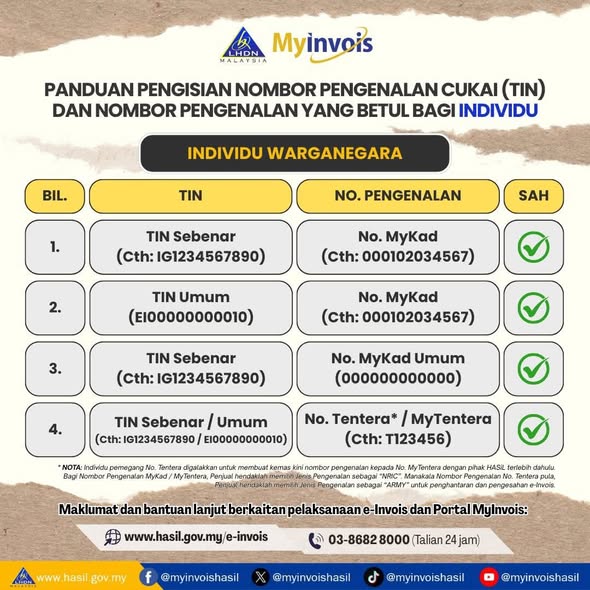
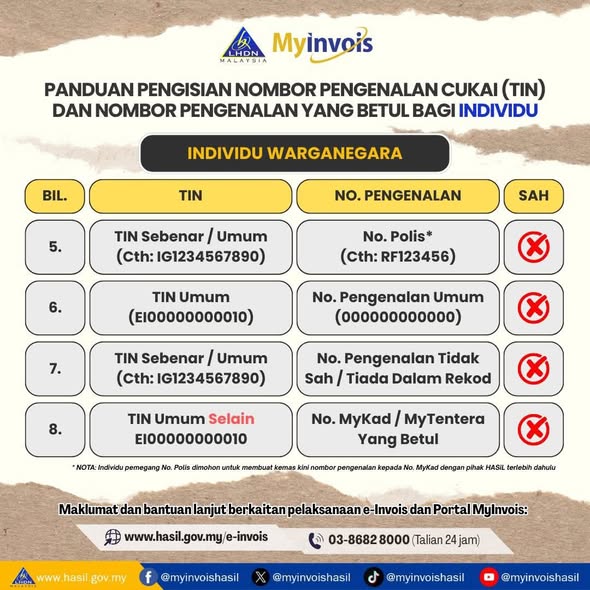
    When issuing or submitting an e-Invoice or self-billed e-Invoice through MyInvois, taxpayers must enter the TIN and identity details that apply to the relevant individual or transaction. Incorrect details may cause validation problems.

    Individual buyers

    For Malaysian individuals and non-Malaysian individuals who hold a MyPR or MyKAS, the supplier may use one of the following combinations:

    • the individual’s TIN;

    • the individual’s MyKad, MyTentera, MyPR or MyKAS identification number, as applicable; or

    • both the TIN and the relevant identification number.

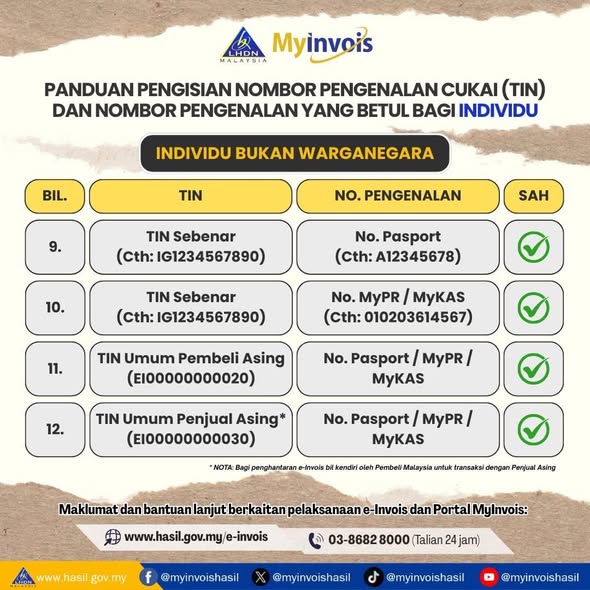
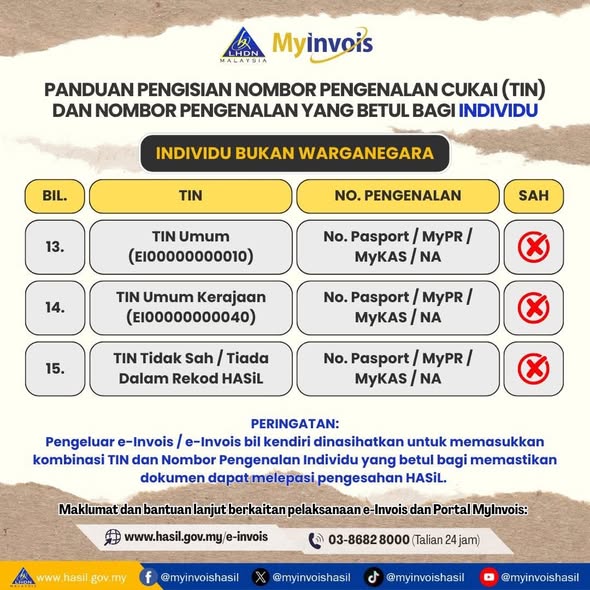
    The TIN prefix for individuals is IG. For non-Malaysian individuals who do not hold a MyPR or MyKAS, the supplier may provide the individual’s TIN alone, or the TIN together with the passport number. If the individual does not have an IRBM-assigned TIN, the applicable general TIN may be used with the passport number.

    General TINs

    HASiL’s e-Invoice Specific Guideline assigns different general TINs to specific circumstances. For example, EI00000000010 is the General Public’s TIN and may be used in specified cases where an individual provides only an identification number. EI00000000020 is designated for foreign buyers, while EI00000000030 is designated for foreign suppliers in applicable self-billed e-Invoice situations.

    These general TINs are not interchangeable. Taxpayers should use the code that applies to the particular transaction and should not substitute a government or other general TIN for a foreign buyer or supplier.

    Check details before submission

    Taxpayers should confirm the TIN and identification details with the relevant party and verify the TIN through MyTax or the MyInvois TIN validation service where appropriate. Using the correct TIN and identity-number combination helps reduce validation errors and supports accurate e-Invoice submission.

    电子发票验证所需的 TIN 与身份号码资料

    通过 MyInvois 开具或提交电子发票或自开电子发票时,纳税人须根据相关个人或交易填写适用的 TIN 和身份资料。资料不正确可能导致验证问题。

    个人买方

    对于马来西亚个人,以及持有 MyPR 或 MyKAS 的非马来西亚个人,供应商可采用以下其中一种资料组合:

    • 个人的 TIN;

    • 个人适用的 MyKad、MyTentera、MyPR 或 MyKAS 身份号码;或

    • TIN 与相关身份号码一并填写。

    个人 TIN 的前缀为 IG。对于未持有 MyPR 或 MyKAS 的非马来西亚个人,供应商可只填写该个人的 TIN,或同时填写 TIN 与护照号码。若该个人没有由 IRBM 指定的 TIN,可在填写护照号码时使用适用的通用 TIN。

    通用 TIN

    HASiL《电子发票专门指南》为特定情况指定了不同的通用 TIN。例如,EI00000000010 是一般公众通用 TIN,可用于指南所列、个人只提供身份号码的特定情况;EI00000000020 指定用于外国买方;EI00000000030 则用于适用自开电子发票情形中的外国供应商。

    这些通用 TIN 不可互换使用。纳税人应根据具体交易选择适用代码,不应以政府或其他通用 TIN 代替外国买方或供应商的适用 TIN。

    提交前核对资料

    纳税人应向相关方确认 TIN 与身份资料,并在适用时通过 MyTax 或 MyInvois 的 TIN 验证服务核对 TIN。使用正确的 TIN 与身份号码组合,有助于减少验证错误,并确保电子发票资料准确提交。

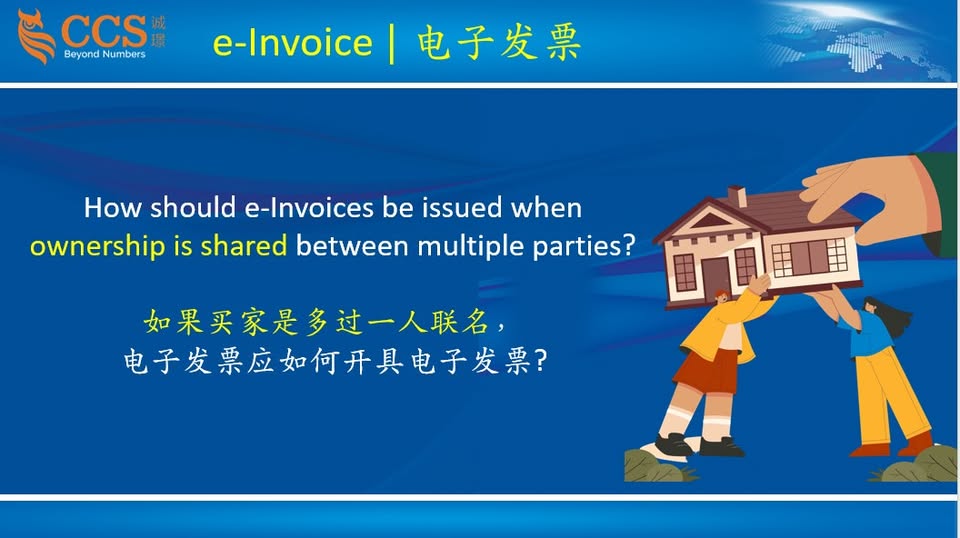
  • e-Invoices for Jointly Owned Property: Rental Payments to Individual Owners

    e-Invoices for Jointly Owned Property: Rental Payments to Individual Owners

    When a business rents property jointly owned by individuals who do not conduct a business, the e-Invoice treatment may involve self-billed e-Invoices.

    HASiL’s e-Invoice Specific Guideline gives the example of Best Mesra Sdn Bhd, which rents office space owned by three individuals: Kamal, Cheng and Sunita. After confirming that the landlords are individuals who do not conduct a business, Best Mesra Sdn Bhd must assume the role of the supplier and issue a separate self-billed e-Invoice to each owner, based on their agreed proportion.

    This treatment concerns rental payments to individual property owners. It should not be confused with maintenance fees charged by a property management body, which are a separate transaction. The jointly owned property example does not establish that a management body must split maintenance-fee e-Invoices according to ownership shares.

    Key point

    For a business renting jointly owned property from individual landlords who do not conduct a business, the tenant business is responsible for issuing separate self-billed e-Invoices to the owners according to their agreed proportions.

    联名物业的电子发票:支付给个人业主的租金

    企业租用由多名个人共同拥有的物业,而这些业主并未从事商业活动时,相关电子发票可能涉及自开电子发票。

    HASiL 的《电子发票专门指南》以 Best Mesra Sdn Bhd 为例。该公司租用由三名个人——Kamal、Cheng 和 Sunita——共同拥有的办公室。Best Mesra Sdn Bhd 与业主确认,他们是没有从事商业活动的个人。因此,Best Mesra Sdn Bhd 须以供应商身份,按照各业主约定的比例,分别向每位业主开具自开电子发票。

    此处理方式针对的是支付给个人物业业主的租金,不应与物业管理机构收取的管理费混为一谈。联名物业的这个例子,并不表示管理机构必须按照产权比例拆分管理费电子发票。

    要点

    企业向未从事商业活动的个人业主租用联名物业时,负责开具自开电子发票的是承租企业,并须按照业主约定的比例分别开具。

  • e-Invoice Exemptions and the Pressures Facing Malaysian Businesses

    e-Invoice Exemptions and the Pressures Facing Malaysian Businesses

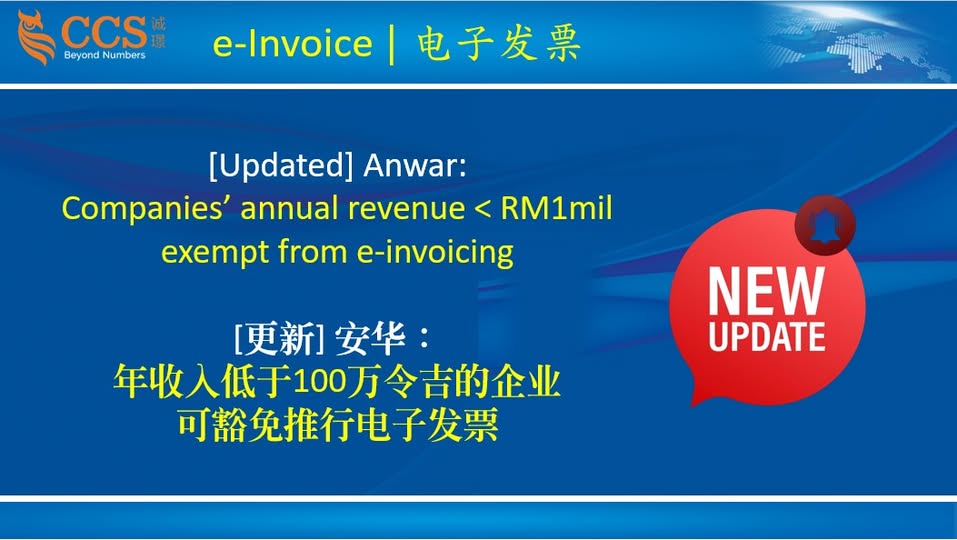
    What may appear to be good news can still bring mixed feelings to business owners close to the threshold or struggling with rising costs. The debate began when Prime Minister Datuk Seri Anwar Ibrahim announced that, following a Cabinet meeting, businesses with annual revenue below RM1 million would be exempt from e-Invoicing. Previously, the exemption threshold was RM500,000. The threshold has since been raised to RM3 million, effective 1 September 2026.

    For some business owners, relief from one requirement does not erase the pressures they face every day. They may feel that costs keep rising: rent increases, raw materials become more expensive, and employee wages go up. When businesses are also asked to meet new administrative requirements, the combined burden can feel exhausting.

    This does not mean that business owners oppose the country’s progress or digitalisation. Many are simply finding it increasingly difficult to keep up with the demands of running a business while managing higher costs and new obligations, including requirements relating to SOCSO.

    The e-Invoice exemption offers relief to eligible businesses, but the broader concern remains: how can businesses continue to adapt and grow when operating costs and compliance demands keep increasing?

    电子发票豁免与马来西亚企业面对的经营压力

    看似是好消息,对于正处于门槛边缘或承受成本上涨压力的企业来说,感受可能并不单一。这场讨论始于首相拿督斯里安华宣布,内阁会议后决定豁免年营业额低于 RM1 million 的企业实施电子发票。此前的豁免门槛为 RM500,000。此后,豁免门槛已提高至 RM3 million,并自2026年9月1日起生效。

    对一些商家而言,豁免一项要求,并不代表日常经营压力就此消失。租金上涨、原材料变贵、员工薪资增加,这些成本持续累积。若同时还要应对新的行政要求,整体负担难免让人感到疲惫。

    这并不代表商家不支持国家进步或数码化。许多企业只是越来越难以兼顾经营、上涨的成本,以及新的合规义务,包括与 SOCSO 相关的要求。

    电子发票豁免为符合条件的企业减轻了一部分负担,但更广泛的疑问仍然存在:当营运成本与合规要求不断增加,企业该如何继续适应并发展?

  • e-Invoice Guideline Version 4.6: Key Changes and the Current RM3 Million Threshold

    e-Invoice Guideline Version 4.6: Key Changes and the Current RM3 Million Threshold

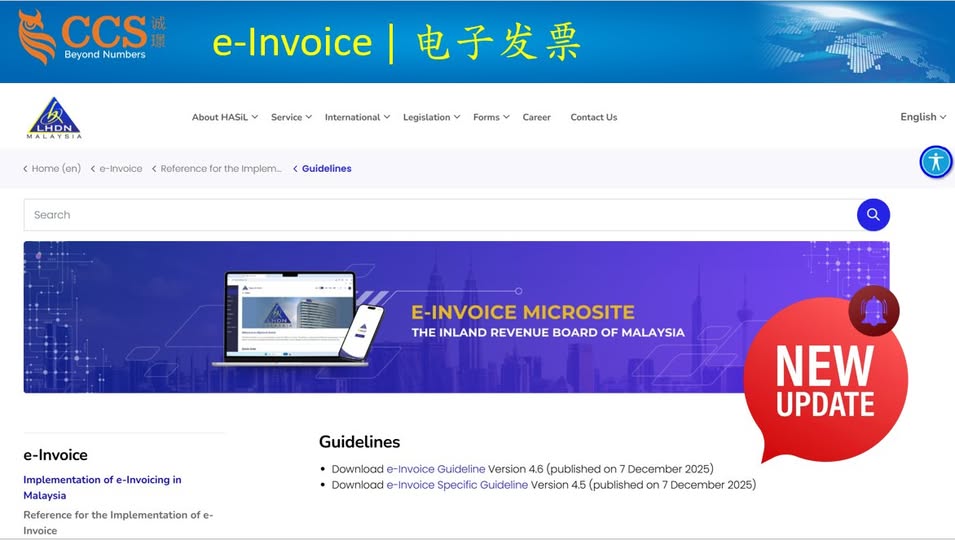
    Version 4.6 of Malaysia’s e-Invoice Guideline, dated 10 December 2025, made three notable changes compared with Version 4.5. Some of the thresholds in Version 4.6 have since changed, so businesses should distinguish between what that version introduced and the current requirements.

    Changes introduced in Version 4.6

    Paragraph 1.0 — policy context: Version 4.6 expanded the introduction’s references to Malaysia’s national development plans by adding the Thirteenth Malaysia Plan alongside the Twelfth Malaysia Plan.

    Paragraph 1.5 — implementation dates: The guideline set 1 January 2026 as the implementation date for taxpayers with annual turnover or revenue of up to RM5 million. It also revised the threshold used to determine implementation dates for certain businesses that began operating between YA2023 and YA2025. At the time, the relevant threshold was RM1 million, increased from RM500,000 under Version 4.5.

    Paragraph 1.6.1(e) — exemption threshold: Version 4.6 raised the e-Invoice exemption threshold from RM500,000 to RM1 million. Eligible taxpayers below that threshold could be exempt from issuing e-Invoices, including self-billed e-Invoices, subject to the exemption criteria.

    The current threshold is RM3 million

    The RM1 million threshold described in Version 4.6 is no longer the current threshold. HASiL’s General FAQ, updated on 4 September 2026, reflects the increase to RM3 million. The exemption remains subject to the applicable criteria, including conditions relating to non-individual shareholders, subsidiaries, related companies and joint ventures.

    For businesses that commenced operations from YA2023 to YA2025, reaching RM3 million in YA2023, YA2024 or YA2025 requires implementation from 1 July 2026. Businesses below RM3 million in those years that meet the exemption criteria are exempt. If an eligible business reaches RM3 million in YA2026 or a later year, it must implement e-Invoicing from 1 January in the second year following the year in which it reaches the threshold.

    For businesses commencing operations from YA2026 onwards, those that do not meet the exemption criteria must implement e-Invoicing from 1 July 2026 or their commencement date, whichever is later. Eligible businesses below RM3 million in their first YA are exempt; if they later reach the threshold, the second-year implementation rule applies.

    Example: a business with RM750,000 in annual turnover

    Under Version 4.6, a business with annual turnover of RM750,000 was below the RM1 million threshold and could qualify for exemption if it met the relevant criteria. Under the current RM3 million threshold, RM750,000 remains below the turnover threshold, but the business must still meet the applicable exemption criteria.

    An exemption for the business does not remove its suppliers’ e-Invoice obligations. Suppliers must issue e-Invoices in accordance with their own implementation requirements.

    企业应按现行门槛评估自身义务,并在判断豁免资格时同时核对适用条件。

    电子发票指南 4.6 版:主要变更与现行 RM3 million 门槛

    马来西亚《电子发票指南》4.6版于2025年12月10日发布,相较4.5版作出三项值得关注的调整。由于其中部分门槛之后已有变更,企业应区分该版本当时的规定与现行要求。

    4.6版引入的变更

    第1.0段——政策背景:4.6版扩充了前言中的国家发展计划背景,在《第十二大马计划》之外,也加入了《第十三大马计划》。

    第1.5段——实施日期:该版本规定,年营业额或收入不超过 RM5 million 的纳税人,实施日期为2026年1月1日。对于在 YA2023 至 YA2025 开始营业的部分企业,该版本也调整了用于确定实施日期的门槛。当时的门槛为 RM1 million,高于4.5版所采用的 RM500,000。

    第1.6.1(e)段——豁免门槛:4.6版将电子发票豁免门槛从 RM500,000 提高至 RM1 million。低于该门槛并符合豁免条件的纳税人,可豁免开具电子发票,包括自开电子发票。

    现行门槛为 RM3 million

    4.6版所述的 RM1 million 门槛已不再是现行门槛。HASiL 于2026年9月4日更新的《一般常见问题解答》反映了门槛上调至 RM3 million。豁免仍须符合适用条件,包括有关非个人股东、子公司、关联公司及合资企业的规定。

    对于在 YA2023 至 YA2025 开始营业的企业,若在 YA2023、YA2024 或 YA2025 达到 RM3 million,须从2026年7月1日起实施电子发票。若这些年度的营业额或收入低于 RM3 million,且企业符合豁免条件,则可获豁免。若符合条件的企业在 YA2026 或之后达到 RM3 million,则须从达到门槛的评税年度之后第二年的1月1日起实施电子发票。

    对于从 YA2026 起开始营业的企业,不符合豁免条件者须从2026年7月1日或业务开始运营之日起实施电子发票,以较迟者为准。符合豁免条件且首个评税年度收入低于 RM3 million 的企业可获豁免;若之后达到门槛,则适用第二年实施规则。

    例子:年营业额为 RM750,000 的企业

    根据4.6版,年营业额为 RM750,000 的企业低于当时的 RM1 million 门槛;若符合相关条件,可享有豁免。按照现行 RM3 million 门槛,RM750,000 仍低于营业额门槛,但企业仍须符合适用的豁免条件。

    企业本身获得豁免,并不免除其供应商的电子发票义务。供应商仍须按照自身适用的实施要求开具电子发票。

    企业应依据现行门槛评估自身义务,并在判断豁免资格时同时核对适用条件。

  • When Does e-Invoicing Apply to Businesses That Started Between 2023 and 2025?

    When Does e-Invoicing Apply to Businesses That Started Between 2023 and 2025?

    If your business started between 2023 and 2025, you may be wondering when e-Invoicing becomes mandatory. Being a new business does not automatically mean the requirement will not apply. The key factors are your annual turnover or revenue and whether you meet the exemption criteria.

    The source material refers to the former RM1 million threshold. Under HASiL’s current General FAQ, updated on 4 September 2026, the exemption threshold is RM3 million.

    If turnover or revenue reached RM3 million in YA2023, YA2024 or YA2025

    Businesses that reached or exceeded RM3 million in any of these years were required to implement e-Invoicing from 1 July 2026.

    For example, a company started in April 2024 and recorded turnover of RM650,000 in YA2024 and RM3.2 million in YA2025. Since it reached the current threshold in YA2025, it was required to implement e-Invoicing from 1 July 2026.

    If turnover or revenue remained below RM3 million

    A business with turnover or revenue below RM3 million in YA2023, YA2024 and YA2025 may be exempt if it meets the applicable exemption criteria. If it does not meet those criteria, it was required to implement e-Invoicing from 1 July 2026, the concessionary implementation date.

    For example, a company that started in April 2024 and recorded RM650,000 in YA2024 and RM1.2 million in YA2025 did not reach the current RM3 million threshold. If it meets the exemption criteria, it is exempt. If it does not, it was required to implement e-Invoicing from 1 July 2026.

    If an eligible business first reaches or exceeds RM3 million in YA2026 or a later year, it must implement e-Invoicing from 1 January in the second year following the YA in which it reaches the threshold.

    That is why monitoring annual turnover or revenue matters. Under the current rules, RM1 million alone does not trigger implementation for a business that qualifies for the exemption; the applicable threshold is RM3 million, and the exemption criteria must also be considered.

    2023 至 2025 年间开业的企业,何时须实施电子发票?

    如果你的企业在2023年至2025年间开始营业,可能会想知道何时必须实施电子发票。企业成立时间较短,并不代表一定不会受到相关要求约束。关键在于年度营业额或收入,以及企业是否符合豁免条件。

    原文提及的是旧有 RM1 million 门槛。根据 HASiL 于2026年9月4日更新的现行《一般常见问题解答》,豁免门槛为 RM3 million。

    YA2023、YA2024 或 YA2025 达到 RM3 million

    若企业在上述任何一个评税年度达到或超过 RM3 million,须从2026年7月1日起实施电子发票。

    例如,一家公司于2024年4月开始营业,在 YA2024 录得 RM650,000 营业额,并在 YA2025 录得 RM3.2 million。由于该公司在 YA2025 达到现行门槛,因此须从2026年7月1日起实施电子发票。

    营业额或收入仍低于 RM3 million

    若企业在 YA2023、YA2024 和 YA2025 的营业额或收入均低于 RM3 million,并符合适用的豁免条件,便可能获得豁免。若不符合豁免条件,则须从优惠实施日期2026年7月1日起实施电子发票。

    例如,一家公司于2024年4月开始营业,在 YA2024 录得 RM650,000 营业额,并在 YA2025 录得 RM1.2 million。该公司未达到现行 RM3 million 门槛。若符合豁免条件,即可获得豁免;若不符合,则须从2026年7月1日起实施电子发票。

    若符合豁免条件的企业首次在 YA2026 或之后某一评税年度达到或超过 RM3 million,则须从达到门槛的评税年度之后第二年的1月1日起实施电子发票。

    因此,持续追踪年度营业额或收入非常重要。根据现行规定,对于符合豁免条件的企业,仅达到 RM1 million 并不会触发实施要求;现行门槛为 RM3 million,同时也须考虑适用的豁免条件。