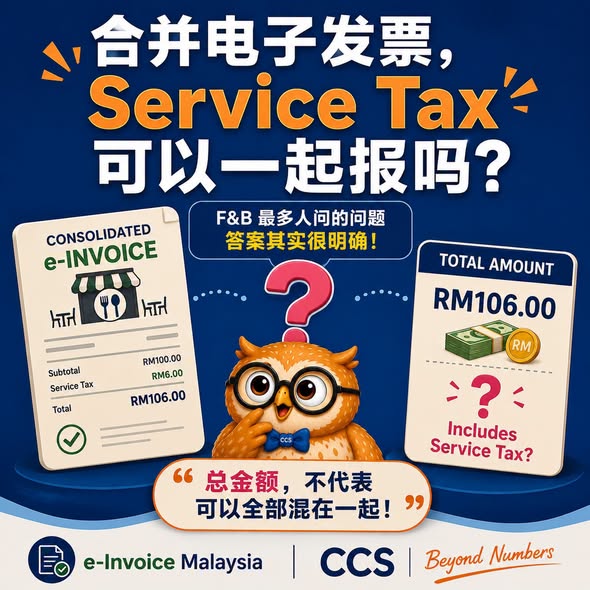
For food and beverage (F&B) businesses, service tax included in a consolidated e-Invoice should be reported separately rather than combined with other amounts.
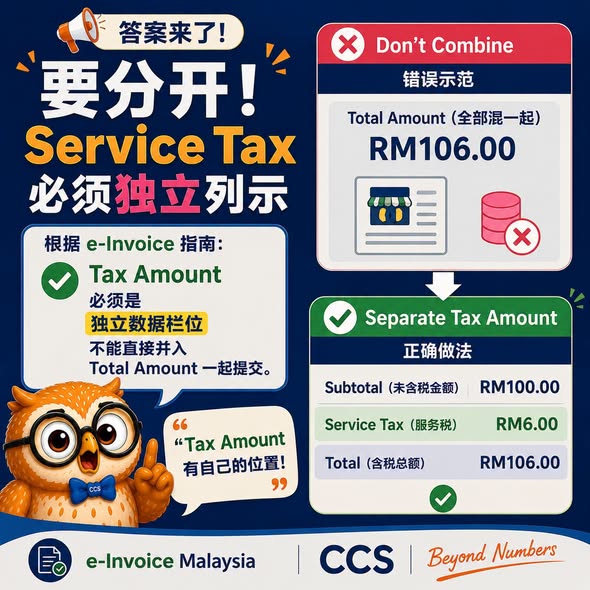
Under the e-Invoice guidelines, Tax Amount is a separate mandatory data field. The applicable tax amount must be stated separately, whether at line-item or invoice level.
The following fields serve different purposes:
- Total Excluding Tax: The total payable after discounts and charges, but excluding applicable taxes such as sales tax or service tax.
- Tax Amount: The applicable tax amount, reported separately.
- Total Including Tax: The total payable, including applicable taxes. This field applies at invoice level.
These fields should not be treated as a single combined figure. The system must be able to identify and report the service tax amount separately.
Practical Considerations for F&B Businesses
If a company’s system currently produces only a consolidated total that already includes service tax, without separately populating the Tax Amount field, the e-Invoice submission may not meet the stated requirements. IRBM requires the tax amount to be reported in its own field for validation and subsequent SST reconciliation.
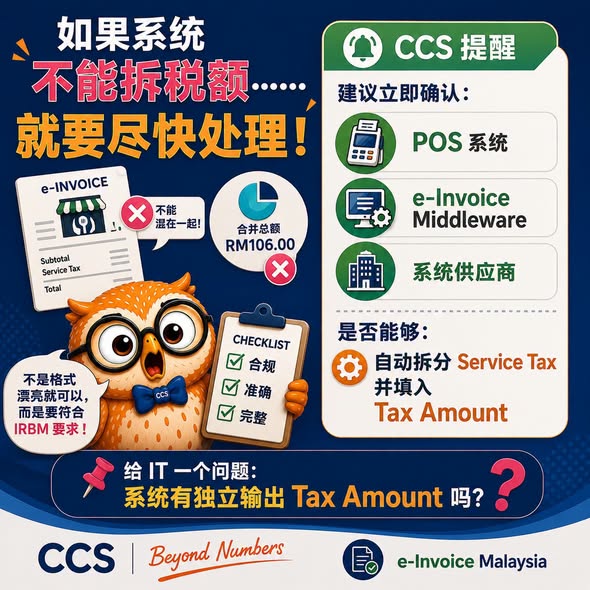
Businesses should check whether their point-of-sale (POS) or cash-register system, or any middleware used, can calculate the service tax separately and populate the Tax Amount field when generating a Consolidated e-Invoice. The tax type should also be identified as “Service Tax”.
If the system cannot do this automatically, businesses may need to discuss the required tax breakdown with their software provider or IT team. The tax amount should be separated by tax type in the e-Invoice data, rather than shown only as part of a total inclusive of tax.
This is not merely a formatting issue. From 15 August, IRBM will validate multiple data fields in the production environment. A missing or incorrect Tax Amount field may result in a rejected submission or validation failure.
F&B企业开具 e-Invoice:服务税金额须单独列示
对于餐饮业(F&B)企业,合并电子发票中的服务税金额应单独申报,不应与其他金额合并提交。
根据电子发票指南,Tax Amount(税额)**是独立且必须填写的数据栏位。无论在逐项层级还是发票层级,都应单独列明适用税额。
以下栏位用途各不相同:
- Total Excluding Tax(未含税总额):扣除折扣并计入收费后的应付总额,但不包括销售税或服务税等适用税项。
- Tax Amount(税额):单独列示适用税额。
- Total Including Tax(含税总额):包含适用税项在内的应付总额。此栏位适用于发票层级。
这些栏位不能合并为一个笼统金额。系统必须能够识别并单独申报服务税金额。
F&B企业的实务注意事项
如果企业目前使用的系统只输出已包含服务税的合并总额,却没有单独填写Tax Amount栏位,电子发票提交可能不符合上述要求。IRBM要求将税额填入独立栏位,以便进行验证及后续SST核对。
企业应检查其销售点系统(POS)、收银系统或中间件,在生成合并电子发票时,能否单独计算服务税并填入Tax Amount栏位;同时也应将税种注明为“Service Tax”。
如果系统无法自动拆分,企业可能需要与软件供应商或IT团队沟通,在生成电子发票数据时按税种分别列出税额,而非只显示含税总额。
这不只是格式问题。自8月15日起,IRBM将在生产环境中验证多个数据栏位。如果Tax Amount栏位缺失或填写错误,提交可能会被拒绝或验证失败。