A business with turnover below RM3 million in YA 2022 is not automatically exempt from implementing e-Invoice. Under FAQ No. 12 of the LHDNM e-Invoice General FAQs, businesses should consider the relevant year, the turnover threshold and whether they meet the exemption criteria.
If the Business Meets the Exemption Criteria
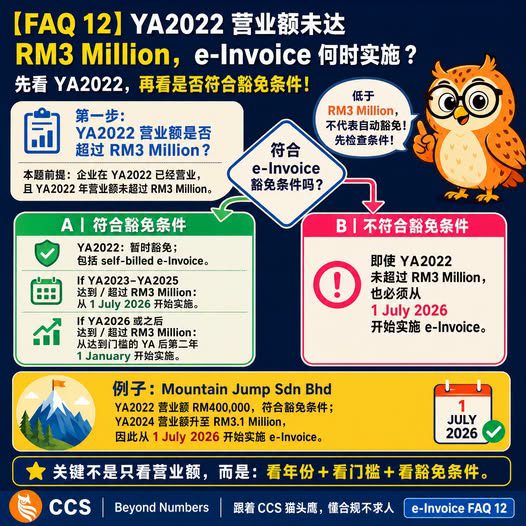
If a business was operating in YA 2022, had turnover not exceeding RM3 million for that year and meets the applicable exemption criteria, it may qualify for an exemption at that stage. The exemption also covers self-billed e-Invoice requirements.
However, the exemption is not permanent. The implementation date depends on when the business reaches the RM3 million threshold:
- If turnover reaches or exceeds RM3 million in YA 2023, YA 2024 or YA 2025, the business must implement e-Invoice from 1 July 2026.
- If turnover first reaches or exceeds RM3 million in YA 2026 or a later year, implementation generally begins on 1 January of the second year following the YA in which the threshold is reached.
If the Business Does Not Meet the Exemption Criteria
Even if the business’s YA 2022 turnover did not exceed RM3 million, it must implement e-Invoice from 1 July 2026 if it does not meet the applicable exemption criteria.
Therefore, turnover below RM3 million does not, by itself, establish eligibility for the exemption.
Example: Mountain Jump Sdn Bhd
Mountain Jump Sdn Bhd recorded turnover of RM400,000 in YA 2022 and met the exemption criteria. It was therefore exempt at that stage.
In YA 2024, the company’s turnover increased to RM3.1 million, exceeding the RM3 million threshold. As a result, it must implement e-Invoice from 1 July 2026.
The initial exemption is a temporary reprieve, not a permanent exemption.
A Practical Checklist
Before determining the implementation date, businesses and finance teams should check:
- Was the business already operating in YA 2022?
- Did its YA 2022 turnover not exceed RM3 million?
- Does it meet the applicable e-Invoice exemption criteria?
If the answer to the third question is unclear, the business should not simply defer the decision. A key compliance risk is assuming that implementation is unnecessary without first confirming eligibility.
e-Invoice豁免:YA 2022营业额低于RM300万就足够吗?
企业在YA 2022的营业额低于RM300万,并不代表自动豁免实施 e-Invoice。根据LHDNM《e-Invoice General FAQs》第12条,企业还须同时考虑相关年度、营业额门槛以及是否符合豁免条件。
符合豁免条件的情况
如果企业在YA 2022已经开始营业,当年的营业额不超过RM300万,并且符合适用的豁免条件,在该阶段可能符合豁免资格。该豁免也涵盖自开 e-Invoice 的要求。
不过,豁免并非永久有效。企业达到RM300万门槛的时间,将影响实施日期:
- 如果企业在YA 2023、YA 2024或YA 2025达到或超过RM300万,须从2026年7月1日起实施 e-Invoice。
- 如果企业首次在YA 2026或之后达到或超过RM300万,一般须从达到门槛所在课税年度之后第二年的1月1日起实施。
不符合豁免条件的情况
即使企业在YA 2022的营业额不超过RM300万,只要不符合适用的豁免条件,仍须从2026年7月1日起实施 e-Invoice。
因此,营业额低于RM300万本身,并不足以确认企业符合豁免资格。
案例:Mountain Jump Sdn Bhd
Mountain Jump Sdn Bhd在YA 2022的营业额为RM400,000,并符合豁免条件,因此当时可获豁免。
到了YA 2024,公司营业额增至RM310万,超过RM300万门槛。因此,公司须从2026年7月1日起实施 e-Invoice。
最初获得的豁免只是暂缓适用,并非永久豁免。
实用自查清单
企业及财务团队在确定实施日期前,应检查:
- 企业在YA 2022是否已经开始营业?
- YA 2022的营业额是否不超过RM300万?
- 企业是否符合适用的 e-Invoice 豁免条件?
如果第三个问题的答案不明确,就不应直接将决定往后拖延。合规风险之一,正是在未确认资格前便假定企业无需实施。