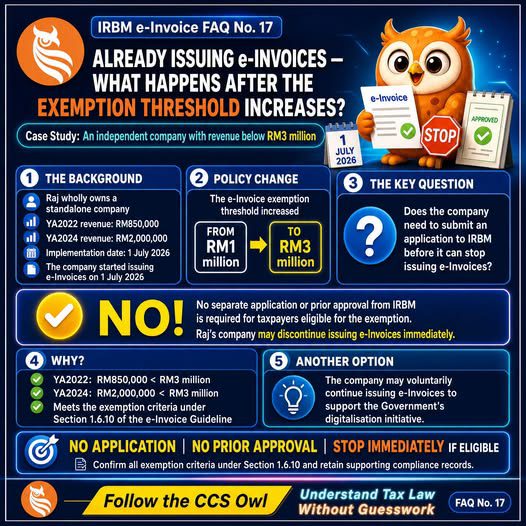
If your business has already started issuing e-Invoices, the increase in the exemption threshold from RM1 million to RM3 million may prompt a practical question: can you stop?
According to IRBM FAQ No. 17, a business that qualifies for the exemption does not need to submit a separate application or obtain prior approval from IRBM before stopping e-Invoice issuance.
For example, Raj’s company recorded revenue of RM850,000 in YA 2022 and RM2 million in YA 2024. Both amounts are below the revised RM3 million threshold. As the company also meets the exemption criteria in Section 1.6.10 of the e-Invoice Guideline, it may stop issuing e-Invoices immediately—even though it began issuing them on 1 July 2026.
Alternatively, the company may continue issuing e-Invoices voluntarily in support of the Government’s digitalisation initiative.
Before making a change, confirm that the business meets the applicable revenue threshold and every exemption condition, and keep the relevant supporting records.
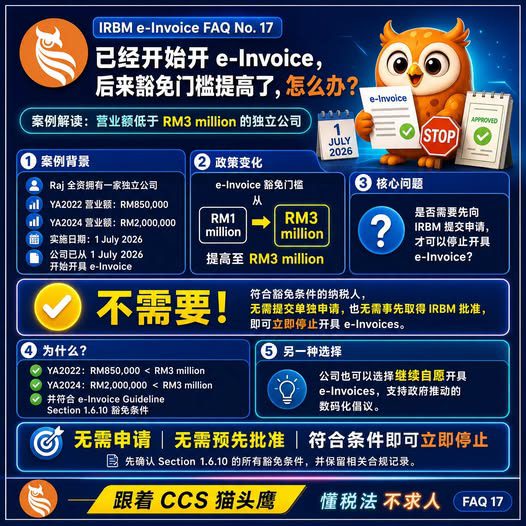
e-Invoice豁免:门槛提高后,企业可以停止开具 e-Invoice 吗?
如果企业已经开始开具 e-Invoice,豁免门槛从RM100万提高至RM300万后,可能会想知道:现在可以停止开具吗?
根据IRBM常见问题第17条,符合豁免条件的企业无需另行提交申请,也无需事先取得IRBM批准,即可停止开具 e-Invoice。
以Raj的公司为例:公司在YA 2022的营业额为RM850,000,在YA 2024为RM200万,两个年度的营业额均低于调整后的RM300万门槛。由于公司也符合《e-Invoice Guideline》第1.6.10节所列的豁免条件,因此即使已经从2026年7月1日开始开具 e-Invoice,也可以立即停止。
公司也可以选择继续自愿开具 e-Invoice,以支持政府推动的数码化计划。
采取行动前,请确认企业符合适用的营业额门槛及所有豁免条件,并妥善保留相关证明文件。