The MIA Digital Technology Blueprint highlighted funding support as a critical driver of digitalisation. Cost was identified as a key barrier preventing small and medium-sized enterprises (SMEs) and accounting practices from adopting technology.
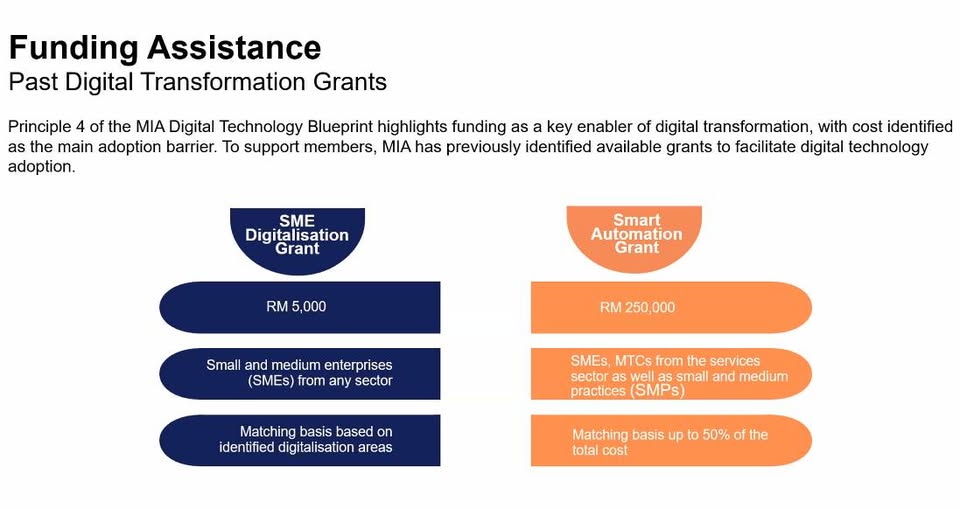
To help address this barrier, MIA previously highlighted two government-supported grants that were available to support digital adoption.
1. SME Digitalisation Grant
The SME Digitalisation Grant was designed to help businesses take initial steps towards digitalisation.
Key features included:
- Grant amount: RM5,000
- Who could apply: SMEs across all sectors
- Funding structure: A matching grant based on identified digitalisation needs
The grant was typically used for basic systems such as accounting software, point-of-sale (POS) systems, payroll tools and simple automation. It helped SMEs begin their digital journey without having to bear high upfront costs.
2. Smart Automation Grant
The Smart Automation Grant supported more advanced digital transformation projects.
Key features included:
- Grant cap: Up to RM250,000
- Who could apply: SMEs, mid-tier companies (MTCs) in the services sector, and small and medium-sized practices (SMPs), including accounting firms
- Funding structure: A matching grant of up to 50% of the total project cost
The grant supported larger-scale initiatives, such as end-to-end workflow automation, system integration and advanced digital tools for professional firms.
Why This Matters to Accountants
These grants reflected a clear policy direction: digital adoption is increasingly important for businesses and professional practices.
Accountants play an important role in this transition by advising clients on their digital readiness, supporting grant justification and implementation, and leading digital transformation within SMPs.
Although these grants are from the past, similar funding structures may feature in future initiatives.
Digital transformation is not simply an IT project; it is an important part of the accounting profession’s future competitiveness.
数码化资助与会计师支持中小企业的角色
MIA《数字科技蓝图》指出,资金支持是推动数码化的重要因素。成本是中小企业(SME)和会计师事务所采用科技的主要障碍之一。
为协助会员应对这一挑战,MIA曾介绍两项支持数码化发展的政府资助计划。
1. SME数码化资助计划
SME数码化资助计划旨在帮助企业迈出数码化的第一步。
主要特点包括:
- 资助金额: RM5,000
- 申请对象: 各行业的中小企业
- 资助方式: 根据已识别的数码化需求提供配对资助
该计划通常用于采购基础系统,例如会计软件、销售点(POS)系统、薪资工具或简单的自动化工具。资助有助于中小企业在不承担高额前期成本的情况下,开启数码化进程。
2. Smart Automation Grant(智能自动化资助)
Smart Automation Grant旨在支持更深入的数码转型项目。
主要特点包括:
- 资助上限: 最高RM250,000
- 申请对象: 中小企业、服务业中型企业(MTC),以及包括会计师事务所在内的中小型专业事务所(SMP)
- 资助方式: 配对资助比例最高可达项目总成本的50%
该资助支持规模较大的项目,例如端到端工作流程自动化、系统整合,以及为专业事务所采用的先进数码工具。
对会计师的意义
这些资助体现了明确的发展方向:数码化对企业和专业事务所日益重要。
会计师在转型过程中发挥着重要作用,包括协助客户评估数码化准备程度、支持资助申请的论证与项目实施,以及带领中小型专业事务所推动数码转型。
尽管上述资助计划属于过往项目,未来的相关计划仍可能采用类似的资助模式。
数码转型不只是资讯科技项目,也是会计专业保持未来竞争力的重要环节。