Q: Does a pawnshop need to issue an e-Invoice for accrued interest receivable recognised at year-end on an unredeemed pawn loan?
A: No.
If the accrued interest receivable is recognised at year-end solely for accounting or tax purposes, an e-Invoice is not required.
In short: Recognising accrued interest at year-end does not, by itself, mean that an e-Invoice must be issued. An accrued interest balance in the accounts does not automatically trigger e-Invoice issuance.
Accounting or tax recognition ≠ e-Invoice issuance.
For business owners, CFOs and accountants, one misconception deserves a clear answer: “Now that the e-Invoice Special Voluntary Disclosure Programme is available, can I issue a supplementary e-Invoice to clean up income I underreported in the past?”
No. The e-Invoice SVDP and income tax voluntary disclosure are separate processes. As the saying goes, “one matter at a time”: each compliance issue must be addressed through the appropriate channel.
What Does the e-Invoice SVDP Cover?
The HASiL e-Invoice Special Voluntary Disclosure Programme (PKPS e-Invois), introduced in 2026 and available until 31 December 2027, addresses e-Invoice compliance failures. These may include transactions that were not submitted despite e-Invoice implementation, errors in submitted information, or failure to submit e-Invoices from the date mandatory implementation began.
Eligible corrections may qualify for exemption from e-Invoice-related penalties.
It is important to understand what this programme covers: e-Invoice-related penalties. It does not address income tax, errors in tax returns or tax underpayments. The programme’s name makes its scope clear: PKPS e-Invois concerns e-Invoices, not income tax.
Can the e-Invoice SVDP Resolve an Earlier Income Tax Omission?
Suppose RM300,000 of income was underreported two years ago, before the taxpayer entered the mandatory e-Invoice period. The e-Invoice SVDP is not the mechanism for resolving that income tax omission.
Issuing an e-Invoice in 2026 to account for income from 2024 would be like using today’s parking ticket to settle a traffic fine from two years ago.
Even if the error occurred after e-Invoice implementation began, the two issues must still be dealt with separately:
At the e-Invoice level, the matter may be corrected through the PKPS e-Invois.
At the income tax level, if income was omitted from Form C or another tax return, the taxpayer must consider income tax voluntary disclosure, an amended return or another appropriate procedure.
Correcting an e-Invoice does not automatically correct an income tax return. Paying a traffic fine, for example, does not automatically renew the vehicle’s road tax. Each matter has to be addressed separately.
Start by Identifying the Year of Assessment
If an accountant reviewing past records discovers that RM300,000 of income was underreported, the first question should not be, “Should we join the e-Invoice SVDP?”
Instead, start by asking:
Which Year of Assessment (YA) does the RM300,000 relate to?
Was the income tax return for that year incorrect?
Was there an income tax underpayment?
As the saying goes, “Understand what happened and why it happened.” Without first identifying the relevant year, it is difficult to determine which procedure applies.
Two Separate Compliance Tracks
Think of the e-Invoice SVDP as a vehicle repair shop: it can address issues such as a faulty headlight, a flat tyre or a noisy engine. Income tax voluntary disclosure is more like dealing separately with an expired road tax or an underpayment.
Fixing the headlight does not renew the road tax. In the same way, an e-Invoice correction does not resolve an income tax issue.
If the review finds problems in both areas, both tracks need to be addressed:
e-Invoice compliance: use the PKPS e-Invois to correct the e-Invoice issue and seek relief from e-Invoice-related penalties, if eligible.
Income tax compliance: use income tax voluntary disclosure or an amended return to report the income and pay any tax due, while considering whether penalty relief may be available.
In short, both processes may be needed; one does not replace the other.
An e-Invoice Is Not an Eraser
Business owners sometimes ask: “If I issue an e-Invoice now, will the tax authority no longer see my earlier income?”
No. An e-Invoice is data, not an eraser. Issuing an e-Invoice in 2026 does not make a 2024 bank statement disappear, nor does it undo a customer payment received in 2024.
HASiL uses e-Invoice data to build analytical models that look at patterns, not just individual documents. Trying to hide the evidence is like covering your ears and expecting a bell to stop ringing.
A Practical Order of Steps
When an earlier underreporting issue comes to light, a sensible order is:
Confirm the YA: Identify the year to which the RM300,000 relates.
Identify the compliance issue: Determine whether it concerns e-Invoice compliance, an income tax omission, or both.
Address each issue through the appropriate process: Use the PKPS e-Invois for e-Invoice matters, and income tax voluntary disclosure or an amended return for income tax matters.
Keep the processes distinct: Correcting an e-Invoice is not the same as correcting a tax return, and vice versa.
Proceed step by step rather than looking for a single process to resolve everything.
For business owners, the key reminder is this: the e-Invoice SVDP is a repair shop, not JPJ. Correcting an e-Invoice does not by itself settle an income tax reporting issue.
An e-Invoice compliance matter and an income tax compliance matter are different, even though both involve “compliance”. Make sure the issue is handled through the right channel.
For SMEs, the essential question is not how many e-Invoices have been issued, but whether the income has been correctly reported. When an accountant reviewing past records discovers underreported income, the first questions should be: “Which YA does this RM300,000 relate to? Was that year’s tax return incorrect?”
As the saying goes, “In trying to be too clever, one may bring about one’s own downfall.” Correcting an e-Invoice without addressing the related income tax issue may leave the underlying problem unresolved.
This article is written in a humorous style and does not constitute tax advice. For tax planning, consult a professional tax adviser.
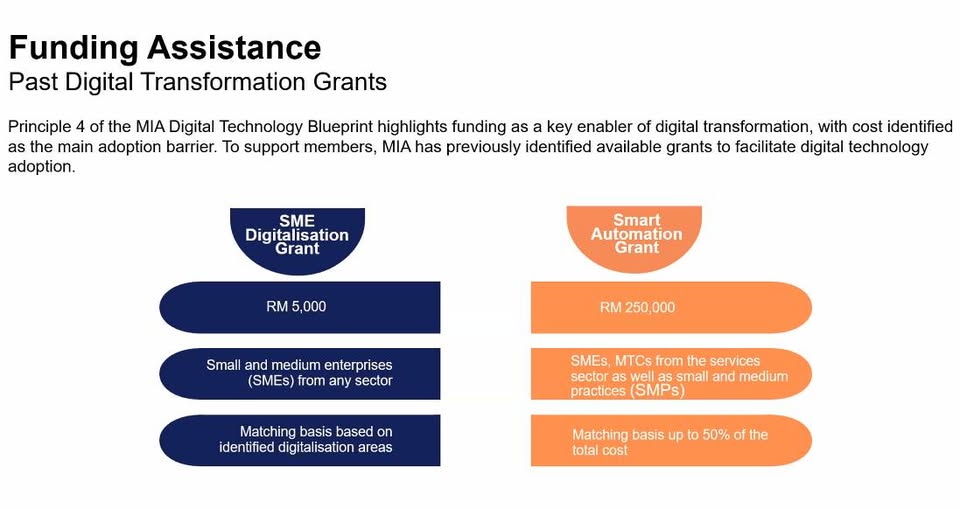
The MIA Digital Technology Blueprint highlighted funding support as a critical driver of digitalisation. Cost was identified as a key barrier preventing small and medium-sized enterprises (SMEs) and accounting practices from adopting technology.
To help address this barrier, MIA previously highlighted two government-supported grants that were available to support digital adoption.
1. SME Digitalisation Grant
The SME Digitalisation Grant was designed to help businesses take initial steps towards digitalisation.
Key features included:
Grant amount: RM5,000
Who could apply: SMEs across all sectors
Funding structure: A matching grant based on identified digitalisation needs
The grant was typically used for basic systems such as accounting software, point-of-sale (POS) systems, payroll tools and simple automation. It helped SMEs begin their digital journey without having to bear high upfront costs.
2. Smart Automation Grant
The Smart Automation Grant supported more advanced digital transformation projects.
Key features included:
Grant cap: Up to RM250,000
Who could apply: SMEs, mid-tier companies (MTCs) in the services sector, and small and medium-sized practices (SMPs), including accounting firms
Funding structure: A matching grant of up to 50% of the total project cost
The grant supported larger-scale initiatives, such as end-to-end workflow automation, system integration and advanced digital tools for professional firms.
Why This Matters to Accountants
These grants reflected a clear policy direction: digital adoption is increasingly important for businesses and professional practices.
Accountants play an important role in this transition by advising clients on their digital readiness, supporting grant justification and implementation, and leading digital transformation within SMPs.
Although these grants are from the past, similar funding structures may feature in future initiatives.
Digital transformation is not simply an IT project; it is an important part of the accounting profession’s future competitiveness.
The IFRS Interpretations Committee has issued a tentative agenda decision on fair presentation and compliance with IFRS Accounting Standards under IAS 1, Presentation of Financial Statements. It addresses how a company should present its financial statements in the rare circumstances where applying a specific accounting requirement would itself result in misleading information.
The Question
Financial statements are used by investors, business owners, banks, regulators and employees. The issue considered was whether a company can depart from a specific accounting requirement in exceptional circumstances and still present its financial statements fairly overall.
In very rare situations, a company may conclude that applying a particular requirement exactly as written would make its financial statements misleading. The accounting requirements allow a departure in such exceptional circumstances. The question was whether the company must still ensure that its financial statements as a whole are fairly presented.
The Committee’s Clarification
The Committee clarified that it must. Even when a company departs from a specific accounting requirement in an exceptional case, it must still present its financial information fairly, provide truthful and transparent information, and avoid misleading users.
The principle is clear: a departure may be permitted in rare circumstances, but fair presentation and transparency remain essential.
Does This Introduce New Rules?
No. The Committee concluded that such situations are very rare and do not affect many companies. It therefore decided not to amend the accounting standards or begin a new standard-setting project.
Invitation to Comment
Accounting professionals, companies and other interested parties are invited to submit their views to the Malaysian Accounting Standards Board (MASB) before 16 January 2026.
Key Takeaways
Accounting requirements are intended to support truthful financial reporting, not obscure it.
In exceptional circumstances, a departure from a specific requirement does not remove the obligation to present financial statements fairly overall.
Transparency and honesty help protect everyone who relies on financial information.
The IFRS Interpretations Committee has issued draft updates to its agenda decisions for IFRS 18, Presentation and Disclosure in Financial Statements. The updates address how certain taxes and government charges should be presented, particularly which payments qualify as income taxes.
Why Does This Matter?
Financial statements affect investors, lenders and banks, business partners, regulators and employees. If taxes are presented incorrectly, reported profits may appear higher or lower than they are, comparisons between companies may be misleading, and confidence in financial information may be weakened.
The clarification is intended to support fairness, transparency and clarity in financial reporting.
What Prompted the Update?
IFRS 18 changes how profit or loss information is presented. As a result, earlier guidance referring to IAS 1 needs to be updated, and the Committee reviewed its previous agenda decisions to ensure they remain appropriate.
Rather than finalising earlier updates, the Committee decided to make further refinements to two specific topics.
Payments That Are Not Income Taxes
Some payments may appear to be taxes but do not qualify as income taxes. Examples include production-based royalties and government charges specific to certain sectors.
The key point is that a payment qualifies as an income tax only if it is based on profit. The way it is paid, who receives it, and whether it reduces the income tax payable do not change its nature. For example, a royalty payment does not become an income tax simply because it reduces a company’s income tax payable.
These payments should be treated as ordinary business expenses, rather than as income tax expense.
Tonnage Taxes in the Shipping Industry
Some shipping companies pay taxes based on the size or capacity of their ships or the tonnage transported.
These taxes are based on gross capacity rather than actual profit, and are calculated using a notional amount rather than actual income and expenses. Accordingly, they do not qualify as income taxes under the accounting requirements.
Tonnage taxes should not be presented as income tax expense. Companies may present them separately if doing so helps users understand their performance.
Does This Create New Rules?
No. The Committee concluded that the existing accounting requirements already provide a clear answer. No new interpretation or standard-setting project is required.
The updates clarify the existing requirements; they do not change the law or accounting principles.
Invitation to Comment
Interested parties may submit feedback to the Malaysian Accounting Standards Board (MASB) by 16 January 2026.
Feedback is particularly useful when it includes clear reasoning, practical alternatives and real-world experience.
Key Takeaways
Not every payment called a “tax” qualifies as an income tax.
Income tax is based on profit, not volume, capacity or production.
Clear classification helps prevent confusion and misleading presentations of profit.
Transparency supports trust in financial reporting.
The IFRS Interpretations Committee has issued a tentative agenda decision on how a parent company should assess its main business activity when preparing its separate financial statements, particularly when its only substantive activity is investing in subsidiaries. The decision clarifies the application of IFRS 18, Presentation and Disclosure in Financial Statements.
Why Does This Matter?
How a company presents its income and expenses affects how its financial performance is understood. This matters to shareholders, investors, banks, regulators and others who rely on financial information.
The classification of income and expenses can shape how users understand what a company actually does.
The Situation Considered
The case involved a parent company that owned many subsidiaries but did not itself operate factories, shops or service businesses. Its activities were limited to holding shares in its subsidiaries, deciding when to buy or sell them, receiving dividends and distributing returns to shareholders.
The parent was not an “investment entity” under the accounting requirements. In its separate financial statements, it measured its investments in subsidiaries at cost and did not use business segments or performance subtotals to explain its results.
The Question
Was investing in subsidiaries the parent company’s main business activity?
The answer affects how related income and expenses are presented. If investing in subsidiaries is the parent’s main business activity, the related income and expenses are presented as operating activities. If it is not, they are presented as investing activities. This affects how users read the statement of profit or loss.
The Committee’s Conclusion
The Committee explained that a company’s main business activity must be assessed based on facts and evidence, rather than labels or claims.
In this case, the parent had no other substantive business activities. If investing in subsidiaries were not considered its main business activity, the company would have no main business activity at all.
The Committee concluded that investing in subsidiaries was the parent’s main business activity for the purposes of its separate financial statements. Accordingly, income and expenses relating to those investments must be presented as operating activities, rather than investing activities. This applies even if the group’s main business activity is different.
Separate and Consolidated Financial Statements
The Committee also highlighted that a parent’s separate financial statements may present a different picture from the group’s consolidated financial statements. This is normal and permitted under the accounting requirements. Each set of financial statements is assessed based on its own facts and purpose.
Does This Create New Accounting Rules?
No. The Committee concluded that existing requirements under IFRS 18 already provide clear guidance, and no new standard or amendment is needed. This is a clarification, not a change to the rules.
Invitation to Comment
The Malaysian Accounting Standards Board (MASB) invites comments until 16 January 2026.
Feedback is particularly useful when it explains practical impacts, provides clear reasoning and suggests alternatives.
Key Takeaways
A company’s main business activity is determined by what it actually does, not by what it calls itself.
If investing in subsidiaries is the parent’s only substantive activity, that investment activity is its main business in its separate financial statements.
The classification of income affects how users understand a company’s performance.
Clear presentation supports trust and transparency.
The IFRS Interpretations Committee has issued a tentative agenda decision on the scope of the requirement to disclose expenses by nature under IFRS 18, Presentation and Disclosure in Financial Statements. The decision clarifies when companies must provide additional details about expenses, particularly when expenses are presented according to their function rather than their nature.
Why Does This Matter?
Financial statements should be clear and understandable. When expenses are presented by function—for example, as “cost of sales” or “administrative expenses”—important information such as employee costs, depreciation and asset impairments may be concealed within larger totals.
The disclosure requirement supports transparency by helping users understand what the company’s money was spent on.
The Key Requirement
If a company presents any operating expenses by function in its statement of profit or loss, it must also provide a clear note disclosing specified expenses by nature. These include:
depreciation and amortisation;
employee benefits;
impairment losses and reversals; and
inventory write-downs and reversals.
The requirement applies regardless of why the expenses are presented by function.
The Question Considered
The question was whether the disclosure requirement applies only to certain operating expenses or to all expenses presented by function.
Some considered that it might apply only to “normal” operating expenses. Others asked whether it also applies to expenses required to be presented by other accounting standards, such as expenses related to financial instruments or insurance contracts.
The Committee’s Conclusion
The Committee clarified that there are no exceptions. If an expense is presented by function in the operating category, the disclosure requirement applies.
This is the case whether the functional presentation is optional or required by another accounting standard, and whether the expense relates to insurance, financial instruments or other activities.
Important Clarification
Some amounts disclosed may not represent expenses incurred in the current year. For example, an insurance expense may include costs that were previously included in the value of an asset.
This is permitted, but the company must clearly explain what those amounts relate to and identify the assets involved. This helps users understand the information and avoid confusion.
Does This Introduce New Accounting Rules?
No. The Committee concluded that IFRS 18 already provides sufficient guidance, and no new accounting standard or amendment is required. This is a clarification, not a change to the rules.
Invitation to Comment
The Malaysian Accounting Standards Board (MASB) invites feedback until 16 January 2026.
Useful feedback may include clear reasoning, real-world examples and practical alternatives.
Key Takeaways
Grouping expenses should not conceal important information about costs.
Transparency helps investors and the public understand the costs of a business.
When expenses are presented by function, the required details by nature must also be disclosed.
Clear disclosure helps build trust in financial reporting.
The IFRS Interpretations Committee has issued a tentative agenda decision on presenting taxes and other charges that are not income taxes within the scope of IAS 12, Income Taxes. The issue concerns how these amounts should be presented under IFRS 18, Presentation and Disclosure in Financial Statements.
The central point is that only income taxes within the scope of IAS 12 may be presented as income tax expense. Other taxes and charges must be presented elsewhere.
Why Does This Matter?
The way taxes and charges are presented can affect how profitable a company appears, cause confusion for investors and shareholders, and obscure the distinction between income tax and other government charges.
Clear presentation helps users understand how much tax a company pays on its profit and what other charges form part of the cost of doing business.
The Question Considered
Some companies asked whether non-income taxes—such as levies, duties or special charges—could be combined with income tax expense or presented in the income tax section.
As different views existed, clarification was sought.
The Committee’s Conclusion
The Committee’s answer was clear: non-income taxes and charges cannot be included in income tax expense or the income tax category.
Under IFRS 18, the line item “income tax expense or income” is reserved for income taxes. The income tax category likewise applies only to income taxes within the scope of IAS 12. A tax or charge that is not based on profit does not belong in that category.
For accounting purposes, an income tax is a tax calculated based on profit and covered by IAS 12. A payment to the government does not qualify as income tax simply because the government receives it.
Where Should Other Taxes and Charges Be Presented?
Other taxes and charges must be presented outside the income tax line and are usually treated as operating expenses or other costs.
Companies may add separate line items if doing so helps users understand the financial statements. The aim is to present the information transparently.
Does This Create New Rules?
No. The Committee concluded that existing accounting standards already provide a clear answer, so no new standard-setting project is needed. This is a clarification, not a change to the accounting requirements.
Invitation to Comment
The Malaysian Accounting Standards Board (MASB) invites comments until 16 January 2026.
Feedback is most helpful when it explains real-world issues, provides clear reasoning and suggests practical alternatives.
Key Takeaways
Not all payments to the government are income tax.
Income tax is limited to tax based on profit and covered by IAS 12.
Combining different types of taxes and charges can mislead readers.
Clear separation supports trust in financial reporting.
The IFRS Interpretations Committee has issued a tentative agenda decision on the classification of gains and losses arising from a derivative used to manage foreign currency exposure. The issue relates to IFRS 18, Presentation and Disclosure in Financial Statements, and clarifies how its new presentation requirements apply in practical situations.
Why Does This Matter?
The classification of gains and losses affects:
how profits and losses are presented;
how risky a company appears; and
how investors and banks understand its financial performance.
If gains and losses are classified incorrectly, readers may misunderstand what caused the profit or loss.
The Example Considered
The example involved a large group of companies in which:
one subsidiary earned interest from a foreign-currency loan;
another subsidiary paid interest on a foreign-currency loan; and
the group had more foreign-currency debt than foreign-currency assets.
To reduce the risk arising from currency movements, the group entered into a forward contract. The contract was used to manage foreign currency risk but was not formally designated as a hedge under the accounting requirements.
The key question was where the gain or loss from the contract should be presented in the statement of profit or loss. The possible categories were operating activities, investing activities and financing activities. This matters because each category presents a different aspect of the business.
How Does IFRS 18 Address the Issue?
The principle is straightforward. If a financial contract is used to manage a specific risk, and that risk affects a particular category of income or expense, the gain or loss from the contract should be presented in the same category.
The Committee’s Conclusion
In this case, the contract was used to manage foreign-currency risk on net debt. Foreign-currency differences arising from debt fall within financing activities.
Accordingly, the Committee concluded that any gain or loss from the contract must be presented under financing activities.
What About “Grossing Up”?
In this context, “grossing up” means presenting gains or losses at amounts greater than those actually arising in order to allocate them across different categories.
IFRS 18 does not permit this treatment. The contract managed a single net risk rather than several separate risks, and that risk affected only one category. Therefore, there was no need to gross up the gain or loss.
This results in a classification that is clear and faithfully reflects the underlying risk.
Internal Contracts Within the Group
The Committee also clarified that, in group financial statements, only external contracts are relevant. Internal contracts between subsidiaries cancel out and are disregarded.
This keeps the group’s financial statements focused on the actual external risks faced by the group.
Does This Create New Accounting Rules?
No. The Committee concluded that the existing accounting standards already provide sufficient guidance and that no new standard-setting project is required.
This is a clarification of the existing requirements, rather than a change to the accounting rules.
Invitation to Comment
The Malaysian Accounting Standards Board (MASB) invites comments until 16 January 2026.
Useful comments may include:
clear reasoning;
practical experience; and
alternative views.
Key Takeaways
Gains and losses should be presented in the category to which the underlying risk properly belongs.
Managing currency risk on debt affects financing activities, not operating activities.
Avoiding “grossing up” helps ensure that profits are presented faithfully.
Clear classification helps users understand the business risks reflected in the financial statements.
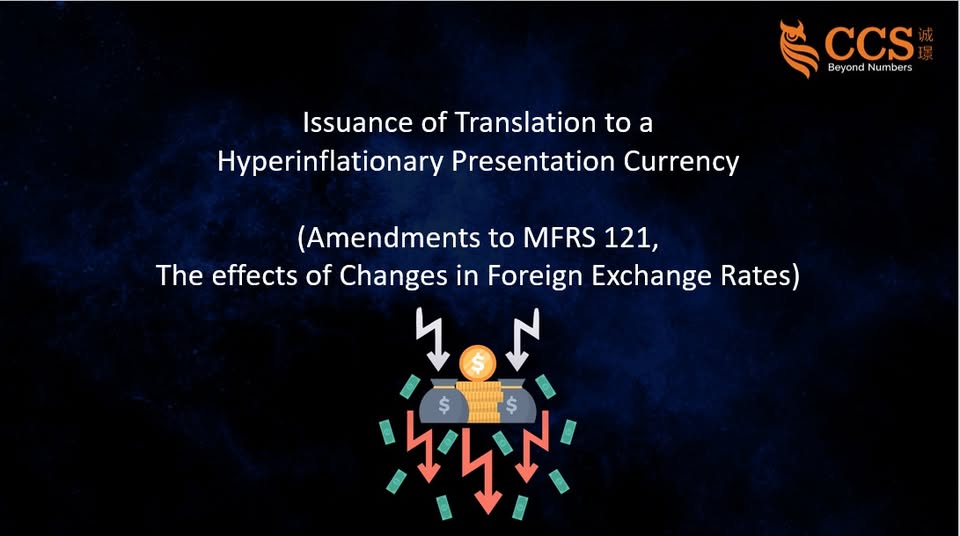
The Malaysian Accounting Standards Board (MASB) has issued an update on how companies should translate their financial statements when the presentation currency is affected by hyperinflation. The update amends MFRS 121, The Effects of Changes in Foreign Exchange Rates, issued under the Financial Reporting Act 1997.
Why is this update needed?
Consider a Malaysian company operating overseas where the local currency loses value rapidly, prices change almost daily and normal exchange rates no longer reflect economic reality. In such circumstances, simply translating figures using normal exchange rates may mislead readers. This is known as a hyperinflationary currency situation.
Before the update, companies used different methods to translate figures, making financial statements from hyperinflationary economies confusing, inconsistent and difficult to compare.
MASB’s aim is to improve consistency, clarity and the usefulness of financial information.
What does the amendment clarify?
The amendment explains how to translate financial statements when a company’s functional currency is not hyperinflationary, but its presentation currency is. It clarifies which exchange rates and adjustments to use so that the resulting figures reflect economic reality and are not distorted by runaway inflation. It also aims to provide a cost-effective approach without unnecessary complexity.
Which Malaysian businesses may be affected?
The update is relevant to Malaysian companies with overseas operations or reporting in high-inflation countries. It is also relevant to groups preparing financial statements under the requirements of bodies such as the Securities Commission Malaysia, Bank Negara Malaysia and the Companies Commission of Malaysia (SSM).
For most local small and medium-sized enterprises (SMEs), the immediate impact is expected to be limited or none. For multinational groups, however, the update may be important.
When does it take effect?
The amendments are effective for financial years beginning on or after 1 January 2027. Early adoption is permitted.
Why this matters beyond accounting
Financial statements are used by investors, banks, regulators and business partners. If figures affected by inflation are not translated appropriately, profits may appear misleading, losses may be obscured and decisions may be based on inaccurate information.
This update is intended to support trust in financial information. Extreme inflation can distort figures; clear accounting requirements help address that distortion and support reporting that is truthful, comparable and understandable. Accounting standards exist to reflect economic reality—not just mathematics.