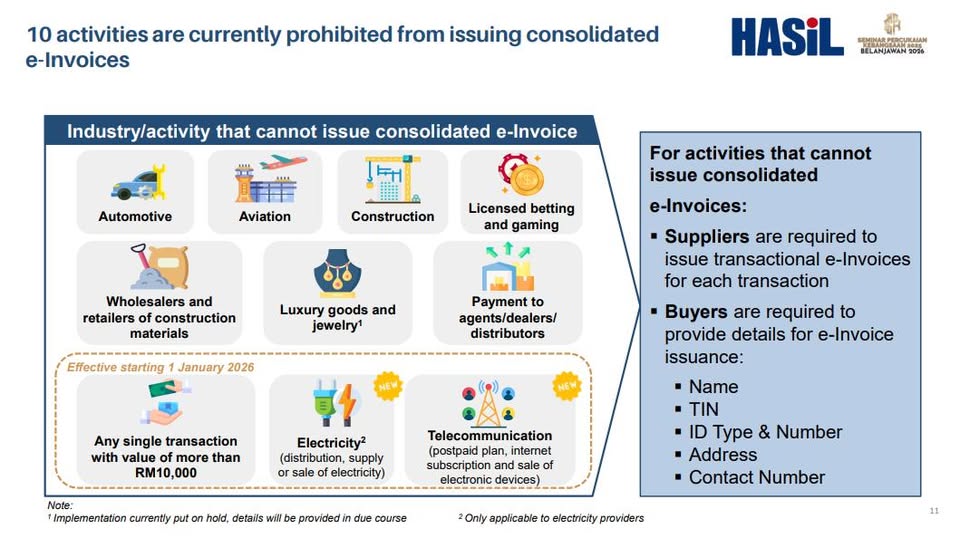
An infographic from the Inland Revenue Board of Malaysia (LHDN) identifies 10 activities that cannot use consolidated e-Invoices and must instead issue an individual transactional e-Invoice for each transaction. However, a review of the e-Invoice Specific Guideline (Version 4.4) raises a question about whether two of the activities listed relate to regular e-Invoices or self-billed e-Invoices.
Activities Listed in the Infographic
The infographic groups the activities as follows:
Stated as currently effective:
- Automotive: vehicle sales and related transactions
- Aviation: aviation industry transactions
- Construction: construction contracts and related activities
- Licensed betting and gaming
- Wholesalers and retailers of construction materials
- Luxury goods and jewellery
- Payments to agents, dealers and distributors, including commissions and incentives
Stated to take effect from 1 January 2026:
- Any single transaction valued at more than RM10,000
- Electricity distribution, supply or sale, applicable only to electricity providers
- Telecommunications, including postpaid plans, internet subscriptions and sales of electronic devices
The infographic also states that suppliers in these activities must issue a transactional e-Invoice for each transaction and cannot combine multiple transactions into one consolidated e-Invoice. Buyers are required to provide details for e-Invoice issuance, including their name, Tax Identification Number (TIN), identification type and number, address, and contact number.
The implementation of the restriction for luxury goods and jewellery is currently on hold, with further details to be provided in due course. The electricity restriction applies only to electricity providers, not to landlords charging tenants for electricity.
Question Raised by the e-Invoice Specific Guideline
Under Table 3.6 of the e-Invoice Specific Guideline (Version 4.4), item 6 concerns payouts to winners in licensed betting and gaming, while item 7 concerns commission payments to agents, dealers and distributors. These are transactions for which the payer issues a self-billed e-Invoice.
Paragraph 3.6.5 of the same guideline states that consolidated self-billed e-Invoices are not allowed for payouts to betting and gaming winners or for payments to agents, dealers and distributors.
The restriction in Table 3.6 appears to concern regular e-Invoices issued by suppliers to buyers. Since the two activities above involve self-billed e-Invoices and are subject to separate restrictions under paragraph 3.6.5, this raises the question of whether they should be counted among activities prohibited from issuing consolidated regular e-Invoices.
Based on this reading of the guideline, the number of activities prohibited from issuing consolidated regular e-Invoices would be eight rather than 10:
- Automotive
- Aviation
- Construction
- Wholesalers and retailers of construction materials
- Luxury goods and jewellery
- Any single transaction valued at more than RM10,000, stated to take effect from 1 January 2026
- Electricity, for electricity providers only, stated to take effect from 1 January 2026
- Telecommunications, stated to take effect from 1 January 2026
The question for LHDN is whether this interpretation is correct: does the infographic combine restrictions on regular and self-billed e-Invoices, meaning that eight activities—not 10—are prohibited from issuing consolidated regular e-Invoices?
合并电子发票限制:八项活动还是十项?
马来西亚内陆税收局(LHDN)的一张信息图表列出十项不能使用合并电子发票、而必须针对每笔交易开具单独交易电子发票的活动。不过,查阅《电子发票特定指南》(第 4.4 版)后,我们对其中两项究竟属于普通电子发票还是自开发票的限制产生疑问。
信息图表列出的活动
信息图表将相关活动分为以下类别:
注明为目前生效的活动:
- 汽车业:车辆销售及相关交易
- 航空业:航空业交易
- 建筑业:建筑合同及相关活动
- 持牌博彩和游戏
- 建筑材料批发商和零售商
- 奢侈品和珠宝
- 支付给代理商、经销商和分销商的款项,包括佣金及奖励
注明自 2026 年 1 月 1 日起生效的活动:
- 任何单笔交易价值超过 RM10,000
- 电力分配、供应或销售,仅适用于电力供应商
- 电信服务,包括后付费计划、互联网订阅及电子设备销售
信息图表也指出,从事这些活动的供应商必须为每笔交易开具交易电子发票,不能将多笔交易合并为一张合并电子发票。买方则须提供开具电子发票所需的资料,包括姓名、税务识别号码(TIN)、身份证明类型及号码、地址和联络号码。
奢侈品和珠宝相关限制的实施目前暂缓,详情将于适当时候公布。电力相关限制仅适用于电力供应商,不包括向租户收取电费的房东。
《电子发票特定指南》引发的疑问
根据《电子发票特定指南》(第 4.4 版)表 3.6,第 6 项涉及持牌博彩和游戏向赢家支付奖金,第 7 项涉及支付佣金给代理商、经销商和分销商。这两类交易均属于付款方开具自开发票的情形。
同一指南第 3.6.5 段指出,以下情况不允许开具合并自开发票:向博彩和游戏赢家支付奖金,以及支付款项给代理商、经销商和分销商。
表 3.6 中的限制似乎针对供应商向买方开具的普通电子发票。由于上述两项活动涉及自开发票,并受第 3.6.5 段的独立限制,因此我们有疑问:这两项是否应计入禁止开具合并普通电子发票的活动?
根据对该指南的理解,禁止开具合并普通电子发票的活动应为八项,而不是十项:
- 汽车业
- 航空业
- 建筑业
- 建筑材料批发商和零售商
- 奢侈品和珠宝
- 任何单笔交易价值超过 RM10,000,注明自 2026 年 1 月 1 日起生效
- 电力,仅适用于电力供应商,注明自 2026 年 1 月 1 日起生效
- 电信,注明自 2026 年 1 月 1 日起生效
我们希望向 LHDN 确认:上述理解是否正确?信息图表是否将普通电子发票与自开发票的限制合并列示,因此禁止开具合并普通电子发票的活动应为八项,而非十项?