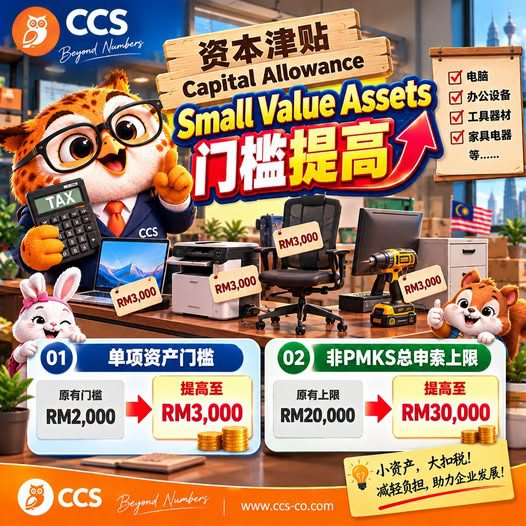
Budget 2027 proposes increasing the capital allowance thresholds for small-value assets, which may make it easier for businesses to claim deductions for qualifying lower-cost assets.
Higher Cost Limit Per Asset
The cost limit for an individual small-value asset is proposed to increase from RM2,000 to RM3,000. Under the special capital allowance rules for small-value assets, qualifying assets costing no more than RM3,000 each may be eligible for a claim.
Higher Aggregate Claim Limit for Non-PMKS Businesses
For businesses that are not PMKS, the aggregate claim limit is proposed to increase from RM20,000 to RM30,000. This limit does not necessarily apply in the same way to every business.
The increase may make it easier for businesses to claim capital allowances on qualifying items such as computers, printers, office chairs or coffee machines. However, an asset must meet the applicable tax requirements and be used for business purposes. Not every purchase will automatically qualify.
Points to Keep in Mind
- The RM3,000 threshold applies to the cost of each qualifying asset, not the total amount on an invoice.
- The RM30,000 aggregate claim limit applies to non-PMKS businesses; other businesses may be subject to different rules.
- A capital allowance is not a cash refund. A RM30,000 claim does not mean that LHDN will pay the business RM30,000.
Before purchasing an asset, consider whether it is needed for the business, meets the tax requirements and is a worthwhile investment. Tax planning should support sound business decisions, not drive unnecessary spending.
CCS | Beyond Numbers
Budget 2027:拟提高小额资产资本津贴门槛
《2027年财政预算案》提出提高小额资产的资本津贴门槛,让企业更容易就符合条件的低成本资产申报扣除。
单项资产成本门槛提高
单项小额资产的成本门槛拟从RM2,000提高至RM3,000。根据小额资产特别资本津贴规则,每项成本不超过RM3,000的合资格资产可能符合申索条件。
非PMKS企业的总申索上限提高
对于非PMKS企业,总申索上限拟从RM20,000提高至RM30,000。不同企业未必适用相同的总申索限制。
这项调整可能让企业更容易就符合条件的电脑、打印机、办公椅或咖啡机等资产申报资本津贴。不过,资产仍须符合适用税务规定并用于业务,并非所有采购都能自动申报。
请留意以下事项
- RM3,000是每项合资格资产的成本门槛,并非每张发票的总额。
- RM30,000总申索上限适用于非PMKS企业;其他企业可能适用不同规定。
- 资本津贴不等于现金退款。申报RM30,000,并不代表LHDN会向企业支付RM30,000。
购买资产前,应先考虑业务是否确实需要、资产是否符合税务条件,以及这项投资是否值得。税务规划应配合稳健的商业决策,而不是促使企业进行不必要的支出。
CCS | Beyond Numbers