
Day: November 10, 2026

  • e-Invoice Compliance: Offences, Receipt Requirements and Record-Keeping

    e-Invoice Compliance: Offences, Receipt Requirements and Record-Keeping

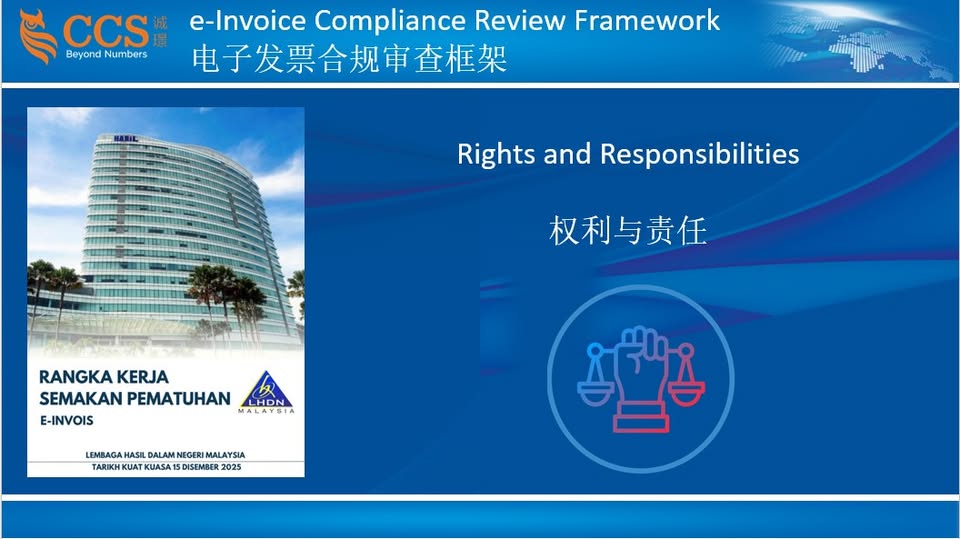
    Sections 6.4.7 to 6.4.10 of the e-Invoice Compliance Review Framework explain the consequences of non-compliance, when an e-Invoice may replace a receipt, the receipt requirement for consolidated e-Invoices and the implications of incomplete records.

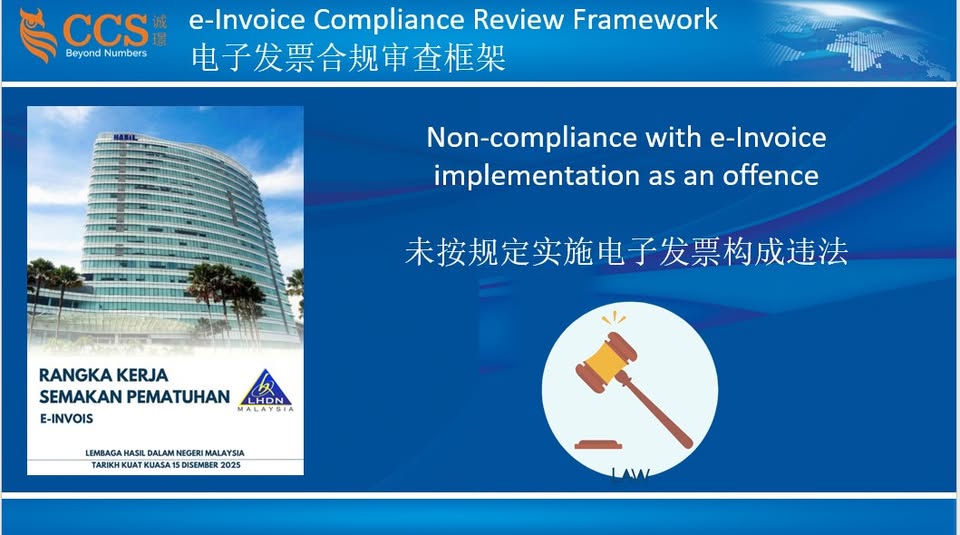
    Non-compliance may constitute an offence

    The framework links e-Invoice non-compliance to offences under three tax laws.

    Under the Income Tax Act 1967, failure to comply with paragraph 82(1)(b) is linked to paragraph 119A(b). Non-compliance with section 82B and subsections 82C(1), 82C(6) and 82C(7) is linked to paragraph 120(1)(d).

    Under the Petroleum Income Tax Act 1967, non-compliance with subsections 34B(1) and 34B(6) is linked to section 57B. Under the Labuan Business Activity Tax Act 1990, non-compliance with subsections 22DA(1), 22DA(6) and 22DA(7) is linked to section 22EA.

    For example, where a business makes sales but fails to issue e-Invoices as required, the fact that the sales are genuine does not remove the obligation to comply. Failure to meet the applicable requirements may expose the taxpayer to penalties under the relevant law.

    When an e-Invoice replaces a receipt

    Under subsection 82(2A) of the Income Tax Act 1967, a taxpayer is exempt from the receipt requirement under paragraph 82(1)(b) for goods sold or services provided where an e-Invoice has been issued under section 82C.

    However, this does not apply in the same way to consolidated transactions. A taxpayer issuing consolidated transaction e-Invoices under subsection 82C(7) must still issue a receipt for every amount received for goods sold or services provided, as required by subsection 82(2B).

    For example, a retailer may submit a consolidated e-Invoice covering eligible sales, but must still issue a receipt for each amount received from customers.

    If business records are incomplete

    Taxpayers are expected to keep complete and sufficient records. If they do not, the e-Invoice Compliance Officer (PEI) may use the best available method or approach to determine whether income has been reported and whether the taxpayer has properly met their e-Invoice obligations.

    Depending on the circumstances, the review may consider other available information, such as bank statements, third-party information or transaction patterns, to assess the taxpayer’s records and compliance.

    These provisions highlight that e-Invoice obligations are legally enforceable, that consolidated e-Invoicing does not remove the receipt requirement for each amount received, and that incomplete record-keeping may affect how compliance is assessed.

    电子发票合规:违法责任、收据要求与记录保存

    《e-Invoice Compliance Review Framework》第6.4.7至6.4.10节说明了电子发票不合规可能导致的后果、电子发票在何种情况下可替代收据、合并电子发票下的收据要求,以及记录不完整可能带来的影响。

    不合规可能构成违法行为

    该框架将电子发票不合规行为与三部税法下的违法条文联系起来。

    根据《1967年所得税法令》,未遵守第82(1)(b)段的规定,与第119A(b)段相关;未遵守第82B条及第82C(1)、82C(6)和82C(7)款的规定,则与第120(1)(d)段相关。

    根据《1967年石油所得税法令》,未遵守第34B(1)及34B(6)款的规定,与第57B条相关。根据《1990年纳闽商业活动税法令》,未遵守第22DA(1)、22DA(6)及22DA(7)款的规定,与第22EA条相关。

    例如,企业进行销售,却未按规定开具电子发票,即使交易本身真实,也不代表企业可以免除合规责任。未遵守适用要求,可能使纳税人面临相关法律规定的处罚。

    电子发票在何种情况下可替代收据

    根据《1967年所得税法令》第82(2A)款,如果纳税人已依据第82C条就所售商品或提供的服务开具电子发票,则该笔交易可豁免第82(1)(b)段规定的收据要求。

    不过,合并交易并不适用相同处理。纳税人依据第82C(7)款开具合并交易电子发票后,仍须根据第82(2B)款,就每笔已收取的商品或服务款项开具收据。

    例如,零售商可以将符合条件的销售合并开具电子发票,但仍须就向顾客收取的每笔款项开具收据。

    业务记录不完整时的处理

    纳税人应保存完整且充分的记录。如果记录不足,电子发票合规官(PEI)可采用最佳可行方法或途径,判断收入是否已申报,以及纳税人是否妥善履行电子发票义务。

    视具体情况,审查人员可能会参考银行对账单、第三方资料或交易模式等其他可用信息,评估纳税人的记录及合规情况。

    这些规定提醒纳税人,电子发票义务具有法律约束力;开具合并电子发票并不会免除每笔收款的收据要求;而记录保存不完整,也可能影响合规情况的评估。
  • e-Invoice Compliance Review Findings: Objections, Final Decisions and Compound Payments

    e-Invoice Compliance Review Findings: Objections, Final Decisions and Compound Payments

    After completing an e-Invoice compliance review, LHDNM issues the taxpayer a Findings Letter. The outcome will classify the taxpayer as compliant, non-compliant or exempt for the period or transactions reviewed.

    A taxpayer is considered compliant if they have implemented e-Invoicing and met the relevant legal and procedural requirements. A taxpayer may be found non-compliant if they have failed to meet one or more requirements—for example, by not transmitting e-Invoices to LHDNM or not issuing self-billed e-Invoices when required. The exempt category applies when the taxpayer is legally exempt from the requirements for the relevant period or transactions.

    Findings involving non-compliance

    If a taxpayer is found to be non-compliant, the Findings Letter will be accompanied by an e-Invoice Non-Compliance Statement and a Compound Application Letter under the relevant legislation: the Income Tax Act 1967, the Petroleum Income Tax Act or the Labuan Business Activity Tax Act. These documents identify the non-compliance and set out the relevant compound application process.

    The 18-calendar-day objection period

    A taxpayer who disagrees with the findings may submit a formal objection within 18 calendar days from the date of the Findings Letter. The objection should include additional information and supporting documentary evidence.

    For example, a taxpayer may provide system logs showing that e-Invoices were transmitted but validation was delayed because of a system outage. The taxpayer should submit the relevant records within the objection period.

    LHDNM will review the objection and supporting evidence before notifying the taxpayer of the finalised findings. The initial findings are not automatically final; they may be revised after the review.

    If no objection is received within 18 calendar days, the taxpayer is deemed to have agreed with the findings. Taxpayers should therefore review the Findings Letter promptly and respond within the specified period if they disagree.

    Compound payment

    Where the taxpayer agrees with the findings, they may contact the LHDNM Legal Branch in the Klang Valley or the relevant State Legal Section to proceed with payment of the compound.

    The review framework sets out a process for communicating findings, submitting objections and handling compound applications. Taxpayers should take note of the objection deadline and follow the instructions in the documents issued by LHDNM.

    电子发票合规审查结果:异议、最终结论与复合罚款

    电子发票合规审查完成后,LHDNM 会向纳税人发出审查结果函。审查结果会将纳税人归类为合规、不合规,或在相关期间或交易中享有豁免。

    如果纳税人已实施电子发票,并符合相关法律及程序要求,即属合规。若纳税人未满足一项或多项要求,例如未向 LHDNM 传送电子发票,或在规定情况下没有开具自开电子发票,则可能被列为不合规。若纳税人在相关期间或交易中依法获得豁免,则适用豁免类别。

    涉及不合规的审查结果

    如果纳税人被认定为不合规,审查结果函将附上电子发票不合规声明,以及根据相关法律发出的复合罚款申请函。相关法律包括《1967年所得税法令》、《石油所得税法令》或《纳闽商业活动税法令》。这些文件会说明不合规事项,并列明相关的复合罚款申请程序。

    18个日历日的异议期限

    如纳税人不同意审查结果,可在审查结果函日期起18个日历日内提交正式异议。异议应附上补充资料及相关书面证据。

    例如,纳税人可提供系统日志,证明电子发票已成功传送,但因系统故障而延迟验证。相关记录应在异议期限内提交。

    LHDNM 会审查异议及支持文件,并在审查后通知纳税人最终确定的结果。初步审查结果并非自动成为最终结论,复核后仍可能作出修订。

    如果 LHDNM 在18个日历日内未收到异议,则视为纳税人同意审查结果。因此,纳税人应尽快审阅审查结果函;如有异议,应在规定期限内回应。

    缴付复合罚款

    若纳税人同意审查结果,可联系 LHDNM 巴生谷法律分行或相关州属法律组,办理复合罚款缴付事宜。

    审查框架规定了通知审查结果、提交异议及处理复合罚款申请的程序。纳税人应留意异议期限,并遵循 LHDNM 发出文件中的指示。

  • e-Invoice Compliance Reviews: Start Date, 90-Day Timeline and Closure

    e-Invoice Compliance Reviews: Start Date, 90-Day Timeline and Closure

    An e-Invoice compliance review is considered to begin on the date the on-site compliance visit starts. The relevant timelines, including the period for completing the case, are calculated from the first day the e-Invoice Compliance Officer (PEI) conducts the visit—not from the date the notification letter is issued.

    For example, if a PEI visits a company on 1 March 2026 to begin a review, the review is considered to have started on that date, even if the notification letter was issued earlier.

    Standard completion period

    A compliance review should generally be completed within 90 days from its start date. This period covers the review process, including examination of documents, communication of findings, consideration of any objections and resolution of the case. If a review starts on 1 March 2026, it would normally be completed by 29 May 2026.

    The 90-day period may not apply where further verification is required from other parties. For example, a review may take longer if LHDNM needs to verify transaction information with a foreign service provider, an e-commerce platform or another government agency. In such cases, the review may continue until the necessary verification is completed.

    Finality after a review is closed

    Once a review is completed, the same case should not be reopened for the same year of assessment and the same issues. However, LHDNM may conduct a new review if new issues arise or new information relating to that year of assessment becomes available.

    For example, if a review of e-Invoice matters for 2024 has been completed and closed, the same issues for that year should not be reviewed again. If new information later emerges—such as previously undisclosed transactions or third-party data indicating missing e-Invoices—LHDNM may initiate a new review of those newly identified matters.

    These procedures provide clarity on when a review begins, establish a standard 90-day completion period, allow for further time when additional verification is needed and provide finality after closure, while allowing action on genuinely new issues or information.

    电子发票合规审查:开始日期、90天期限与结案

    电子发票合规审查被视为在现场合规访查开始之日正式启动。包括案件完成期限在内的相关时间计算,均从电子发票合规官(PEI)进行访查的第一天开始,而不是从通知函发出之日开始。

    例如,若 PEI 于2026年3月1日到访某公司并开始审查,即使通知函较早发出,该审查仍视为于2026年3月1日开始。

    标准完成期限

    合规审查一般应在开始之日起90天内完成。此期限涵盖整个审查流程,包括文件检查、告知审查发现、处理纳税人提出的异议,以及解决案件。如果审查于2026年3月1日开始,通常应于2026年5月29日前完成。

    如需向其他方进一步核实资料,90天期限可能不适用。例如,若 LHDNM 需要与外国服务提供商、电商平台或其他政府机构核实交易资料,审查时间可能超过90天,并延续至所需核实完成为止。

    审查结案后的最终性

    审查完成后,同一案件不应针对同一课税年度及相同问题重新开启。不过,如果出现新问题,或取得与该课税年度有关的新资料,LHDNM 仍可开展新的审查。

    例如,若2024年度的电子发票审查已经完成并结案,同一年度的相同问题不应再次审查。但若之后出现新资料,例如先前未披露的交易,或第三方资料显示有电子发票遗漏,LHDNM 可针对这些新发现的事项启动新的审查。

    这些程序明确了审查的开始日期,设定了90天的标准完成期限,并允许在需要额外核实时延长审查时间。案件结案后,纳税人可获得一定的确定性;如确实出现新问题或新资料,LHDNM 仍可采取进一步行动。

  • Employee Overseas Expenses and ACCA Membership Fees: e-Invoice Treatment in Malaysia

    Employee Overseas Expenses and ACCA Membership Fees: e-Invoice Treatment in Malaysia

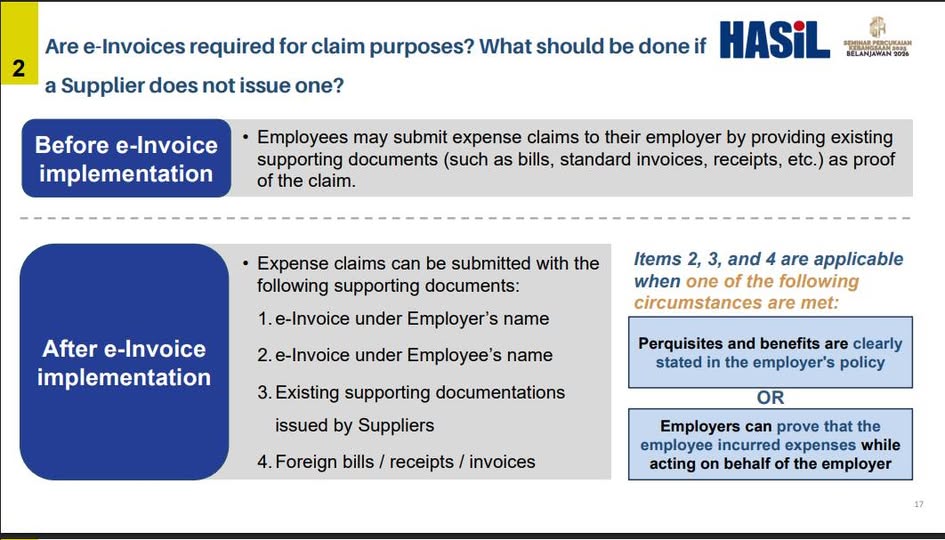
    Employees who pay business expenses on behalf of their employer may submit expense claims supported by bills, receipts, invoices or other relevant documents. Under HASiL’s e-Invoice rules, the treatment depends on whether the expense is a genuine staff claim made on the employer’s behalf or a service acquired directly by the Malaysian business from a foreign supplier.

    Business expenses incurred overseas

    Where an employee pays for expenses incurred overseas on behalf of the employer, neither the employee nor the employer is required to issue a self-billed e-Invoice for those expenses. The employer may rely on foreign bills, receipts, invoices or other existing supporting documents as proof of expense.

    This concession applies when the employer can demonstrate that the employee incurred the expense on the employer’s behalf. The expense should therefore be supported by the company’s usual expense-claim procedures and relevant records.

    For other staff claims, businesses should request an e-Invoice in the employer’s name where this is possible. If that cannot be arranged, HASiL allows an e-Invoice issued in the employee’s name or existing supporting documents to be used as proof of expense.

    Professional membership fees paid to a foreign body

    If an employee pays a professional membership fee, such as an ACCA fee payable to a UK professional body, and claims it as a genuine staff expense incurred on the employer’s behalf, the employer may generally use the foreign receipt or invoice as supporting documentation. The overseas-expense concession means that a self-billed e-Invoice is not required where the relevant conditions are met.

    However, the fact that the professional body is based overseas does not, by itself, determine the treatment. If the Malaysian business directly acquires services from a foreign supplier, the general cross-border rule may require the Malaysian purchaser to issue a self-billed e-Invoice. The business should assess who acquired the service and whether the payment qualifies as an employee expense incurred on the employer’s behalf.

    For imported services subject to the self-billed e-Invoice requirement, the Malaysian purchaser generally has until the end of the month following the earlier of the month in which payment is made or the foreign supplier’s invoice is received, subject to the applicable rules for imported taxable services.

    Key point

    For both overseas business expenses and professional fees, keep the foreign invoice or receipt and document the business purpose. The staff-claim concession applies when the employee is acting on the employer’s behalf; it should not be assumed to apply automatically to every payment made to a foreign organisation.

    员工海外费用与 ACCA 会费:马来西亚电子发票处理

    员工代雇主支付业务费用后,可凭账单、收据、发票或其他相关文件提交费用报销。根据 HASiL 的电子发票规定,处理方式取决于这笔费用是否属于员工代表雇主支付的真实费用申报,还是马来西亚企业直接向外国供应商购买服务。

    在海外产生的业务费用

    如果员工代表雇主支付在海外产生的费用,员工与雇主均无需就该费用开具自开电子发票。雇主可使用外国账单、收据、发票或其他现有支持文件,作为费用凭证。

    这项宽免适用于雇主能够证明员工是代表雇主支付有关费用的情况。因此,费用应符合公司的常规报销程序,并有相关记录支持。

    对于其他员工费用申报,企业应在可行的情况下要求供应商以雇主名义开具电子发票。如果无法做到,HASiL 允许使用以员工名义开具的电子发票,或现有支持文件,作为费用凭证。

    支付给外国专业机构的会员费

    如果员工支付专业会员费,例如支付给英国专业机构的 ACCA 会费,并以代表雇主支付的真实员工费用申报,雇主一般可使用外国收据或发票作为支持文件。在符合相关条件时,海外费用宽免意味着无需开具自开电子发票。

    不过,专业机构位于海外这一点本身,并不能决定适用的处理方式。如果马来西亚企业直接向外国供应商购买服务,一般的跨境交易规则可能要求马来西亚买方开具自开电子发票。企业应评估服务由谁购买,以及该款项是否符合员工代表雇主支付费用的条件。

    对于须开具自开电子发票的进口服务,马来西亚买方一般须在以下较早月份的次月底前完成开具:付款月份,或收到外国供应商发票的月份。实际期限仍须依据适用于进口应税服务的相关规定判断。

    重点

    无论是海外业务费用还是专业会费,都应保留外国发票或收据,并记录费用的业务用途。员工费用申报宽免适用于员工代表雇主支付费用的情况,不应假设所有支付给外国机构的款项都自动符合条件。

  • Voluntary Disclosure under the e-Invoice Compliance Review Framework

    Voluntary Disclosure under the e-Invoice Compliance Review Framework

    The e-Invoice Compliance Review Framework, effective from 15 December 2025, explains when taxpayers may voluntarily disclose e-Invoice non-compliance, what information they should provide and how LHDNM may handle the disclosure.

    When a voluntary disclosure may be made

    A voluntary disclosure is a formal submission made in writing or electronically to LHDNM after the e-Invoice implementation deadline, but before a compliance review has started. It should be sent to the State Operations Director (e-Invoice & Employer Audit Section) or the Director of the Special Branch of LHDNM.

    A taxpayer may make a disclosure whether or not an Income Tax Return (BNCP) has already been submitted.

    If the BNCP has already been submitted

    Where the BNCP has already been filed, the disclosure should include complete supporting documents so LHDNM can verify the matter. These may include a copy of the BNCP, audited accounts or an income statement, and a clear explanation of the issue with supporting ledgers or other records.

    The taxpayer should identify the transactions affected and provide details of any unreported documents. These may include normal e-Invoices, self-billed e-Invoices, consolidated e-Invoices, credit notes, debit notes and refund notes. Other relevant information, such as system screenshots, internal correspondence or an explanation of system errors, may also be provided.

    If the BNCP has not yet been submitted

    A taxpayer may still make a voluntary disclosure before submitting the BNCP. The taxpayer must provide complete transaction details for LHDNM’s verification.

    How LHDNM handles a disclosure

    LHDNM will review the documents submitted and may request additional information. It may also ask the taxpayer to attend its office to provide further explanations.

    If the taxpayer fails to provide complete documents or information without a valid reason, the disclosure may be considered unsuccessful and not accepted. Where further checks are required, LHDNM will inform the taxpayer before the case is finalised by mutual agreement. Further action may include a compliance visit or an enquiry letter, followed by additional review based on the information obtained.

    If no further adjustment is required and LHDNM accepts the information as submitted, the disclosure will be treated as final. LHDNM will notify the taxpayer before officially closing the case.

    《电子发票合规审查框架》下的自愿申报

    自2025年12月15日起生效的《e-Invoice Compliance Review Framework》,说明纳税人何时可主动申报电子发票不合规事项、应提供哪些资料,以及 LHDNM 可能如何处理有关申报。

    何时可以进行自愿申报

    自愿申报是指纳税人在电子发票实施期限过后、合规审查开始之前,以书面或电子方式正式向 LHDNM 申报不合规事项。申报应提交给州属营运总监(电子发票与雇主审计组),或 LHDNM 特别分行主任。

    无论纳税人是否已提交所得税申报表(BNCP),都可以进行自愿申报。

    已提交 BNCP 的情况

    如果 BNCP 已经提交,纳税人应附上完整的支持文件,以便 LHDNM 核实相关事项。文件可包括 BNCP 副本、经审计账目或收入报表,以及对问题的清楚说明和相关分类账或其他记录。

    纳税人应说明受影响的交易,并提供任何未申报文件的资料。这些文件可能包括一般电子发票、自开电子发票、合并电子发票、贷项通知单、借项通知单及退款通知单。纳税人也可提供其他相关资料,例如系统截图、内部往来记录,或系统错误的说明。

    尚未提交 BNCP 的情况

    即使尚未提交 BNCP,纳税人仍可进行自愿申报,但须提供完整的交易资料,以供 LHDNM 核实。

    LHDNM 如何处理自愿申报

    LHDNM 会审查所提交的文件,并可能要求纳税人补充资料,也可能要求纳税人前往 LHDNM 办公室进一步说明。

    如果纳税人没有合理理由而未能提供完整文件或资料,该申报可能被视为不成功,并不获接受。如需进一步核查,LHDNM 会在案件经双方同意后最终结案前通知纳税人。后续行动可能包括进行合规访查或发出询问信函,并根据取得的新资料作进一步审查。

    如果无需进一步调整,且 LHDNM 接受所提交的资料,申报便会被视为最终确认。LHDNM 会在正式结案前通知纳税人。

  • Taxpayer Rights During an e-Invoice Compliance Review: The Role of Compliance Officers

    Taxpayer Rights During an e-Invoice Compliance Review: The Role of Compliance Officers

    The e-Invoice Compliance Review Framework, effective from 15 December 2025, sets out the standards of conduct for e-Invoice Compliance Officers (PEI), how they must identify themselves and the conduct that is prohibited during a review.

    Professional conduct and responsibilities

    PEI must comply with LHDNM’s rules and code of ethics. They are expected to act professionally, courteously, honestly and with integrity throughout the review. They should remain respectful even when a taxpayer is anxious or upset.

    Officers should be ready to explain the purpose of the review and the taxpayer’s rights and responsibilities. They must have the necessary knowledge of tax laws and apply them fairly and consistently, without bias.

    A PEI’s role includes providing guidance as well as conducting reviews. For example, if a business has misunderstood how to issue self-billed e-Invoices, the officer should explain the correct process. Reviews should also be carried out efficiently, without unnecessary delays or repeated requests. Where possible, officers should provide a clear list of required documents in advance.

    PEI may request only documents and information relevant to the review. They must explain their findings and give the taxpayer an opportunity to respond or provide further evidence within the specified timeframe. They must also respect taxpayer rights, treat tax agents fairly and protect taxpayer documents from misuse or disclosure to unauthorised parties.

    Identifying a PEI

    Every PEI is issued an official authority card showing the officer’s name and photograph, together with a statement that the officer is authorised to inspect records at the taxpayer’s premises. Taxpayers are encouraged to check the card to verify the officer’s identity before a review begins.

    If a taxpayer has doubts about an officer’s identity, they may contact the State Operations Director (e-Invoice & Employer Audit) or the Director of the Special Branch of LHDNM to verify it.

    Conduct that is prohibited

    A PEI must not have a personal or financial interest in the business being reviewed. An officer must not review a company owned by a close family member.

    PEI must not recommend or pressure a taxpayer to appoint a particular tax agent. They must also not misuse their position or authority. The framework refers to section 118 of the Income Tax Act 1967 and section 56 of the Petroleum Income Tax Act in relation to the prohibition on abuse of authority.

    These safeguards are intended to support a fair and professional review process. Taxpayers who understand the framework can better recognise what to expect and how to verify an officer’s authority.

    电子发票合规审查中的纳税人权益:合规官的职责与操守

    自2025年12月15日起生效的《e-Invoice Compliance Review Framework》,说明电子发票合规官(PEI)在审查期间应遵守的行为标准、身份识别方式,以及不得从事的行为。

    职业操守与职责

    PEI 必须遵守 LHDNM 的规章与职业道德,在审查过程中保持专业、有礼、诚实及正直。即使纳税人感到紧张或不安,官员也应保持冷静与尊重。

    PEI 应准备好说明审查目的,以及纳税人的权利与责任。他们必须具备必要的税务法律知识,并以公平、一致且不带偏见的方式执行审查。

    PEI 除了进行审查,也应提供合规指导。例如,若企业误解了自开电子发票的开具方式,官员应说明正确流程。审查也应有效率地进行,避免不必要的拖延或反复索取资料;在可行情况下,应预先清楚列出所需文件。

    PEI 只能要求与审查事项相关的文件及资料。他们必须向纳税人说明审查发现,并给予纳税人在规定期限内回应或提供补充证据的机会。同时,PEI 必须尊重纳税人权益、公平对待税务代理,并保护纳税人文件,避免遭到滥用或披露给未获授权的人士。

    核实 PEI 身份

    每位 PEI 均持有官方授权证件,证件上载有官员姓名与照片,并注明其获授权检查纳税人营业场所的记录。纳税人可在审查开始前检查该证件,核实官员身份。

    如对官员身份有疑问,纳税人可联系州属营运总监(电子发票与雇主审计)或 LHDNM 特别分行主任进行核实。

    禁止的行为

    PEI 不得对受审企业拥有任何个人或财务利益。例如,官员不得审查由其近亲拥有的公司。

    PEI 不得推荐或施压要求纳税人聘用某一特定税务代理,也不得滥用职权或职位。框架在有关禁止滥用职权的规定中,提及《1967年所得税法令》第118条及《石油所得税法令》第56条。

    这些保障措施旨在确保审查过程公平且专业。了解相关框架,有助纳税人掌握审查时应有的程序,并核实官员的授权身份。

  • Malaysia’s e-Invoice FAQ Version 4.6: Understanding the RM1 Million Threshold

    Malaysia’s e-Invoice FAQ Version 4.6: Understanding the RM1 Million Threshold

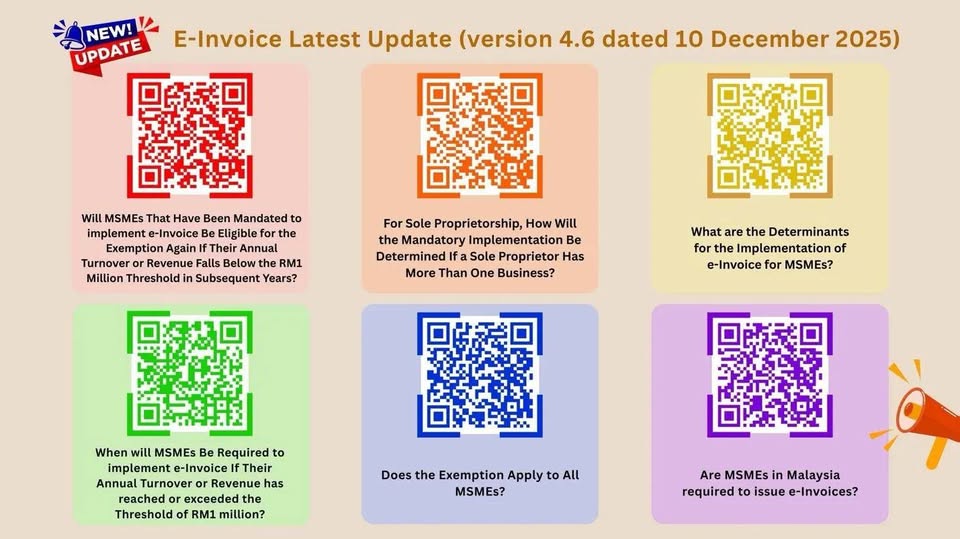
    HASiL’s e-Invoice General FAQ Version 4.6, dated 10 December 2025, clarified implementation rules after the exemption threshold was raised from RM500,000 to RM1 million. The RM1 million threshold is now historical: the Government subsequently raised the exemption threshold to RM3 million, effective 1 September 2026. The points below describe the guidance in Version 4.6 and should be read in that context.

    Key clarifications in Version 4.6

    The threshold was an important factor in determining e-Invoice obligations, but it was not the only one. Under the rules then in effect, taxpayers with annual turnover or revenue below RM1 million could qualify for exemption only if they also met the applicable exemption criteria. Some taxpayers below the threshold could therefore still be required to implement e-Invoice.

    Version 4.6 also stated that, once a taxpayer’s mandatory implementation date had been determined, a later fall in turnover or revenue would not, by itself, restore the exemption. Subsequent changes to the threshold and guidance mean taxpayers should check the latest HASiL rules to determine their current position.

    For sole proprietors with more than one business, the turnover or revenue of all businesses under the same proprietor was to be combined when assessing the threshold.

    The implementation date depended on the taxpayer’s circumstances; it was not always simply the year after turnover first reached RM1 million. For example, under Version 4.6, new businesses or operations that commenced between YA 2023 and YA 2025 and reached annual turnover or revenue of at least RM1 million were generally required to implement e-Invoice from 1 July 2026. Other timelines applied to existing businesses and operations commencing from YA 2026 onwards.

    The interim relaxation period also remained relevant. For taxpayers whose implementation date was 1 July 2026, the period ran from 1 July to 31 December 2026.

    The RM1 million threshold was therefore not a blanket exemption for every MSME with turnover below that amount. Businesses needed to consider the exemption criteria, their business structure and the applicable implementation timeline. As the threshold and guidance have since changed, taxpayers should refer to the latest HASiL publications when assessing their current obligations.

    马来西亚电子发票 FAQ 第4.6版:了解 RM1 million 门槛

    HASiL 于2025年12月10日发布的电子发票常见问题解答(FAQ)第4.6版,进一步说明了豁免门槛从 RM500,000 提高至 RM1 million 后的实施规则。如今,RM1 million 门槛已属于历史规定:政府随后将豁免门槛提高至 RM3 million,并自2026年9月1日起生效。以下内容整理的是第4.6版当时说明的规则,应以此背景理解。

    第4.6版的重点说明

    营业额或收入门槛是判断电子发票义务的重要因素,但并非唯一条件。按照当时适用的规定,年度营业额或收入低于 RM1 million 的纳税人,只有同时符合相关豁免条件,才可能获得豁免。因此,即使收入低于门槛,部分纳税人仍可能需要实施电子发票。

    第4.6版也说明,一旦纳税人的强制实施日期已经确定,之后营业额或收入下降,本身并不会让纳税人自动重新获得豁免。由于门槛及指引后来有所调整,企业应查阅 HASiL 最新规定,确认目前适用的处理方式。

    如果一名独资经营者拥有多家业务,判断门槛时须合并计算同一业主名下所有业务的营业额或收入。

    实施日期须根据纳税人的具体情况判断,并非一律在营业额首次达到 RM1 million 的下一年实施。例如,按照第4.6版,若企业或业务在 YA 2023 至 YA 2025 期间开始营运,并达到至少 RM1 million 的年度营业额或收入,一般须从2026年7月1日起实施电子发票。既有业务及 YA 2026 或之后开始营运的业务,则适用其他时间表。

    中间宽限期也仍然适用。对于实施日期为2026年7月1日的纳税人,宽限期为2026年7月1日至12月31日。

    因此,RM1 million 门槛并不代表所有营业额低于该金额的 MSME 都自动获得豁免。企业还须考虑豁免条件、业务结构及适用的实施时间表。由于门槛与指引其后已有调整,纳税人应参考 HASiL 最新发布的资料,确认目前的合规义务。

  • December 2025 e-Invoice FAQ: Implementation Dates Following the RM1 Million Threshold Revision

    December 2025 e-Invoice FAQ: Implementation Dates Following the RM1 Million Threshold Revision

    At the time of this update, the Government had raised the e-Invoice implementation threshold from RM500,000 to annual turnover exceeding RM1 million. HASiL subsequently issued e-Invoice FAQ Version 4.6, dated 10 December 2025, to clarify implementation dates for different business scenarios.

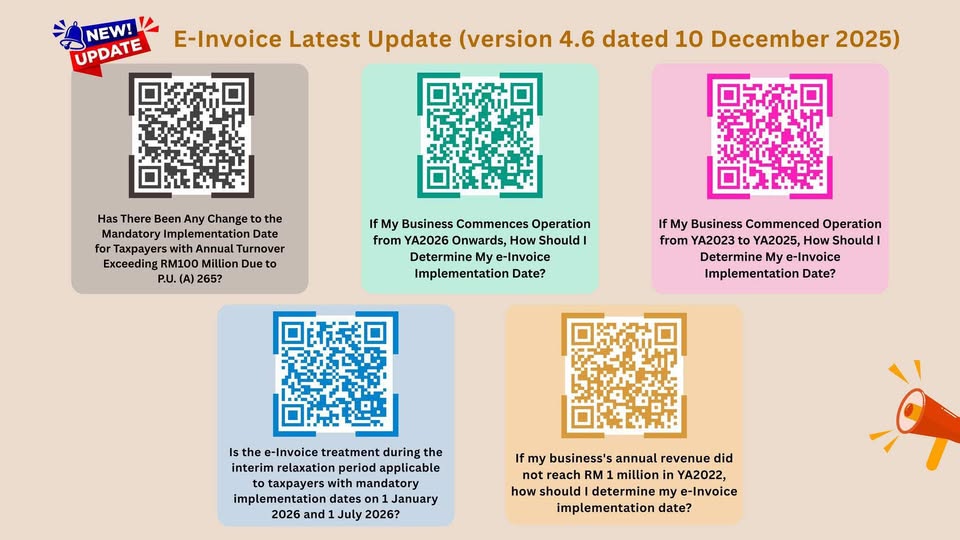
    CCS reviewed the changes and summarised the key questions addressed in the FAQ, including whether P.U. (A) 265 affected implementation dates; how to determine the timeline for businesses that commenced operations between 2023 and 2025 or from 2026 onwards; what applies when revenue did not reach RM1 million in YA 2022; and whether the interim relaxation period remained relevant.

    These clarifications help businesses assess their implementation timeline according to their circumstances, rather than assume that the same date applies to every taxpayer. This article reflects the position addressed in FAQ Version 4.6, dated 10 December 2025. Businesses should refer to the latest HASiL guidance when checking their current obligations.

    2025年12月电子发票 FAQ:RM100万门槛调整后的实施日期

    在这项更新发布时,政府已将电子发票实施门槛从 RM500,000 调高至年营业额超过 RM1 million。随后,HASiL 于2025年12月10日发布电子发票常见问题解答(FAQ)第4.6版,进一步说明不同企业情况所适用的实施日期。

    CCS 检视了相关变化,并整理了该 FAQ 涉及的重点问题,包括 P.U. (A) 265 是否影响实施日期;2023至2025年开始营运的企业,以及2026年或之后开始营运的企业,应如何确定实施时间;YA 2022 年收入未达到 RM1 million 的情况应如何处理;以及中间宽限期是否仍然适用。

    这些说明有助企业根据自身情况判断实施时间,而不是假设所有纳税人都适用同一个日期。本文反映的是 FAQ 第4.6版(2025年12月10日)所说明的情况。企业查询现行义务时,应参考 HASiL 最新发布的指引。

  • Advance Payments and Deposits: Tax Treatment and e-Invoice Requirements

    Advance Payments and Deposits: Tax Treatment and e-Invoice Requirements

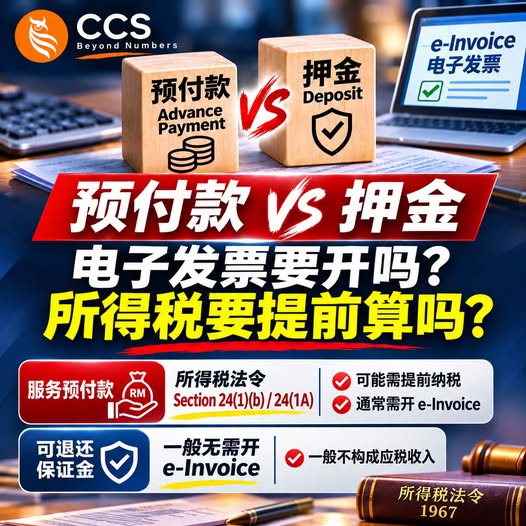
    Receiving money from a customer does not, by itself, determine its tax treatment. The key question is what the payment represents: an advance payment for goods or services, or a genuinely refundable security deposit.

    Advance payments for services

    An advance payment for services to be provided in a future year may be taxable as business gross income before the services are performed.

    Under paragraph 24(1)(b) of the Income Tax Act 1967, a debt arising from a contractual liability to pay for services to be provided is generally treated as gross income in the period when that liability arises, whether or not the amount is then due and payable. Where a sum is received for future services before a debt has arisen, subsection 24(1A) generally treats the amount as gross income in the period it is received.

    For example, a customer pays RM30,000 in 2026 for consultancy services to be provided in 2027. The amount may be taxable in 2026. Which provision applies depends on when the contractual liability to pay arises. Recording the amount as deferred income in the accounts does not, on its own, defer its recognition for income tax purposes.

    Refundable security deposits

    A genuine refundable security deposit is generally not treated as business gross income when received, provided it is refundable under the agreement. HASiL’s Public Ruling No. 4/2020 explains that such deposits do not fall within paragraph 24(1)(b) or subsection 24(1A) when received.

    The e-Invoice treatment is also different: under HASiL’s e-Invoice General FAQ, an e-Invoice is not required for a refundable deposit, while one is required for a non-refundable deposit.

    The name used in an agreement is not conclusive. If an amount described as a “deposit” will be applied towards the price of future services, it may in substance be an advance payment. Its treatment should be assessed based on the agreement’s terms and how the payment is handled. Refundability, whether the amount will be credited against service fees, and what happens if the customer cancels are all relevant.

    Tax treatment and e-Invoice timing are not the same

    The timing for recognising an amount as taxable income and the requirement to issue an e-Invoice are separate matters. Businesses should assess each under the relevant tax provisions and e-Invoice guidance rather than assume that the same timing applies to both.

    References: Income Tax Act 1967, paragraphs 24(1)(b) and subsection 24(1A); HASiL Public Ruling No. 4/2020; HASiL e-Invoice General FAQ, Question 57.

    预付款与押金:所得税处理及电子发票要求

    收到客户款项,并不代表其税务处理方式已经确定。关键在于这笔款项的性质:它是商品或服务的预付款,还是确实可退还的履约保证金。

    服务预付款

    即使服务要到下一年度才提供,收到的服务预付款也可能需要在服务尚未完成前计入企业应课税收入。

    根据《1967年所得税法令》第24(1)(b)段,若合同责任已经产生,企业因未来服务而拥有的应收款项,一般须在该责任产生的期间计入总收入,不论款项当时是否已经到期或须立即支付。若企业在债务尚未产生前已收到未来服务的款项,第24(1A)款一般规定,该款项须在收款期间计入总收入。

    例如,客户在2026年支付 RM30,000,预订于2027年提供的顾问服务。这笔款项可能须在2026年计税。具体适用哪一项条文,取决于合同付款责任何时产生。即使账目将款项记录为递延收入,也不代表所得税上的收入确认时间必然随之递延。

    可退还的履约保证金

    如果一笔款项根据协议确实可以退还,通常不会在收取时被视为企业总收入。HASiL《Public Ruling No. 4/2020》说明,这类押金在收取时不属于第24(1)(b)段或第24(1A)款所涵盖的款项。

    电子发票的处理也有所不同。根据 HASiL 的《e-Invoice General FAQ》,可退还的押金无需开具电子发票;不可退还的押金则须开具电子发票。

    协议中使用的名称并非决定性因素。如果一笔称为“押金”的款项最终会抵扣未来服务费,其实质可能是预付款。企业应根据协议条款及实际处理方式判断款项性质,包括款项是否可以退还、是否会抵扣服务费,以及客户取消交易时如何处理。

    所得税处理与电子发票开具时间并不相同

    将款项确认为应税收入的时间,与开具电子发票的要求,是两个不同的问题。企业应分别根据相关税务条文及电子发票指南评估,不应假设两者的处理时间必然相同。

    参考依据:《1967年所得税法令》第24(1)(b)段及第24(1A)款;HASiL《Public Ruling No. 4/2020》;HASiL《e-Invoice General FAQ》第57题。

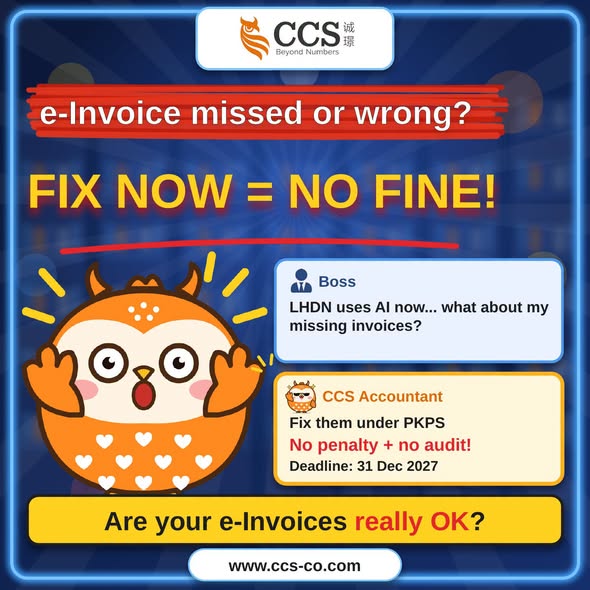
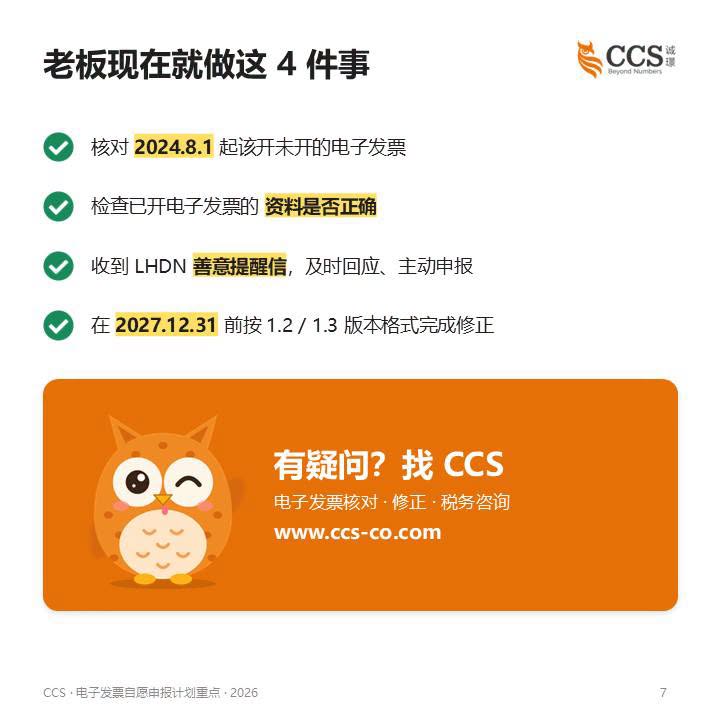
  • Malaysia’s e-Invoice Voluntary Disclosure Programme: Correct Errors by 31 December 2027

    Malaysia’s e-Invoice Voluntary Disclosure Programme: Correct Errors by 31 December 2027

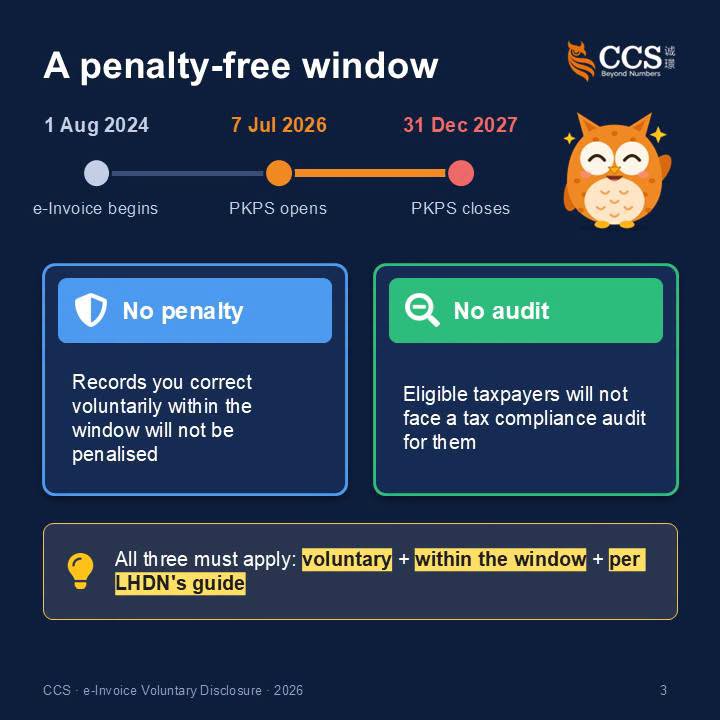
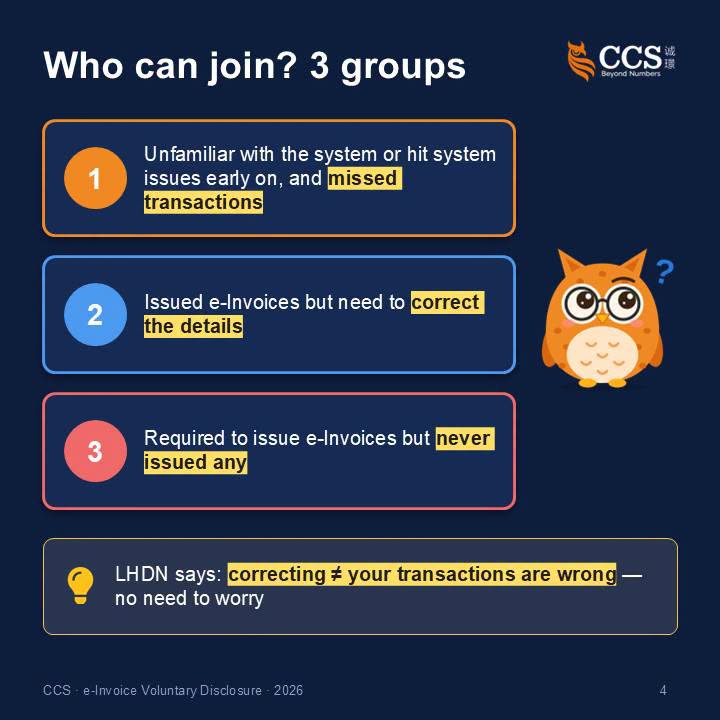
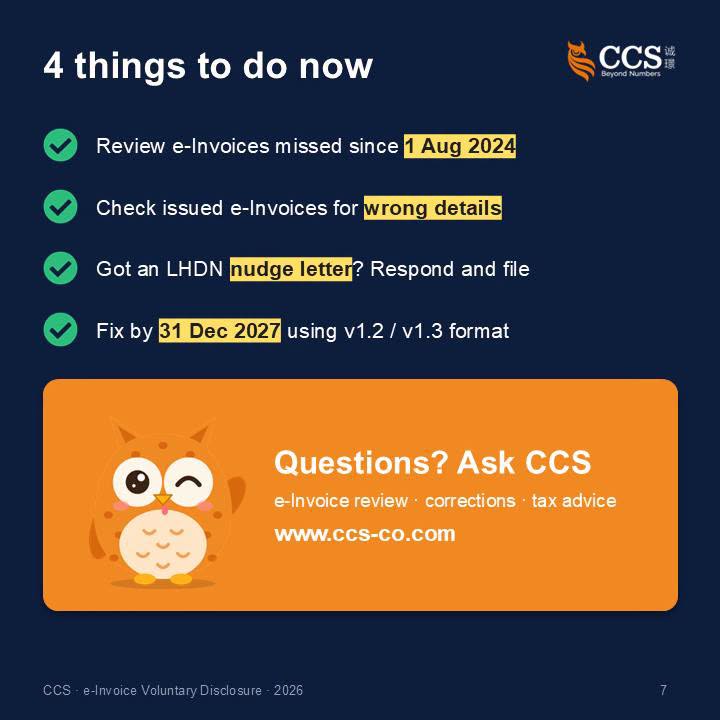
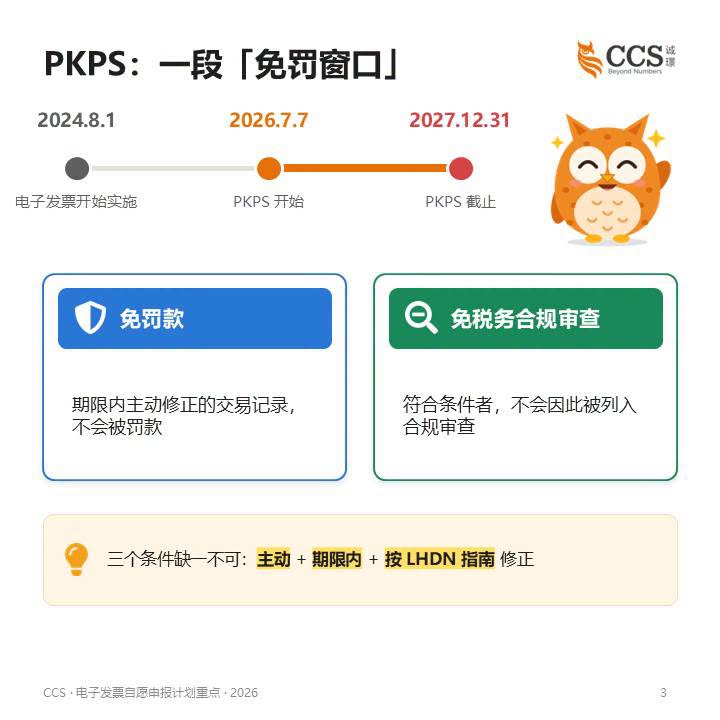
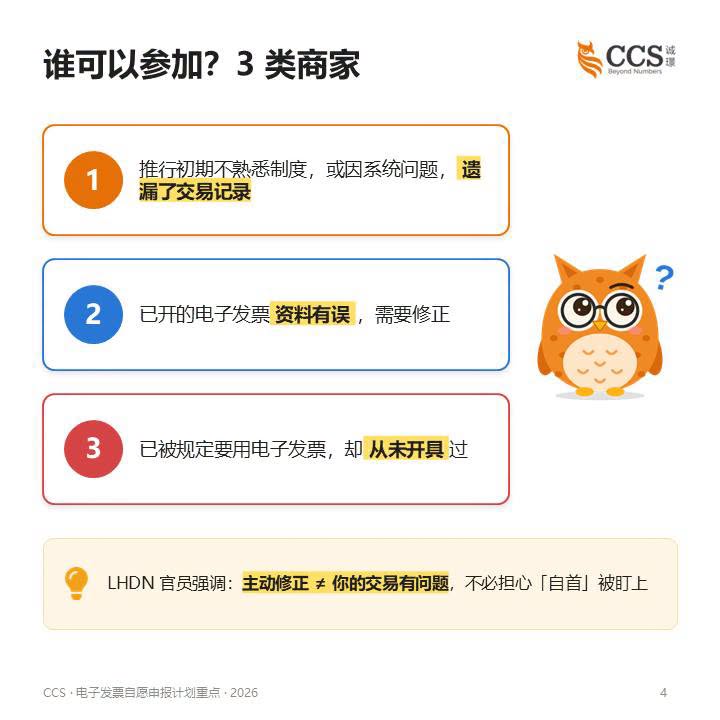
    When e-Invoicing began in August 2024, some businesses faced system issues, uncertainty about the requirements and questions about which transactions needed an e-Invoice. For businesses that missed submissions or need to correct earlier records, HASiL’s e-Invoice Special Voluntary Disclosure Programme (SVDP), also known as PKPS e-Invois, provides a way to regularise their e-Invoice records.

    The programme runs from 7 July 2026 to 31 December 2027. It covers taxpayers who missed or did not submit e-Invoices, submitted e-Invoices with errors or details that do not meet the requirements, or have not issued any e-Invoices since their mandatory implementation date. The guidelines also cover taxpayers who are undergoing, or have been notified that they will undergo, an e-Invoice compliance review.

    What the programme provides

    For e-Invoices disclosed under the programme, HASiL will not conduct e-Invoice compliance reviews or enforcement actions, including imposing penalties or pursuing prosecution, provided the disclosure is made in good faith and meets the prescribed requirements.

    This relief does not apply if the submitted e-Invoices fail to meet the required specifications or if the disclosure involves fraud, wilful default or negligence. Making a correction under the programme does not, by itself, mean that all the taxpayer’s transactions were incorrect; some records may simply need to be updated.

    How to make a disclosure

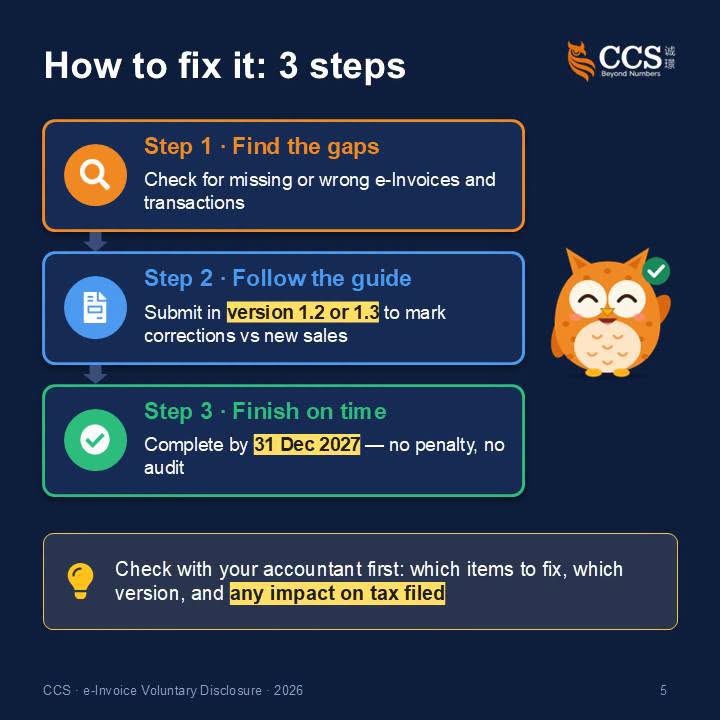
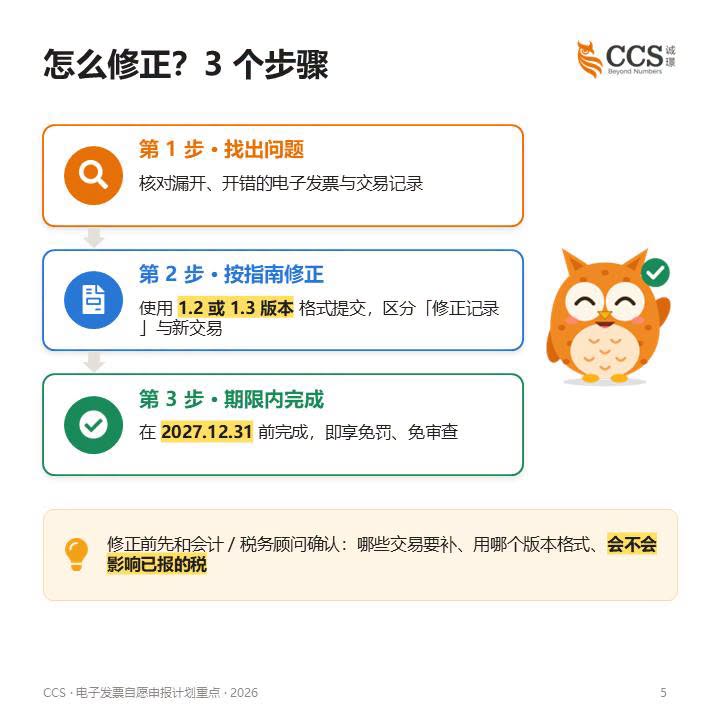
    Taxpayers should identify the missing or incorrect records and submit them using the designated SVDP 1.2 format if submitting without a digital signature, or SVDP 1.3 if submitting with a digital signature. These formats are for SVDP submissions only.

    Where previously unsubmitted consolidated e-Invoices are involved, they must be submitted according to the relevant transaction month, not as one lump-sum submission covering several months. Disclosures should be accurate and completed by 31 December 2027.

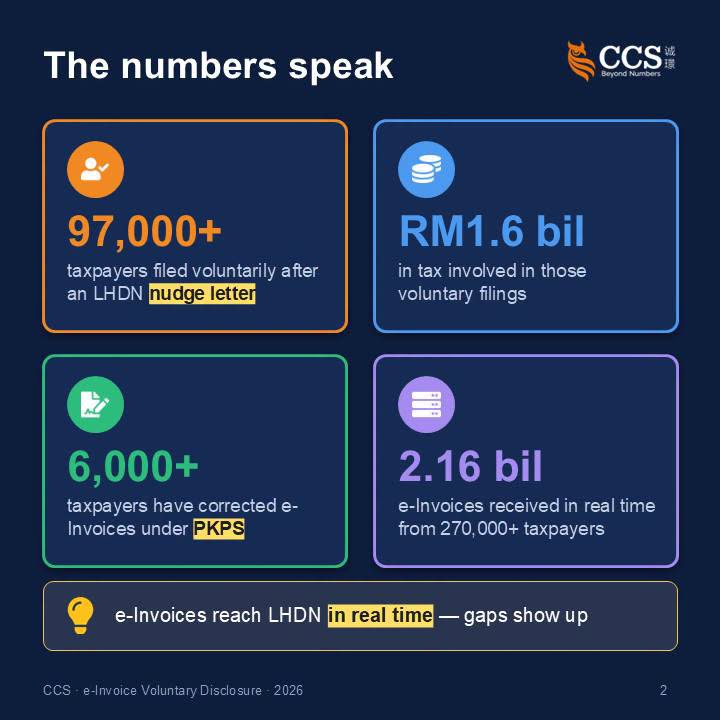
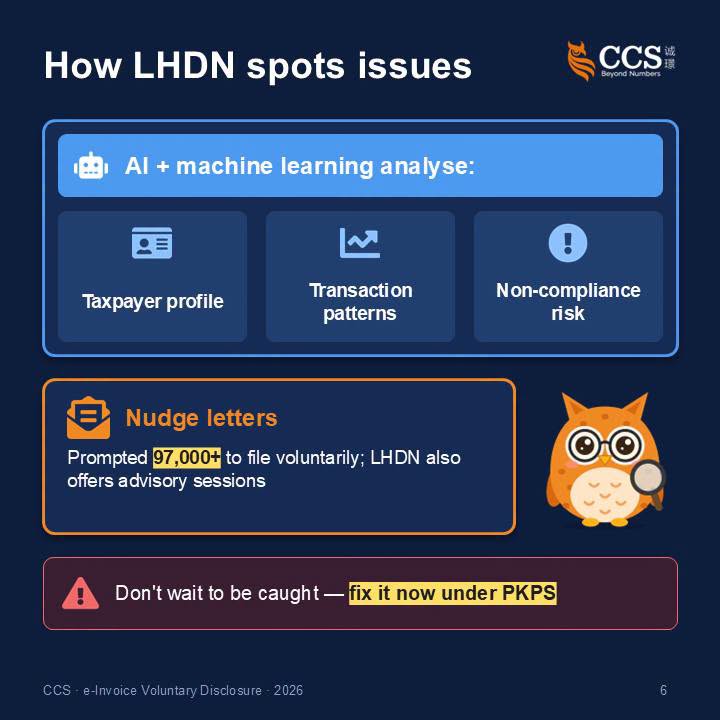
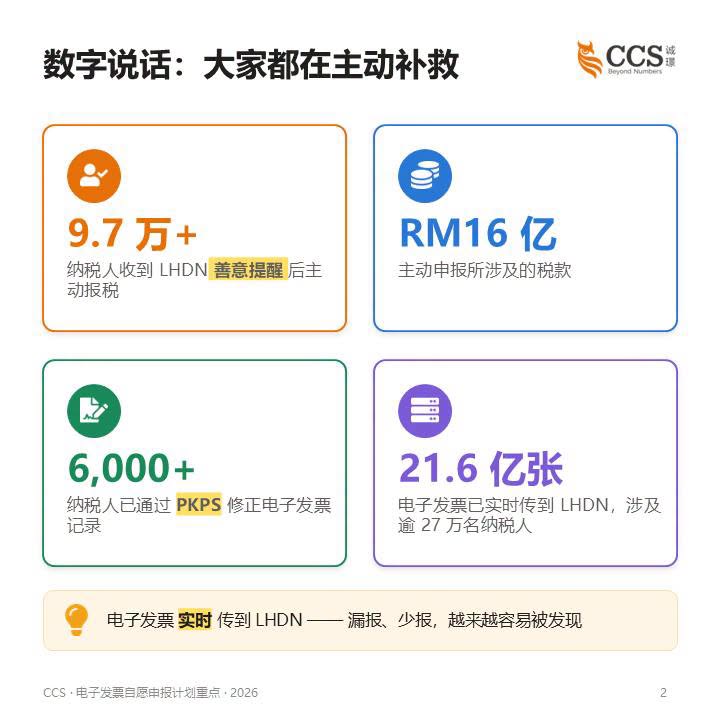
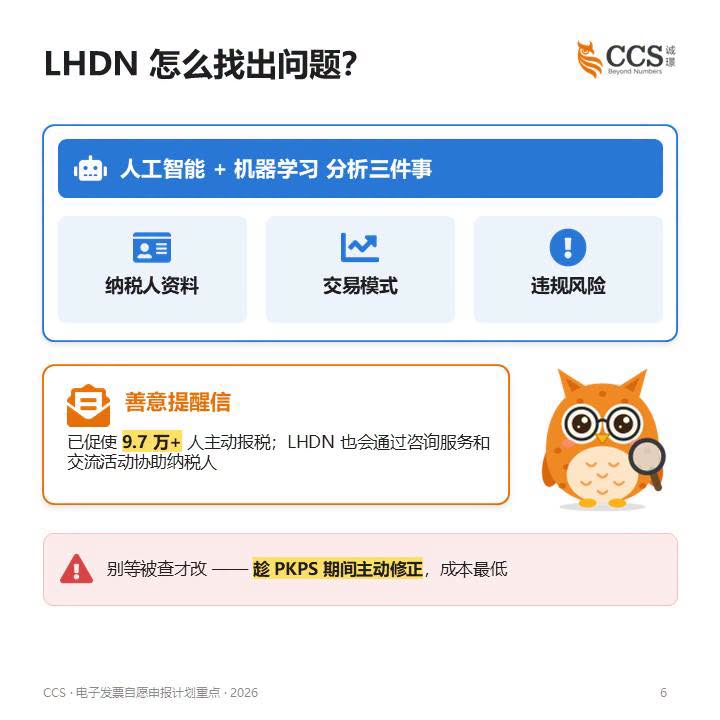
    The programme is already being used by taxpayers. As reported on 7 November 2026, more than 6,000 taxpayers had come forward to correct their e-Invoice transaction records. HASiL had also received 2.16 billion e-Invoices from more than 270,000 taxpayers since the system began on 1 August 2024. The report noted that HASiL uses artificial intelligence and machine learning to analyse taxpayer profiles, identify transaction patterns and assess potential tax-compliance risks.

    HASiL also reported that its nudge-based approach had encouraged more than 97,000 taxpayers to file tax returns voluntarily, involving RM1.6 billion in tax payable. These figures underline the importance of reviewing e-Invoice records and addressing gaps while the programme remains open.

    马来西亚电子发票自愿披露计划:把握期限,于2027年12月31日前更正

    电子发票于2024年8月开始推行时,部分企业面对系统问题、对规定不确定,也不清楚哪些交易需要开具电子发票。对于曾遗漏提交或需要更正记录的企业,HASiL 推出的电子发票特别自愿披露计划(SVDP),亦称 PKPS e-Invois,为纳税人提供了补正电子发票记录的途径。

    计划开放日期为 2026年7月7日至2027年12月31日。适用对象包括遗漏或未提交电子发票、已提交但资料错误或不符合要求,以及自强制实施日期起尚未开具任何电子发票的纳税人。指南也涵盖正在接受电子发票合规审查,或已接获通知将接受审查的纳税人。

    计划提供的安排

    对于根据计划披露的电子发票,只要纳税人秉持诚信并符合规定要求,HASiL 将不会就相关电子发票进行合规审查或采取执法行动,包括施加罚款或提起检控。

    如果提交的电子发票不符合规定规格,或披露涉及欺诈、蓄意违约或疏忽,则不适用上述安排。根据计划进行更正,本身并不代表纳税人的所有交易都有错误;部分记录可能只是需要更新。

    如何进行披露

    纳税人应先找出遗漏或资料有误的记录,再按规定格式提交:未使用数码签名的,使用指定的 SVDP 1.2 格式;使用数码签名的,则使用 SVDP 1.3 格式。这些格式仅供 SVDP 申报使用。

    若涉及之前未提交的合并电子发票,须按相关交易月份分别提交,不可将数个月份的资料合并成一笔总额提交。披露资料应准确,并须于 2027年12月31日前完成。

    纳税人已开始使用这项计划。截至2026年11月7日,已有超过6,000名纳税人主动更正电子发票交易记录。自2024年8月1日系统启用以来,HASiL 已从超过270,000名纳税人收到21.6亿张电子发票。报道指出,HASiL 正运用人工智能与机器学习分析纳税人资料、识别交易模式,并评估潜在的税务合规风险。

    HASiL 也表示,其提醒式推动措施促使超过97,000名纳税人自愿提交报税表,涉及 RM1.6 billion 的应缴税款。这些数据提醒企业检视电子发票记录,并在计划开放期间处理任何遗漏或需要更正的事项。