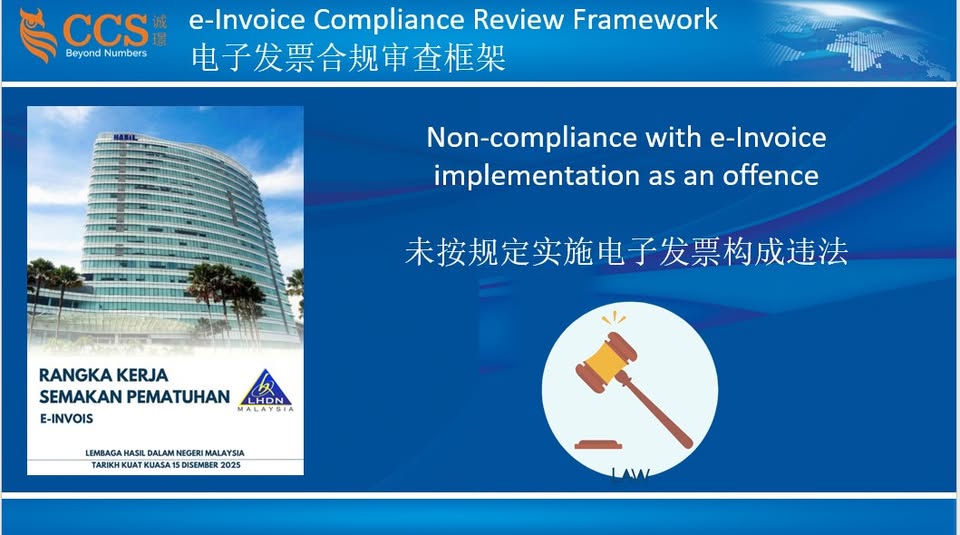
Sections 6.4.7 to 6.4.10 of the e-Invoice Compliance Review Framework explain the consequences of non-compliance, when an e-Invoice may replace a receipt, the receipt requirement for consolidated e-Invoices and the implications of incomplete records.
Non-compliance may constitute an offence
The framework links e-Invoice non-compliance to offences under three tax laws.
Under the Income Tax Act 1967, failure to comply with paragraph 82(1)(b) is linked to paragraph 119A(b). Non-compliance with section 82B and subsections 82C(1), 82C(6) and 82C(7) is linked to paragraph 120(1)(d).
Under the Petroleum Income Tax Act 1967, non-compliance with subsections 34B(1) and 34B(6) is linked to section 57B. Under the Labuan Business Activity Tax Act 1990, non-compliance with subsections 22DA(1), 22DA(6) and 22DA(7) is linked to section 22EA.
For example, where a business makes sales but fails to issue e-Invoices as required, the fact that the sales are genuine does not remove the obligation to comply. Failure to meet the applicable requirements may expose the taxpayer to penalties under the relevant law.
When an e-Invoice replaces a receipt
Under subsection 82(2A) of the Income Tax Act 1967, a taxpayer is exempt from the receipt requirement under paragraph 82(1)(b) for goods sold or services provided where an e-Invoice has been issued under section 82C.
However, this does not apply in the same way to consolidated transactions. A taxpayer issuing consolidated transaction e-Invoices under subsection 82C(7) must still issue a receipt for every amount received for goods sold or services provided, as required by subsection 82(2B).
For example, a retailer may submit a consolidated e-Invoice covering eligible sales, but must still issue a receipt for each amount received from customers.
If business records are incomplete
Taxpayers are expected to keep complete and sufficient records. If they do not, the e-Invoice Compliance Officer (PEI) may use the best available method or approach to determine whether income has been reported and whether the taxpayer has properly met their e-Invoice obligations.
Depending on the circumstances, the review may consider other available information, such as bank statements, third-party information or transaction patterns, to assess the taxpayer’s records and compliance.
These provisions highlight that e-Invoice obligations are legally enforceable, that consolidated e-Invoicing does not remove the receipt requirement for each amount received, and that incomplete record-keeping may affect how compliance is assessed.
电子发票合规:违法责任、收据要求与记录保存
《e-Invoice Compliance Review Framework》第6.4.7至6.4.10节说明了电子发票不合规可能导致的后果、电子发票在何种情况下可替代收据、合并电子发票下的收据要求,以及记录不完整可能带来的影响。
不合规可能构成违法行为
该框架将电子发票不合规行为与三部税法下的违法条文联系起来。
根据《1967年所得税法令》,未遵守第82(1)(b)段的规定,与第119A(b)段相关;未遵守第82B条及第82C(1)、82C(6)和82C(7)款的规定,则与第120(1)(d)段相关。
根据《1967年石油所得税法令》,未遵守第34B(1)及34B(6)款的规定,与第57B条相关。根据《1990年纳闽商业活动税法令》,未遵守第22DA(1)、22DA(6)及22DA(7)款的规定,与第22EA条相关。
例如,企业进行销售,却未按规定开具电子发票,即使交易本身真实,也不代表企业可以免除合规责任。未遵守适用要求,可能使纳税人面临相关法律规定的处罚。
电子发票在何种情况下可替代收据
根据《1967年所得税法令》第82(2A)款,如果纳税人已依据第82C条就所售商品或提供的服务开具电子发票,则该笔交易可豁免第82(1)(b)段规定的收据要求。
不过,合并交易并不适用相同处理。纳税人依据第82C(7)款开具合并交易电子发票后,仍须根据第82(2B)款,就每笔已收取的商品或服务款项开具收据。
例如,零售商可以将符合条件的销售合并开具电子发票,但仍须就向顾客收取的每笔款项开具收据。
业务记录不完整时的处理
纳税人应保存完整且充分的记录。如果记录不足,电子发票合规官(PEI)可采用最佳可行方法或途径,判断收入是否已申报,以及纳税人是否妥善履行电子发票义务。
视具体情况,审查人员可能会参考银行对账单、第三方资料或交易模式等其他可用信息,评估纳税人的记录及合规情况。
这些规定提醒纳税人,电子发票义务具有法律约束力;开具合并电子发票并不会免除每笔收款的收据要求;而记录保存不完整,也可能影响合规情况的评估。