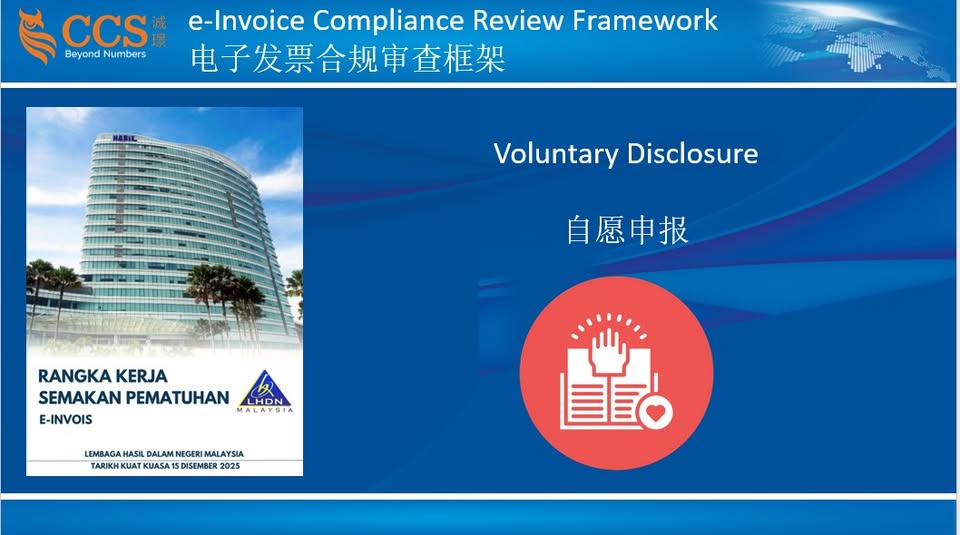
The e-Invoice Compliance Review Framework, effective from 15 December 2025, explains when taxpayers may voluntarily disclose e-Invoice non-compliance, what information they should provide and how LHDNM may handle the disclosure.
When a voluntary disclosure may be made
A voluntary disclosure is a formal submission made in writing or electronically to LHDNM after the e-Invoice implementation deadline, but before a compliance review has started. It should be sent to the State Operations Director (e-Invoice & Employer Audit Section) or the Director of the Special Branch of LHDNM.
A taxpayer may make a disclosure whether or not an Income Tax Return (BNCP) has already been submitted.
If the BNCP has already been submitted
Where the BNCP has already been filed, the disclosure should include complete supporting documents so LHDNM can verify the matter. These may include a copy of the BNCP, audited accounts or an income statement, and a clear explanation of the issue with supporting ledgers or other records.
The taxpayer should identify the transactions affected and provide details of any unreported documents. These may include normal e-Invoices, self-billed e-Invoices, consolidated e-Invoices, credit notes, debit notes and refund notes. Other relevant information, such as system screenshots, internal correspondence or an explanation of system errors, may also be provided.
If the BNCP has not yet been submitted
A taxpayer may still make a voluntary disclosure before submitting the BNCP. The taxpayer must provide complete transaction details for LHDNM’s verification.
How LHDNM handles a disclosure
LHDNM will review the documents submitted and may request additional information. It may also ask the taxpayer to attend its office to provide further explanations.
If the taxpayer fails to provide complete documents or information without a valid reason, the disclosure may be considered unsuccessful and not accepted. Where further checks are required, LHDNM will inform the taxpayer before the case is finalised by mutual agreement. Further action may include a compliance visit or an enquiry letter, followed by additional review based on the information obtained.
If no further adjustment is required and LHDNM accepts the information as submitted, the disclosure will be treated as final. LHDNM will notify the taxpayer before officially closing the case.
《电子发票合规审查框架》下的自愿申报
自2025年12月15日起生效的《e-Invoice Compliance Review Framework》,说明纳税人何时可主动申报电子发票不合规事项、应提供哪些资料,以及 LHDNM 可能如何处理有关申报。
何时可以进行自愿申报
自愿申报是指纳税人在电子发票实施期限过后、合规审查开始之前,以书面或电子方式正式向 LHDNM 申报不合规事项。申报应提交给州属营运总监(电子发票与雇主审计组),或 LHDNM 特别分行主任。
无论纳税人是否已提交所得税申报表(BNCP),都可以进行自愿申报。
已提交 BNCP 的情况
如果 BNCP 已经提交,纳税人应附上完整的支持文件,以便 LHDNM 核实相关事项。文件可包括 BNCP 副本、经审计账目或收入报表,以及对问题的清楚说明和相关分类账或其他记录。
纳税人应说明受影响的交易,并提供任何未申报文件的资料。这些文件可能包括一般电子发票、自开电子发票、合并电子发票、贷项通知单、借项通知单及退款通知单。纳税人也可提供其他相关资料,例如系统截图、内部往来记录,或系统错误的说明。
尚未提交 BNCP 的情况
即使尚未提交 BNCP,纳税人仍可进行自愿申报,但须提供完整的交易资料,以供 LHDNM 核实。
LHDNM 如何处理自愿申报
LHDNM 会审查所提交的文件,并可能要求纳税人补充资料,也可能要求纳税人前往 LHDNM 办公室进一步说明。
如果纳税人没有合理理由而未能提供完整文件或资料,该申报可能被视为不成功,并不获接受。如需进一步核查,LHDNM 会在案件经双方同意后最终结案前通知纳税人。后续行动可能包括进行合规访查或发出询问信函,并根据取得的新资料作进一步审查。
如果无需进一步调整,且 LHDNM 接受所提交的资料,申报便会被视为最终确认。LHDNM 会在正式结案前通知纳税人。