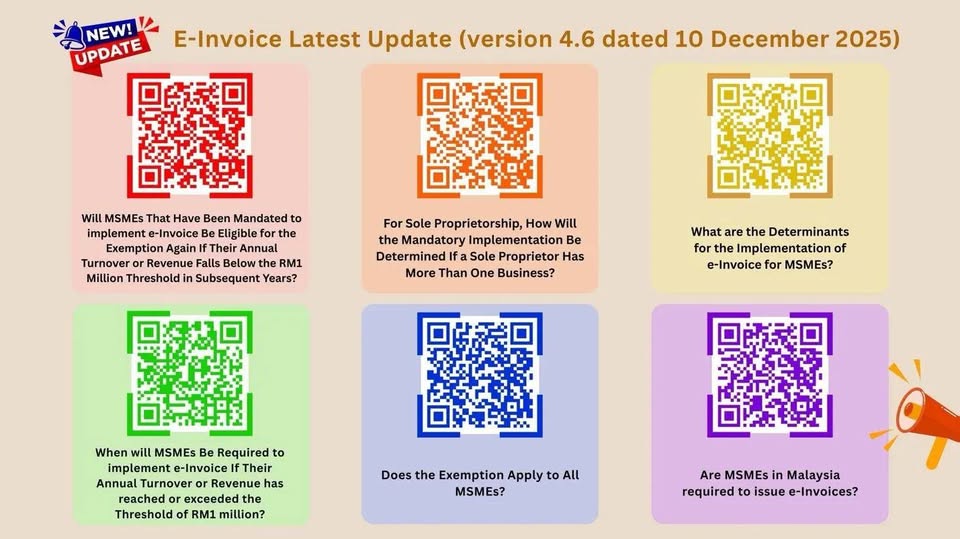
HASiL’s e-Invoice General FAQ Version 4.6, dated 10 December 2025, clarified implementation rules after the exemption threshold was raised from RM500,000 to RM1 million. The RM1 million threshold is now historical: the Government subsequently raised the exemption threshold to RM3 million, effective 1 September 2026. The points below describe the guidance in Version 4.6 and should be read in that context.
Key clarifications in Version 4.6
The threshold was an important factor in determining e-Invoice obligations, but it was not the only one. Under the rules then in effect, taxpayers with annual turnover or revenue below RM1 million could qualify for exemption only if they also met the applicable exemption criteria. Some taxpayers below the threshold could therefore still be required to implement e-Invoice.
Version 4.6 also stated that, once a taxpayer’s mandatory implementation date had been determined, a later fall in turnover or revenue would not, by itself, restore the exemption. Subsequent changes to the threshold and guidance mean taxpayers should check the latest HASiL rules to determine their current position.
For sole proprietors with more than one business, the turnover or revenue of all businesses under the same proprietor was to be combined when assessing the threshold.
The implementation date depended on the taxpayer’s circumstances; it was not always simply the year after turnover first reached RM1 million. For example, under Version 4.6, new businesses or operations that commenced between YA 2023 and YA 2025 and reached annual turnover or revenue of at least RM1 million were generally required to implement e-Invoice from 1 July 2026. Other timelines applied to existing businesses and operations commencing from YA 2026 onwards.
The interim relaxation period also remained relevant. For taxpayers whose implementation date was 1 July 2026, the period ran from 1 July to 31 December 2026.
The RM1 million threshold was therefore not a blanket exemption for every MSME with turnover below that amount. Businesses needed to consider the exemption criteria, their business structure and the applicable implementation timeline. As the threshold and guidance have since changed, taxpayers should refer to the latest HASiL publications when assessing their current obligations.
马来西亚电子发票 FAQ 第4.6版:了解 RM1 million 门槛
HASiL 于2025年12月10日发布的电子发票常见问题解答(FAQ)第4.6版,进一步说明了豁免门槛从 RM500,000 提高至 RM1 million 后的实施规则。如今,RM1 million 门槛已属于历史规定:政府随后将豁免门槛提高至 RM3 million,并自2026年9月1日起生效。以下内容整理的是第4.6版当时说明的规则,应以此背景理解。
第4.6版的重点说明
营业额或收入门槛是判断电子发票义务的重要因素,但并非唯一条件。按照当时适用的规定,年度营业额或收入低于 RM1 million 的纳税人,只有同时符合相关豁免条件,才可能获得豁免。因此,即使收入低于门槛,部分纳税人仍可能需要实施电子发票。
第4.6版也说明,一旦纳税人的强制实施日期已经确定,之后营业额或收入下降,本身并不会让纳税人自动重新获得豁免。由于门槛及指引后来有所调整,企业应查阅 HASiL 最新规定,确认目前适用的处理方式。
如果一名独资经营者拥有多家业务,判断门槛时须合并计算同一业主名下所有业务的营业额或收入。
实施日期须根据纳税人的具体情况判断,并非一律在营业额首次达到 RM1 million 的下一年实施。例如,按照第4.6版,若企业或业务在 YA 2023 至 YA 2025 期间开始营运,并达到至少 RM1 million 的年度营业额或收入,一般须从2026年7月1日起实施电子发票。既有业务及 YA 2026 或之后开始营运的业务,则适用其他时间表。
中间宽限期也仍然适用。对于实施日期为2026年7月1日的纳税人,宽限期为2026年7月1日至12月31日。
因此,RM1 million 门槛并不代表所有营业额低于该金额的 MSME 都自动获得豁免。企业还须考虑豁免条件、业务结构及适用的实施时间表。由于门槛与指引其后已有调整,纳税人应参考 HASiL 最新发布的资料,确认目前的合规义务。