
Day: November 10, 2026

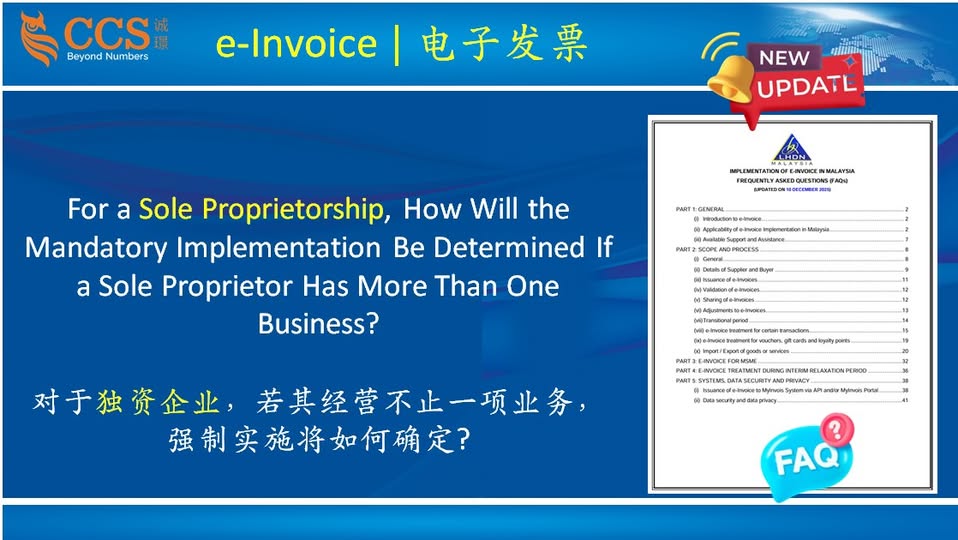
  • How the e-Invoice Threshold Applies to Sole Proprietors with Multiple Businesses

    How the e-Invoice Threshold Applies to Sole Proprietors with Multiple Businesses

    For a sole proprietor who owns or operates more than one sole proprietorship business, annual turnover or revenue from all those businesses is aggregated to determine whether the RM3 million e-Invoice threshold is met.

    This means each business is not assessed separately just because it operates under a different business name. The relevant factor is whether the businesses are owned or registered as sole proprietorships under the same proprietor.

    HASiL’s example

    In its General FAQ, updated on 4 September 2026, HASiL gives the example of Awiyah, who owns three sole proprietorship businesses: RAM Cosmetic Enterprise, Princess Tailor and Fifty Cafe.

    As at 31 December 2026, their annual turnover or revenue is:

    • RAM Cosmetic Enterprise: RM750,000

    • Princess Tailor: RM820,000

    • Fifty Cafe: RM1,540,000

    • Total: RM3,110,000

    Because Awiyah’s combined turnover or revenue exceeds RM3 million, she is required to implement e-Invoicing from 1 January 2028.

    What sole proprietors should consider

    A business’s individual turnover may be below RM3 million, but that figure should not be considered in isolation if the same proprietor owns other sole proprietorship businesses. Sole proprietors with multiple businesses should keep track of their combined annual turnover or revenue and assess the e-Invoice requirement against the total.

    独资经营者拥有多项业务时,电子发票门槛如何计算?

    如果独资经营者拥有或经营多项独资业务,计算是否达到 RM3 million 电子发票门槛时,必须汇总所有业务的年度营业额或收入。

    即使各项业务以不同名称经营,也不能因此分别计算。关键在于这些业务是否属于同一名独资经营者名下的独资业务。

    HASiL 提供的例子

    在2026年9月4日更新的《一般常见问题解答》中,HASiL 举例说明,Awiyah 拥有三项独资业务:RAM Cosmetic Enterprise、Princess Tailor 和 Fifty Cafe。

    截至2026年12月31日,各业务的年度营业额或收入如下:

    • RAM Cosmetic Enterprise:RM750,000

    • Princess Tailor:RM820,000

    • Fifty Cafe:RM1,540,000

    • 总额:RM3,110,000

    由于 Awiyah 名下所有独资业务的营业额或收入总额超过 RM3 million,她须从2028年1月1日起实施电子发票。

    独资经营者应注意的事项

    即使某一项业务的营业额低于 RM3 million,只要同一名独资经营者还拥有其他独资业务,就不能单独以该项业务的营业额判断是否达到门槛。经营多项业务的独资经营者应持续追踪所有业务的年度营业额或收入总额,并以合计金额评估电子发票实施要求。
  • Can a Business Regain e-Invoice Exemption After Its Revenue Falls?

    Can a Business Regain e-Invoice Exemption After Its Revenue Falls?

    Under the current HASiL FAQ, a taxpayer does not regain the e-Invoice exemption simply because its annual turnover or revenue falls below the applicable threshold after its mandatory implementation year has been determined. The FAQ states that the taxpayer must continue issuing e-Invoices even if its revenue in subsequent years does not exceed RM3 million.

    The RM1 million threshold cited in HASiL’s FAQ version 4.6, dated 10 December 2025, has since been raised. The RM3 million threshold took effect on 1 September 2026.

    Example: Winner Fertilizer Sdn Bhd

    Winner Fertilizer Sdn Bhd closes its accounting period on 31 December. By 31 August 2026, its annual turnover or revenue had exceeded RM3 million. Under the current FAQ, the company is required to implement e-Invoicing from 1 January 2028.

    If its revenue falls below RM3 million in 2027, the company must still implement e-Invoicing from 1 January 2028. A later reduction in revenue does not restore the exemption once the mandatory implementation year has been determined.

    Transitional treatment following the threshold increase

    The threshold increase also introduced specific transitional treatment for certain businesses that had been scheduled to implement e-Invoicing under the former RM1 million threshold. Under the current FAQ, a taxpayer with annual turnover or revenue below RM3 million that meets the exemption criteria in Section 1.6.10 may discontinue issuing e-Invoices, even if it had already started issuing them under the previous implementation schedule. No separate application or prior approval from IRBM is required. The taxpayer may also choose to continue voluntarily.

    These transitional cases are distinct from businesses whose mandatory implementation year is determined under the current RM3 million threshold. Businesses should assess their circumstances against the applicable threshold and exemption criteria.

    营业额下降后,企业能否重新获得电子发票豁免?

    根据 HASiL 现行 FAQ,若纳税人的强制实施年份已确定,仅因后续年度的营业额或收入降至适用门槛以下,并不会自动恢复电子发票豁免。FAQ 指出,即使纳税人在后续年度的营业额或收入未达到 RM3 million,仍须继续开具电子发票。

    HASiL 于2025年12月10日发布的 FAQ 4.6 所提及的 RM1 million 门槛之后已上调。RM3 million 门槛自2026年9月1日起生效。

    例子:Winner Fertilizer Sdn Bhd

    Winner Fertilizer Sdn Bhd 的会计期间于每年12月31日结束。截至2026年8月31日,该公司的年度营业额或收入已超过 RM3 million。根据现行 FAQ,公司须从2028年1月1日起实施电子发票。

    如果公司在2027年的收入降至 RM3 million 以下,仍须从2028年1月1日起实施电子发票。强制实施年份一旦确定,后续收入下降并不会恢复豁免资格。

    门槛上调后的过渡安排

    门槛上调后,部分原先根据 RM1 million 门槛被安排实施电子发票的企业,可适用特定过渡安排。根据现行 FAQ,若纳税人的年度营业额或收入低于 RM3 million,并符合第1.6.10节所列的豁免条件,即使已按照旧实施时间表开始开具电子发票,也可以停止开具。无需另行向 IRBM 提交申请或事先取得批准。纳税人也可选择自愿继续开具电子发票。

    这些过渡个案与根据现行 RM3 million 门槛确定强制实施年份的企业情况不同。企业应根据适用门槛及豁免条件评估自身情况。

  • Net-Basis Self-Billed e-Invoices for Agent Commissions: Recording Reversals

    Net-Basis Self-Billed e-Invoices for Agent Commissions: Recording Reversals

    HASiL’s FAQ allows businesses to issue self-billed e-Invoices for commissions on a net basis—gross commission less reversals—provided the commission reversal details are included in the document. This allows businesses to reflect their existing statement and payment practices while showing how the net amount was calculated.

    When the reversal is less than the commission

    Suppose an agent earns RM3,000 in commission in January 2025. The company pays the full amount and issues a self-billed e-Invoice for RM3,000.

    In February, the agent earns RM2,000, but RM1,000 of commission paid for January is reversed. The company pays RM1,000. The February self-billed e-Invoice may show both components:

    • February commission: RM2,000

    • Reversal of January commission: (RM1,000)

    • Net amount: RM1,000

    The reversal must be shown in the line details; the document should not show only a single net figure.

    When the reversal exceeds the commission

    In a second example, the agent earns RM2,000 in February, while a RM3,000 reversal applies to January commission. No cash is paid to the agent in February, and the net position is a RM1,000 deficit.

    The FAQ states that a self-billed credit note is required for incentives payable to agents even if the actual payment is nil. In its example, the monthly documents are listed as RM3,000 for January, a self-billed credit note of (RM1,000) for February, and a self-billed e-Invoice of RM2,000 for March. The March cash payment is RM1,000 after the remaining reversal is set off.

    This example shows why businesses should not omit the relevant self-billed document simply because no cash payment is made in a particular month.

    Apply the basis consistently

    Self-billed e-Invoices for agents, dealers and distributors may be prepared on an accrual or paid basis, provided the chosen basis is applied consistently and aligns with the supporting statements. They may also follow the business’s existing statement frequency.

    The key requirement is to show commission reversals clearly in the self-billed e-Invoice. A net total alone does not provide the required detail.

    代理佣金自开电子发票的净额处理:如何列示佣金冲回

    HASiL 的 FAQ 允许企业按净额开具佣金自开电子发票,即以佣金总额减去冲回金额,但前提是必须在单据中列明佣金冲回的具体明细。这样既能配合企业现有的对账单与付款做法,也能清楚说明净额的计算方式。

    冲回金额低于佣金

    假设代理商在2025年1月赚取 RM3,000 佣金。公司支付全额,并开具 RM3,000 的自开电子发票。

    2月,代理商赚取 RM2,000 佣金,但须冲回 RM1,000 的1月佣金。公司实际支付 RM1,000。2月的自开电子发票可列示以下明细:

    • 2月佣金:RM2,000

    • 冲回1月佣金:(RM1,000)

    • 净额:RM1,000

    冲回金额必须列在单据明细中,不能只列一个净额。

    冲回金额超过当月佣金

    在另一个例子中,代理商于2月赚取 RM2,000 佣金,但须冲回 RM3,000 的1月佣金。公司在2月无需支付现金,净额为负 RM1,000。

    FAQ 指出,即使实际付款为零,仍须就应付给代理商的奖励开具自开贷项通知单。该例列出的月度单据为:1月 RM3,000、2月自开贷项通知单(RM1,000),以及3月 RM2,000 的自开电子发票。3月实际支付给代理商的现金为 RM1,000,这是扣除剩余冲回金额后的付款。

    此例说明,即使某个月没有实际现金付款,也不能因此省略相关的自开单据。

    保持处理基础一致

    支付给代理商、经销商及分销商的自开电子发票,可按应计制或实付制处理,但所选基础必须保持一致,并与提供给代理商的支持性对账单相符。开具频率也可按照企业现有的对账单周期安排。

    关键要求是清楚列示自开电子发票中的佣金冲回明细。单独列出净额,并不足以呈现所需资料。

  • Understanding Malaysia’s e-Invoice Compliance Review Framework

    Understanding Malaysia’s e-Invoice Compliance Review Framework

    The e-Invoice Compliance Review Framework, issued by Lembaga Hasil Dalam Negeri Malaysia (LHDNM), sets out the procedures and responsibilities for reviewing taxpayers’ compliance with e-Invoice requirements. It guides e-Invoice Compliance Officers (PEI), taxpayers and tax agents on their respective roles and responsibilities.

    The framework aims to help PEI carry out their duties effectively, enable taxpayers to understand the review process and meet their obligations, and ensure that only registered tax agents represent taxpayers during compliance reviews. It also clarifies the responsibilities of tax agents.

    Scope and process

    Compliance reviews focus on whether taxpayers have complied with the laws and requirements relating to e-Invoice implementation. They may involve examining and verifying tax records and business documents under relevant laws, including the Income Tax Act 1967, the Petroleum Income Tax Act 1967 and the Labuan Business Activity Tax Act 1990, together with applicable regulations and guidance.

    LHDNM selects cases based on computerised analysis, risk assessment criteria and information from various sources. e-Invoice compliance reviews are conducted through comprehensive reviews, which include a field visit. Taxpayers must receive a Visit Notification Letter at least 14 calendar days before the visit.

    During the review, PEI identify themselves, explain the purpose and scope of the review, and examine relevant records. If a related company holds overseas documents concerning transactions in Malaysia, the taxpayer should make efforts to bring those documents to the taxpayer’s premises before the review begins.

    Compliance and business responsibilities

    Failure to meet e-Invoice requirements may constitute an offence and result in enforcement action under the relevant tax laws.

    Businesses should maintain complete and accessible records and ensure that their e-Invoice processes meet applicable requirements. They should cooperate with LHDNM during a review by providing relevant information. Where a tax agent is appointed to represent the taxpayer, the agent must be registered. Businesses should also keep up to date with LHDNM’s latest guidance.

    Understanding the framework helps businesses prepare for a compliance review and understand the respective responsibilities of LHDNM officers, taxpayers and tax agents.

    了解马来西亚电子发票合规审查框架

    马来西亚内陆税收局(Lembaga Hasil Dalam Negeri Malaysia,LHDNM)发布的《e-Invoice Compliance Review Framework》,说明了电子发票合规审查的程序与相关责任,并为电子发票合规官(PEI)、纳税人及税务代理界定各自的职责。

    该框架旨在协助 PEI 有效履行职责,帮助纳税人了解审查流程并履行合规义务,同时确保只有注册税务代理才能在合规审查期间代表纳税人。框架也进一步说明税务代理的职责范围。

    适用范围与审查流程

    合规审查重点在于纳税人是否遵守电子发票实施相关法律及要求。审查可能涉及查阅和核实税务记录及业务文件,并依据相关法律进行,包括《1967年所得税法令》、《1967年石油所得税法令》及《1990年纳闽商业活动税法令》,以及适用的法规与指引。

    LHDNM 会根据电脑系统分析、风险评估标准及不同信息来源筛选审查案件。电子发票合规审查通过全面审查方式进行,其中包括实地访查。纳税人须至少在访查日期前14个日历日收到访查通知函。

    审查期间,PEI 会表明身份、说明审查目的与范围,并查阅相关记录。如果关联公司在海外保存与马来西亚交易有关的文件,纳税人应尽力在审查开始前将这些文件带到纳税人的营业场所。

    企业的合规责任

    未遵守电子发票要求可能构成违法行为,并可能依据相关税法面对执法行动。

    企业应妥善保存完整且便于查阅的记录,并确保电子发票流程符合适用要求。审查期间,企业应配合 LHDNM 并提供相关资料。若委任税务代理代表纳税人,该代理必须是注册税务代理。企业也应持续关注 LHDNM 发布的最新指引。

    了解该框架,有助企业为合规审查做好准备,并掌握 LHDNM 官员、纳税人及税务代理各自的责任。

  • Malaysia’s e-Invoice Compliance Review Framework: Process and Business Responsibilities

    Malaysia’s e-Invoice Compliance Review Framework: Process and Business Responsibilities

    The e-Invoice Compliance Review Framework is a guideline issued by the Inland Revenue Board of Malaysia (LHDNM) for conducting e-Invoice compliance reviews. It sets out the responsibilities of e-Invoice Compliance Officers (PEI), taxpayers and tax agents, and explains the review process.

    The framework aims to help PEI carry out their duties effectively, enable taxpayers to understand the review process and meet their obligations, and ensure that only registered tax agents represent taxpayers during compliance reviews. It also helps tax agents understand their roles and responsibilities.

    Scope and review process

    Compliance reviews assess whether taxpayers have met the legal and regulatory requirements relating to e-Invoice implementation. They may involve examining and verifying tax records and business documents under the relevant laws, including the Income Tax Act 1967 and related regulations and guidelines.

    LHDNM selects cases using computerised analysis, risk assessment criteria and information from various sources. e-Invoice compliance reviews are conducted through comprehensive reviews, which include a field visit. Taxpayers must receive a Visit Notification Letter at least 14 calendar days before the visit.

    During the review, PEI identify themselves, explain the purpose and scope of the review, and examine relevant business records. If documents relating to transactions in Malaysia are held overseas by a related company, the taxpayer should make efforts to bring them to the taxpayer’s premises before the review begins.

    Compliance and taxpayer responsibilities

    Failure to comply with e-Invoice requirements may constitute an offence and lead to enforcement action under the relevant tax laws.

    Businesses should maintain complete and accessible records, ensure their e-Invoice processes meet the applicable requirements, and cooperate with officers during a review by providing relevant information. They should also ensure that any tax agent appointed to represent them is registered and keep up to date with the latest LHDNM guidance.

    Understanding the framework helps businesses prepare for a review and better understand the respective responsibilities of LHDNM officers, taxpayers and tax agents.

    马来西亚电子发票合规审查框架:流程与企业责任

    《e-Invoice Compliance Review Framework》是马来西亚内陆税收局(LHDNM)发布的电子发票合规审查指引,说明电子发票合规官(PEI)、纳税人及税务代理的责任,并介绍合规审查流程。

    该框架旨在协助 PEI 有效履行职责,帮助纳税人了解审查流程并履行合规责任,同时确保只有注册税务代理才能在合规审查过程中代表纳税人。框架也协助税务代理了解其职责范围。

    适用范围与审查流程

    合规审查旨在评估纳税人是否遵守电子发票实施相关的法律及监管要求。审查可能涉及相关税法下的税务记录及业务文件,包括《1967年所得税法令》及相关法规与指引。

    LHDNM 可根据电脑系统分析、风险评估标准及不同信息来源筛选审查案件。电子发票合规审查通过全面审查方式进行,其中包括实地访查。纳税人须至少在访查日期前14个日历日收到访查通知函。

    审查期间,PEI 会表明身份、说明审查目的与范围,并查阅相关业务记录。如果关联公司在海外保存与马来西亚交易有关的文件,纳税人应尽力在审查开始前将这些文件带到其营业场所。

    合规要求与纳税人责任

    未遵守电子发票要求可能构成违法行为,并可能依据相关税法面对执法行动。

    企业应妥善保存完整且便于查阅的记录,确保电子发票流程符合适用要求,并在审查期间配合官员,提供相关资料。企业也应确认获委任代表自己的税务代理已注册,并持续关注 LHDNM 发布的最新指引。

    了解该框架有助企业为合规审查做好准备,并掌握 LHDNM 官员、纳税人及税务代理各自的责任。

  • e-Invoice Compliance Reviews: Objectives, Methods and Scope

    e-Invoice Compliance Reviews: Objectives, Methods and Scope

    The main objective of the Inland Revenue Board of Malaysia’s (IRBM) e-Invoice compliance reviews is to encourage taxpayers to comply voluntarily with the tax laws and regulations relating to e-Invoice implementation. These reviews also form part of IRBM’s enforcement activities.

    The e-Invoice Compliance Officer (PEI) is responsible for ensuring that taxpayers properly implement the relevant e-Invoice requirements, supporting an effective tax administration system in Malaysia.

    What a compliance review covers

    An e-Invoice compliance review assesses a taxpayer’s compliance with the tax laws and regulations governing e-Invoicing. It involves reviewing, examining and verifying business records and documents, whether submitted manually or through the e-Invoice system.

    For audit activities generally, IRBM uses two review methods: general review and comprehensive review. However, e-Invoice compliance reviews are conducted using the comprehensive review method only. This includes an interview about the business’s operations and takes place at the taxpayer’s premises or at another location agreed by the taxpayer and IRBM.

    The review may cover sales invoice records, sales receipts and other sales documents. It may also include purchase invoice records, purchase orders and related documents, records of debit notes, credit notes and refund notes, as well as other invoice-related source documents.

    If business records have not been kept completely, the review may extend to the taxpayer’s non-business records, such as personal bank statements, asset ownership records and other documents. Taxpayers will be notified in advance by official letter or email before a comprehensive review is carried out.

    电子发票合规审查:目标、方式与范围

    马来西亚内陆税收局(IRBM)开展电子发票合规审查的主要目标,是鼓励纳税人自愿遵守与电子发票实施相关的税务法律及规定。这类审查也是 IRBM 执行税法的一种方式。

    电子发票合规官(PEI)负责确保纳税人妥善落实相关电子发票要求,以支持马来西亚建立有效的税务管理体系。

    合规审查的范围

    电子发票合规审查旨在评估纳税人是否遵守与电子发票相关的税法规定。审查包括检查、查阅及核实业务记录与文件,无论这些资料是以纸本方式提交,还是通过电子发票系统提交。

    对于一般审计活动,IRBM 采用两种审查方式:一般审查与全面审查。但电子发票合规审查仅采用全面审查方式。全面审查包括了解企业营运方式的访谈,并在纳税人营业场所或纳税人与 IRBM 同意的其他地点进行。

    审查范围可能包括销售发票记录、销售收据及其他销售文件,也可能包括采购发票记录、采购订单及相关文件、借项通知单、贷项通知单与退款通知单的记录,以及其他发票相关原始文件。

    如果业务记录保存不完整,审查范围可能延伸至纳税人的非业务记录,例如个人银行对账单、资产所有权记录及其他文件。进行全面审查前,纳税人将通过正式信函或电邮预先收到通知。

  • e-Invoice Compliance Reviews: Years Covered and the 12-Year Prosecution Period

    e-Invoice Compliance Reviews: Years Covered and the 12-Year Prosecution Period

    The e-Invoice Compliance Review Framework sets out both the period a compliance review may cover and the time limit for prosecution action under the relevant laws.

    For e-Invoice compliance reviews under the Income Tax Act 1967 and the Petroleum Income Tax Act 1967, a review may cover up to two years of assessment. Separately, prosecution action may be taken within twelve years from the year in which the offence was committed. These are different time periods: the review may cover up to two years of assessment, while the prosecution period may extend for up to twelve years from the year of the offence.

    For example, if IRBM conducts a review in 2026 of a company that began implementing e-Invoicing in 2024, the review may cover the 2024 and 2025 years of assessment. If an offence was committed in 2024, prosecution action may be taken within the 12-year period, which the example calculates as extending to 2036. The 12-year period is a window for prosecution action; it does not mean that legal action can only begin after twelve years.

    电子发票合规审查:涵盖的评税年度与12年起诉时限

    《e-Invoice Compliance Review Framework》分别规定了合规审查可涵盖的期间,以及相关法律下可采取起诉行动的时限。

    根据《1967年所得税法令》及《1967年石油所得税法令》进行的电子发票合规审查,最多可涵盖两个课税年度。另一方面,对于相关违法行为,起诉行动可在该违法行为发生年度起的12年内采取。这是两个不同的时限:审查最多涵盖两个课税年度,而起诉时限则可能延伸至违法行为发生年度起的12年内。

    例如,若 IRBM 于2026年审查一家从2024年开始实施电子发票的公司,审查范围可能涵盖2024及2025课税年度。如果违法行为发生于2024年,则起诉行动可在12年时限内采取;按本例计算,时限可延伸至2036年。12年是可采取起诉行动的期间,并不表示必须等到12年后才能采取法律行动。

  • e-Invoice Compliance Review Visits: Notice, Postponement and Preparation

    e-Invoice Compliance Review Visits: Notice, Postponement and Preparation

    e-Invoice compliance reviews are conducted through field visits. Under the review framework, LHDNM may visit a taxpayer’s premises or the premises of a related taxpayer after giving advance notice.

    Advance notice and postponement requests

    LHDNM must issue a Visit Notification Letter for Compliance Review at least 14 calendar days before the planned visit. After receiving the letter, a taxpayer may contact the e-Invoice and Audit Compliance Section or the relevant LHDNM Special Branch Division to request a postponement. A request may be made for reasonable grounds that cannot be avoided, such as the unavailability of key personnel.

    The notification letter should state the visit date, the records to be provided, the year of assessment or records period under review, the name of the e-Invoice Compliance Officer (PEI) and the expected duration of the visit.

    For example, a letter sent to JKL Enterprise may set out a planned visit on 20 July 2026, identify the e-Invoice records to be reviewed for 2024 and 2025, name the officers and estimate that the visit will take three days.

    Records held overseas

    If a related company keeps overseas documents concerning transactions carried out in Malaysia, the taxpayer must make efforts to bring those documents to the taxpayer’s premises before the compliance review visit begins.

    For example, EFG Holdings, a foreign company with a Malaysian subsidiary, should arrange for e-Invoice records relating to its Malaysian transactions to be brought to the subsidiary’s premises before the review starts.

    Advance notice gives taxpayers an opportunity to understand the scope of the review, prepare the requested records and raise any scheduling issues before the visit.

    电子发票合规审查访查:通知、延期申请与准备

    电子发票合规审查通过实地访查进行。根据审查框架,LHDNM 可在事先通知纳税人后,前往纳税人或其关联纳税人的营业场所进行访查。

    事先通知与延期申请

    LHDNM 须在计划访查日期至少14个日历日前,向纳税人发出合规审查访查通知函。收到通知函后,纳税人可联系电子发票与审计合规组,或相关 LHDNM 特别分行,申请延期。若有无法避免的合理理由,例如关键人员无法出席,纳税人可提出延期申请。

    通知函应列明访查日期、须提供的记录、审查所涵盖的课税年度或记录期间、电子发票合规官(PEI)的姓名,以及预计访查时间。

    例如,发给 JKL Enterprise 的通知函可列明计划于2026年7月20日进行访查,说明将审查2024年及2025年的电子发票记录,列出官员姓名,并注明预计访查时间为三天。

    存放在海外的记录

    如果关联公司在海外保存与马来西亚境内交易有关的文件,纳税人必须尽力在合规审查访查开始前,将这些文件带到纳税人的营业场所。

    例如,EFG Holdings 是一家在马来西亚设有子公司的外国公司,应安排在审查开始前,将与马来西亚交易有关的电子发票记录带到子公司的营业场所。

    提前通知让纳税人有机会了解审查范围、准备所需记录,并在访查前提出任何时间安排方面的问题。

  • What to Expect During an e-Invoice Compliance Review Visit

    What to Expect During an e-Invoice Compliance Review Visit

    An e-Invoice Compliance Officer (PEI) has specific responsibilities and legal powers during an on-site compliance review. The e-Invoice Compliance Review Framework also sets out what the officer must explain and how the review should be conducted.

    Identification and purpose of the visit

    When arriving, the PEI must identify themselves by showing an official LHDNM authority card bearing their name and photograph, or an official authorisation letter issued by LHDNM.

    At the start of the visit, the PEI must explain its purpose, including the period or years under review. For example, the officer may explain that the review will check whether the company correctly issued e-Invoices for sales made in 2024 and 2025 and whether the submitted data is consistent with the accounting records.

    The PEI must also inform the taxpayer or tax agent of the relevant legal powers under Section 80 of the Income Tax Act 1967, Section 33 of the Petroleum Income Tax Act 1967 and Section 22D of the Labuan Business Activity Tax Act 1990.

    Powers during the review

    Within the scope of the applicable laws, a PEI may enter and inspect relevant land, buildings, offices, warehouses, shops or other business premises. For instance, an officer may visit a warehouse where invoices are processed or stored to understand how sales records and e-Invoices are handled.

    The PEI may inspect relevant books, documents, records and materials, and take copies or extracts without charge. These may include sales invoices, e-Invoice submission reports, debit notes and credit notes.

    Where records are stored electronically, the PEI may access relevant computers, servers or systems and download e-Invoice-related data for review.

    The officer’s responsibilities

    The PEI must explain the scope of the review, including which documents will be examined and how long the review is expected to take. The officer must also provide their name and office telephone number, together with details of the senior officer supervising the visit.

    The PEI must explain the taxpayer’s rights and responsibilities, including the need to cooperate and provide information honestly. Taxpayers may ask questions and seek clarification if anything is unclear.

    The review of documents is normally conducted at the taxpayer’s business premises. The PEI may also interview the taxpayer, key staff, finance personnel or other relevant employees to understand how e-Invoices are prepared and submitted and how related internal controls operate.

    Knowing what to expect can help businesses prepare relevant records and understand how the review will be conducted.

    电子发票合规审查访查:企业应了解的事项

    电子发票合规官(PEI)在进行现场合规审查时,依法拥有特定权限,也须履行相应职责。《e-Invoice Compliance Review Framework》说明了官员应向纳税人解释的事项,以及审查期间应遵循的程序。

    核实身份与访查目的

    PEI 到达现场时,须出示载有姓名与照片的 LHDNM 官员证,或由 LHDNM 发出的正式授权信,以证明其身份。

    访查开始时,PEI 必须说明访查目的,包括所审查的期间或课税年度。例如,官员可能说明,此次访查是为了核查公司在2024年及2025年的销售是否正确开具电子发票,以及提交的数据是否与会计记录一致。

    PEI 也须告知纳税人或税务代理有关的法定权限依据,包括《1967年所得税法令》第80条、《1967年石油所得税法令》第33条,以及《1990年纳闽商业活动税法令》第22D条。

    审查期间的权限

    在相关法律规定的范围内,PEI 可进入并检查有关土地、建筑物、办公室、仓库、商店或其他营业场所。例如,官员可前往处理或存放发票的仓库,了解销售记录及电子发票的处理方式。

    PEI 可查阅相关账簿、文件、记录及资料,并免费复制或摘录内容。有关资料可能包括销售发票、电子发票提交报告、借项通知单及贷项通知单。

    若记录以电子方式储存,PEI 可查阅相关电脑、服务器或系统,并下载电子发票相关数据进行审查。

    官员的职责

    PEI 必须说明审查范围,包括将查阅哪些文件,以及预计审查所需的时间。官员也须提供姓名、办公室电话号码,以及负责监督此次访查的高级官员资料。

    PEI 必须说明纳税人在审查期间的权利与责任,包括配合审查及如实提供资料的责任。如果有任何事项不清楚,纳税人可以提问并要求进一步说明。

    文件审查通常会在纳税人的营业地点进行。PEI 也可按需要访谈纳税人、主要员工、财务人员或其他相关员工,以了解电子发票的制作与提交流程,以及相关内部控制如何运作。

    了解访查程序,有助企业准备相关记录,并清楚掌握审查的进行方式。

  • e-Invoice Compliance Reviews: Records, Access and Taxpayer Responsibilities

    e-Invoice Compliance Reviews: Records, Access and Taxpayer Responsibilities

    An e-Invoice compliance review is not limited to e-Invoices. Under Section 6.4 of the e-Invoice Compliance Review Framework, an e-Invoice Compliance Officer (PEI) may examine relevant business records to assess whether the taxpayer has properly implemented e-Invoicing.

    Records that may be reviewed

    The review may cover a range of records, including the company’s financial statements, general ledger, trial balance and profit and loss account. PEI may also examine transaction ledgers, payment vouchers and bank statements to verify that recorded transactions are genuine and complete.

    Other documents may be relevant, such as sales agreements, contracts, purchase orders and delivery notes. The review may also include e-Invoice records, including invoices, debit notes, credit notes and refund notes. For example, where goods have been returned, PEI may check whether the relevant e-Invoice adjustments were handled correctly.

    Access to records and copies

    Under Section 80 of the Income Tax Act 1967, Section 33 of the Petroleum Income Tax Act 1967 and Section 22D of the Labuan Business Activity Tax Act 1990, PEI may access relevant taxpayer records and, where necessary, make copies of documents.

    If PEI needs to take original documents or records, a list must be prepared and an acknowledgement of receipt issued. The list must be signed by both the PEI and the taxpayer or tax agent. The taxpayer may review the list and make copies of the documents if needed.

    Where accounting or financial records are stored electronically, PEI may access the relevant computers, servers or electronic devices and download accounting data to storage media for review.

    Purpose of the review and record-keeping duties

    PEI examines the relevant records to determine whether e-Invoice requirements have been met properly and systematically. This may include checking the accuracy and completeness of information, whether e-Invoices were issued within the applicable timeframes, and whether required fields were completed correctly.

    Taxpayers should maintain proper business records in line with the relevant LHDNM Public Rulings on record-keeping:

    • Public Ruling No. 4/2000 — Sufficient Record Keeping (Companies and Cooperatives) (Amendment)

    • Public Ruling No. 5/2000 — Sufficient Record Keeping (Individuals and Partnerships) (Amendment)

    • Public Ruling No. 6/2000 — Sufficient Record Keeping (Persons Other Than Companies, Cooperatives or Individuals) (Amendment)

    Supporting records for e-Invoices, including source documents and relevant system reports, should be retained for the prescribed period. Incomplete records may lead to difficulties during a compliance review.

    The key point is that PEI may examine a range of relevant business records—not just the e-Invoices themselves—to assess compliance. Maintaining complete, accessible records helps businesses respond to that review more effectively.

    电子发票合规审查:记录范围、查阅权限与纳税人责任

    电子发票合规审查不只检查电子发票本身。根据《e-Invoice Compliance Review Framework》第6.4节,电子发票合规官(PEI)可审查相关业务记录,以评估纳税人是否妥善落实电子发票制度。

    可审查的记录

    审查范围可能包括公司的财务报表、总分类账、试算平衡表及损益表。PEI 也可能查阅交易分类账、付款凭证及银行对账单,以核实记录中的交易是否真实、完整。

    其他相关文件也可能纳入审查,例如销售协议、合同、采购订单及交货单。审查亦可能包括电子发票相关记录,例如发票、借项通知单、贷项通知单及退款通知单。例如,若发生退货,PEI 可能核查相关电子发票调整是否妥善处理。

    记录查阅与复制

    根据《1967年所得税法令》第80条、《1967年石油所得税法令》第33条及《1990年纳闽商业活动税法令》第22D条,PEI 可在法定权限范围内查阅纳税人的相关记录,并在必要时复制有关文件。

    如果 PEI 需要带走原始文件或记录,须编制清单并出具收取确认书。清单须由 PEI 与纳税人或税务代理共同签署。纳税人可以核对清单,并在有需要时复制相关文件。

    若会计或财务记录以电子方式储存,PEI 可查阅相关电脑、服务器或电子设备,并将会计数据下载至储存介质进行审查。

    审查目的与记录保存责任

    PEI 会审查相关记录,以判断纳税人是否妥善且系统地履行电子发票要求。审查可能涉及资料的准确性与完整性、电子发票是否在适用期限内开具,以及必填字段是否正确填写。

    纳税人应根据 LHDNM 相关记录保存公共裁定,妥善保存业务记录:

    • 第4/2000号公共裁定——充分记录保存(公司与合作社)(修订版)

    • 第5/2000号公共裁定——充分记录保存(个人与合伙企业)(修订版)

    • 第6/2000号公共裁定——充分记录保存(公司、合作社或个人以外人士)(修订版)

    纳税人应在规定期限内保存电子发票的支持文件,包括原始凭证及相关系统报告。记录不完整,可能使企业在合规审查期间难以提供所需资料。

    重点是,PEI 可审查多种相关业务记录,而不仅是电子发票。妥善保存完整且便于查阅的记录,有助企业更有效地应对合规审查。