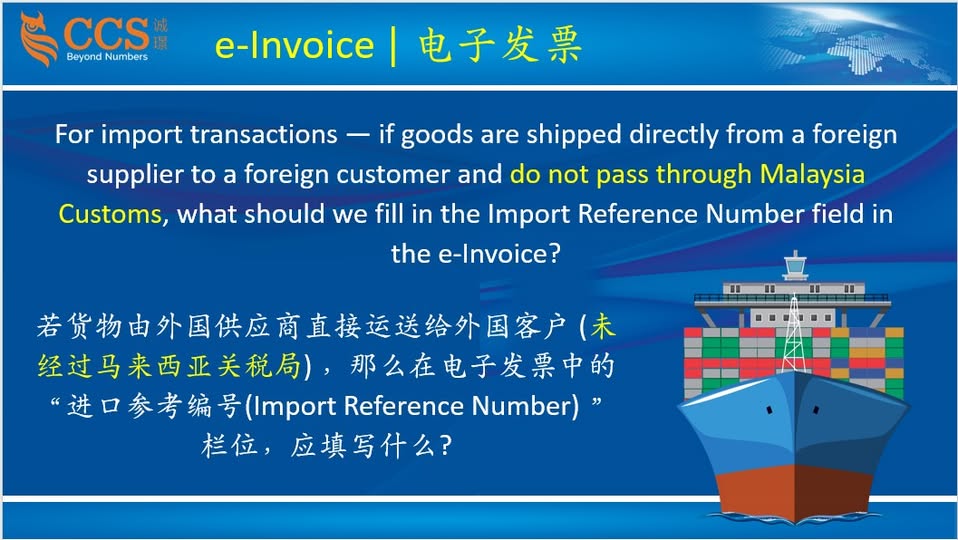
When goods are shipped directly from a foreign supplier to a foreign customer without entering Malaysia or passing through Malaysian Customs, should the “Import Reference Number” field in the e-Invoice be completed?
According to HASiL’s guidance, if goods are not physically imported into Malaysia, the field for the reference number of Customs Form No. 1, 9 and similar forms is not applicable. Taxpayers do not need to complete this field when issuing an e-Invoice for LHDNM validation.
Goods Shipped Directly Overseas
For example, Malaysian Company A orders goods from a supplier in China, who ships them directly to a customer in Singapore without the goods entering Malaysia.
As the goods do not pass through Malaysian Customs, there is no import declaration form, such as K1 or K9. The “Import Reference Number” field can therefore be left blank or omitted.
Goods Imported into Malaysia
If Malaysian Company A orders goods from a supplier in China and the goods are shipped into Malaysia and cleared through Malaysian Customs, the company must enter the relevant Customs Form number, such as K1, in the “Import Reference Number” field when issuing the e-Invoice.
直接运往海外的货物应如何填写进口参考编号?
若货物由外国供应商直接运送给外国客户,未进入马来西亚或经过马来西亚海关,那么电子发票中的“进口参考编号”栏位应如何填写?
根据内陆税收局(HASiL)的说明,若货物并未实际进口进入马来西亚,“海关表格编号(如 Customs Form No. 1、9 等)”栏位便不适用。纳税人在开具电子发票以供 LHDNM 验证时,无需填写此栏位。
货物直接运往海外
例如,马来西亚公司 A 向中国供应商采购货物,供应商随后将货物直接运送给新加坡客户,货物并未进入马来西亚。
由于货物没有经过马来西亚海关,因此不会有进口申报表格,例如 K1 或 K9。电子发票中的“进口参考编号”栏位可留空或不填写。
货物进口至马来西亚
如果马来西亚公司 A 向中国供应商采购货物,并将货物运入马来西亚,经马来西亚海关清关,则公司在开具电子发票时,必须在“进口参考编号”栏位填写相关海关表格编号,例如 K1。