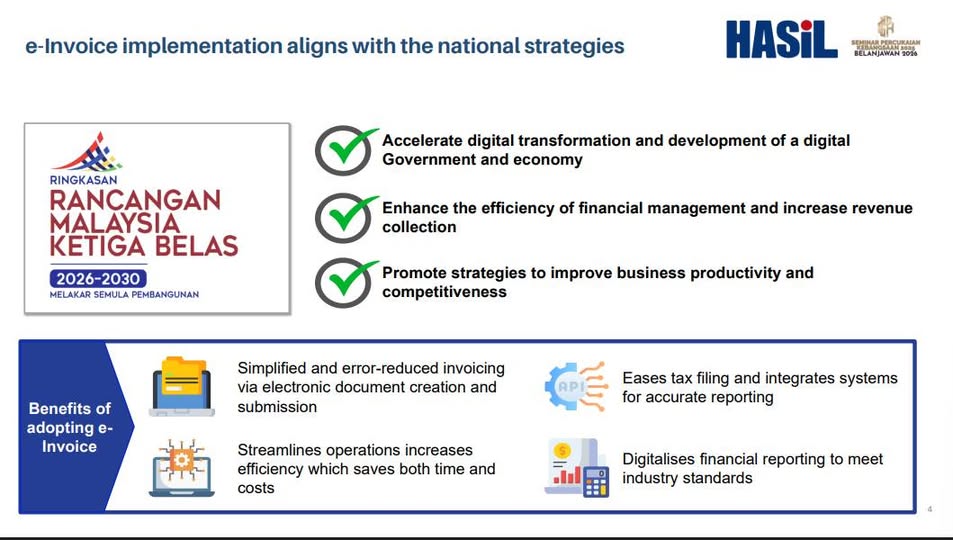
Malaysia’s e-Invoice initiative is part of the country’s wider digitalisation agenda. HASiL describes it as supporting the digitalisation of the business ecosystem and improving the efficiency of tax administration, in line with the Thirteenth Malaysia Plan (RMK13, 2026–2030).
What is an e-Invoice?
An e-Invoice is a structured, machine-readable digital representation of a transaction between a supplier and a buyer. It is submitted to the Inland Revenue Board of Malaysia (HASiL) through the MyInvois Portal or an integrated system in the prescribed format. A PDF or image of an invoice, on its own, is not an e-Invoice.
The MyInvois System checks submitted data against its requirements. Validation generally takes place in near real time and, according to HASiL, usually takes less than two seconds. Once validated, an e-Invoice receives a unique identifier. Its QR code can be used to check the invoice’s existence and status.
Potential benefits for businesses
Digital invoicing can reduce repeated manual data entry and support more consistent transaction records. When e-Invoicing is integrated with a business’s accounting or enterprise systems, it may also help streamline invoicing and reconciliation. The practical benefits depend on each business’s processes and systems; cost savings or faster reporting are not automatic.
The system applies to business-to-business, business-to-consumer and business-to-government transactions. Its requirements also cover a range of business activities, including retail, food and beverage, construction, and cross-border transactions. The relevant treatment differs by transaction type. For example, certain transactions with foreign suppliers require a self-billed e-Invoice, while eligible transactions for which buyers do not request individual e-Invoices may be included in a consolidated e-Invoice.
Current implementation dates and exemption
HASiL’s current implementation timeline sets out the following dates according to annual turnover or revenue:
- More than RM100 million: 1 August 2024.
- More than RM25 million and up to RM100 million: 1 January 2025.
- More than RM5 million and up to RM25 million: 1 July 2025.
- Up to RM5 million: 1 January 2026, subject to the applicable exemption.
Effective 1 September 2026, taxpayers with annual turnover or revenue below RM3 million may be exempt from implementation, provided they meet the relevant exemption criteria. The criteria include rules that businesses should review before relying on the exemption. Eligible taxpayers are encouraged to participate voluntarily.
Businesses without their own invoicing system can use the free MyInvois Portal and MyInvois Mobile App. Qualifying e-Invoice implementation expenditure may also be eligible for tax incentives, subject to the relevant legislation and conditions.
The implementation schedule and related concessions have changed over time. Businesses should check HASiL’s current implementation timeline and e-Invoice guidance when determining their obligations.
马来西亚电子发票计划:国家策略、企业效益与现行要求
马来西亚电子发票计划是国家整体数码化议程的一部分。HASiL 指出,该计划旨在推动商业生态系统数码化,并提升税务管理效率,与《第十三大马计划》(RMK13,2026–2030)的方向一致。
什么是电子发票?
电子发票是供应商与买方之间交易的结构化、机器可读数码记录。纳税人须通过 MyInvois 门户或整合系统,以规定格式提交电子发票。单独的 PDF 或图像文件并不构成电子发票。
MyInvois 系统会根据相关要求检查已提交的数据。HASiL 表示,验证一般以近乎实时的方式进行,通常少于两秒。电子发票通过验证后会获得唯一识别号码,买方可扫描二维码核实发票是否存在及其状态。
对企业的潜在效益
数码开票有助于减少重复的手动数据输入,并支持企业建立更一致的交易记录。若电子发票与企业的会计或企业管理系统整合,也可能简化开票与对账流程。实际效益取决于企业自身的流程和系统;节省成本或加快报告工作并非自动实现。
电子发票适用于企业对企业、企业对消费者及企业对政府的交易。相关要求也涵盖零售、餐饮、建筑和跨境交易等不同业务。不同交易类型的处理方式并不相同。例如,向某些外国供应商采购时须开具自开电子发票;若买方没有要求个别电子发票,符合条件的交易则可纳入合并电子发票。
现行实施日期与豁免
HASiL 现行实施时间表根据年营业额或收入列出以下日期:
- 超过 RM100 million:2024年8月1日。
- 超过 RM25 million 且不超过 RM100 million:2025年1月1日。
- 超过 RM5 million 且不超过 RM25 million:2025年7月1日。
- 不超过 RM5 million:2026年1月1日,但须考虑适用的豁免规定。
自2026年9月1日起,年营业额或收入低于 RM3 million 的纳税人,如符合相关豁免条件,可获豁免实施电子发票。企业在依据豁免安排前,应先查阅相关条件。符合豁免资格的纳税人也可自愿参与。
没有自有开票系统的企业,可使用免费的 MyInvois 门户及 MyInvois 手机应用程序。符合条件的电子发票实施支出也可能享有税务优惠,但须遵守相关法令与条件。
实施时间表及相关宽松安排曾多次调整。企业在确定自身义务时,应查阅 HASiL 的现行实施时间表及电子发票指南。