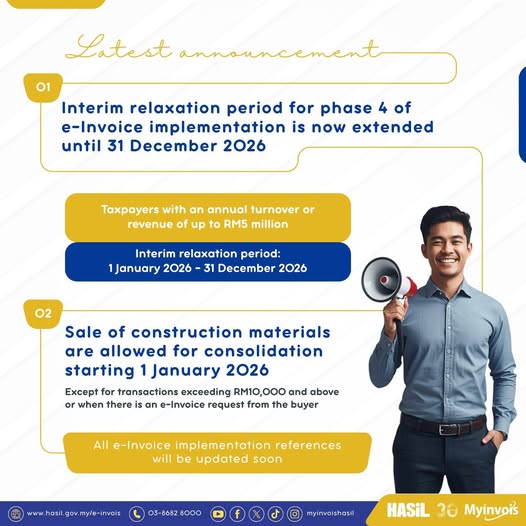
Businesses with annual turnover or revenue of up to RM5 million that are required to implement e-Invoice may have additional time to adapt. Under the latest e-Invoice Specific Guideline, the interim relaxation period for Phase 4 taxpayers runs until 31 December 2027. Businesses that qualify for an e-Invoice exemption should assess that separately.
During the relaxation period, eligible taxpayers may issue consolidated e-Invoices for all activities and transactions, including those that would normally require an individual e-Invoice. They may also use a consolidated e-Invoice even when a buyer requests an individual e-Invoice, provided they comply with the applicable consolidated e-Invoice requirements. IRBM will not undertake prosecution under Section 120 of the Income Tax Act 1967 for e-Invoice non-compliance during this period, provided those requirements are met.
Consolidated e-Invoices for construction material sales
Construction material suppliers may use consolidated e-Invoices where the applicable rules allow. Under the standard rules, an individual e-Invoice is generally required if a single transaction exceeds RM10,000 or the buyer requests one.
However, eligible Phase 4 taxpayers may rely on the interim relaxation described above, which allows consolidation across all activities and transactions during the relaxation period, subject to the requirements for issuing consolidated e-Invoices.
The relaxation period gives businesses more time to prepare their systems, train employees and organise their records. Businesses should confirm their implementation and exemption status, and check the latest HASiL guidance before deciding how to issue their e-Invoices.
第四阶段企业 e-Invoice 宽限安排:合并开票与建筑材料销售
对于须实施 e-Invoice、年度营业额或收入不超过 RM5 million 的企业,现有额外时间适应。根据最新的《e-Invoice Specific Guideline》,第四阶段纳税人的临时宽限期截至2027年12月31日。符合 e-Invoice 豁免条件的企业,应另行评估自身是否适用豁免。
在宽限期内,符合条件的纳税人可就所有活动及交易开具合并电子发票,包括通常须开具个别电子发票的交易。即使买方要求开具个别电子发票,纳税人仍可使用合并电子发票,但须遵守适用的合并电子发票要求。只要符合这些要求,IRBM 在宽限期内不会就电子发票不合规行为根据《1967年所得税法令》第120条提起检控。
建筑材料销售的合并电子发票
建筑材料供应商可在适用规定允许的情况下开具合并电子发票。按照一般规则,单笔交易金额超过 RM10,000,或买方要求开具个别电子发票时,通常须开具个别电子发票。
不过,符合条件的第四阶段纳税人可在宽限期内采用上述临时安排,就所有活动及交易开具合并电子发票,但须遵守合并电子发票的开具要求。
这段宽限期让企业有更多时间准备系统、培训员工及整理记录。企业应确认自身的实施时间表和豁免资格,并在决定如何开具电子发票前查阅 HASiL 最新指引。