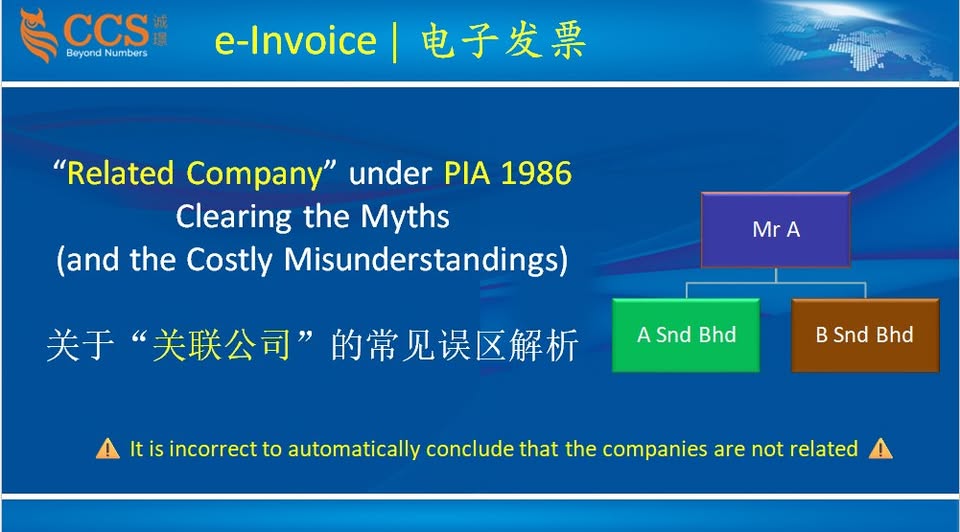
The term “related company” is not limited to a parent–subsidiary relationship. Under section 2(1) of Malaysia’s Promotion of Investments Act 1986 (PIA 1986), the definition includes both control-based tests and a separate rule that deems companies related when specified shareholding thresholds are met.
The Inland Revenue Board of Malaysia (IRBM) has referred to this definition in its e-Invoice FAQs. Where a tax rule adopts the PIA 1986 definition, businesses should consider both the ownership structure and who controls, or can control, the companies’ operations.
The control-based tests
Under paragraphs (a) to (c) of the definition, companies may be related if:
- one company controls, or can control, the operations of the other;
- one company’s operations are controlled, or can be controlled, by the other; or
- the operations of both companies are controlled, or can be controlled, by the same person.
These tests focus on actual or potential control. Paragraph (c) does not specify a minimum shareholding. As a result, a small shareholding does not, by itself, rule out a related-company relationship if the common-control test is otherwise met.
A common director alone does not automatically make two companies related. However, the director’s powers and actual role in directing the companies’ operations may be relevant. Being the sole director may be a relevant indicator, but the conclusion depends on the circumstances and the applicable legal test.
The 20% deemed-related rule
The definition also provides that one company is deemed to be related to another if at least 20% of the issued share capital of one company is beneficially owned, directly or indirectly, by the other.
This is a separate, shareholding-based rule. When the specified 20% threshold is met, the companies are deemed related without needing to establish operational control under paragraphs (a) to (c). Conversely, a shareholding below 20% does not satisfy this particular deeming rule, but the control-based tests may still need to be considered.
Applying the tests
Consider a situation where Mr A holds 10% of Company A and 10% of Company B, and is the sole director of both. The shareholdings do not meet the 20% deemed-related threshold. That alone, however, does not determine whether the companies are related. The assessment must also consider whether Mr A controls, or can control, the operations of both companies under paragraph (c).
Similarly, where one company holds at least 20% of another, the deemed-related rule may apply even if the shareholder does not participate in the other company’s day-to-day management.
Why the distinction matters
A related-company determination may affect eligibility for tax incentives or other tax treatments where the relevant rules rely on the PIA 1986 definition. Separate incorporation or a small shareholding should therefore not be treated as conclusive on its own.
Businesses should review both the legal ownership and the practical control arrangements, and assess the specific tax provision that applies. If the facts or the interpretation are uncertain, professional advice may be needed.
《1986年投资促进法令》下的关联公司:控制权与20%持股规则
“关联公司”并不只限于母公司与子公司之间的关系。根据马来西亚《1986年投资促进法令》(PIA 1986)第2(1)条,关联公司的定义既包括控制权测试,也包括根据特定持股门槛将公司视为关联公司的独立规则。
马来西亚内陆税收局(IRBM)在电子发票常见问题中引用了这项定义。如果相关税务规定采用 PIA 1986 的定义,企业就应同时考虑股权结构,以及谁实际控制或有能力控制公司的营运。
控制权测试
根据定义中的(a)至(c)段,以下情况可能构成关联公司关系:
- 一家公司控制或能够控制另一家公司的营运;
- 一家公司的营运由另一家公司控制或能够被其控制;或
- 两家公司的营运均由同一人控制或能够由同一人控制。
这些测试关注实际或潜在的控制权。第(c)段没有规定最低持股比例。因此,即使持股比例较低,只要符合共同控制测试,两家公司仍可能构成关联公司。
仅有共同董事,并不自动代表两家公司属于关联公司。不过,董事的权限及其在指挥公司营运方面实际发挥的作用,可能与判断有关。担任唯一董事可以是相关指标,但仍须根据具体情况及适用的法律测试作出判断。
20%视同关联规则
该定义也规定,如果一家公司的至少20%已发行股本由另一家公司直接或间接实益持有,则前者会被视为与后者有关联。
这是一项独立的持股规则。达到规定的20%门槛后,即可适用视同关联规则,无须再依据(a)至(c)段证明存在营运控制。反之,持股低于20%并不符合这项特定的视同关联规则,但仍可能需要进一步考虑控制权测试。
如何应用这些测试
假设 A 先生持有公司 A 10%的股份、公司 B 10%的股份,并担任两家公司的唯一董事。该持股比例未达到20%的视同关联门槛,但这本身并不能决定两家公司是否属于关联公司。仍须根据第(c)段,评估 A 先生是否控制或有能力控制两家公司的营运。
同样地,如果一家公司持有另一家公司至少20%的股份,即使该股东没有参与另一家公司的日常管理,也可能适用视同关联规则。
为什么这项区别很重要
如果相关税务规定采用 PIA 1986 的定义,关联公司关系可能影响企业是否符合税务优惠或其他税务处理条件。因此,公司分别注册成立或持股比例较低,本身都不足以作出最终判断。
企业应检视法律上的股权结构及实际控制安排,并确认适用的具体税务条文。如事实或法律解释存在不确定性,可能需要寻求专业意见。