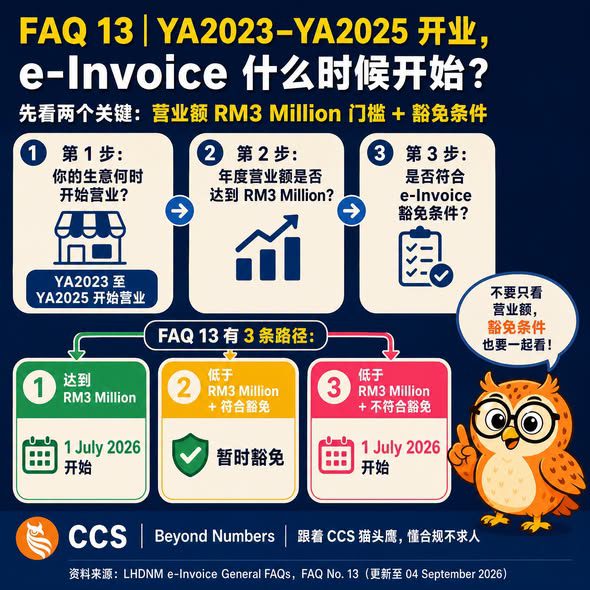
Businesses that started operating in YA 2023, YA 2024 or YA 2025 should not determine their e-Invoice implementation date by looking only at whether their turnover is below RM3 million. They must also check whether they meet the e-Invoice exemption criteria.
FAQ No. 13 sets out three possible paths.
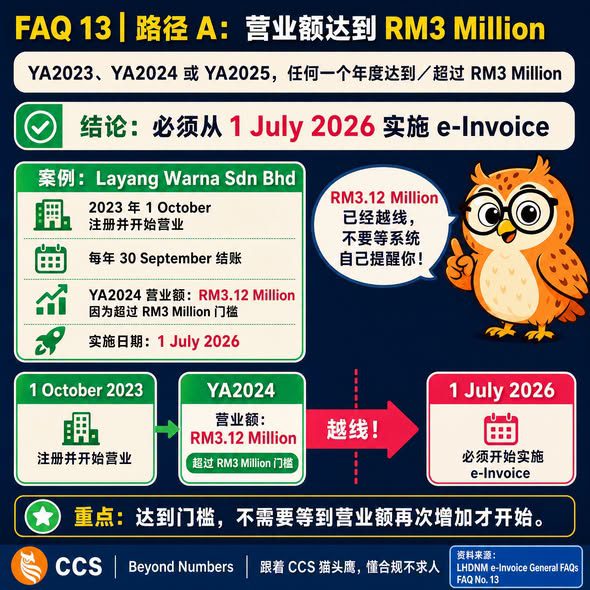
Path A: Turnover Reached RM3 Million
If a business reached or exceeded RM3 million in any one of YA 2023, YA 2024 or YA 2025, it must begin implementing e-Invoice from 1 July 2026.
Example: Layang Warna Sdn Bhd
Layang Warna registered and began operating on 1 October 2023, and its financial year ends on 30 September. In YA 2024, its turnover reached RM3.12 million.
As RM3.12 million exceeds the RM3 million threshold, the company must implement e-Invoice from 1 July 2026. Businesses that have crossed the threshold should plan for implementation rather than wait for a system reminder.
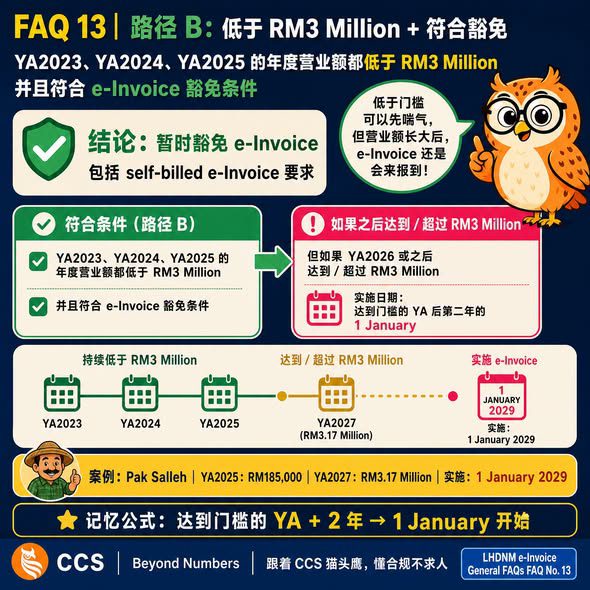
Path B: Turnover Below RM3 Million and Exemption Criteria Met
If a business’s turnover remained below RM3 million in YA 2023, YA 2024 and YA 2025, and it meets the e-Invoice exemption criteria, it is temporarily exempt from implementing e-Invoice, including self-billed e-Invoice.
The exemption may not be permanent. If the business reaches or exceeds RM3 million in YA 2026 or a later year, it must begin implementation on 1 January of the second year following the YA in which it reached the threshold.
Example: Pak Salleh
Pak Salleh’s turnover was RM185,000 in YA 2025. As it was below RM3 million and he met the exemption criteria, he was temporarily exempt.
His business grew, and turnover reached RM3.17 million in YA 2027. The second year after YA 2027 is YA 2029, so he must begin implementing e-Invoice from 1 January 2029.
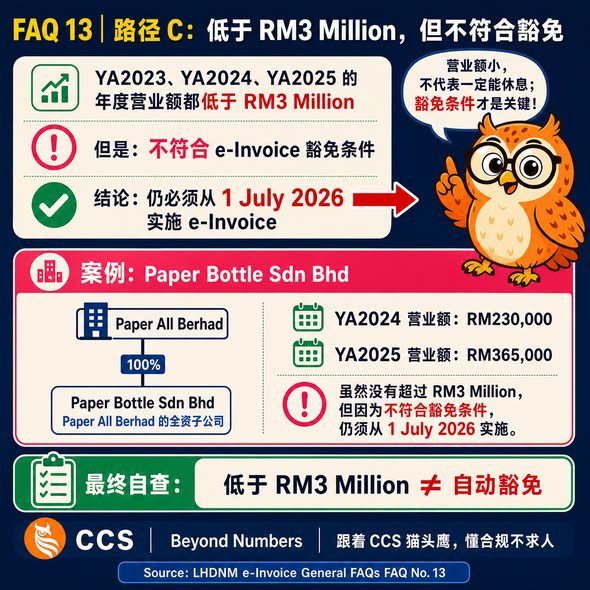
Path C: Turnover Below RM3 Million but Exemption Criteria Not Met
A business with turnover below RM3 million must still implement e-Invoice from 1 July 2026 if it does not meet the exemption criteria.
Example: Paper Bottle Sdn Bhd
Paper Bottle Sdn Bhd is a wholly owned subsidiary of Paper All Berhad, which has already implemented e-Invoice. Paper Bottle’s turnover was:
- YA 2024: RM230,000
- YA 2025: RM365,000
Although its turnover was well below RM3 million, Paper Bottle did not meet the exemption criteria. It must therefore implement e-Invoice from 1 July 2026.
FAQ No. 13 in Brief
- Turnover reached RM3 million in YA 2023, YA 2024 or YA 2025: Implement from 1 July 2026.
- Turnover below RM3 million and exemption criteria met: Temporarily exempt; if the threshold is reached in a future YA, implement from 1 January of the second following year.
- Turnover below RM3 million but exemption criteria not met: Implement from 1 July 2026.
Business Self-Assessment Checklist
Before concluding that e-Invoice implementation is not required, check:
- Did the business start operating in YA 2023, YA 2024 or YA 2025?
- Did its turnover reach RM3 million in any of those years?
- If turnover was below RM3 million, does it meet all the exemption criteria?
- Is it an independent business, or part of a group or related-company structure?
- If it reaches RM3 million in a future YA, what will its implementation date be?
The answer “I think we are exempt because I heard so from another business owner” is not a reliable basis for determining compliance. Each business should assess its own turnover, structure and eligibility.
YA 2023至YA 2025开始营业的企业:e-Invoice实施时间的三种情况
在YA 2023、YA 2024或YA 2025开始营业的企业,判断 e-Invoice 实施日期时,不能只看营业额是否低于RM300万,还须确认是否符合 e-Invoice 豁免条件。
FAQ No. 13列出三种可能情况。
路径A:营业额达到RM300万
如果企业在YA 2023、YA 2024或YA 2025任何一个年度,营业额达到或超过RM300万,就必须从2026年7月1日起实施 e-Invoice。
案例:Layang Warna Sdn Bhd
Layang Warna于2023年10月1日注册并开始营业,财政年度截至每年9月30日。公司在YA 2024的营业额达到RM312万。
由于RM312万超过RM300万门槛,公司必须从2026年7月1日起实施 e-Invoice。已经达到门槛的企业,应认真安排实施工作,而不是等待系统提醒。
路径B:营业额低于RM300万,并符合豁免条件
如果企业在YA 2023、YA 2024及YA 2025的营业额均低于RM300万,且符合 e-Invoice 豁免条件,便可暂时豁免实施 e-Invoice,包括自开 e-Invoice。
不过,豁免并非永久有效。如果企业在YA 2026或之后达到或超过RM300万,就必须从达到门槛所在YA之后第二年的1月1日起实施。
案例:Pak Salleh
Pak Salleh在YA 2025的营业额为RM185,000,低于RM300万,而且符合豁免条件,因此暂时豁免。
之后生意增长,他在YA 2027的营业额达到RM317万。YA 2027之后的第二年是YA 2029,因此他必须从2029年1月1日起实施 e-Invoice。
路径C:营业额低于RM300万,但不符合豁免条件
即使营业额低于RM300万,如果企业不符合豁免条件,仍须从2026年7月1日起实施 e-Invoice。
案例:Paper Bottle Sdn Bhd
Paper Bottle Sdn Bhd是Paper All Berhad的全资子公司,而Paper All Berhad已经实施 e-Invoice。Paper Bottle的营业额如下:
- YA 2024:RM230,000
- YA 2025:RM365,000
虽然Paper Bottle的营业额远低于RM300万,但公司不符合豁免条件,因此仍须从2026年7月1日起实施 e-Invoice。
FAQ No. 13重点总结
- YA 2023、YA 2024或YA 2025任何一个年度达到RM300万:从2026年7月1日起实施。
- 营业额低于RM300万且符合豁免条件:暂时豁免;未来达到门槛时,从第二个后续课税年度的1月1日起实施。
- 营业额低于RM300万但不符合豁免条件:仍须从2026年7月1日起实施。
企业自查清单
在判断企业无需实施 e-Invoice 之前,请先确认:
- 企业是在YA 2023、YA 2024还是YA 2025开始营业?
- YA 2023、YA 2024或YA 2025是否有任何一个年度达到RM300万?
- 如果营业额低于RM300万,企业是否符合所有豁免条件?
- 企业是独立经营,还是属于集团或关联公司架构?
- 如果未来达到RM300万,适用的实施日期是哪一天?
“听别的老板说应该豁免”并不足以作为合规判断依据。每家企业都应根据自身营业额、架构及资格条件进行评估。