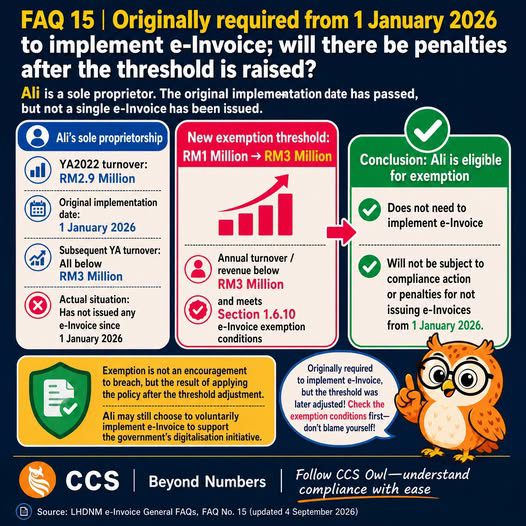
FAQ No. 15 concerns Ali’s sole proprietorship, which recorded turnover of RM2.9 million in YA 2022. Its original e-Invoice implementation date was 1 January 2026, but it did not issue e-Invoices during that period.
The exemption threshold has since increased from RM1 million to RM3 million. As the business’s turnover in subsequent years did not exceed RM3 million, and it meets the exemption criteria in Section 1.6.10, it is not required to implement e-Invoicing.
Accordingly, the business will not face compliance action or penalties for not issuing e-Invoices from 1 January 2026 onwards. It may nevertheless choose to implement e-Invoicing voluntarily in support of the Government’s digitalisation programme.
e-Invoice常见问题第15条:营业额低于RM300万的独资企业豁免
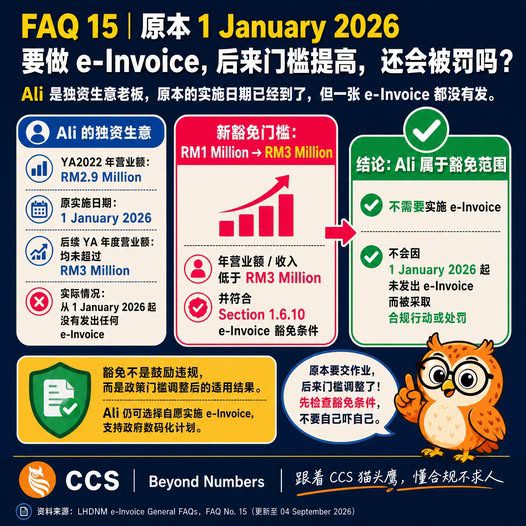
常见问题第15条以Ali的独资生意为例。该生意在YA 2022的营业额为RM290万,原定实施 e-Invoice 的日期为2026年1月1日,但在该期间并未开具 e-Invoice。
后来,e-Invoice豁免门槛从RM100万提高至RM300万。由于该生意之后各年度的营业额均未超过RM300万,并符合第1.6.10节所列的豁免条件,因此无需实施 e-Invoice。
因此,该生意不会因自2026年1月1日起未开具 e-Invoice 而面临合规行动或处罚。不过,企业仍可选择自愿实施 e-Invoice,以支持政府的数码化计划。