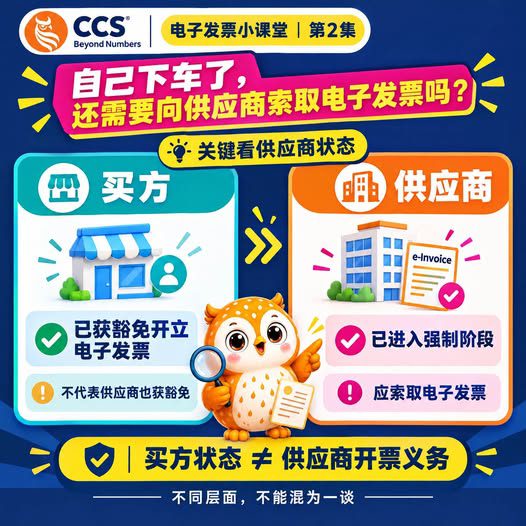
A buyer’s exemption from issuing e-Invoices and a supplier’s obligation to issue them are separate matters and should not be confused.
The Core Principle: The Issuance Requirement Depends on the Supplier
Whether e-Invoice issuance is mandatory is determined by the seller’s (supplier’s) annual turnover or revenue and the applicable threshold. The current threshold is RM3 million, as stated in paragraph 1.6.10 of the e-Invoice Guideline v4.8.
This is not directly related to whether the buyer is “out of scope”—that is, whether the buyer’s own turnover is below RM3 million and it is exempt from issuing e-Invoices.
A business’s exemption means that, when acting as a seller, it is not required to issue e-Invoices to its customers. It does not change the requirements that apply when the business acts as a buyer and requests an invoice from a supplier.
Should a Buyer Request an e-Invoice from Its Supplier?
The key factor is the supplier’s e-Invoice status.
Scenario 1: The Supplier Has Reached the Mandatory Implementation Threshold
If the supplier has reached the mandatory implementation threshold and has started issuing e-Invoices, the buyer should request one as supporting documentation for claiming the expense as a tax deduction.
Even if the buyer is exempt from issuing e-Invoices, requesting one from a supplier that is already issuing e-Invoices through the MyInvois system is the prudent approach.
Scenario 2: The Supplier Has Not Reached the Threshold or Is Exempt
During the transition period, the buyer may use an ordinary invoice or receipt to support a tax deduction. An e-Invoice is not compulsory if the supplier has not yet reached its mandatory implementation date or is exempt.
The official FAQs state that, during the transition period, taxpayers may use ordinary bills, receipts or invoices from suppliers that have not yet reached their mandatory implementation date or are exempt to substantiate business expenses, until e-Invoicing is fully implemented.
Additional Clarification
If a supplier claims to be exempt but is not actually eligible, the compliance obligation generally rests with the issuer—the supplier—rather than the buyer, who records the expense using an ordinary invoice.
In summary: Whether your business is “out of scope” does not determine whether you should request an e-Invoice as a buyer. The key question is whether your supplier has entered the mandatory e-Invoice implementation phase.
买方获豁免,仍需向供应商索取 e-Invoice 吗?
买方是否获豁免开具 e-Invoice,与供应商是否有义务开具 e-Invoice,是两个不同层面的问题,不能混为一谈。
核心原则:开票义务取决于供应商
是否必须开具 e-Invoice,取决于卖方(供应商)的年度营业额或收入是否达到适用门槛。目前的门槛为RM300万,参见《e-Invoice Guideline v4.8》第1.6.10段。
这与买方是否“下车”并无直接关系。所谓“下车”,是指买方自身营业额低于RM300万,因此获豁免开具 e-Invoice。
换言之,企业获豁免,代表其作为卖方时无需向自己的客户开具 e-Invoice;但这不会改变其作为买方向供应商索取发票时所适用的规则。
买方是否应向供应商索取 e-Invoice?
关键在于供应商自身的 e-Invoice 实施状态。
情况一:供应商已达到强制实施门槛
如果供应商已达到强制实施门槛并开始开具 e-Invoice,买方应向供应商索取 e-Invoice,作为申报扣除该笔支出的凭证。
即使买方本身获豁免开具 e-Invoice,只要供应商已在MyInvois系统开具 e-Invoice,向供应商索取仍是较稳妥的做法。
情况二:供应商尚未达到门槛或本身获豁免
在过渡期间,如果供应商尚未进入强制实施阶段或本身获豁免,买方仍可使用普通发票或收据作为申报扣除该笔支出的凭证,并非必须索取 e-Invoice。
官方常见问题解答指出,在过渡期间,纳税人可以使用尚未达到强制实施期限或获豁免的供应商所提供的普通账单、收据或发票,作为证明交易支出的凭证,直至 e-Invoice 全面落实。
补充说明
如果供应商声称自己属于豁免范围,但实际上并不符合资格,原则上,合规义务在于开具发票的一方——供应商,而非使用普通发票入账的买方。
简单来说:自己是否“下车”,不影响您作为买方判断是否应索取发票。真正要看的是供应商是否已进入 e-Invoice 强制实施阶段。