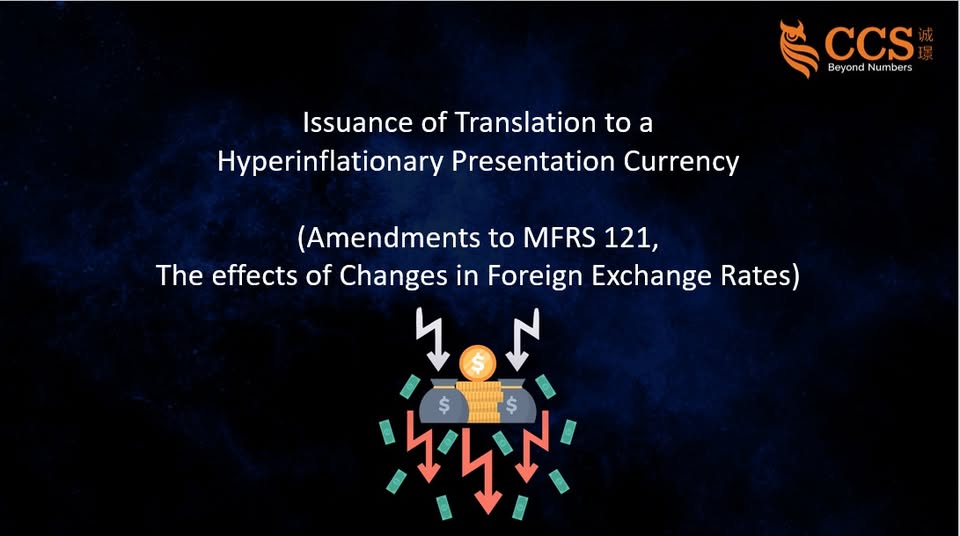
The Malaysian Accounting Standards Board (MASB) has issued an update on how companies should translate their financial statements when the presentation currency is affected by hyperinflation. The update amends MFRS 121, The Effects of Changes in Foreign Exchange Rates, issued under the Financial Reporting Act 1997.
Why is this update needed?
Consider a Malaysian company operating overseas where the local currency loses value rapidly, prices change almost daily and normal exchange rates no longer reflect economic reality. In such circumstances, simply translating figures using normal exchange rates may mislead readers. This is known as a hyperinflationary currency situation.
Before the update, companies used different methods to translate figures, making financial statements from hyperinflationary economies confusing, inconsistent and difficult to compare.
MASB’s aim is to improve consistency, clarity and the usefulness of financial information.
What does the amendment clarify?
The amendment explains how to translate financial statements when a company’s functional currency is not hyperinflationary, but its presentation currency is. It clarifies which exchange rates and adjustments to use so that the resulting figures reflect economic reality and are not distorted by runaway inflation. It also aims to provide a cost-effective approach without unnecessary complexity.
Which Malaysian businesses may be affected?
The update is relevant to Malaysian companies with overseas operations or reporting in high-inflation countries. It is also relevant to groups preparing financial statements under the requirements of bodies such as the Securities Commission Malaysia, Bank Negara Malaysia and the Companies Commission of Malaysia (SSM).
For most local small and medium-sized enterprises (SMEs), the immediate impact is expected to be limited or none. For multinational groups, however, the update may be important.
When does it take effect?
The amendments are effective for financial years beginning on or after 1 January 2027. Early adoption is permitted.
Why this matters beyond accounting
Financial statements are used by investors, banks, regulators and business partners. If figures affected by inflation are not translated appropriately, profits may appear misleading, losses may be obscured and decisions may be based on inaccurate information.
This update is intended to support trust in financial information. Extreme inflation can distort figures; clear accounting requirements help address that distortion and support reporting that is truthful, comparable and understandable. Accounting standards exist to reflect economic reality—not just mathematics.
MFRS 121修订:将财务报表换算为恶性通货膨胀呈列货币
马来西亚会计准则委员会(MASB)发布了一项更新,说明当呈列货币受到恶性通货膨胀影响时,公司应如何换算财务报表。这项更新修订了根据《1997年财务报告法令》发布的MFRS 121《外汇变动的影响》。
为什么需要这项更新?
设想一家马来西亚公司在海外经营,当地货币迅速贬值,物价几乎每天都在变化,而一般汇率已无法反映经济现实。在这种情况下,如果仍按一般汇率换算数字,可能会误导报表读者。这就是恶性通货膨胀货币的情形。
在这项更新发布之前,不同公司采用不同的方法换算数字,导致来自恶性通货膨胀经济体的财务报表难以理解、做法不一致,也不容易比较。
MASB旨在提高财务信息的一致性、清晰度和实用性。
修订内容说明了什么?
这项修订说明,当公司的功能货币并未处于恶性通货膨胀环境,但其呈列货币处于该环境时,应如何换算财务报表。修订也阐明应采用哪些汇率及调整方式,使最终数字能够反映经济现实,避免受到失控通胀的扭曲。同时,相关方法也兼顾成本效益,避免不必要的复杂程序。
哪些马来西亚企业可能受到影响?
这项更新与在高通胀国家拥有海外业务或进行财务报表呈列的马来西亚公司有关。根据马来西亚证券委员会、马来西亚国家银行及马来西亚公司委员会(SSM)等机构要求编制财务报表的集团,也可能需要关注这项更新。
对大多数本地中小企业而言,短期影响预计有限或没有影响;但对跨国集团来说,这项更新可能相当重要。
什么时候生效?
修订适用于自2027年1月1日或之后开始的财政年度,并允许提早采用。
为什么这不只是会计人员需要关注的事项?
投资者、银行、监管机构和商业伙伴都会参考财务报表。如果通胀影响下的数字未能妥善换算,利润可能显得失真,亏损可能被掩盖,决策也可能建立在不准确的信息上。
这项更新旨在维护公众对财务信息的信任。恶性通货膨胀会扭曲数字;清晰的会计要求有助于纠正这种扭曲,并支持真实、可比较且易于理解的报告。会计准则的作用,是反映经济现实,而不只是处理数学计算。