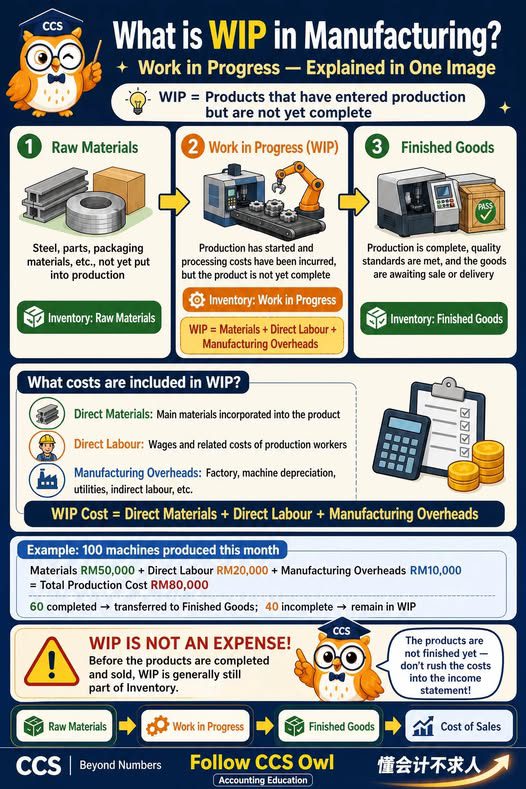
In manufacturing, WIP stands for Work in Progress or Work in Process.
It refers to products that have entered the production process but are not yet complete.
The Manufacturing Flow
The production process can be understood as follows:
1. Raw Materials
Raw materials are items such as:
- Steel;
- Components;
- Parts; and
- Packaging materials
that are still in storage and have not yet been used in production.
2. Work in Progress
WIP consists of products that have entered the production line and have incurred costs, but are still incomplete.
These costs may include:
- Direct materials;
- Direct labour; and
- Manufacturing overheads, such as factory rent, machine depreciation, utilities and indirect labour.
The basic formula is:
WIP Cost = Direct Materials + Direct Labour + Manufacturing Overheads
3. Finished Goods
Finished goods are products that have been fully completed, passed the relevant quality checks and are ready to be sold or delivered.
Example
Assume a company produces 100 machines during the month at a total production cost of RM80,000.
At the end of the month:
- 60 machines are completed and transferred to Finished Goods; and
- 40 machines remain incomplete and stay in WIP.
The production costs are allocated between finished goods and WIP based on the stage of completion and the applicable costing method.
WIP Is Not an Expense
This is an important point:
WIP is not an expense.
As long as the product has not been completed and sold, the accumulated production cost remains as inventory in the statement of financial position.
The cost should not be transferred to profit or loss simply because it has already been incurred.
The usual sequence is:
Raw Materials → WIP → Finished Goods → Cost of Sales
Only when the finished goods are sold is the related cost transferred to Cost of Sales.
Keeping these categories separate helps manufacturing businesses maintain cleaner records and produce more reliable information about inventory, production costs and profit margins.
CCS | Beyond Numbers
制造业的 WIP 是什么?从原材料到销售成本
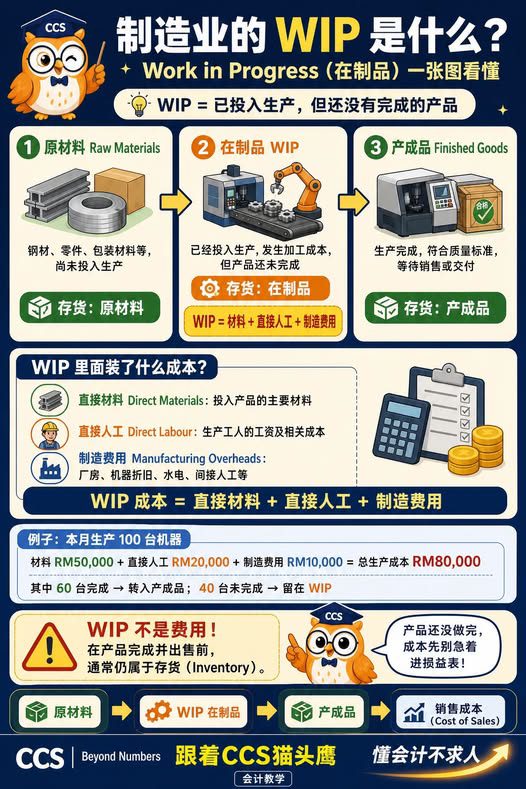
在制造业中,WIP 是 Work in Progress 或 Work in Process 的简称,中文通常称为在制品。
简单来说,WIP 指的是:
产品已经投入生产,但还没有完成。
制造流程
整个生产流程可以这样理解:
一、原材料(Raw Materials)
原材料包括:
- 钢材;
- 零件;
- 部件;以及
- 包装材料,
这些物品仍然存放在仓库里,还没有投入生产使用。
二、在制品(WIP)
在制品是指已经进入生产线、已经发生相关成本,但产品还没有完成的项目。
WIP 成本可能包括:
- 直接材料;
- 直接人工;以及
- 制造费用,例如厂房租金、机器折旧、水电费及间接人工。
基本计算公式为:
WIP 成本 = 直接材料 + 直接人工 + 制造费用
三、产成品(Finished Goods)
产成品是已经全部完成、通过相关质量检查,并等待出售或交付的产品。
一个简单例子
假设一家公司在本月生产 100 台机器,总生产成本为 RM80,000。
月底时:
- 60 台已经完成,转入产成品(Finished Goods);以及
- 40 台仍未完成,继续留在**在制品(WIP)**中。
生产成本应根据产品的完成阶段及所采用的成本计算方法,在产成品和在制品之间进行分配。
WIP 不是费用
这一点非常重要:
WIP 不是费用。
只要产品还没有完成并出售,已经累积的生产成本仍然属于存货(Inventory),并列在财务状况表中。
不能因为成本已经发生,就马上把它全部转入损益表。
制造业通常遵循以下顺序:
原材料 → WIP 在制品 → 产成品 → 销售成本
只有当产成品真正出售时,相关成本才会转入销售成本(Cost of Sales)。
把这些类别清楚区分,有助于制造企业保持更整洁的会计记录,并更准确地了解存货、生产成本及利润率。
CCS | Beyond Numbers