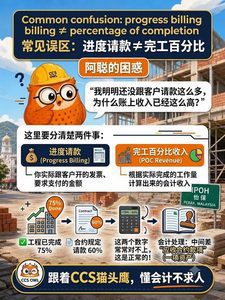
A construction contractor may be surprised when an accountant says that the company has already earned a profit even though:
- The project is not yet complete;
- The customer has not paid the final instalment; and
- Some materials and project costs have not yet been fully settled.
The reason is simple:
Accounting looks at how much work has been performed, not only how much money the customer has paid.
A Simple Example
Suppose Ah Chong, a renovation contractor in Ipoh, enters into a shop-house renovation contract with a total contract price of RM800,000.
At the halfway point of the project, the customer has not yet paid the final instalment, and some project costs remain unpaid. Ah Chong may think:
“The project is not finished yet. How can I have earned any profit?”
However, the accountant assesses the revenue based on the progress of the work.
Assume:
- Contract price: RM800,000
- Estimated total project cost: RM640,000
- Costs incurred to date: RM480,000
The percentage of completion is calculated as follows:
Percentage of completion = Costs incurred to date ÷ Estimated total project cost
= RM480,000 ÷ RM640,000 = 75%
This means that the project is estimated to be 75% complete based on the costs incurred.
The revenue recognised to date may therefore be calculated as:
RM800,000 × 75% = RM600,000
After deducting the costs incurred to date:
Profit recognised = RM600,000 − RM480,000 = RM120,000
The RM120,000 represents the profit recognised based on the progress of the work, subject to the applicable revenue recognition requirements and the reliability of the estimates.
Why Not Wait Until the Project Is Complete?
Many business owners ask:
“I have not received all the money yet. Why should the profit be recognised now?”
If revenue and profit were recognised only when a project was fully completed and the customer had paid in full, the financial statements for a three-year project might show no revenue or profit during the first two years.
That would make it difficult for:
- The business owner;
- Banks;
- Investors; and
- Other users of the financial statements
to understand how the project was performing during that period.
Where the applicable requirements for recognising revenue over time are satisfied, the accounting records should reflect the progress of the work as it is performed. This provides a more meaningful picture of the company’s current operating performance.
Why Do Progress Billings and Accounting Revenue Differ?
This is one of the areas that often confuses contractors.
Progress Billings
Progress billings are the amounts invoiced to the customer based on the contractual billing milestones.
Accounting Revenue
Accounting revenue is the amount recognised based on the work performed and the progress of the contract.
These two amounts do not necessarily match, and that is not unusual.
For example, a contractor may have completed 75% of the work, but the contract may allow billing only after a particular milestone, such as the completion of the building structure.
If the recognised revenue is higher than the amount billed, the difference may be recognised as a contract asset, subject to the applicable requirements. This represents work already performed for which the right to payment is still conditional on a future event, such as achieving a milestone or obtaining customer acceptance.
In simple terms:
The contractor has performed the work, but the customer has not yet been billed or the right to payment is not yet unconditional.
What If the Project Is Expected to Make a Loss?
This is especially important.
If the contractor determines that the project is expected to be loss-making overall, the expected loss should be recognised in accordance with the applicable financial reporting requirements when the loss becomes evident. It should not be delayed until the project is completed.
For example, if the estimated total project cost is expected to exceed the contract price by RM50,000, the expected loss should be recognised when the loss is identified, subject to the applicable requirements.
This prevents financial statements from showing only favourable results while delaying the recognition of known risks.
Early recognition allows:
- The business owner;
- Banks; and
- Shareholders
to understand the project’s financial position and take timely action.
The Key Principle
As the work progresses, the accounting should reflect the work performed—not merely the timing of customer payments.
Revenue recognition for construction and renovation contracts must still be assessed based on the contract terms, the performance obligations, the method used to measure progress and the applicable financial reporting framework.
CCS | Beyond Numbers
为什么工程还没完成,会计师却说公司已经赚钱了?
建筑承包商有时会感到疑惑:
- 工程还没有完成;
- 客户还没有支付最后一笔款项;以及
- 部分材料费和工程成本也还没有完全结清,
为什么会计师却说公司已经赚到利润?
原因很简单:
会计看的是工程已经完成了多少,而不只是客户已经付了多少钱。
一个简单例子
假设怡保装修承包商阿聪接了一项店屋翻新工程,合约总价为 RM800,000。
工程进行到中途时,客户的尾款还没有支付,部分工程成本也还没有结清。阿聪可能会想:
“工程都还没有完成,哪里来的利润?”
但会计师会根据工程实际完成进度来确认收入。
假设:
- 合约总价:RM800,000
- 预计工程总成本:RM640,000
- 目前已经发生的成本:RM480,000
完工百分比可以这样计算:
完工百分比 = 目前已经发生的成本 ÷ 预计工程总成本
= RM480,000 ÷ RM640,000 = 75%
这表示,根据已经发生的成本计算,这项工程估计已经完成 75%。
截至目前,可以确认的收入可能是:
RM800,000 × 75% = RM600,000
扣除目前已经发生的成本后:
已确认利润 = RM600,000 − RM480,000 = RM120,000
这 RM120,000,是根据工程完成进度确认的利润,但实际确认仍须符合适用的收入确认要求,并且相关成本及进度估计必须可靠。
为什么不能等到工程全部完成才算利润?
很多老板会问:
“我还没有收到全部钱,为什么现在就要确认利润?”
如果所有收入和利润都要等到工程全部完工、客户也全额付款后才确认,那么一项为期三年的工程,前两年的财务报表可能一直显示没有收入和利润。
这样一来,以下人士都无法清楚了解工程在这两年期间的实际表现:
- 企业老板;
- 银行;
- 投资者;以及
- 其他财务报表使用者。
如果相关合同符合随时间确认收入的条件,会计记录就应根据工程实际履约进度反映已经完成的工作。
这样,财务报表才能更有意义地反映企业目前的经营表现。
为什么进度请款和账面收入不一样?
这是建筑承包商最容易混淆的地方之一。
进度请款
进度请款,是承包商根据合约规定的计费里程碑,向客户开票或要求付款的金额。
账面收入
账面收入,是会计师根据企业已经完成的工程进度确认的收入。
这两个数字不一定相同,这是正常的。
例如,承包商已经完成 75% 的工程,但合约规定必须等到某个里程碑完成,例如建筑结构封顶后,才可以向客户请款。
如果按照履约进度确认的收入高于已经开票的金额,差额可能会确认为合同资产(Contract Asset),但必须符合适用的会计要求。
这代表企业已经完成部分工作,但收款权仍然取决于未来条件,例如达到某个工程里程碑或获得客户验收。
简单来说:
工程已经做了,但客户还没有被开票,或者企业的收款权还不是无条件的。
如果工程最后注定会亏本,应该怎么办?
这一点非常重要。
如果承包商发现整个工程预计会出现亏损,就应根据适用的财务报告要求,在亏损变得明显时确认预计损失,不能等到工程完成后才处理。
例如,如果预计工程总成本将比合约总价高出 RM50,000,那么当企业发现这项预计亏损时,就应按照适用要求确认相关损失。
这样做,是为了避免财务报表只显示好的消息,却把已经知道的风险延迟到以后才反映。
及早确认预计亏损,可以帮助以下人士及时了解工程的财务状况并采取行动:
- 企业老板;
- 银行;以及
- 股东。
关键原则
工程做到多少,账上就应在符合条件时反映多少,而不是只看客户什么时候付款。
建筑及装修工程的收入确认,仍然必须根据合约条款、履约义务、工程进度的计量方式及适用的财务报告框架进行评估。
CCS | Beyond Numbers