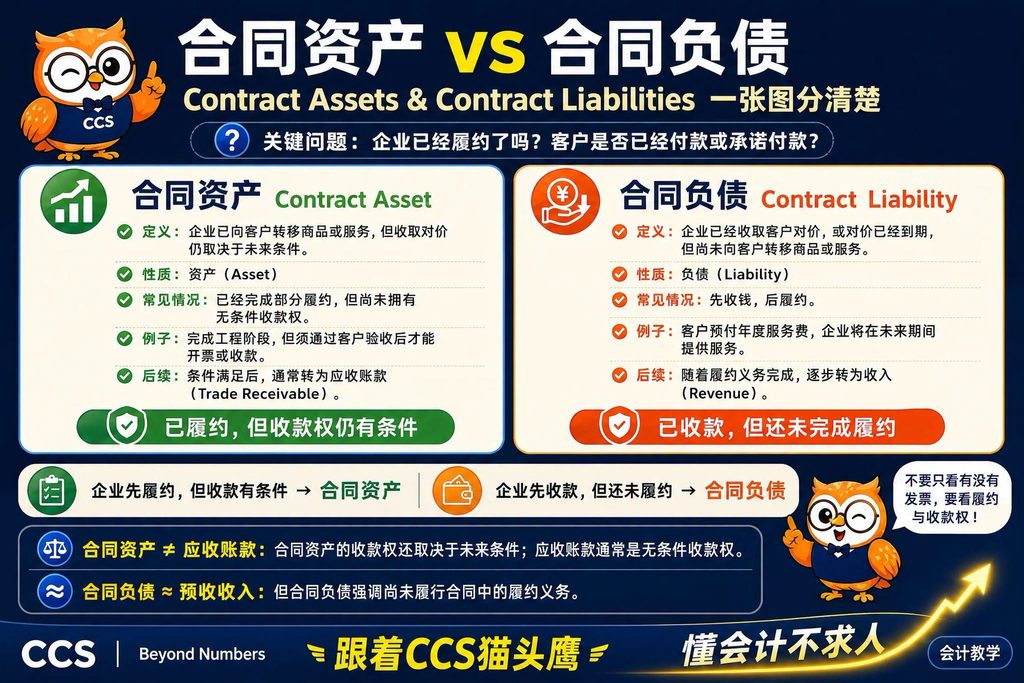
Contract assets and contract liabilities represent two situations in which a transaction has not yet been fully completed, but accounting recognition is already required.
A simple way to remember the difference is:
- Contract asset: I have performed part of the work, but I do not yet have an unconditional right to receive payment.
- Contract liability: I have received payment in advance, but I have not yet completed the work.
1. Contract Asset: Performing First, Subject to a Condition Before Payment
Imagine that you have undertaken a renovation project.
You have completed 80% of the work for your client. The walls have been painted and the flooring has been installed. However, the contract provides that you may only issue an invoice and receive payment after the client has approved the completed work.
At this point, you have already provided the service and are likely to receive payment in the future. However, your right to receive payment is still subject to a condition — the client’s approval.
Therefore, the accounting position is:
“The client owes me payment, but I must first satisfy the approval condition.”
This is a contract asset.
Simple rule: Perform first, receive payment later; the right to receive payment is still conditional = contract asset.
Common examples include work performed under staged construction contracts, long-term projects, milestone-based services, and work that has been completed but cannot be invoiced until it has been approved.
2. Contract Liability: Receiving Payment First, Performing Later
Now consider another example.
You operate an online course company. A customer pays RM1,200 upfront for a one-year membership.
The money has already been received, but you are still required to provide courses and services over the next 12 months.
The RM1,200 cannot immediately be recognised entirely as revenue because you have not yet fulfilled all of your performance obligations.
Therefore, the accounting position is:
“I have received the money, but I still owe the customer the services.”
This is a contract liability, which is commonly reflected in practice as advance receipts or deferred revenue.
Simple rule: Receive payment first, perform later; the service has not yet been completed = contract liability.
Common examples include advance receipts for annual services, subscription fees received in advance, customer prepayments, and deposits received before the related products or services have been delivered.
A Quick Comparison
| Situation | Accounting treatment |
|---|---|
| The work has been performed, but payment remains subject to client approval or another condition | Contract asset — the business has an asset, which will generally be reclassified as a trade receivable once the condition is satisfied |
| Payment has been received, but the service has not yet been completed or the goods have not yet been delivered | Contract liability — the business has an obligation, which is gradually recognised as revenue when the performance obligation is fulfilled |
根据 MFRS 15 理解合同资产与合同负债
合同资产和合同负债,可以理解为交易尚未完全完成,但会计上已经需要先行确认的两种状态。
可以先记住以下两句话:
- **合同资产:**我已经完成了一部分工作,但还没有无条件收取款项的权利。
- **合同负债:**我已经先收到款项,但还没有完成相关工作。
1. 合同资产:先履约,收款仍取决于条件
想象你接了一份装修工程。
你已经为客户完成了 80% 的工程,墙也刷好了,地板也铺好了。然而,合同规定,必须等客户验收通过后,你才可以正式开票和收款。
在这个时候,你已经提供了服务,未来也很可能可以收取款项。不过,你的收款权仍然取决于一个条件——客户验收。
因此,会计上的情况是:
“客户欠我款项,但我必须先满足验收条件。”
这就是合同资产(Contract Asset)。
**简单口诀:**先履约,后收钱;收款权仍然附带条件 = 合同资产。
常见例子包括分阶段进行的工程、长期项目、按里程碑收款的服务,以及已经完成但必须通过验收后才能开票的工作。
2. 合同负债:先收钱,后履约
现在换一个例子。
你经营一家线上课程公司。客户先支付 RM1,200,购买一整年的会员服务。
虽然款项已经进入银行账户,但你在未来 12 个月内仍然必须持续提供课程和相关服务。
这 RM1,200 不能马上全部确认为收入,因为你还没有完成全部履约义务。
因此,会计上的情况是:
“钱已经收到了,但我还欠客户服务。”
这就是合同负债(Contract Liability)。在日常业务中,合同负债通常也会体现为预收收入或递延收入。
**简单口诀:**先收钱,后做事;服务尚未完成 = 合同负债。
常见例子包括预收年度服务费、预收订阅费、客户预付款,以及在产品或服务尚未交付前收到的定金。
一张表快速分清楚
| 情况 | 会计处理 |
|---|---|
| 企业已经完成工作,但收款仍取决于客户验收或其他条件 | 合同资产——企业拥有一项资产;条件满足后,通常会转为应收账款 |
| 企业已经收到款项,但尚未完成服务或交付商品 | 合同负债——企业承担一项履约义务;完成履约义务后,逐步转为收入 |