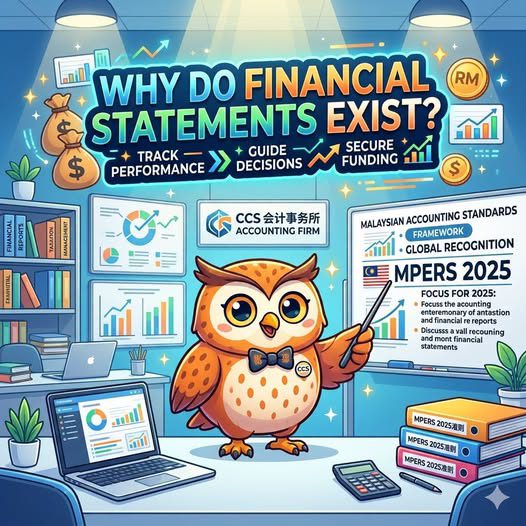
Financial statements exist to provide financial information that is useful to investors, lenders and creditors when they decide whether to provide resources to an entity.
This is one of the most important principles in MPERS.
Financial statements are decision-making tools. They are not prepared solely:
- For auditors;
- For tax agents;
- To satisfy the requirements of the Companies Commission of Malaysia (SSM); or
- For banks.
They help users assess whether they should provide funds, credit or other resources to a business.
For example:
- A bank may ask, “Should we lend RM5 million?” It will review the company’s financial statements.
- An investor may ask, “Should I invest in this business?” The investor will study its financial position and performance.
- A supplier may ask, “Should we grant 90 days’ credit?” The supplier may assess the company’s ability to pay by reviewing its financial information.
Many business owners believe that financial statements are prepared only because SSM requires them.
SSM may impose statutory requirements, but the purpose of financial statements is much broader.
The real purpose of financial statements is to provide useful information for economic decision-making.
CCS | Beyond Numbers
财务报表为何存在?协助使用者作出更好的经济决策
财务报表的目标,是为投资者、贷款人及债权人提供有用的财务信息,协助他们判断是否应向企业提供资金、信贷或其他资源。
这是 MPERS 中非常重要的一项基本原则。
财务报表是帮助使用者作出决策的工具,并不是单纯为了:
- 满足审计师的要求;
- 满足税务代理人的要求;
- 满足马来西亚公司委员会(SSM)的法定要求;或
- 只满足银行的需要。
财务报表可以帮助使用者评估是否应该向企业提供资金、信贷或其他资源。
例如:
- 银行可能会问:“我们是否应该贷款 RM5 million?”银行会审阅企业的财务报表。
- 投资者可能会问:“我是否应该投资这家公司?”投资者会研究企业的财务状况及经营表现。
- 供应商可能会问:“我们是否应该给予 90 天的信用期?”供应商可能会通过财务资料评估企业的偿债能力。
许多企业主以为,编制财务报表只是因为 SSM 有要求。
SSM 可能确实规定企业必须履行相关法定义务,但财务报表的目的远不止于此。
财务报表真正的目的,是提供有用的信息,协助使用者作出经济决策。
CCS | Beyond Numbers