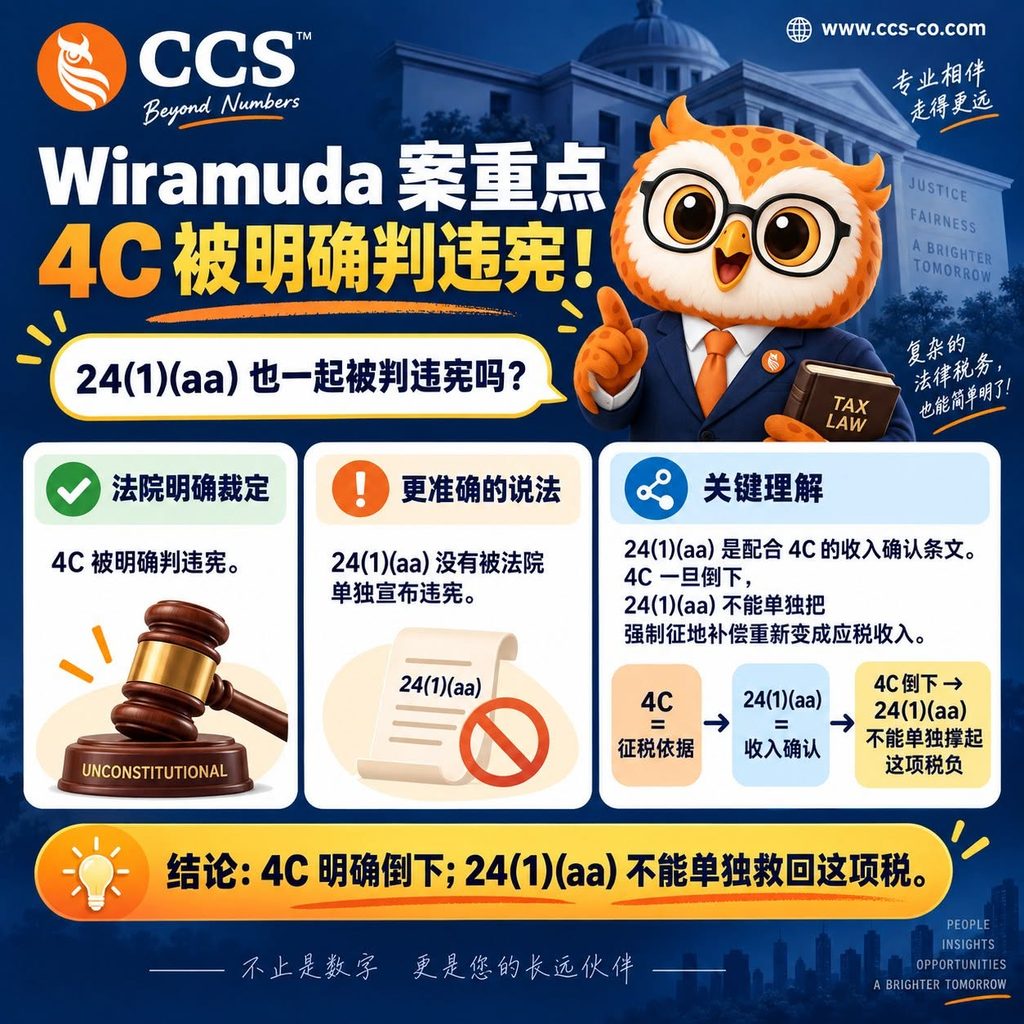
The Federal Court expressly declared Section 4C unconstitutional in its judgment in Wiramuda.
Section 4C treats compensation received as a result of compulsory acquisition as business gains or profits. Section 24(1)(aa), in turn, provides that a debt arising from the compulsory disposal of stock-in-trade is treated as gross income in the relevant basis period.
Both provisions were introduced through the Finance Act 2014. More importantly, the explanatory statement to the Finance Bill at the time expressly stated that the new Section 24(1)(aa) was introduced “as a consequence of the introduction of a new section 4C”.
However, the Federal Court ultimately focused its determination on Question (ii):
Whether Section 4C was unconstitutional for depriving a person of adequate compensation under Article 13(2) of the Federal Constitution.
The Federal Court’s conclusion was clear:
“Section 4C is thus unconstitutional and liable to be struck down.”
The judgment did not separately state in its conclusion:
“Section 24(1)(aa) is also unconstitutional and struck down.”
Accordingly, based on the wording of the judgment, it would not be accurate to state that the Federal Court expressly struck down Section 24(1)(aa) itself.
From a tax perspective, however, the relationship between the two provisions is significant.
Section 4C addresses why the compensation is taxable. It provides that:
Compensation arising from compulsory acquisition is treated as business gains or profits.
Section 24(1)(aa) addresses the basis period in which the amount is recognised as income. It provides that, where a debt owing arises as a result, the amount is treated as gross income in the relevant basis period.
In that sense, Section 4C is the engine, while Section 24(1)(aa) is the transmission. Once the Federal Court has held that the engine is unconstitutional and liable to be struck down, the transmission cannot operate the vehicle on its own.
In other words, in relation to the compulsory acquisition compensation considered in Wiramuda, Section 24(1)(aa) cannot independently recreate a tax charge that has been held unconstitutional under Section 4C.
Section 24 is, in substance, a gross-income timing and recognition mechanism. It is not an independent charging provision.
This also explains why, although Wiramuda noted that the assessments had been made under Sections 4C and 24(1)(aa), the Federal Court’s substantive challenge was directed at the deeming effect of Section 4C—namely, the treatment of compensation as profit or gain.
There is also an interesting current position. In the statutory materials publicly available from HASiL, the wording of Section 24(1)(aa) remains visible, and the official consolidated version of the Income Tax Act continues to list the provision.
In other words, the fact that a provision remains printed in the Act is not the same as saying that it can, in the Wiramuda circumstances, produce an effective tax outcome.
In summary, Section 4C was expressly declared unconstitutional, whereas Section 24(1)(aa) was not separately declared unconstitutional by the Court.
However, Section 24(1)(aa) is an income-recognition provision intended to operate together with Section 4C. Once Section 4C falls, Section 24(1)(aa) cannot independently convert compulsory acquisition compensation into taxable income.
Wiramuda 判词下第 4C 条与第 24(1)(aa) 条的宪法地位
Federal Court 在 Wiramuda 判词中,已明确宣告第 4C 条违宪。
第 4C 条把因 compulsory acquisition 而取得的 compensation 视为 business gains 或 profits;第 24(1)(aa) 条则进一步规定,因强制处置 stock-in-trade 而产生的 debt,应在相关 basis period 作为 gross income。
这两项条文都是通过 Finance Act 2014 同时引入的。更关键的是,当年的 Finance Bill explanatory statement 明确说明,新增第 24(1)(aa) 条是 “as a consequence of the introduction of a new section 4C”。
不过,Federal Court 最终集中裁定的是 Question (ii):
第 4C 条是否因剥夺 Article 13(2) 所保障的 adequate compensation,而构成违宪。
Federal Court 的结论非常明确:
“Section 4C is thus unconstitutional and liable to be struck down.”
然而,判词在结论部分并没有另外写明:
“Section 24(1)(aa) is also unconstitutional and struck down.”
因此,从判决文字来看,不能准确地说 Federal Court 已明确把第 24(1)(aa) 条本身也宣告违宪并予以 strike down。
但从税务层面来看,这两项条文之间的关系相当重要。
第 4C 条处理的是为什么该项补偿需要征税。它规定:
Compulsory acquisition compensation 应被视为 business gains 或 profits。
第 24(1)(aa) 条处理的是该项收入应在哪一个期间确认。它规定,如果因此产生 debt owing,就应在有关 basis period 把该金额视为 gross income。
因此,可以这样理解:
第 4C 条是发动机;第 24(1)(aa) 条是变速箱。
当 Federal Court 已裁定发动机违宪并 liable to be struck down 后,变速箱本身不能独立让整辆车运行。
换句话说,就 Wiramuda 所涉及的 compulsory acquisition compensation 而言,第 24(1)(aa) 条不能单独重新创造一个已经被裁定为源自第 4C 条、且属违宪的 tax charge。
第 24 条本质上属于 gross-income timing and recognition machinery,即收入总额的时间及确认机制,并不是一项独立的 charging provision。
这也解释了为什么,虽然 Wiramuda 提到有关 assessments 是根据第 4C 条及第 24(1)(aa) 条作出,但 Federal Court 真正所审查和否定的是第 4C 条的 substantive deeming effect——也就是把 compensation 视为 profit 或 gain。
目前还有一个值得注意的情况。在 HASiL 现有公开的 statutory materials 中,第 24(1)(aa) 条的文字仍然可见,而官方 consolidated version of the Income Tax Act 也仍然列示该条文。
换句话说,一项条文“仍然印在 Act 里面”,与该条文“在 Wiramuda 所涉及的情形下能够有效产生税务结果”,是两回事。
总结而言,第 4C 条已被明确宣告违宪;但第 24(1)(aa) 条并没有被法院单独宣告违宪。
不过,第 24(1)(aa) 条是配合第 4C 条运作的收入确认条文。在第 4C 条倒下后,第 24(1)(aa) 条不能单独把 compulsory acquisition compensation 重新转化为应税收入。