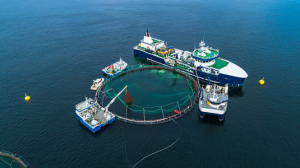
Certain food production projects, including the planting of vegetables, fruits, kenaf, herbs or spices; the rearing of cows, buffaloes, goats or sheep; and aquaculture and deep-sea fishing, are eligible for certain tax incentives, provided that applications were received by the Ministry of Agriculture and Food Security (MAFS) by December 31, 2022.
Tax incentives for food production projects are given under the:-
Income Tax (Deduction of Investment in New Food Production Project or Expansion Project) Rules 2020 [P.U.(A) 374]
Income Tax (Exemption) (No. 6) Order 2020 [P.U.(A) 373]
Income Tax (Deduction of Investment in New Food Production Project or Expansion Project) Rules 2020 [P.U.(A) 374]
An investment company that undertakes investment in a subsidiary company engaging in a new food production project is given a tax deduction equivalent to the amount of investment made in the basis year the investment is made; and
Income Tax (Exemption) (No. 6) Order 2020 [P.U.(A) 373]
A qualified person (which includes companies, sole proprietorships, partnerships and associations solely engaged in agriculture or fishery) that is resident in Malaysia and is engaging in food production projects is exempted from the payment of income tax in relation to:
A new project is given income tax exemption of 100% on statutory income for 10 years of assessment; or
An expansion project for an existing company is given an income tax exemption of 100% on statutory income for 5 years of assessment.
Planting of industrial crops, vegetables, fruits, herbs, spices and cash crops;
Aquaculture;
Rearing of honey and urena lobata bees;
Rearing of cows, buffaloes, goats, sheep and deer;
Deep-sea fishing; and
Planting of feed mill (cultivated in a project which has been identified by the Minister charged with the responsibility of that project and approved by the Minister)
In year 2021, the scope of the food production project was expanded to planting of seeds for agro-food and high seas fishing projects.
Expansion project
A project:
To expand the new project (as above)
Which involves a new area of land; and
Which is approved by the Minister
Proposal
To further promote the participation of industry players in the agriculture sector and to ensure the security of domestic food supply, it is proposed tax incentives be reviewed as follows:
scope of tax incentives is expanded to include agricultural-based projects on Controlled Environment Agriculture (CEA); and
the tax incentive is extended for 3 years.
Effective Date
For applications received by MAFS from 1 January 2023 until 31 December 2025
Our website's articles, templates, and material are solely for reference. Although we make every effort to keep the information up to date and accurate, we make no representations or warranties of any kind, either express or implied, regarding the website or the information, articles, templates, or related graphics that are contained on the website in terms of its completeness, accuracy, reliability, suitability, or availability. Therefore, any reliance on such information is strictly at your own risk.
Keep in touch with us so that you can receive timely updates |
“Bio Nexus Status Company” means a company incorporated under the Companies Act 2016 [Act 777] engaged in the life sciences business.
Tax incentives for BioNexus status companies are given as follows:
a company undertaking biotechnology activity and approved with BioNexus status:
Income Tax Exemption of 70% on statutory income commencing from the first statutory income for a period of 10 or 5 years, subject to new or existing business (expansion project);
concessionary tax rate of 20% on income from qualifying activities for 10 years upon the expiry of the tax exemption period;
Double Tax Deduction on research & development expenditure;
Industrial Building Allowance on building for biotechnology research activities; and
Import Duty Exemption on raw materials / components and machinery / equipment.
a company that undertakes investment in a BioNexus status subsidiary company engaging in a new project is given a tax deduction equivalent to the amount of investment made in the basis year the investment is made.
The tax incentive is for applications received by the Malaysian Bioeconomy Development Corporation from 1 January 2021 until 31 December 2022.
Proposal
To encourage more industry players, it is proposed tax incentives be reviewed as follows:
income tax exemption on statutory income be increased from 70% to 100%; and
the application period for tax incentives is extended for 2 years.
Effective Date
For applications received by the Malaysian Bioeconomy Development Corporation from 1 January 2023 until 31 December 2024.
Updated on 15 July 2023- Dialogue between MOF, LHDNM, and CTIM [21/6/2023]
BioNexus status companies also get an income tax exemption which is equivalent to the allowance based on 100% of qualifying capital expenditure (“QCE”), i.e. Investment Tax Allowance (“ITA”).
CTIM sought to confirm that the proposed two years application period extension applies to all tax incentives for BioNexus status companies, including the ITA and is not just restricted to the items listed in Appendix 19.
MOF’s Feedback:
Extending the 2-year application period applies to all tax incentives for BioNexus status companies, including the Investment Tax Allowance.
Disclaimer:
The articles, templates, and other materials on our website are provided only for your reference.
While we strive to ensure that the information presented is current and accurate, we cannot guarantee the completeness, reliability, suitability, or availability of the website or its content, including any related graphics. Consequently, any reliance on this information is entirely at your own risk.
If you intend to use the content of our videos and publications as a reference, we recommend that you take the following steps:
Verify that the information provided is current, accurate, and complete.
Seek additional professional opinions, as the scope and extent of each issue, may be unique.
Under the National Automotive Policy 2020 and the Low Carbon Mobility Blueprint 2021 – 2030, Malaysia is making significant strides toward developing an ecosystem for electric mobility.
The National Automotive Policy 2020 was launched on February 21, 2020, with the goal of improving the automotive industry during the digital industrial transformation era. Its focus is on Next-Generation Vehicles (NxGV), Industrial Revolution 4.0 (IR 4.0), and Mobility-as-a-Service (MaaS) to position Malaysia as a regional leader in manufacturing, engineering, and technology.
The policy builds upon the objectives of the NAP 2014, which aimed to establish Malaysia as a hub for Energy Efficient Vehicles (EEV) through research and development capabilities for right-hand drive vehicles and related technologies such as fuel efficiency, light materials, telematics, tooling, and component design. To widen the infrastructure network of charging equipment, it is vital to ensure that the product can be produced locally at competitive cost.
Proposal
It is proposed that the following tax incentives be offered to better complement the ecosystem for electric vehicles and to attract immediate high-value investment in the manufacturing of electric vehicle charging equipment.
income tax exemption of 100% on statutory income from the year of assessment 2023 to the year of assessment 2032. Companies that make early investments are eligible to enjoy tax exemption for a period up to 10 years. Thus, companies that make investments after the year of assessment 2023 are eligible to enjoy the remaining exemption period only; or
Investment Tax Allowance of 100% for 5 years, and it can be used to offset up to 100% of statutory income for each year of assessment.
Effective Date
For applications received by the Malaysian Investment Development Authority (MIDA) from 25 February 2023 until 31 December 2025.
Our website's articles, templates, and material are solely for reference. Although we make every effort to keep the information up to date and accurate, we make no representations or warranties of any kind, either express or implied, regarding the website or the information, articles, templates, or related graphics that are contained on the website in terms of its completeness, accuracy, reliability, suitability, or availability. Any reliance on such information is therefore strictly at your own risk.
Keep in touch with us so that you can receive timely updates |
Malaysia plans to reach its Low Carbon Nation Aspiration by 2040, part of its National Energy Policy 2022–2040.
The government has devised a plan to control CO2 emissions using Carbon Capture and Storage Technology (CCS) to reach this goal.
In Malaysia, the oil and gas and power generation industries are seen as the first ones to use CCS technology.
This technology comprises of 3 activities as follows:
carbon capture;
transportation of captured CO2; and
underground or sea bed carbon storage.
Proposal
To recognise CCS activities as a new source of economic growth and to achieve net zero greenhouse gas emissions, it is proposed tax incentives be given as follows:
i. companies undertaking CCS in-house activity
Investment Tax Allowance (ITA) of 100% of qualifying capital expenditure for a period of 10 years and can be set off against up to 100% of business statutory income;
full import duty and sales tax exemption on equipment for CCS technology commencing from 1 January 2023 until 31 December 2027; and
tax deduction for allowable pre-commencement expenses within 5 years before the date of commencement of operation.
ii. companies undertaking CCS services
ITA of 100% of qualifying capital expenditure for a period of 10 years and can be set off against up to 100% of statutory income; or
tax exemption of 70% on statutory income for a period of 10 years; and
full import duty and sales tax exemption on equipment for CCS technology starting 1 January 2023 until 31 December 2027.
iii. companies engaging in CCS services are to be given tax deductions on fees incurred for using CCS services.
Effective Date
For applications received by the Ministry of Finance from 25 February 2023 until 31 December 2027.
The tax deduction can be claimed through the Income Tax Return Form from the year of assessment 2023 until 2027.
Updated on 15 July 2023- Dialogue between MOF, LHDNM, and CTIM [21/6/2023]
In Budget 2023, the Government proposed the introduction of a raft of tax incentives for carbon capture and storage (“CCS”).
CTIM believed the Government intends for these tax incentives to be available for a broad range of CCS applications across different industrial subsectors (e.g. oil & gas, concrete, plastics, etc.). CTIM sought confirmation.
MOF’s Feedback:
As an introduction to the incentive, the government plans to provide incentives to companies/businesses engaged in carbon capture and compression activities, converting it into liquid form and subsequently storing it through injection methods into geological reservoirs at the seabed using carbon capture and storage (CCS) technology.
With regard to the proposed tax deduction for allowable pre-commencement expenses incurred by Companies undertaking CCS in-house activity within five years from the date of commencement of operation, CTIM sought clarification on the following:
What types of allowable pre-commencement expenses did the Government envisage when proposing this?
Whether the date of commencement of operation refers to the date of commencement of the operation of such company (i.e. new company) or the date of commencement of CCS in-house activity? If the latter, please clarify why this is considered a pre-commencement expense, given that the company would already have commenced operation and is already generating income.
Please clarify if this should also be extended to companies undertaking CCS services.
MOF’s Feedback:
Details of allowable pre-operational expenses and the commencement date of operations will be issued in a detailed guideline that will be published for general reference in the near future.
MOF is currently in the process of specifying the relevant details.
Presently, pre-operational expenses only apply to companies engaged in carbon capture and storage activities.
With regard to the proposed tax deduction on fees incurred for the use of CCS services, CTIM sought clarification on the following:
Please confirm this deduction is meant to be a further deduction.
Whether this is subject to the application received by MOF from 25 February 2023 until 31 December 2027?
Is tax deduction limited to fees incurred from 25 February 2023 until 31 December 2027?
LHDNM’s Feedback:
This incentive will be explained in detail in the guidelines that will be issued for general reference in the near future.
MOF is currently in the process of specifying the relevant details.
Investment tax allowance for qualifying capital expenditure:
Whether MOF or IRB will issue a list of CCS technologies that qualify for the incentive?
How will the MOF determine the effective date for a chargeable person to qualify for the incentive?
MOF’s Feedback:
Detailed information on the list of CCS technologies and the effective date for eligible taxpayers to qualify for this incentive will be provided in the guidelines that will be issued for general reference in the near future.
MOF is currently in the process of specifying the relevant details.
Which will be the qualifying person for the tax exemption? (e.g. Identified companies/operators or entities authorised by relevant approving authority)
LHDNM’s Feedback:
This incentive will be explained in detail in the guidelines that will be issued for general reference in the near future.
MOF is currently in the process of specifying the relevant details.
If a company undertakes “carbon capture” in-house activity and also subscribed to “carbon storage” services from external parties, would the company be eligible for both CCS incentives under proposal items (i) and also (iii) of Appendix 16 to the Budget Speech?
LHDNM’s Feedback:
This incentive will be explained in detail in the guidelines that will be issued for general reference in the near future.
MOF is currently in the process of specifying the relevant details.
CTIM would like to confirm which Government authority will be the governing body for CCS activities.
MOF’s Feedback:
Details of the administering body for CCS activities will be finalised and explained in detail in the guidelines that will be issued for general reference in the near future.
MOF is currently in the process of specifying the relevant details.
It was also mentioned in Appendix 16 that tax deduction can be claimed through the Income Tax Return Form (“ITRF”) from YA 2023 until YA 2027.
CTIM urged the Authorities to extend the period to YA 2028 to cater for companies that are having a basis period ending on a date other than 31 December.
LHDNM’s Feedback:
This incentive will be explained in detail in the guidelines that will be issued for general reference in the near future.
MOF is currently in the process of specifying the relevant details.
Disclaimer:
The articles, templates, and other materials on our website are provided only for your reference.
While we strive to ensure that the information presented is current and accurate, we cannot guarantee the completeness, reliability, suitability, or availability of the website or its content, including any related graphics. Consequently, any reliance on this information is entirely at your own risk.
If you intend to use the content of our videos and publications as a reference, we recommend that you take the following steps:
Verify that the information provided is current, accurate, and complete.
Seek additional professional opinions, as the scope and extent of each issue, may be unique.
RA was extended to the agricultural sector to encourage local food production and thus increase its supply.
In Budget 2003, chicken and duck farmers who switched from an open house system to a closed house system were given Reinvestment Allowance (RA) for 15 consecutive years.
The RA is given on 60% of qualifying capital expenditure incurred and is allowed to be set off against 70% (100% for promoted areas) of statutory income.
For YAs 2009 and 2010, chicken and duck rearers who reinvest to expand the closed house system in existing or new locations approved by the Ministry of Agriculture and Agro-based Industry are given incentives as follows:
projects located in the promoted areas are eligible for RA of 60% on qualifying capital expenditure to be set off against 100% of the statutory income, and
projects located outside the promoted areas are eligible for RA of 60% on qualifying capital expenditure to be set off against 70% of the statutory income.
Proposal
To encourage more chicken rearers to adopt an environmental-friendly closed house system, it is proposed tax incentives be given as follows:
Accelerated Capital Allowance (ACA) 100% on the qualifying capital expenditure; and
Income Tax Exemption of 100% equivalent to the qualifying capital expenditure.
These tax incentives are given on the Qualifying Capital Expenditure incurred from the year of assessment 2023 until the year of assessment 2025 and are to be fully absorbed within a year.
Effective Date
From the year of assessment 2023 until the year of assessment 2025.
Our website's articles, templates, and material are solely for reference. Although we make every effort to keep the information up to date and accurate, we make no representations or warranties of any kind, either express or implied, regarding the website or the information, articles, templates, or related graphics that are contained on the website in terms of its completeness, accuracy, reliability, suitability, or availability. Any reliance on such information is, therefore strictly at your own risk.
Keep in touch with us so that you can receive timely updates |
On 23 December 2022, the IRB released PR No. 7/2022 on Venture Capital Tax Incentives, which replaces the previously issued PR No. 2/2016 from 9 May 2016.
The new 17-page PR contains the following contents and includes six examples:-
Objective
Related provisions of the law
Interpretation
Venture capital industry in Malaysia
Regulatory framework for the venture capital industry
Tax exemption incentive for a venture capital company (VCC) investing in a venture company (VC)
Tax deduction incentive for an individual or a company investing in a VC or VCC
Mutually exclusive
Tax incentive for a venture capital management company (VCMC)
Application for certification of investment for tax exemption and tax deduction in a VC and VCC
Updates and amendments
Disclaimer
The newly published PR No. 7/2022 is mainly similar to PR No. 2/2016. It provides an overview of the tax incentives offered to the venture capital industry in Malaysia.
It explains and provides examples of the new P.U. Orders gazetted in 2022, which involve the provision of early-stage financial capital to start-up VCs with high potential but also higher risk.
VCCs are companies established to raise funds in the form of equity or loan capital, which is then invested in the VC as seed capital, start-up, or early-stage financing.
VCMCs manage these investments on behalf of VCCs at different life cycle stages.
Relevant subsidiary laws referred to in this PR are as follows:
1. Income Tax (Exemption) (No. 2) Order 2022 [P.U.(A) 115/2022]
2. Income Tax (Exemption) (No. 3) Order 2022 [P.U.(A) 116/2022]
3. Income Tax (Deduction for Investment in a Venture Company or Venture Capital Company) Rules 2022 [P.U.(A) 117/2022]
Regulatory Framework for the Venture Capital Industry
The new PR also stipulates that SCM has been entrusted with assessing and certifying applications for tax incentives for the venture capital industry under the relevant Income Tax Rules and Income Tax (Exemption) Orders.
SCM has issued the following:
the Guidelines on the Registration of VC and Private Equity Corporations and Management Corporations (revised on 28 November 2022); and
the Venture Capital Tax Incentives Guidelines (revised on 28 November 2022),
which are available from the SCM’s website at www.sc.com.my.
Reference
1. Public Ruling No. 7/2022: Venture Capital Tax Incentives
We put a lot of emphasis on ensuring that our team members enjoy a balanced life outside work.
Hence, our firm’s Sports and Social Committee is responsible for actively organising an exciting variety of events, such as the Annual Dinner, Annual Trips and Inter-accounting Firm Tournament.
These events are planned so that our professionals can take some time off to relax and, more importantly, come together to strengthen their sense of community and teamwork.
This year’s Inter-Accounting Firm Tournament will be held on February 25 and 26, 2023 (Saturday and Sunday). We welcome your support!
Our website's articles, templates, and material are solely for you to look over. Although we make every effort to keep the information up to date and accurate, we make no representations or warranties of any kind, either express or implied, regarding the website or the information, articles, templates, or related graphics that are contained on the website in terms of its completeness, accuracy, reliability, suitability, or availability. Therefore, any reliance on such information is strictly at your own risk.
Keep in touch with us so that you can receive timely updates |
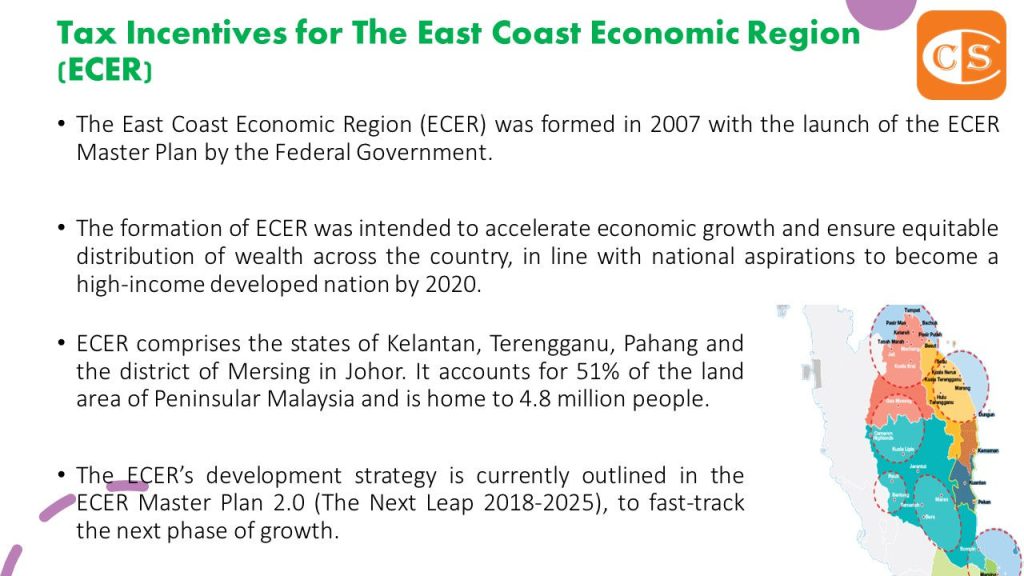
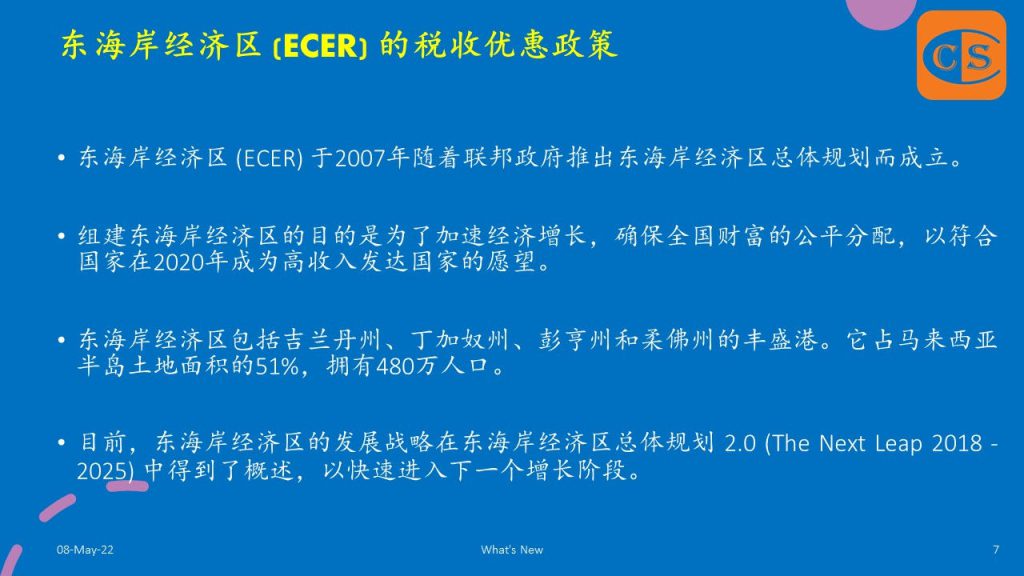
1. The East Coast Economic Region (ECER) was formed in 2007 with the launch of the ECER Master Plan by the Federal Government.
2. The formation of ECER was intended to accelerate economic growth and ensure equitable distribution of wealth across the country, in line with national aspirations to become a high-income developed nation by 2020.
3. As a result, the government has provided tax incentives for the ECER
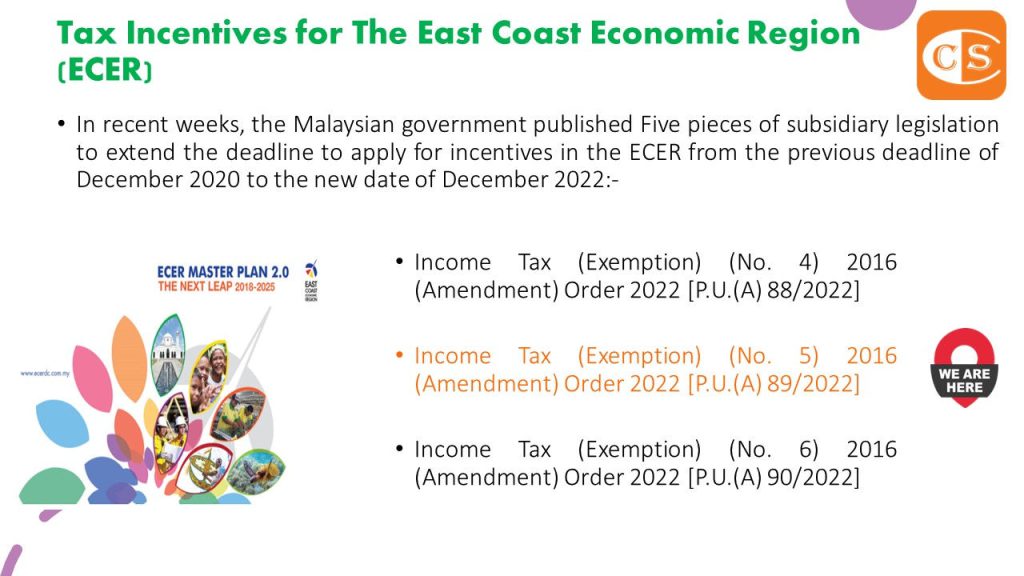
4. In recent weeks, the Malaysian government published Five pieces of subsidiary legislation to extend the deadline to apply for incentives in the ECER from the previous deadline of December 2020 to the new date of December 2022:-
👉 Income Tax (Exemption) (No. 4) 2016 (Amendment) Order 2022 [P.U.(A) 88/2022]
👉 Income Tax (Exemption) (No. 5) 2016 (Amendment) Order 2022 [P.U.(A) 89/2022]
👉 Income Tax (Exemption) (No. 6) 2016 (Amendment) Order 2022 [P.U.(A) 90/2022]
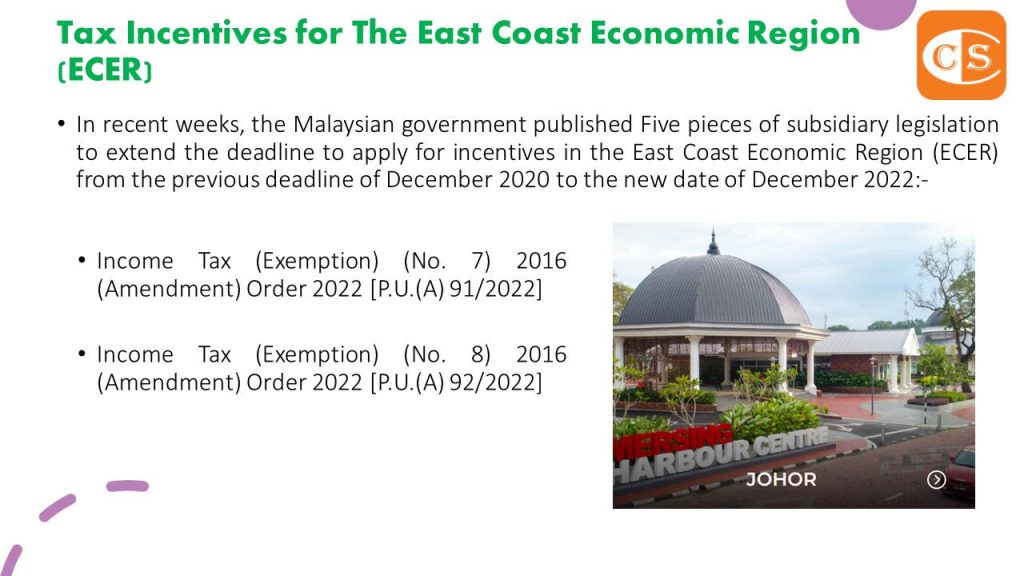
👉 Income Tax (Exemption) (No. 7) 2016 (Amendment) Order 2022 [P.U.(A) 91/2022]
👉 Income Tax (Exemption) (No. 8) 2016 (Amendment) Order 2022 [P.U.(A) 92/2022]
5. Income Tax (Exemption) (No. 8) Order 2016 (‘P.U.(A) 161/2016’) exempts an approved developer from paying income tax for ten consecutive years on statutory income derived from:
👉 The disposal of any right over any land or the disposal of a building or right over a building or part of a building located in an industrial zone or a free zone; or
👉 The rental of a building or part of a building located in an industrial zone.
1. The East Coast Economic Region (ECER) was formed in 2007 with the launch of the ECER Master Plan by the Federal Government.
2. The formation of ECER was intended to accelerate economic growth and ensure equitable distribution of wealth across the country, in line with national aspirations to become a high-income developed nation by 2020.
3. As a result, the government has provided tax incentives for the ECER
4. In recent weeks, the Malaysian government published Five pieces of subsidiary legislation to extend the deadline to apply for incentives in the ECER from the previous deadline of December 2020 to the new date of December 2022:-
👉 Income Tax (Exemption) (No. 4) 2016 (Amendment) Order 2022 [P.U.(A) 88/2022]
👉 Income Tax (Exemption) (No. 5) 2016 (Amendment) Order 2022 [P.U.(A) 89/2022]
👉 Income Tax (Exemption) (No. 6) 2016 (Amendment) Order 2022 [P.U.(A) 90/2022]
👉 Income Tax (Exemption) (No. 7) 2016 (Amendment) Order 2022 [P.U.(A) 91/2022]
👉 Income Tax (Exemption) (No. 8) 2016 (Amendment) Order 2022 [P.U.(A) 92/2022]
5. In accordance with paragraphs 5A and 6 of The Income Tax (Exemption) (No. 7) Order 2016 (P.U.(A) 160/2016 (*)), a qualifying person is exempt from payment of income tax on statutory income derived from a special qualifying activity at the rate of not less than 70% and not more than 100% as specified by the Minister for a period of consecutive years of assessment as the Minister may determine.
(*) As amended by the Income Tax (Exemption) (No. 7) 2016 (Amendment) Order 2018 [P.U.(A) 394/2018]
1. The East Coast Economic Region (ECER) was formed in 2007 with the launch of the ECER Master Plan by the Federal Government.2. The formation of ECER was intended to accelerate economic growth and ensure equitable distribution of wealth across the country, in line with national aspirations to become a high-income developed nation by 2020.
3. As a result, the government has provided tax incentives for the ECER
4. In recent weeks, the Malaysian government published Five pieces of subsidiary legislation to extend the deadline to apply for incentives in the ECER from the previous deadline of December 2020 to the new date of December 2022:-
👉 Income Tax (Exemption) (No. 4) 2016 (Amendment) Order 2022 [P.U.(A) 88/2022]
👉 Income Tax (Exemption) (No. 5) 2016 (Amendment) Order 2022 [P.U.(A) 89/2022]
👉 Income Tax (Exemption) (No. 6) 2016 (Amendment) Order 2022 [P.U.(A) 90/2022]
👉 Income Tax (Exemption) (No. 7) 2016 (Amendment) Order 2022 [P.U.(A) 91/2022]
👉 Income Tax (Exemption) (No. 8) 2016 (Amendment) Order 2022 [P.U.(A) 92/2022]
5. Under the Income Tax (Exemption) (No. 5) Order 2016 (‘P.U.(A) 158/2016’), a qualifying person is exempted from paying income tax on statutory income derived from a special qualifying activity that is equal to the rate of allowance specified by the Minister, which shall not be less than 60% and not more than 100% of the qualifying capital expenditure incurred by the qualifying person for such period of consecutive years as the Minister may determine.
1. The East Coast Economic Region (ECER) was formed in 2007 with the launch of the ECER Master Plan by the Federal Government.
2. The formation of ECER was intended to accelerate economic growth and ensure equitable distribution of wealth across the country, in line with national aspirations to become a high-income developed nation by 2020.
3. As a result, the government has provided tax incentives for the ECER
4. In recent weeks, the Malaysian government published Five pieces of subsidiary legislation to extend the deadline to apply for incentives in the ECER from the previous deadline of December 2020 to the new date of December 2022:-
👉 Income Tax (Exemption) (No. 4) 2016 (Amendment) Order 2022 [P.U.(A) 88/2022]
👉 Income Tax (Exemption) (No. 5) 2016 (Amendment) Order 2022 [P.U.(A) 89/2022]
👉 Income Tax (Exemption) (No. 6) 2016 (Amendment) Order 2022 [P.U.(A) 90/2022]
👉 Income Tax (Exemption) (No. 7) 2016 (Amendment) Order 2022 [P.U.(A) 91/2022]
👉 Income Tax (Exemption) (No. 8) 2016 (Amendment) Order 2022 [P.U.(A) 92/2022]
5. A qualifying person is exempt from paying income tax for ten consecutive years on statutory income derived from a qualifying activity under the Income Tax (Exemption) (No. 6) Order 2016 (‘P.U.(A) 159/2016’), provided that the provisions of paragraphs 5A and 6 of P.U.(A) 159/2016 are adhered to, and the qualifying activity is carried out in The East Coast Economic Region (ECER)