A “Due Inquiry” or “Domestic Inquiry” is one of the processes that must be carried out before dismissal for misconduct can be justified, as required by section 14(1)(a) of the Employment Act 1955.
This procedure must be carried out before the dismissal can be justified.
When wrongdoing is alleged to have been committed by an employee, this provision’s goal is to ensure that the concept of Natural Justice, which states that the employee has the right to be heard, is upheld through a thorough investigation.
Domestic Inquiry
A domestic inquiry, also known as a “DI,” is an internal investigation procedure carried out by an employer to investigate an employee’s behaviour while on employment, specifically to determine whether or not the person has committed an act of misconduct.
The DI is a procedure that allows the allegedly guilty employee to respond to the allegations that have been made against him.
However, section 14(1) of the Employment Act 1955 does not define and does not define or clarify what constitutes “due inquiry” or how an investigation has to be carried out.
Practical Questions
Then,
Does this imply that the employer must carry out an official DI before dismissing an employee for misconduct?
What repercussions will this have for the employer if an employee files a complaint against his employer for unfair dismissal because the employer did not conduct a DI?
Gissco Sdn Bhd vs Jagjit Singh Mahinder Singh
In Gissco Sdn Bhd vs Jagjit Singh Mahinder Singh (Award No: 13 of 1988), the Claimant is dissatisfied and seeks to refer the following question to the High Court:
Does the Industrial Court have jurisdiction to ignore provisions making it mandatory to hold an inquiry under the Employment Act 1955 in making an award under Section 30 of the Industrial Relations Act 1967?
Can the Industrial Court conclude that the Claimant was dismissed with just cause and excuse in the absence of an inquiry?
The Evaluation Of Evidence And Findings
The late Fong Seng Yee, the then president of the Industrial Court, observed that:
The absence of a domestic inquiry or the presence of a defective domestic inquiry is not a fatality but merely an irregularity.
It is open to the company to justify its action before the tribunal [the Industrial Court] by leading all relevant evidence before it and by having the entire matter open before the tribunal.
Unless the Industrial Court has found that the dismissal was without just cause or excuse, the Industrial Court has no jurisdiction to offer any relief
Conclusion
The absence of an inquiry is not fatal to the Company’s case.
Simply put, employers do not necessarily have to carry out a formal DI.
Our website's articles, templates, and material are solely for reference. Although we make every effort to keep the information up to date and accurate, we make no representations or warranties of any kind, either express or implied, regarding the website or the information, articles, templates, or related graphics that are contained on the website in terms of its completeness, accuracy, reliability, suitability, or availability. Therefore, any reliance on such information is strictly at your own risk.
Keep in touch with us so that you can receive timely updates |
Harapan R Sdn. Bhd. vs. RY Jabatan Perhubungan Perusahaan 7 October 1997
The parties to the dispute are Harapan R Sdn. Bhd. (hereinafter referred to as ‘the company’) and Encik RY (hereinafter referred to as ‘the claimant‘).
The dispute is over the claimant’s dismissal by the company on 5 April 1994.
The claimant contends that the dismissal was without just cause or excuse and prays for reinstatement to his former position without loss of benefits.
争议双方是 Harapan R Sdn. Bhd.(以下简称’公司‘)和 Encik RY(以下简称’申诉人‘)。
争议是关于1994年4月5日,申诉人被公司解雇的问题。
申诉人辩称,解雇是没有正当理由或借口的,并要求在不丧失福利下,恢复他以前的职位。
The Company
The company has adduced evidence before the Court to show that the claimant was absent from work without leave being approved on three separate occasions.
On each occasion, the claimant proceeded to go on leave despite being told his application for leave had not been approved.
The company had treated his absence from work as absence without leave, and on each occasion, it issued a warning letter to the claimant.
The authority for approving leave applications was the executive director A, after the recommendation of supervisor B (the claimant’s immediate superior).
First Absence Without Leave
The claimant’s application for a leave commencing 14 November 1993 to 18 November 1993 had been sent to executive director A directly for approval. After discussing with supervisor B, and due to the exigency of service, he disapproved the application.
The claimant was duly informed by supervisor, B but he did not turn up for work from 14 November to 18 November 1993.
When the claimant was issued a show cause letter, he refused to acknowledge receipt.
Executive director A subsequently called the claimant to his office for an explanation, and the claimant did not give any explanation.
Second Absence Without Leave
The claimant again applied for leave from 25 February to 28 February 1994.
Executive director A approved two days out of the four days applied for and duly informed the claimant, but he did not return to work from 1 March 1994 to 5 March 1994.
When executive director A confronted the claimant after his return, the claimant said he had informed the telephone operator about his leave.
The managing director was briefed on this incident and decided to issue a second Show Cause Letter to the claimant, who did not give any explanation. A second Warning Letter was sent to him.
Third Absence Without Leave
The claimant again asked for leave from 16 March 1994 to 17 March 1994, and the leave was not approved by executive director A.
The claimant was informed of the refusal of his leave, but he, nevertheless, did not turn up for work from 16 March to 18 March 1994.
The claimant again refused to give any explanation and was issued a final warning letter.
The board of directors made a decision to dismiss the claimant, and a letter of dismissal dated 5 April 1994 was sent to the claimant.
The company contended that it had done more than required to be fair to the claimant before dismissing him.
The claimant
The claimant completely denied being absent without leave. He denied he had applied for leave on all three occasions. He denied the signature on the leave forms. He challenged the accuracy of the punch cards. The information brought out is that the company went out of its way to forge those documents produced as exhibits in Court and concocted the whole story to mislead the Court.
The claimant, however bizarrely, did not put his case on the authenticity of the leave forms when cross-examining the company’s witnesses. The claimant only cross-examined at great length and in minute detail the particulars contained in the leave forms, including whether the executive director was the proper authority to approve or disapprove leave in the company.
The claimant also complained that he was not given an opportunity to be heard by the company before the decision to dismiss him. This is a breach of his fundamental right guaranteed in s. 14 of the Employment Act 1955 .
The claimant further contended that there was no cogent evidence produced before the Court that the misconduct alleged was in fact, committed to justify the punishment of dismissal.
It is also the claimant’s contention that the company’s stand that it was unnecessary for a charge sheet to be given to the claimant for the reason of dismissal under s. 15(2) was a wrong statement of law. The law lays down the procedure for employer to impose disciplinary action after due inquiry.
The claimant in his testimony denied he had received the several warning letters and had no knowledge of their contents.
His defence is that he was framed for the three applications for leave on three separate occasions and his signature on the leave forms was forged.
申诉人在其证词中否认他收到过几封警告信,也不知道其内容。
他的辩护是,他是在三个不同的场合被陷害申请休假的,他在休假表上的签名是伪造的。
The Evaluation Of Evidence And Findings
It is true that in a dispute for unfair dismissal the burden is on the employer to prove the employee’s misconduct to justify its action of dismissal.
The Court has thoroughly scrutinised the documentary and oral evidence of the company as against that of the claimant’s and has come to the finding that the company has established its case against the claimant.
The company has adduced evidence to show that an employee had to fill up the application form for leave prior to going on leave and submitted it for approval by the executive director. That was a definite procedure for employees to apply for leave.
诚然,在不公平解雇的纠纷中,雇主有责任证明雇员的不当行为,以证明其解雇行为的合理性。
法庭彻底审查了公司的文件和口头证据与申诉人的证据,并得出结论,公司已经建立了针对申诉人的案件。
公司举出的证据显示,员工在休假前必须填写休假申请表并提交给执行董事批准。
这是员工申请休假的一个明确程序。
The Witnesses
The company called five witnesses to give evidence that the claimant was absent without leave on three occasions when his application for leave was rejected. The witnesses included two senior executives of the company, the managing director and the executive director besides the executive from the assignor of the quarry operation.
The claimant admitted in his evidence he had no problem working with executive director and had never walked out from his job. Three witnesses had personal knowledge of the claimant’s absence when they communicated with each other, when the claimant was absent, not one occasion but on all the three occasions.
Their evidence was not rebutted and their corroboration remained intact. The claimant’s forgery defence had failed miserably.
The claimant’s witness stated in evidence that the claimant was warned once orally and twice in writing for being absent without leave. One of the written warnings as follows:
Berhubung dengan perkara di atas, dimaklumkan bahawa RL k/p No. xxxxxxx telah tidak hadir bertugas pada 16 Mac, 1994 hingga 18 Mac, 1994 iaitu selama 3 hari.
2. Buat pengetahuan, amaran pertama dan amaran kedua pihak kami telahpun kemukakan tetapi tiada apa-apa tindakan dan perhatian yang diambil.
3. Saya berharap perkara ini dapat perhatian daripada pihak tuan. Segala kerjasama yang diberikan diucapkan terima kasih. Sekian.
Yang menjalankan tugas, signed … (MANAGING DIRECTOR) HARAPAN R SDN. BHD.
The claimant has not produced evidence to substantiate his allegation that his leave application forms and punch cards were forged.
The company had produced all the documents the claimant disputed before the Court and also had 5 witnesses to substantiate its allegation against the claimant.
Their evidence had withstood the cross examination by the claimant.
There is no reason for them to jointly concoct the story of absence without leave and to lie before this Court.
An employee’s entitlement to annual leave cannot be claimed as of right and he must obtain permission from his employer relieving him from duty of attending work. Unless the leave sought is granted, an employee cannot absent himself from duty and if he does, it is absence without leave, a fundamental breach of the employee’s contract of employment.
The claimant failed to obtain approval before proceeding on leave. The claimant, in fact, defiantly went against the company’s wishes when his leave was rejected, and went on leave. He did not only do it once but he did it 3 times.
The claimant could not justify his defiant attitude towards the question of his absence without leave. Therefore in his evidence before the Court he denied the whole affair. In the Court’s view this is an afterthought so clumsily presented and so untenable.
It is unthinkable to suggest that the managing director, the executive director, the supervisor and all those down the line conspired to get rid of the claimant who was just a driver by forging all the documents. Such a suggestion sounds hollow and unbelievable.
The conduct of the company towards the claimant has been one of extraordinary patience and forbearance.
The standard of fairness demonstrated by the company in this case far exceeds the reasonable standard expected of an employer before dismissing an employee for absence without leave.
The company had in fact bent backwards to accommodate the claimant but he went over the limit of tolerance.
He was absent without leave on three occasions and he also exceeded the leave he applied for by overstaying after his leave.
The claimant contends that the company failed to conduct an inquiry.
It is the opinion of the Court that the case of dismissal for misconduct is different from committing a fundamental breach of the contract of employment.
There is no need for an inquiry in the case of fundamental breach as compared to a case of dismissal for misconduct.
申诉人辩称,公司没有进行内部听证会(调查)。
法庭却认为,因行为不当而被解雇的情况,与原则上违反雇用合约的情况不同。
与因行为不当而被解雇的案件相比,原则上违反雇用合约的案件是没有必要进行调查的。
Section 15(2) of the Employment Act states follows:
(2) An employee shall be deemed to have broken his contract of service with the employer if he has been continuously absent from work for more than two consecutive working days without prior leave from his employer, unless he has a reasonable excuse for such absence and has informed or attempted to inform his employer of such excuse prior to or at the earliest opportunity during such absence.
In the case of Gissco Sdn. Bhd. and Jagjit Singh Mahinder Singh (Award No. 36/88) , it was stated:
Furthermore, Section 15(2) of the Employment Act 1955 does not require an
inquiry - it is for the employee to give an explanation to the satisfaction of the employer why he was absent.
The claimant was dismissed because he breached the provision of s. 15(2) of the Employment Act 1955.
That is to say, he absented himself on the three occasions. the Chairman is satisfied from the evidence adduced by the company that it was justified in its action against the claimant.
For the above reasons, the Court finds that the dismissal of the claimant is with just cause and excuse.
Could you please explain how the employer prevailed in this court case?
请你解释一下雇主是如何在这个法庭案件中获胜的?
Our website's articles, templates, and material are solely for reference. Although we make every effort to keep the information up to date and accurate, we make no representations or warranties of any kind, either express or implied, regarding the website or the information, articles, templates, or related graphics that are contained on the website in terms of its completeness, accuracy, reliability, suitability, or availability. Therefore, any reliance on such information is strictly at your own risk.
Keep in touch with us so that you can receive timely updates |
Leave cannot be claimed as of Right; the Employer reserves the Discretion to Refuse or Revoke the Leave
Photo: 金老大
M Company v. IBS
Industrial Court, Kuala Lumpur
[Case No: 4/4-334/94 (15 August 1994)]
27 September 1995
The Claimant contends that
he had been dismissed without just cause or excuse on 1 December 1993;
the company’s failure to hold a Domestic Inquiry before dismissing him, and this was a gross violation of natural justice.
The Company contends that
Photo: 李馨怡
the claimant’s absence from work from 27 November 1993 to 1 December 1993, although he had alleged, he had important personal matters to attend to
the claimant’s services as a lorry driver were terminated by himself for being absent from work for more than two days without informing or attempting to inform of the excuse before or at the earliest opportunity during such absence.
the claimant was not dismissed but had contravened s. 15 of the Employment Act and had terminated his own contract of employment as a lorry driver.
Reason of the Claimant for absence:
had to be in Jengka, Pahang, from 27 November to 1 December 1993 to attend to his school-going children’s needs.
Leave Application Procedures
Photo: Tahir Khan
Before taking a leave of absence, any employee who is planning to do so is required to fill out an application for leave and acquire approval for their time off.
The leave needed to be reviewed and approved by the appropriate authorities before taking it.
The claimant was aware of the procedure as he had previously put in a proper application for leave.
Employment Act 1955
Section 15(2) of the Employment Act 1955 provides inter alia:
An employee shall be deemed to have broken his contract of service with the employer if he has been continuously absent from work for more than two consecutive working days without prior leave from his employer unless he has a reasonable excuse for such absence and has informed or attempted to inform his employer of such excuse prior to or at the earliest opportunity during such absence.
The Law
The employment contract binds the employee, and as part of that contract, he is required to report to work each and every day unless he was authorised not to do so (on approved leave or rest day).
The Evaluation Of Evidence And Findings
The claimant, in his testimony, under cross-examination, admitted he did not contact the company anytime between 27 November 1993 to 1 December 1993.
The Conclusion
1. On Domestic Inquiry
On the need to hold a domestic inquiry, the Court reminded itself on the decision of the highest Court that it is now not necessary to hold an inquiry before dismissing the employee.
For a breach under s. 15, the Court was of the view that there is no need for an inquiry.
2. On Dismissal Without Just Cause or Excuse
The Court holds that the claimant’s reason for absence to attend to his domestic needs may be a reasonable excuse but finds that the claimant failed to inform or attempt to inform the company at the earliest opportunity before or during his absence.
The Court further finds as a fact the claimant had not applied for leave before his absence.
Employers can refuse or revoke leave at their discretion
It cannot be denied a workman’s leave is granted according to the exigencies of his service. Leave cannot be claimed as of right, and the employer reserves the discretion to refuse or revoke leave.
It, therefore, connotes the necessity of obtaining permission from his employer, relieving him from the obligation of attending his work.
Unless the permission or leave required is granted, the workman seeking leave cannot absent himself from work. Until and unless a workman’s leave is approved by the proper approving authority, he runs the risk of being absent without leave and in breach of the statutory provision in the Employment Act.
The Court found that the claimant had committed a fundamental breach of his employment contract by absenting himself from work for more than two days from November 27, 1993, without reasonable excuse and without proper leave.
Award
The claimant’s claim is dismissed.
Our website's articles, templates, and material are solely for reference. Although we make every effort to keep the information up to date and accurate, we make no representations or warranties of any kind, either express or implied, regarding the website or the information, articles, templates, or related graphics that are contained on the website in terms of its completeness, accuracy, reliability, suitability, or availability. Any reliance on such information is therefore strictly at your own risk.
Keep in touch with us so that you can receive timely updates |
An employer shall be deemed to have broken his contract of service with the employee if he fails to pay wages per Part III.
An employee shall be deemed to have broken his contract of service with the employer if he has been continuously absent from work for more than two consecutive days:-
without prior leave from his employer or without reasonable excuse; or
without informing or attempting to inform his employer of the excuse before or at the earliest opportunity during such absence.”
The word “consecutive” has been defined in the Oxford Advanced Learner’s Dictionary of Current English (Fifth Edition) as “coming one after the other without interruption or following continuously”.
The Facts
The Claimant was first employed on the 410-acre rubber estate as a rubber tapper in 1954.
In November 1977, the Claimant informed the Estate Manager verbally that he proposed to take 35 days’ leave to go to India to visit his sick mother-in-law.
He was only entitled to 14 days’ leave at the time. the Estate Manager told him to put his request in writing.
On 1.12.1978, the Claimant did not report for work. The following day, he left for India by air and returned on 4.1.1979.
He reported for work on 5.1.1979, but as it was raining heavily that day, there was no work on the estate.
On the same day, however, the Estate Manager addressed a letter to the Claimant terminating his service with the Company with effect from that day because he had been absent from work without leave for 35 days.
The Claimant contends that
he had been dismissed without just cause or excuse on January 5, 1979;
The Company contends that
the Claimant never applied for leave in writing.
the Estate Manager did not grant the leave verbally either.
in any event, the Estate Manager had no authority to grant leave exceeding 14 days.
The Union contends that
The written application for leave was made on 22.11.1978 and handed in on 23.11.1978.
Further, the Estate Manager granted verbal approval of the leave before the Claimant left for India.
The Law
It is obvious that an absent workman misconducted himself if he was absent from work without reasonable excuse or, if he had such reasonable excuse, fails to inform or attempt to inform his employer of such excuse before or at the earliest possible opportunity during his absence.
The Evaluation Of Evidence And Findings
The Claimant knew he had to apply for leave in writing.
He did not do so, but even if he did, he did not wait for the approval.
He was only entitled to 14 days of leave at the time, and the Estate Manager did not have the authority to grant more than 14 days. Approval had to come from the Company’s head office in Melaka.
In its Statement of Case, the Union said that the Claimant waited until 1.12.1978, and as his leave application had not been rejected, he proceeded to India.
Three days after his departure, the Company made enquiries regarding his absence.
On 30.12.1978, the Estate Manager reported his absence to the Director of Labour and the Company’s decision to terminate his service.
On 5.1.1979, the Estate Manager, by letter addressed to the Claimant, terminated his services from that day.
The Conclusion
The Court made no specific reference to Section 15 (2) of the EA 1955 as there is no such thing as statutory termination.
Breach of contract of service and termination of employment are two different things.
A breach of contract of service may or may not lead to termination of employment.
Section 15 of the Act is only a deeming provision.
It cannot be the intention of the legislature that employees automatically lose their jobs whenever an employer fails to pay their wages under s 15(1). Nor do we foresee employees terminating their contracts of service every time an employer delays paying their salaries for more than seven days after the due date.
In such instances, the employer commits an offence and may be dealt with under Section 91 of the Act.
However, unlike the employer, there is no penalty clause in the Act against the employee if he breaches his service contract.
The consequence of any such breach depends on the conditions of employment and the provisions of the Act.
Absence without prior leave for more than two consecutive days is deemed a breach of the contract of service by Section 15 (2) of the Act.
If the circumstances of the breach are such that it justifies termination of service, then the employer may terminate the contract of service under Section 13 (2) of the Act, which provides:-
"Either party to a contract of service may terminate such contract of service without notice in the event of any wilful breach by the other party of a condition of the contract of service."
It follows that the act of termination is a separate process though consequential, following a breach of the contract of service.
The question NOW is, did the Company properly terminate the Claimant’s services?
There was, therefore, sufficient evidence to show that by absenting himself from work without prior leave of his employer for 35 days, the Claimant committed a wilful breach of a condition of his contract of service.
The facts clearly show that his services were terminated under Section 13 (2) of the Act.
Award
The claimant’s claim is dismissed.
Our website's articles, templates, and material are solely for reference. Although we make every effort to keep the information up to date and accurate, we make no representations or warranties of any kind, either express or implied, regarding the website or the information, articles, templates, or related graphics that are contained on the website in terms of its completeness, accuracy, reliability, suitability, or availability. Any reliance on such information is therefore strictly at your own risk.
Keep in touch with us so that you can receive timely updates |
1. On 27 April 2022, the Minister, in the exercise of the powers conferred by section 23 of the National Wages Consultative Council Act 2011 [Act 732], Gazette the Minimum Wages Order 2022 [P.U. (A) 140].
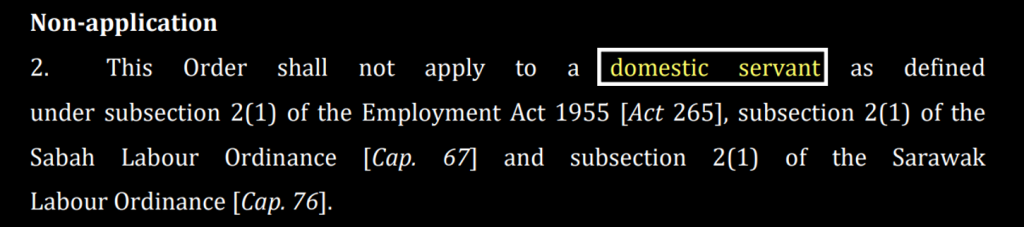
2. This Order shall not apply to a Domestic Servant as defined under subsection 2(1) of the Employment Act 1955 [Act 265], subsection 2(1) of the Sabah Labour Ordinance [Cap. 67] and subsection 2(1) of the Sarawak Labour Ordinance [Cap. 76]. 本指令不适用于《1955年劳工法令》[第265号法案] 第2(1)款、《沙巴劳工条例》[第67章] 第2(1)款和《砂拉越劳工条例》[第76章] 第2(1) 款所定义的家庭佣工。
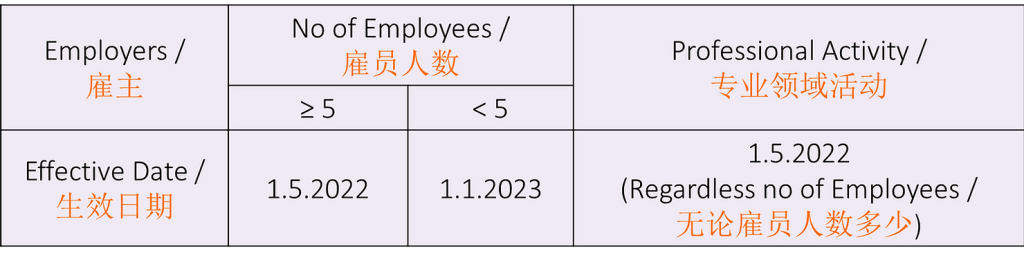
3. The Minimum Wage of RM 1,500 starting with the following two types of employers will come into effect on 1 May 2022 .:-
a) an employer who employs five or more employees; and
b) regardless of the number of employees employed, an employer who carries out a professional activity is classified under the Malaysia Standard Classification of Occupations (MASCO) as published officially by the Ministry of Human Resources.
RM 1,500 的最低薪金将于2022年5月1日生效,首先针对以下两类型的雇主:
a) 雇用5名或以上雇员的雇主;以及
b) 从事人力资源部正式公布的马来西亚标准职业分类(MASCO)下的专业活动的雇主,无论其雇员人数多少
4.1 The minimum wages rates payable to an employee with effect from 1 May 2022 shall be as follows:-
自2022年5月1日起,应支付给雇员的最低工资标准如下:-
4.2 If the employee is paid on a Daily Basis, the Minimum Wage will be as follows:-
a) 6 working days in a week – RM 57.69 per day
b) 5 days in a week – RM 69.23 per day
c) 4 working days in a week – RM 86.54 a day
如果雇员薪金是按日薪 [Daily] 制,其最低工资标准如下:
a) 一星期工作日为6天 – 一天最低工资 RM 57.69
b) 一星期工作日为5天 – 一天最低工资 RM 69.23
c) 一星期工作日为4天 – 一天最低工资 RM 86.54
4.3 if the employee is paid on an Hourly Basis, the wage is not less than RM 7.21 per hour
如果雇员薪金是按时薪 [Hourly] 制,其最低工资为每小时不少于 RM 7.21
5.1 For Employers with less than 5 employees that do not carry out a professional activity classified under the Malaysia Standard Classification of Occupations (MASCO), the Minimum Wage of RM 1,500 will come into effect on 1 January 2023
5.2 For Employers with less than 5 employees that do not carry out a professional activity classified under the Malaysia Standard Classification of Occupations (MASCO), the Minimum Wage will be as per the Previous Order until 31 December 2022, i.e.
a) Place of employment is in the City Council or Municipal Council area – RM 1,200
b) Place of employment is located at Other than City Council or Municipal Council area – RM 1,100
a) 经营场所在市议会或市议会区 [City Council or Municipal Council area] – RM 1,200
b) 经营场所在非市议会或市议会地区 (Other than City Council or Municipal Council area)- RM 1,100
6. In addition to the Minimum Wages Order 2022 [P.U.(A) 140/2022], I have also compiled a list of past Minimum Wage Orders and the Malaysian Standard Classification of Occupations which you can download at the bottom of this article
Remark: 1) The Malaysia Standard Classification of Occupations (MASCO) is a national benchmark for the classification of occupations in the employment structure of the country. MASCO has been developed in accordance with the International Standard Classification of Occupations (ISCO) with changes and modifications to meet the needs of the country.
MASCO lists down the descriptions and tasks as well as the code for each position listed.
It contains ten categories of major groups, namely:
Major Group 1: Managers
Major Group 2: Professionals
Major Group 3: Technicians and Associate Professionals
Major Group 4: Clerical Support Workers
Major Group 5: Service and Sales Workers
Major Group 6: Skilled Agricultural, Forestry, Livestock, and Fishery Workers
Major Group 7: Craft and Related Trades Workers
Major Group 8: Plant and Machine Operators and Assemblers