Have you ever paid first and only enjoyed the goods or services later, but wondered why the accountant records the amount as an asset?
That is the purpose of prepayments, also known as prepaid expenses.
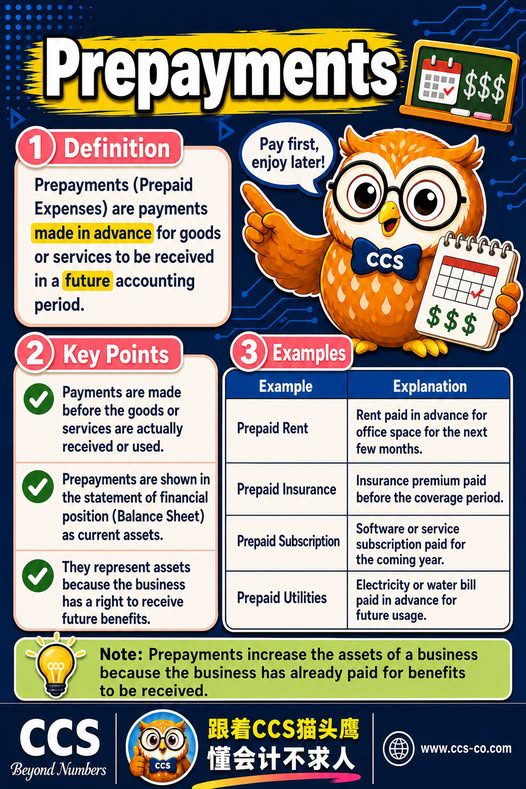
What Are Prepayments?
A prepayment arises when a company has already paid for goods or services but has not yet fully received or used the related benefits.
Because the company still has a future economic benefit, the amount is initially recognised as an asset.
Common Examples
- Rent paid for the next few months → Prepaid rent;
- Insurance premium paid before the coverage period begins → Prepaid insurance;
- Software licence or subscription paid for the following year → Prepaid subscription; and
- Utilities or other services paid for in advance → Prepaid utilities.
A Simple Example
Assume a company pays RM12,000 on 1 January for 12 months of insurance coverage.
The full RM12,000 is not necessarily recognised as an expense on 1 January because the company has not yet received 12 months of insurance protection.
Initially, the amount may be recorded as:
Dr Prepaid insurance RM12,000
Cr Bank RM12,000
As the insurance coverage is used, the relevant portion is transferred to expense. For example, the monthly entry may be:
Dr Insurance expense RM1,000
Cr Prepaid insurance RM1,000
By the end of the 12-month coverage period, the prepaid asset will have been fully recognised as an expense.
The Simple Rule
Pay first, use or enjoy later → Prepayment and asset.
Use or receive the benefit → Recognise the expense.
Prepayments are commonly presented under current assets in the statement of financial position when the benefit is expected to be received within the next 12 months.
The amount is not an expense merely because cash has been paid. It becomes an expense as the related goods or services are consumed.
CCS | Beyond Numbers
预付款项:为什么提前支付的费用会是资产?
有没有遇过这种情况:
钱已经先付了,但商品或服务还没有完全使用,结果会计却说这是一项“资产”?
这就是预付款项(Prepayments/Prepaid Expenses)。
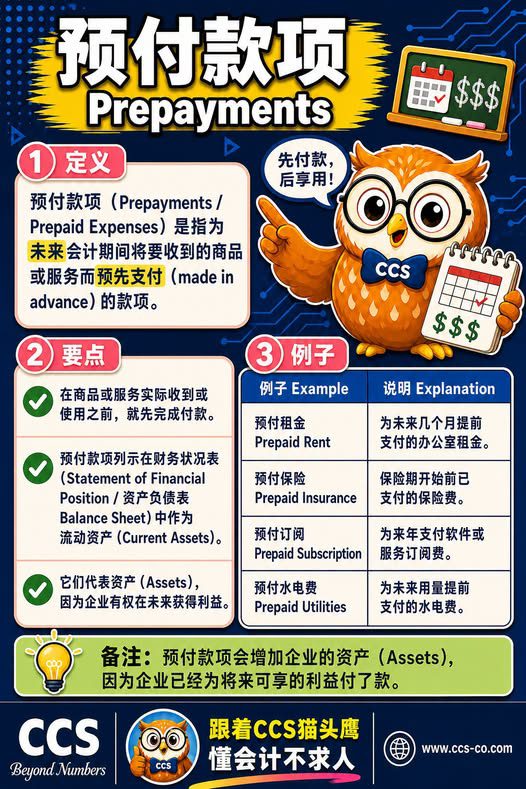
什么是预付款项?
当公司已经付款,但相关商品或服务还没有完全收到或使用时,就可能产生预付款项。
由于公司仍然拥有未来可以享用的经济利益,这笔款项一开始会确认为一项资产。
常见例子
- 提前支付未来几个月的租金 → 预付租金(Prepaid Rent);
- 在保险保障期开始前支付保费 → 预付保险费(Prepaid Insurance);
- 预先支付下一年度的软件费用或订阅费 → 预付订阅费(Prepaid Subscription);以及
- 提前支付水电费或其他服务费用 → 预付水电费(Prepaid Utilities)。
一个简单例子
假设公司在 1 月 1 日支付 RM12,000,购买 12 个月的保险保障。
这 RM12,000 不一定要在 1 月 1 日一次性确认为费用,因为公司还没有在当天享有完整 12 个月的保险保障。
开始付款时,可以记录为:
借:预付保险费 RM12,000
贷:银行存款 RM12,000
随着保险保障逐月使用,再将相关部分转入费用。例如,每月可以记录:
借:保险费用 RM1,000
贷:预付保险费 RM1,000
12 个月的保险保障期结束后,预付款项就会全部转为费用。
一个简单记忆法
先付钱,之后才使用或享受 → 预付款项,属于资产。
实际使用或享受相关利益 → 确认为费用。
当预付款项预计会在未来 12 个月内使用或获得相关利益时,通常会在财务状况表的流动资产项下列示。
企业不能因为已经付出现金,就马上把全部金额确认为费用。相关金额应随着商品或服务被使用,逐步转为费用。
CCS | Beyond Numbers