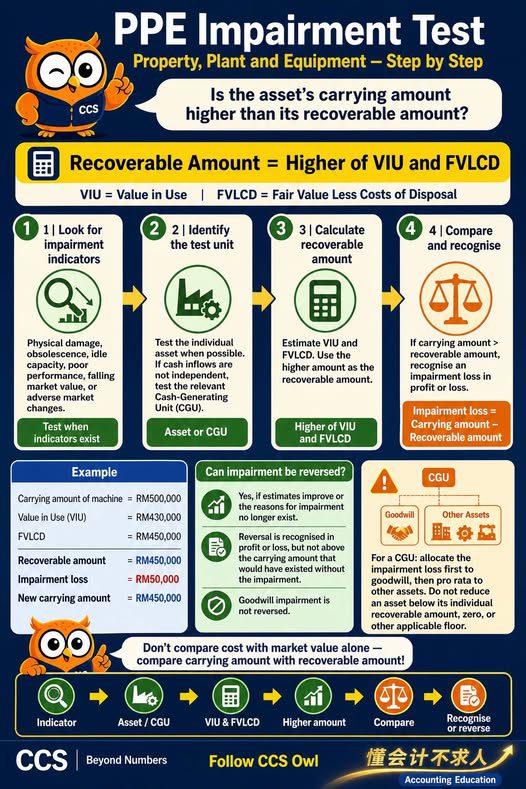
For property, plant and equipment (PPE), the basic impairment test is:
If the carrying amount is higher than the recoverable amount, the asset is impaired.
How Is Recoverable Amount Determined?
The recoverable amount is the higher of:
- Value in Use (VIU): The present value of the future cash flows expected to arise from continuing to use the asset and from its disposal; and
- Fair Value Less Costs of Disposal (FVLCD): The amount obtainable from selling the asset in an orderly transaction, less the costs of disposal.
A Simple Three-Step Process
1. Look for Impairment Indicators
First, assess whether there are indicators that the asset may be impaired.
2. Identify the Testing Unit
Determine whether the impairment test should be performed for:
- The individual asset; or
- A Cash-Generating Unit (CGU), where the asset does not generate largely independent cash inflows.
3. Compare the Amounts
Compare the asset’s carrying amount with its recoverable amount.
If the carrying amount is higher, the difference is recognised as an impairment loss and the asset’s carrying amount is reduced.
Example
Assume:
- Carrying amount: RM500,000
- Value in Use: RM430,000
- Fair Value Less Costs of Disposal: RM450,000
The recoverable amount is the higher of VIU and FVLCD:
Recoverable amount = RM450,000
The impairment loss is:
RM500,000 − RM450,000 = RM50,000
The asset’s new carrying amount becomes:
RM450,000
Reversal of Impairment
An impairment loss may be reversed if the asset’s recoverable amount subsequently increases, subject to the applicable requirements.
However:
An impairment loss recognised for goodwill cannot be reversed.
For a CGU, the impairment loss is generally allocated first to goodwill and then pro rata to the other assets in the CGU. The carrying amount of an individual asset must not be reduced below the applicable individual floor, such as its fair value less costs of disposal, value in use or zero, where relevant.
The Key Principle
Do not compare cost with market value. Compare carrying amount with recoverable amount.
CCS | Beyond Numbers
PPE 资产减值测试:账面金额与可收回金额的比较
对于不动产、厂房及设备(Property, Plant and Equipment,PPE),资产减值测试可以用一句话概括:
如果账面金额高于可收回金额,资产就发生减值。
可收回金额如何确定?
可收回金额(Recoverable Amount)是以下两者中的较高者:
- 使用价值(Value in Use,VIU): 资产持续使用及最终处置预计产生的未来现金流量的现值;以及
- 公允价值减处置成本(Fair Value Less Costs of Disposal,FVLCD): 在有序交易中出售资产可以取得的金额,扣除处置成本后的金额。
简单三步法
第一步:寻找减值迹象
首先,企业应评估资产是否出现可能发生减值的迹象。
第二步:确定测试单位
判断减值测试应针对:
- 单项资产;或
- 现金产生单位(Cash-Generating Unit,CGU),即当资产本身不能产生大致独立的现金流入时,需与其他资产组成现金产生单位进行测试。
第三步:进行比较
将资产的账面金额与可收回金额进行比较。
如果账面金额较高,差额就应确认为减值损失,并将资产的账面金额调低。
例子
假设:
- 账面金额:RM500,000
- 使用价值:RM430,000
- 公允价值减处置成本:RM450,000
可收回金额取两者中的较高者:
可收回金额 = RM450,000
减值损失为:
RM500,000 − RM450,000 = RM50,000
资产调整后的新账面金额为:
RM450,000
减值可以回拨吗?
如果资产的可收回金额之后回升,之前确认的减值损失可能可以回拨,但必须符合适用的会计要求。
不过:
商誉已经确认的减值损失不能回拨。
对于现金产生单位,减值损失一般应先分配至商誉,再按比例分配至现金产生单位内的其他资产。
但是,单项资产的账面金额不能被减至低于适用的最低金额,例如其公允价值减处置成本、使用价值或零,具体取决于相关情况。
关键原则
不要拿成本和市价比较,而要比较账面金额与可收回金额。
CCS | Beyond Numbers