Imagine that you operate “Lim’s Nasi Lemak” Sdn. Bhd. in Penang. Business is steady, and customers enjoy your sambal. The company is not listed, and it is not required to lodge financial statements with the Securities Commission Malaysia (SC) or Bank Negara Malaysia (BNM).
Then your accountant asks:
“Boss, should we use MPERS or MFRS?”
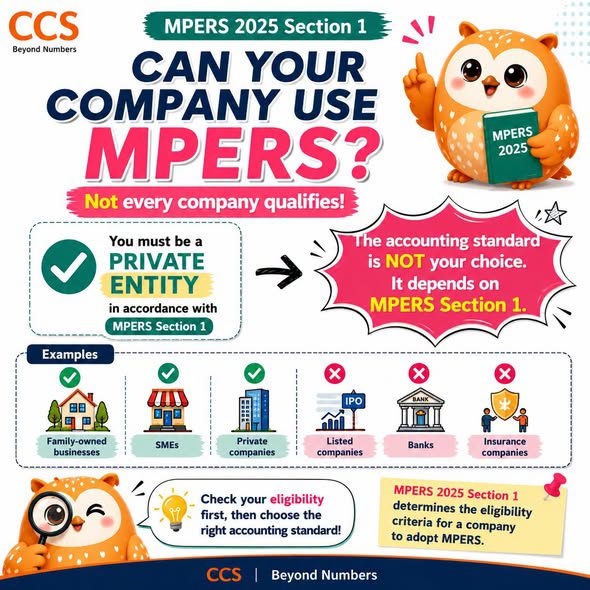
MPERS Section 1 makes the position clear: a private company may choose MPERS, but only if it qualifies.
Who Qualifies to Apply MPERS?
The entity must be a private company as defined under the Companies Act 2016, and both of the following conditions must be satisfied:
- The entity is not required to lodge financial statements under any law administered by the SC or BNM; and
- The entity is not a subsidiary, associate or jointly controlled entity of an entity that is required to lodge financial statements under any law administered by the SC or BNM.
There is also an important restriction. If the entity, or an entity within its group, is linked to a management company under the Interest Schemes Act 2016, it does not qualify as a private entity for this purpose.
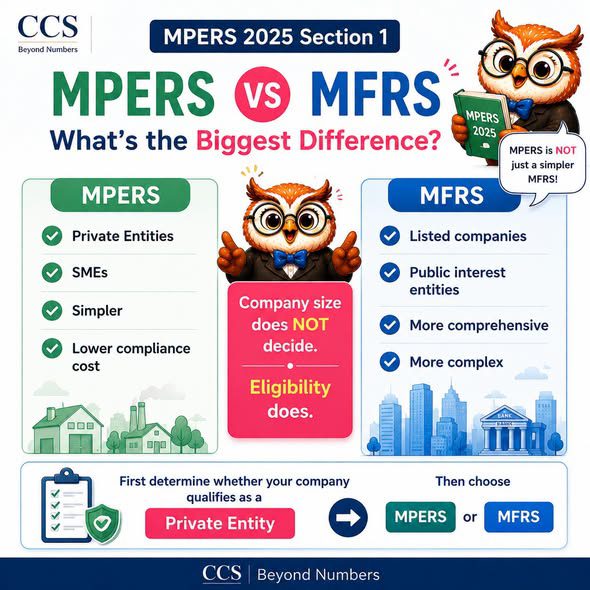
MFRS or MPERS?
A simple comparison may help:
- MFRS is like a ten-course banquet: comprehensive and detailed, but more demanding to apply; and
- MPERS is like nasi campur: practical, sufficient and designed to meet the needs of eligible private entities more simply.
Practical Advice for Business Owners
Before choosing MPERS, business owners should:
- Review the group and ownership structure;
- Check whether the parent or sister company is part of a listed group;
- Confirm whether the entity or any relevant group entity is subject to reporting requirements administered by the SC or BNM; and
- Reassess eligibility every financial year, as the entity’s status may change.
Once an entity adopts MPERS, it must apply the framework in full. It should not combine MPERS and MFRS selectively.
The revised MPERS was issued in October 2025 and takes effect for annual periods beginning on or after 1 January 2027, with early adoption permitted.
Quick rule: If the company is not required to report to the SC or BNM, and none of the relevant entities in its group are subject to those reporting requirements, an eligible Sdn. Bhd. may choose MPERS.
The decision should be made carefully, applied consistently and reviewed annually. Businesses should begin preparing for the 2027 edition now.
CCS | Beyond Numbers
MPERS 第 1 节:私人公司真的可以自行选择会计准则吗?
想象一下,你在槟城经营一家“林记椰浆饭”Sdn. Bhd.,生意稳定,客人也很喜欢你的 sambal。公司没有上市,也不需要向证券委员会马来西亚(SC)或马来西亚国家银行(BNM)呈交财务报表。
这时,会计师问你:
“老板,我们要用 MPERS,还是 MFRS?”
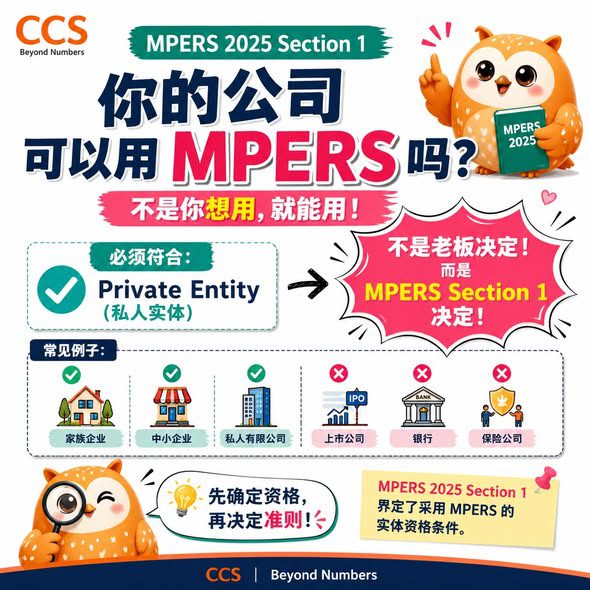
MPERS 第 1 节说明得很清楚:私人公司可以选择使用 MPERS,但必须符合资格。
哪些企业符合使用 MPERS 的资格?
企业必须是《2016 年公司法令》所定义的私人公司,并且同时符合以下两个条件:
- 企业本身不需要根据由 SC 或 BNM 管辖的任何法律呈交财务报表;以及
- 企业不是某个需要根据由 SC 或 BNM 管辖的任何法律呈交财务报表的实体的子公司、联营公司或共同控制实体。
此外,还有一个重要限制:如果企业本身,或集团内的某个实体,与《2016 年利益计划法令》下的管理公司(management company)有关联,就不符合私人实体的资格。
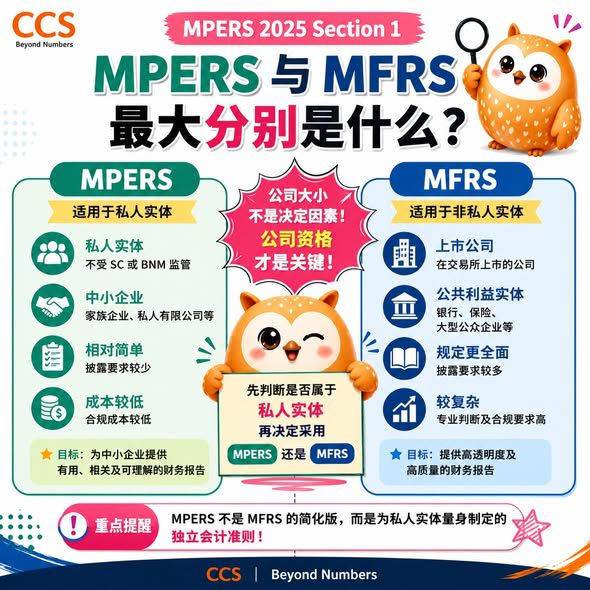
MFRS 还是 MPERS?
可以用一个简单的比喻来理解:
- MFRS 就像十道菜的宴席:内容完整、要求详细,但执行起来较为复杂;以及
- MPERS 就像 nasi campur:实用、足够,并且以较简单的方式满足符合资格的私人企业的需要。
给企业老板的实用建议
在选择 MPERS 之前,企业老板应当:
- 先检查集团及股权架构;
- 确认母公司或姐妹公司是否属于上市集团;
- 确认企业本身或集团内相关实体是否受 SC 或 BNM 管辖的报告要求约束;以及
- 每个财政年度重新评估资格,因为企业身份及集团结构可能发生变化。
一旦企业采用 MPERS,就必须完整应用这套准则,不能挑选部分 MPERS,再混用部分 MFRS。
新版 MPERS 已于 2025 年 10 月发布,适用于 2027 年 1 月 1 日或之后开始的年度期间,企业也可以选择提前采用。
**简单规则:**如果公司不需要向 SC 或 BNM 报告,而集团内相关实体也没有受到这些报告要求约束,符合条件的 Sdn. Bhd. 就可以选择采用 MPERS。
这个决定应当谨慎作出,并持续一致地执行,同时每年重新检视资格。企业应从现在开始,为 2027 年新版 MPERS 提前准备。
CCS | Beyond Numbers