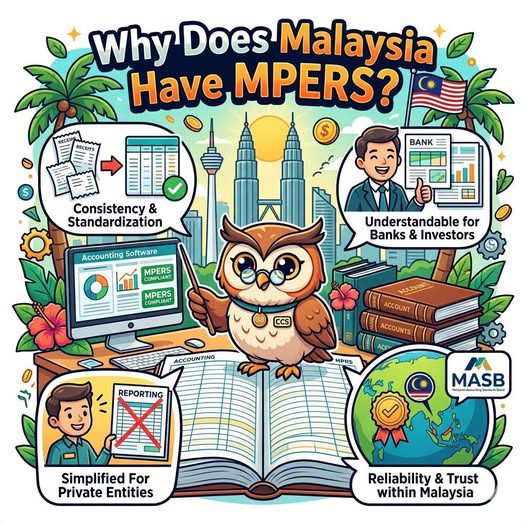
The Malaysian Accounting Standards Board (MASB) developed MPERS specifically for Malaysian private entities.
MPERS is based on the IFRS for SMEs Accounting Standard issued by the International Accounting Standards Board (IASB), with certain modifications to reflect Malaysian laws and business circumstances.
IFRS for SMEs and MPERS
A simple way to understand the relationship is:
- IFRS for SMEs: The international version; and
- MPERS: The Malaysian version.
Most of the underlying requirements are similar, but MASB has modified selected areas where Malaysian requirements or business conditions need to be taken into account.
It is similar to an international restaurant brand adapting its menu for the local market. The main products remain recognisable, but local offerings may be added to suit local preferences.
MPERS follows a similar approach: it retains the international foundation while incorporating specific Malaysian adjustments.
Private Entities and Public Accountability
The IASB framework uses concepts such as:
- Small and medium-sized entities; and
- Public accountability.
MPERS instead uses the Malaysian concept of a private entity.
Under the international approach, an entity may need to consider questions such as:
- Does it have public accountability?
- Does it hold assets belonging to a broad group of outsiders in a fiduciary capacity?
- Is it publicly accountable?
Under MPERS, the focus is more directly on whether the entity:
- Is a private company; and
- Satisfies the applicable private entity criteria under Malaysian requirements.
Using the Malaysian legal concept of a private entity helps make the framework more straightforward for local businesses.
Malaysian Consolidation Requirement
One important difference between MPERS and IFRS for SMEs concerns consolidation.
Under the Malaysian requirements, the ultimate Malaysian parent may still be required to prepare consolidated financial statements even if a foreign parent has already prepared consolidated financial statements.
For example, consider the following group structure:
Singapore Holding Co
↓
Malaysia Holding Co
↓
Malaysia Subsidiary A
↓
Malaysia Subsidiary B
The Singapore holding company may already prepare consolidated financial statements for the wider international group.
However, the Malaysian holding company may still be required to prepare consolidated financial statements for the Malaysian group.
This enables Malaysian users to understand the financial position and performance of the Malaysian group itself, rather than relying only on the consolidated financial statements of the wider foreign group.
The information may be relevant to:
- Malaysian banks;
- Malaysian creditors;
- Malaysian investors; and
- Malaysian regulators.
A simple analogy is a family photograph. Even if there is already a photograph of the entire extended family, an immediate family may still need its own photograph to show its particular members and relationships.
Other Features of MPERS
MPERS is:
- A Malaysian adaptation of IFRS for SMEs;
- Modified only where necessary to reflect Malaysian requirements;
- Organised by topic to support practical application; and
- Supported by appendices that may contain either mandatory guidance or non-mandatory examples, depending on their nature.
MPERS is not simply a copy of IFRS for SMEs. It is a Malaysian framework built on an international foundation and adapted to meet the needs of Malaysian private entities.
CCS | Beyond Numbers
MPERS:马来西亚调整版的 IFRS for SMEs
**马来西亚会计准则委员会(MASB)**专门为马来西亚私人实体制定了 MPERS。
MPERS 是以国际会计准则理事会(IASB)发布的 IFRS for SMEs Accounting Standard 为基础,同时根据马来西亚的法律及商业环境作出部分调整。
IFRS for SMEs 与 MPERS
可以这样理解两者的关系:
- **IFRS for SMEs:**国际版本;以及
- **MPERS:**马来西亚版本。
两者的大部分基本要求相似,但 MASB 会在某些领域进行调整,以配合马来西亚的法律要求及商业情况。
这就像国际餐饮品牌根据当地市场调整菜单。主要产品仍然保持相同特色,但也可能加入符合当地口味及需要的产品。
MPERS 采用的也是类似概念:保留国际准则的基础,同时加入特定的马来西亚调整。
私人实体与公众问责
IASB 的框架采用以下概念:
- 中小型企业;以及
- 公众问责。
而 MPERS 则采用马来西亚的**私人实体(Private Entity)**概念。
按照国际框架,企业可能需要考虑:
- 是否承担公众问责;
- 是否以受托身份持有广泛外部人士的资产;以及
- 是否属于需要向公众负责的实体。
MPERS 则更直接地关注企业是否:
- 是一家私人公司;以及
- 符合马来西亚相关要求下的私人实体资格。
采用马来西亚法律所定义的私人实体概念,有助于本地企业更容易理解及应用这套会计框架。
马来西亚的合并财务报表要求
MPERS 与 IFRS for SMEs 的一个重要差异,涉及合并财务报表。
根据马来西亚的相关要求,即使外国母公司已经编制了合并财务报表,最终的马来西亚母公司仍可能需要为马来西亚集团编制合并财务报表。
例如,集团架构如下:
新加坡控股公司
↓
马来西亚控股公司
↓
马来西亚子公司 A
↓
马来西亚子公司 B
新加坡控股公司可能已经为整个国际集团编制合并财务报表。
不过,马来西亚控股公司仍可能需要为马来西亚集团编制合并财务报表。
这样,马来西亚的财务报表使用者就能了解马来西亚集团本身的财务状况及经营表现,而不只是依赖外国集团整体的合并财务报表。
相关资料可能对以下人士具有重要价值:
- 马来西亚银行;
- 马来西亚债权人;
- 马来西亚投资者;以及
- 马来西亚监管机构。
可以用家庭合照来比喻。即使整个大家族已经拍了一张合照,一个核心家庭仍可能需要自己的家庭照,以清楚呈现自己的成员及关系。
MPERS 的其他特点
MPERS:
- 是 IFRS for SMEs 的马来西亚调整版;
- 只在有必要时根据马来西亚要求作出修改;
- 按主题编排,以方便企业实际应用;以及
- 通过附录提供额外资料,而附录内容可能是强制性指引,也可能是非强制性的示例,具体取决于其性质。
MPERS 并不是简单复制 IFRS for SMEs,而是一套建立在国际基础之上,并根据马来西亚私人实体需要进行调整的会计框架。
CCS | Beyond Numbers