MPERS 2025 Section 9: Understanding Control and Consolidated Financial Statements
45
Share the Post:
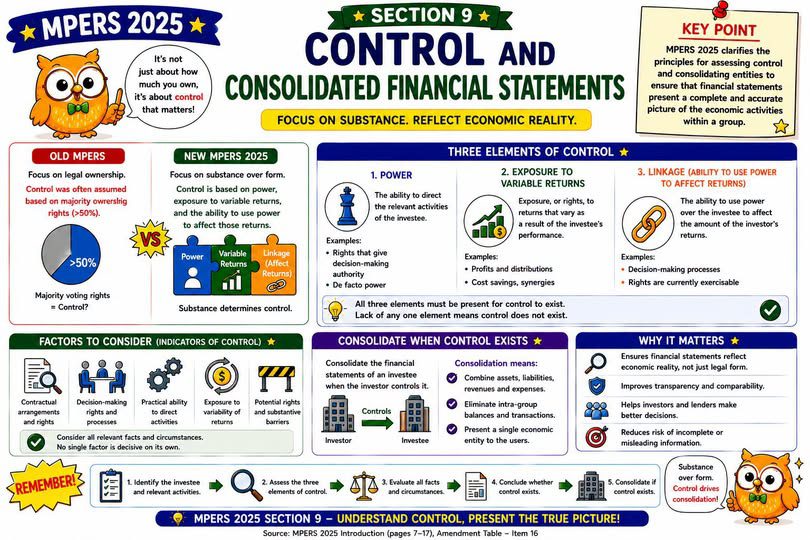
In the past, control was mainly assessed based on whether an investor owned more than 50% of a company’s shares.
Under MPERS 2025 Section 9, the assessment focuses on substance, rather than legal ownership alone.
To determine whether an entity controls another company, all three of the following elements must be present at the same time.
1. Power
Can the entity direct the other company’s relevant activities, such as making key decisions or appointing management?
2. Exposure to Variable Returns
Does the entity benefit or suffer when the other company performs well or poorly?
Examples include profits, cost savings and synergies.
3. Linkage Between Power and Returns
Can the entity actually use its power to influence the returns it receives from the other company?
All three elements must be present. If any one of them is missing, there is no control.
When Consolidation Is Required
If an entity has control over another company, it must consolidate that company’s financial statements. This generally involves combining the group’s assets, liabilities, income and expenses, while eliminating intra-group transactions.
This enables the financial statements to reflect the group’s underlying economic position, rather than merely its legal form.
The key takeaway is:
Control is not determined solely by the number of shares owned. The key question is whether the entity can truly direct the company’s relevant activities and benefit from, or be affected by, its performance.