Revenue recognition can be confusing, but MPERS 2025 Section 23 provides a clear five-step approach:
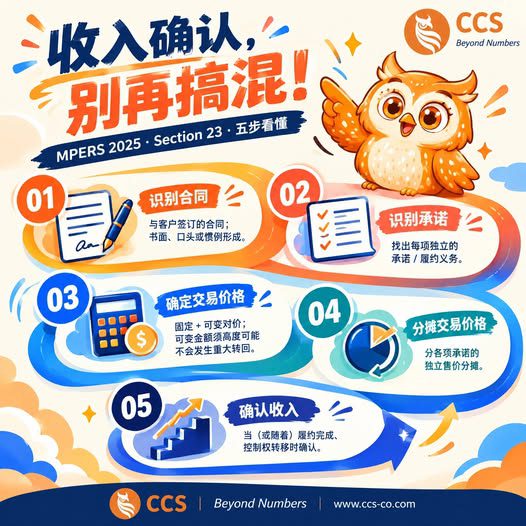
- Identify the contract — Is there an agreement with the customer? It may be written, oral or implied by customary business practices.
- Identify the promises — What exactly has the business promised to deliver? Each separate performance obligation should be identified.
- Determine the transaction price — This includes the fixed consideration and any variable consideration. Variable amounts should only be included to the extent that it is highly probable that a significant reversal of recognised revenue will not occur.
- Allocate the transaction price — Allocate the total transaction price to each performance obligation based on its relative stand-alone selling price.
- Recognise revenue — Recognise revenue when the business satisfies a performance obligation, such as when control of the promised goods or services is transferred to the customer.
The simple process is:
Contract → Promises → Price → Allocation → Recognition
By following these five steps, revenue recognition becomes more consistent and less likely to raise unnecessary questions.
MPERS 2025 第 23 节:收入确认的五步法
老板们,收入确认又搞混了吗?
MPERS 2025 第 23 节其实提供了一套清晰的五步法,帮助企业更有条理地确认收入。
- 识别合同——企业是否与客户达成了协议?协议可以是书面的、口头的,也可以是根据企业惯常的商业做法而形成的默示协议。
- 识别承诺——企业到底答应向客户提供什么?企业应将每项独立的履约义务分别识别出来。
- 确定交易价格——交易价格包括固定金额及可变金额。不过,可变金额只有在高度可能不会发生重大收入转回的情况下,才应计入交易价格。
- 分摊交易价格——根据每项承诺的相对独立售价,将总交易价格分摊至各项履约义务。
- 确认收入——当企业完成履约义务,例如将承诺商品或服务的控制权转移给客户时,才确认收入。
简单流程就是:
合同 → 承诺 → 价格 → 分摊 → 确认
照着这五个步骤处理,收入确认就会更加一致,也不容易在审阅时被问得一头雾水。