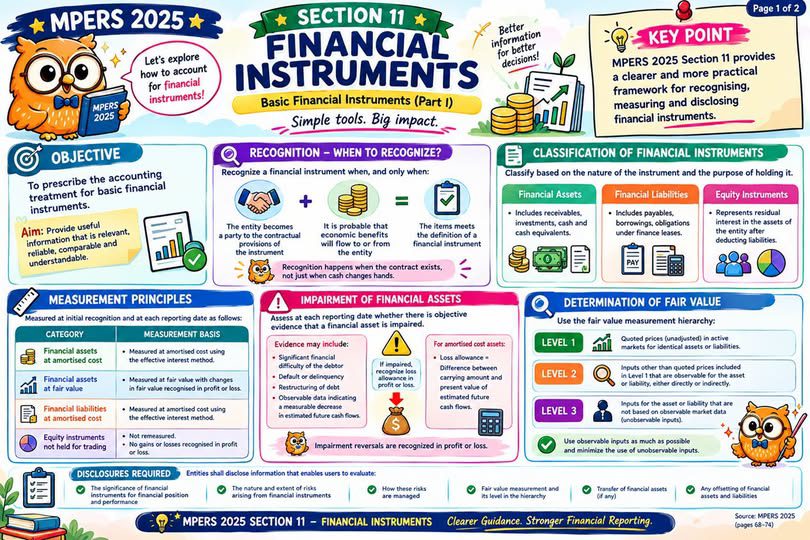
MPERS 2025 Section 11, Financial Instruments – Basic Financial Instruments, covers the common and relatively simple financial instruments used by most companies, including cash, receivables, payables and ordinary loans.
When Should a Financial Instrument Be Recognised?
A financial instrument should be recognised when the entity becomes a party to the contractual provisions and it is probable that cash will flow to or from the entity in the future.
How Are Financial Instruments Classified?
Financial instruments are generally classified as follows:
- Financial assets: Amounts the entity will receive.
- Financial liabilities: Amounts the entity is required to pay.
- Equity instruments: The residual interest in the entity after deducting all liabilities.
How Are They Measured?
Most basic financial instruments are measured at amortised cost using the effective interest method. This means that the relevant amount is gradually adjusted over time based on the applicable effective interest rate.
Some investments are measured at fair value, with changes in fair value recognised in profit or loss.
Impairment
At each reporting date, the entity should assess whether there is objective evidence that a financial asset is impaired.
If impairment exists, the entity should recognise a loss allowance.
Fair Value
When fair value measurement is required, the following inputs are generally prioritised:
- Level 1: Quoted prices in active markets;
- Level 2: Other observable inputs; and
- Level 3: Unobservable inputs, including the entity’s own estimates, where necessary.
In summary, basic financial instruments are accounted for using methods that are relatively simple and practical, helping financial statements provide clearer information.
MPERS 2025 第 11 节:金融工具——基本金融工具(第一部分)
MPERS 2025 第 11 节《金融工具——基本金融工具》,主要涵盖大多数公司日常使用的常见及相对简单的金融工具,包括现金、应收账款、应付账款和普通贷款等。
什么时候需要确认入账?
当企业成为合同条款的一方,并且未来很可能会有现金流入或现金流出时,就应确认相关金融工具。
金融工具如何分类?
金融工具一般可分为以下几类:
- **金融资产(Financial Assets):**企业将会收到款项的项目。
- **金融负债(Financial Liabilities):**企业需要支付款项的项目。
- **权益工具(Equity Instruments):**扣除所有负债后,企业所剩余的权益。
金融工具如何计量?
大多数基本金融工具采用**摊余成本(Amortised Cost)**计量,并使用实际利率法进行计算。这意味着,相关金额会根据适用的实际利率,随着时间逐步调整。
部分投资则采用**公允价值(Fair Value)**计量,公允价值的变动计入损益。
减值
在每一个报告日,企业都应评估金融资产是否存在客观的减值证据。
如果存在减值,企业就应确认损失准备。
公允价值
当金融工具需要按照公允价值计量时,一般会优先使用以下输入数据:
- **第一层级(Level 1):**活跃市场中的公开报价;
- **第二层级(Level 2):**其他可观察的输入数据;以及
- **第三层级(Level 3):**在必要时使用不可观察的输入数据,包括企业自身的估计。
简单来说,基本金融工具采用相对简单且实用的会计方法进行确认和计量,让财务报表提供更清晰的信息。